Feeds:
Posts
Comments

Having been out at the sett the other night I’ve got a rough idea of the time when the badgers come out.  This made it easy this evening to pop down for a quick look just at the time of dusk.  Of course, it is always a good idea when badger watching to arrive early.  It gives you a chance to arrive and get settled without disturbing the badgers, and if you arrive too late there’s always the danger of bumping into an early riser.

This evening was perfect, and the badgers emerged on cue at 8.15pm.  Three badgers came out of the tangle of bushes in the middle of the sett area and disappeared into a hole at the west end.  This hole has been enlarged in the last two days, and now has a very impressive spoil heap outside.  Busy badgers!

Then another badger appeared in the central area, followed quickly by another.  The second badger was undoubtedly a cub on one of its first trips outside.

I assume it was with its mother (I tend to regard all fairly slim badgers as female, on the flimsiest of evidence – nevertheless this one acted like a parent).  The cub was small, but not as small as some I’ve seen, and it was still unsteady on its feet.  It stayed very close to the sett entrance, with the mother keeping a close watch until she too wandered over to the other sett entrance, leaving the cub alone.  Thanks mum!  The cub took the hint and disappeared underground.

With all the badgers out of sight I took my chance and left.  I had no desire tonight to spend hours up a tree, nor to thrash my way home through a pitch-dark wood.  Not tonight, anyway.

So there we are.  The first cub of the year.  It is out quite early – last year I saw the first cub on April 21st.  I wonder how many brothers and sisters it has?  I wonder too what is happening at the sett, with at least two holes in very active use? There’s only one way to find out…keep watching!

I’ve just come across badgerpics.org.uk, and a great site it is too.

John has got some truly excellent badger pictures in his gallery (they put my efforts to shame!) and he shares my fascination with badger watching.  It’s obvious that he’s spent some time inside a camouflage jacket staring intently at holes in the ground while being bitten by midges.  I can relate to that!

Overall it’s an excellent site, and well worth visiting for information on badgers and their habits, and a treasure trove of details on how to watch and photograph these elusive animals.

Damp, still nights aren’t the best for badger watching.  The moist air carries your scent further, and since badgers rely heavily on their sense of smell there’s a greater chance of them detecting you.  Nevertheless, 7.30pm found me in my favourite tree.

It was good to be back again, to put on the camouflage jacket and assume my secret identity.  There’s something liberating about it.    I was the Badger Watching Man once more.  I imagine that Superman must feel the same way when he casts away Clark Kent and becomes himself again.

At 7.58pm a fox appeared from one of the holes in the middle area of the sett.  This is an interesting development.  I wonder if he’s taken up residence permanently?  I’ll see if this is a regular occurrence.

At 8.20pm the first badgers appeared.  Two adults ambled across from the eastern end of the sett, joined almost immediately by three others from what looks like a very active entrance on the west.

I am pleased to say that I still get a thrill from seeing badgers.  This is my fourth year of badger watching, but the sight of these big, bold beasts still impresses me.  The idea that such animals can exist almost under our noses is amazing.

In no time at all there were at least seven adult badgers outside the sett (badgers are notoriously difficult to count).  There were at least ten badgers last year, including cubs, so I’m curious to see how the number has changed.  This time of year is when the male badgers tend to leave the sett, so I’ll see if I can get a better idea of numbers and try and work out if this has happened.  I’ve got a better understanding of how badgers leave and join other setts since reading Hans Kruuk’s The Social Badger, so when I get a chance I’ll put a brief summary on here.

As well as the usual scratching and rolling round, I was treated to a view of badger sex.  At the risk of being labelled as some sort of wildlife peeping tom, I watched this with interest.  Badgers have a complex reproductive life, but the females are fertile very soon after cubs are born, and badgers can mate at any time of year.
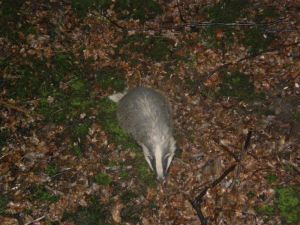
Badger under my tree

Badger under my tree

By now it was getting dark, and I had badgers all around me.  It was still just possible to see them using binoculars (binoculars gather more light than the naked eye, hence you can often see more with them when the light is failing). I took my first ever picture of a badger using the flash on my camera.  I’ve never done this before for fear of spooking them, but after taking a few flash pictures in the pasture field in November without any serious impact on the badger, I decided to give it a go.  Luckily, the badger didn’t seem bothered.

The badgers were still snuffling around me quite happily, which put me in a dilemma.  My number one rule of badger watching is ‘don’t disturb the badgers’.  Unfortunately, if you’re up a tree with badgers all around, this means that you’re pretty much stuck there.  To climb down and appear in the middle of them would be very bad style.

By the time the snuffling and scuffling sounds had moved away it was pretty much dark.  If you’ve ever been in a rural wood on a dark and misty April night then you can imagine just how dark it gets.  Of course, it is just these occasions that make it a good idea to take a torch when badger watching.  I had one with me, but out of a perverse desire to avoid disturbance I didn’t use it.  Climbing down the tree by feel wasn’t elegant, but I got down in one piece.  Luckily I know these woods very well, but even so there were a few Blair Witch Project moments as I crept out, using my tracking stick in front of me like a blind man.

But that’s the joy of the whole thing.  To be out in a wood at night, with the deer barking and the tawny owls crying – I wouldn’t have missed it for anything.

The Red Kite has been preying on my mind.

After my wife saw it, and after I saw it myself from my car, I just had to get a better view of it.  Like I said, it isn’t a great rarity, but it is unusual for this area, and for me that’s a good enough reason to try and track it down.  I resolved to get outside and find it.

I’ve got friends who live in the Chilterns who would be perplexed by this.  Over there the kites are almost as common as sparrows and it isn’t unusual to have ten or more in the sky at one time.

But as far as I know we’ve only got the one kite around here, and this makes it special.  So what are the chances of finding one individual bird?  I love a challenge so this is just the sort of thing I enjoy, and it gave me a perfect excuse to get out and about.  I was a naturalist on a mission!

Half past seven this morning saw me wandering the countryside, binoculars in hand.  I concentrated on the road where I saw the kite, and followed a big loop all around it.  The road itself is at the bottom of a broad, dry valley, so I followed the footpaths on either side of it.

Two hours and five miles later my breakfast was calling me, and I conceded defeat.  Perhaps looking for a single bird, one that could effortlessly cover a territory miles across, was a bit far-fetched after all.

But the idea wouldn’t go away.  By early evening I had finished what I needed to do around the house, so I grabbed the binoculars and headed out for a short walk.  It was a beautiful evening to be out, so it seemed a waste to be sitting indoors.

Half a mile or so from my house there is a large oak tree where you can sit and look out across the valley.  I sat and scanned the landscape slowly, and there, perched on a tree about 500 yards away, was a large bird of prey.  As I watched it slowly flapped off and glided into a patch of woodland.

I couldn’t see the shape of the wings or the tail as it was flying directly away from me, but it was a reddish brown colour with a distinctly pale head.  It was my Red Kite.  I had managed to find it.

The reintroduction of the Red Kite has been a phenomenal success story, and the rate at which they are spreading across the country means that they are likely to be commonplace here within a few years.  Nevertheless, I’ll always be able to think of the time when I tracked down the first Red Kite I saw in Bedfordshire.

It’s been a beautiful spring day – warm and sunny.  It’s a great feeling after the cold winter we’ve had.  The daffodils and the blackthorn are blooming, the hazels and hawthorns are in bud, and the first butterflies are up and about.  There was even a skylark up in the clear blue sky, giving a wonderful summer feel to the day.

I decided that today would be the perfect day for my first badger watching session of the year.  It is still a little early, as the badgers will only be emerging just as it is getting dark, but I thought I’d give it a go and see.

It was good to be back in the wood again.  A small herd of fallow deer crossed the path a hundred yards or so ahead of me, and the buzzard was flying round the trees.  I can never tire of watching the buzzard when it does this; there is is something truly wild about seeing and hearing such an impressive bird of prey at close quarters.

The wind was blowing from the right direction for me to sit in my favourite tree.  The good thing about watching badgers at this time of year is that the undergrowth has not yet grown up to block the view, so I could see the whole sett from my perch.  It looked like a number of sett entrances were in regular use, and the paths and play areas looked well trodden.  The badgers have obviously been busy.

I sat in the tree from 6.30pm until just after 8.00, but sadly the badgers did not oblige.  I did not see so much as a whisker on a stripey nose.  I guess they are still emerging after dusk.

By 8.10pm it was getting too dark to see, even with binoculars, so I called it a night.  Even without the badgers it was good to get out again, to just sit in a tree in a wood and do nothing.  And besides, it shows that even after four years of watching badgers I still can’t guarantee anything.  I’ll try again in a week or so.

Note to self: even though it’s a warm day, and you’re too hot when walking, after the sun has gone down and you’ve been sitting still for an hour it gets bloody freezing.  Wear your waistcoat or an extra jumper next time!

Only in silence the word
Only in dark the light
Only in dying life
Bright the hawk’s flight on the empty sky

Ursula Le Guin

Regular readers will know that there are two species (apart from badgers) that I have been trying to see in my local area: the Red Kite and the stoat.

Since my wife saw a kite a few weeks ago I’ve been looking out for it, and my failed attempts to find and watch stoats are legendary (see A total absence of stoats).

Today was a beautiful, bright, warm spring day.  I drove out the DIY shop in the afternoon, and as I came back into the village I looked across the fields and there, gliding effortlessly across the sky, was a Red Kite.

It was unmistakeable.   Its primary feathers were splayed out and its forked tail stood out clearly against the blue of the sky as it soared on the warm air.  A magnificent bird.  I allowed myself to feel a little satisfaction at having caught sight of it at last.

Another 500 yards further down the road, and there was a stoat, lying dead in the middle of the road.

Nature can be cruel sometimes.

I parked the car and walked back.  The stoat was in the same place that I had seen one almost a year ago.  It was probably the same stoat.  I suppose I had a hope that it was just stunned.  The body was still warm and there wasn’t a mark on it, but it was quite dead.  It must have been killed no more than minutes before.

I’ve never seen a stoat close up before, and it was a beautiful creature.  Sleek and lithe and every inch the predator.  I somehow felt unwilling to leave it there by the road for the carrion birds – the crows and magpies and yes, the kites – and I took it away and buried it.

I guess this is the great game of nature being played out.  Still, where there’s one stoat there must be more.  I still want to see one, but under happier circumstances.

I’ve said it before.  Badgers are fascinating creatures.  Almost everyone who comes into contact with them finds them compelling and slightly addictive.  Our countryside is certainly a better and richer place for having badgers.

And yet surely there are many perils in the world for badgers.  They are affected by development and loss of habitat.  They are killed on the roads in large numbers.  Most sickeningly, there is still a small minority of people who set out to deliberately harm them.

This is why anyone who gives up their time and energy protecting badgers is worthy of support.

The Kirklees Badger Protection Group are just such people.  Like many groups, they work hard behind the scenes to help the badgers in their local area, and their passion for the animals is obvious.

What is even better is that you too can get involved.  The KBPG is looking for volunteers to help monitor setts.  If you live in the West Yorkshire area and you’ve ever fancied the idea of getting out and watching badgers, then this is a great opportunity.

Don’t worry if you’ve never been badger watching before and you’re not sure what to do – everything will be explained.  Not only will you get an introduction to these wonderful animals, but you’ll be helping to protect them too.

Check out the website for more details – Kirklees Badger Protection Group

Common toads mating by the pond

Common toads mating by the pond

I chanced to be walking past the pond this evening, when a strange noise caught my attention – a thin piping, like a cricket or similar insect.

When I shone my torch on the ground I found a dozen or so toads* scattered about, obviously enjoying the cool night.  The noise was coming from a pair of toads in – to put it politely – an amorous embrace.

I watched them for a few minutes.  I’m aware that staring at mating toads by torchlight is slightly voyeuristic, but there was a lot going on.  The female on the bottom (at least, I assume that’s how it works with toads) was walking about quite actively, despite the male on her back.  The male, on the other hand, was vigorously defending his position.  Every now and then another toad would creep up behind, obviously intent on taking over, whereupon the male would push him away with long strokes of his powerful back legs – all while he was still on top of the female.

Fascinating stuff.  I suspect there’ll be the patter of lots of tiny webbed feet soon!

(*The last time I saw a toad I mistook it for a frog.  I checked this time!)

Blackthorn in flower

Blackthorn in flower

In Britain, the spring weather follows a fairly consistent pattern.  The warmer days of February and early March tend to be followed by a short cold spell at the end of March.  This cold snap coincides with the flowering of the blackthorn, hence its country name: the Blackthorn Winter.

This year has followed the tradtional pattern.  The last few weeks have been sunny and relatively warm, but yesterday we had squally hail showers and today there was a ground frost in the morning.  The Blackthorn Winter has arrived.

I’ve been working a fairly hectic schedule recently (as usual!) and I’ve also been on holiday, so I took the chance of getting out and about on one of my Sunday dawn walks.  Getting out of bed wasn’t so easy, as dawn is now about 6.30am, although because the clocks went forward this morning that translates to 5.30am in real terms.  Nevertheless, it was good to get out again.  It’s become quite a comforting routine for me.

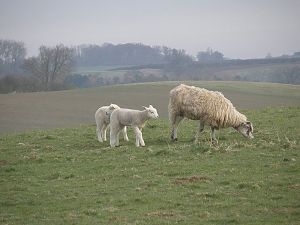
Despite the cold weather, there are signs of spring everywhere.  The lambs in the fields are getting quite big now.

Aww, cute

Aww, cute

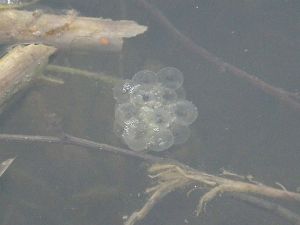
Frogspawn has started to appear in the pond – not much yet, but hopefully there’ll be more to come.

Frogspawn

Frogspawn

In terms of wildlife, one of the fields had been invaded by a gang of geese.  They were mostly Greylags, with a few Canada Geese joining in.  Not a rarity, but it’s the first time I’ve seen them in the village.

Greylag geese

Greylag geese

The badgers in the woods seem to be doing fine.  Judging by the quantity of dung in the latrines they’re obviously busy at the moment.  In fact, I was able to add a few more sites to my expanding map of badger latrines in the area.  This is starting to make some sense now, and I can get a rough idea of the different territories.  Perhaps come the autumn I’ll try the bait marking approach that Pablo mentioned, putting out food containing coloured plastic pellets so I can monitor the precise latrine sites used by different badger clans.  As I always say, there’s always more to learn about badgers.

April is nearly on us, so in another couple of weeks I’ll start proper badger watching again.  Watch this space for more details.

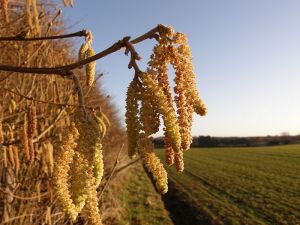
Catkins - spring is coming!

Catkins - spring is coming!

Well, it seems that spring is here at last.  I’ve been keeping busy travelling the world with work lately.  When I went away everything was frozen solid, and now that I’m back it’s thawed out, and allowed the first signs of spring to peep through.

Snowdrops are flowering down the lane, and the hazel catkins are out.  The hawthorns in the hedgerows have the first small buds.  In the vegetable garden I’ve finished the first planting of the year, so the potatoes, onions and beans have all gone in.  Unfortunately one of my chickens (Clarissa) escaped and ate my winter cabbage.  Frustrating, but a fairly regular occurrence in my kitchen garden.

The badgers and the foxes must be busy with young at the moment.  I’ll wait until the end of the month and then I’ll see what they’re up to.  The badger cubs won’t appear above ground until towards the end of April, but it will be good to get out and get up a tree again.

On a sadder note, there has been another badger killed on the roads.  This makes it three that I’m aware of in the last year around our village.  This latest casualty occurred in exactly the same place as the one in October (see The Grim Tithe Part 2).  There’s been some discussion on the Wild About Britain forum on the subject of badger road deaths, and it seems that there is a peak at this time of year.  I wonder if I can get the council to put up a sign?  Given the speed that people drive down this particular road it probably wouldn’t do any good, but you never know.

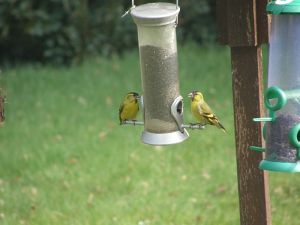
Siskins on the niger seed feeder

Siskins on the niger seed feeder

To end on a happier subject, my garden bird twitching list has increased slightly.  For the last month or so a woodpecker has been hammering on an oak tree just down the road.  I guess he’s getting territorial for spring.  I can hear him well enough, but I’m damned if I can spot him.  There’s been a fieldfare hanging about recently, and my niger seed feeder has been taken over by a gang of siskins.  Not particularly rare, but good-looking birds and new for me.