Feeds:
Posts
Comments

As a psychologist I find coincidences strangely intriguing.  Since I started writing this blog they seem to happening regularly.  Take the sparrowhawks for example; or the time I mused about never having seen a long-tailed tit and then saw a whole flock of them the very next day.

My last post was about the kites that I watched in Hong Kong last week (the birds of prey, not the flying toys).  This morning I received an e-mail from my wife saying that she had seen an unusual bird of prey as she drove to work.  Now, my wife is no twitcher, but she knows the birds and animals of the area pretty well, and she certainly knows something new when she sees it.  She described the bird as being the same size as a buzzard, feeding on a dead pheasant by the roadside and, crucially, having a forked tail.

There’s no doubt about it, this was a Red Kite – the forked tail clinches it.  Red Kites are not unknown in Bedfordshire, according to the Bedfordshire Bird Report 2007, but they aren’t common either.  They are outliers of the large population in the Chilterns.  Put it another way, I’ve never seen one, and I look out for these things.

To see a Red Kite in our area is thus a fairly rare and improbable event.  So, what are the chances of one appearing literally at the end of my road, just at the same time that I’m writing about them?

Carl Jung, the famous (and slightly mad) psychologist saw coincidences such as this as evidence of synchronicity – a meaningful relationship that reveals hidden aspects of reality and illustrates the working of the collective unconscious – the cosmic governing intelligence that connects all things.

More prosaically, it could just be one of those things.  I’ve wrote about quite a few things on here, and only a very small number happen the next day.  I still haven’t got a good look at a stoat, for instance, despite really looking.  What might be happening is that I pay more attention to those events that do coincide, and give them more significance because they are unusual.

Was the Red Kite some sort of cosmic messenger offering dark hints about the mysteries of the universe?  Am I in some way summoning birds and animals with the power of my thoughts?  Was it just a random thing – no explanation, and no point looking for one?  Or am I still a bit jet-lagged, and should I settle down and stop thinking about these things?

Whatever it is, one thing’s for sure.  I’m going to get out at the weekend and see if I can track down the kite.  They’re wonderful birds and it would be great to have them living locally.

And don’t worry, give me a few more good nights’ sleep and I’ll stop this esoteric rambling.  There’ll be more badgers soon, I promise!

causeway-bay-hong-kongThings have been very quiet on the wildlife front lately because I’ve been working in Hong Kong.  It’s been a fantastic experience in one of the world’s most dynamic and exciting cities, but at the same time it’s nice to be back in the green fields and quiet lanes of rural Bedfordshire.

Oddly enough, even in the bustling mega-city that is Hong Kong, there is still wildlife to be seen.  From my window on the 14th floor of my hotel you could see large birds of prey circling on the thermals.

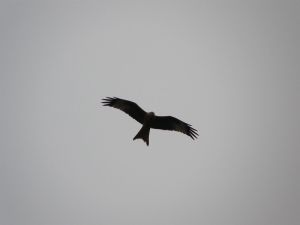
The locals referred to them as ‘eagles’, but they’re a species of Black Kite.  Considering how scarce kites are across most of the UK, it was odd to see them in such an urban environment.    They were perfectly at home, riding on the air currents between the skyscrapers, and giving me some great views as they glided past my window.

kiteI’ve seen similar kites in India, in Delhi and Bangalore, where they are known as Pariah Kites.  Kites are carrion eaters, and they feed on the bodies of cows in the cities. These cows are sacred, hence the kites are seen as outcasts or pariahs for eating them, although they do perform a necessary function in cleaning up the remains.

It’s another great example of nature adapting.  Who knows, perhaps the day isn’t far off when we’ll have urban kites in the UK?

Another day, another fall of snow.  I took a stroll up to the pasture field tonight.  The snow is 20cm deep at the top of the hill, and yet there were still the tracks of a couple of badgers.

One of these tracks followed the same general route as one on Monday – out of the wood and down the hill, following the footpath across the pasture.  The other came out of the wood from some distance away, went up to the first track and then doubled back on itself.

As I said, the general line of the first set of tracks follows the footpath up to the wood, and there are three separate badger latrine sites within half a mile along this path.  This has got me thinking.

Badger latrines generally act as territory markers, and it is common for two neighboring badger clans to share a latrine on the border (see my post on mapping badger latrines for more details).  Suppose the badger tracks mark the boundary between two territories, and that the two badgers were from neighbouring setts?  This would explain why the tracks came from opposite directions, and why so many tracks on Monday all converged on this area.  The badgers were walking along the boundary line – staking out their territories from both sides.

If this is true, it also explains why the latrine sites are on the same line, and why the badgers on Monday were taking such an interest in each others’ tracks – they were from different clans.

Such ‘border patrol’ activities are mentioned in the literature.  For instance, I’ve finally read Hans Kruuk’s The Social Badger (and excellent it is, too), and he describes witnessing aggressive encounters between badgers on these shared paths between territories.

Lastly, on Monday I thought that the badger tracks showed that the territory of my badgers is much bigger than I thought it was.  This may not be the case.  If I was walking along a boundary between territories, I was looking at tracks from two different badger clans, one on either side of the border, rather than one big territory covering the whole area.

Curiouser and curiouser.  This means that my tracking in the snow may have pinpointed the precise line between two badger clans.  As a theory, this boundary idea fits all the facts.  I wonder how I could prove it?

Winter Oak

Winter Oak

On Monday it snowed.  We had about 4-6 inches of snow, but it was enough to paralyse the whole of the UK.  Everything ground to a halt – the roads jammed up or closed, the trains were cancelled, and even the London buses stopped running for the first time ever.

I woke up at 5.30am as usual, saw the snow and decided to work from home, which I’m luckily able to do.  But once again my thoughts were on tracking, with visions of following badger trails across the pristine fields of snow.  By 9.30 in the evening I’d got dressed up and slipped out into the freezing night.

You may think that I’m eccentric for going out in the middle of the night during the worst snow the UK has seen for 18 years.  You may find it difficult to understand my excitement and wonder why I didn’t sit by the fire in the warm like everyone else.

Let me explain.  I’ve been watching badgers for three years now, and I’ve got closer to them than most people ever do.  I’ve sat by their setts and watched them come out in the evening, and I’m starting to understand their behaviour.

But there’s a whole big part of the badgers’ life that I know very little about.  Every evening they leave the sett and spend the night foraging.  I’ve caught brief glimpses of them as they range about their territory, but the truth is that it’s still a mystery to me.

Tracking has helped me fill in some of the blanks.  An animal’s tracks are an enduring record of its movements, so they help you to piece together its activities.  As well as being a fascinating pastime in its own right, tracking adds to my overall picture of badger behaviour.

But if tracking is like reading a book, then it’s a book with only one or two legible words on each page and most of the pages missing.  You can only track in areas of soft ground, so most of the picture remains hidden.

But snow, now!  Snow gives you the chance to see the whole picture, if only for a night.   Imagine spending months and years trying to understand a book from a few isolated words, and then imagine having the chance to see the whole story, page after glorious page.  Given the chance, wouldn’t you want to get out there for a look?  Isn’t that worth a walk on a snowy night?

So – out into the cold night I went.  Actually, it wasn’t too bad.  Because of the snow it was light enough to see without a torch, and it was exhilarating to be out when the rest of the world was tucked up in bed.

When I got to the pasture field, it was everything I had hoped for.  There were tracks of rabbits, and a fox, and some people with a sledge; but there amongst them were the clear tracks of badgers, no more than an hour or two old.

Thinking about it afterwards, Monday night reflected my development as a tracker.  When I first started tracking, I was excited to find tracks and identify the animals that made them.  So it was on Monday, and I was delighted to find clear badger tracks in the snow.

Here’s a badger forepaw – note the claws, the big pad and the toes like peas in a pod:

Track of badger's forepaw - note the claws

Track of badger's forepaw - note the claws

Here’s a badger track as you often find them, showing the rear foot superimposed on the front one:

Badger tracks showing registration

Badger tracks showing registration

But recognising tracks is only the first part of learning to track.  The interesting thing is using the tracks to tell you about the behaviour of the animal.  I spent two hours in the field, following the tracks of four different badgers.  This was a priceless experience – for the first time I was able to get a real understanding of their movements.  I could see where they had dug into the snow for food:

Following the badger as it foraged

Following the badger as it foraged

I could even see where they relieved themselves:

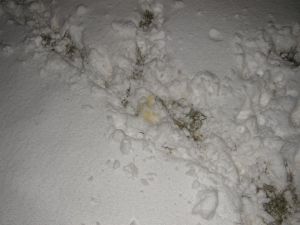
Badger urine (makes a change from pictures of dung!)

Badger urine (makes a change from pictures of dung!)

Mind you, with badgers nothing is simple.  This is just as likely to be scent marking as anything else (see my post on why badgers use paths for more details).

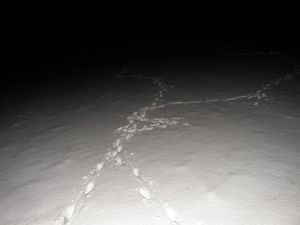
The next level of tracking is not just understanding the individual animals, but understanding how they interact with each other and with their environment.  I followed the tracks of each badger as they meandered across the field, but where the tracks crossed an interesting thing happened.  You could clearly see where the second badger had come across the tracks of the first – it would double back or walk in parallel for a short distance.  This happened on every occasion the tracks crossed, so the badgers were obviously aware of each other, presumably by scent, and checked out each others’ tracks.

Badger tracks interacting

Badger tracks interacting

It was absolutely fascinating to see how the different trails interacted.  At one point in the field the tracks of four different badgers converged.  One of these trails came out of the wood, went to this very spot, turned round and went back again.  This cannot be coincidence – this was obviously an illustration of some badger behaviour I don’t yet understand.

Four badger trails converging

Four badger trails converging

Wandering around a snow-covered field in the middle of the night with a torch is probably not everyone’s idea of a good time, but I thoroughly enjoyed myself.  I learnt more about the foraging activities of my badgers than I have done in years.  I learnt about the routes they took and the way in which they interact.  By following the tracks I’ve revised my ideas about the size of their territory (bigger than I suspected) and the boundary markers they use.

Two hours went by quickly, and then it was time for bed.  While the rest of the country ground to a halt, I had a wonderful evening of tracking.  Like I always say, this sort of thing is out there for anyone willing to take a look.

Theodore Roosevelt, the 26th president of the United States, had a pet badger called Josiah.

Apparently, Josiah was given to the president as a cub in 1903 by a little girl in Kansas.  Roosevelt was on a tour of the country at the time, and when his train stopped and he stepped out of the carriage the girl literally thrust the baby badger into his hands, saying that it was called Josiah.

I can’t imagine this sort of thing happening to a president today, but Roosevelt was made of sterner stuff.  A rugged outdoorsman in his day, he took the event in his stride and adopted the badger.   He had many pets, including a guinea pig called Fighting Bob Evans, which gives you a clue to his character.

His family kept Josiah in the White House and fed him on milk, and as soon as he was old enough he would run around the building, biting the legs of passers-by.

Sadly, although Roosevelt went on to become the only president to be awarded the Congressional Medal of Honor, it seems that Josiah’s fate was less noble.  He was eventually sent to live in the Bronx Zoo on account of his habit of “hissing like a tea kettle” and biting guests on the ankle. 

Despite Josiah’s ignominious retirement, he did set the standard for badgers in the White House.  Barack Obama, take note – if you want to get ahead, get a badger…

Thanks to Louise for alerting me to this story.

This Sunday I found a lovely clear set of badger tracks from the field behind my house.  It seems this badger has a longer route than I thought, and it’s making me think about where its sett could be located.

If you want to have a go at tracking a badger, have a look at the photo below.  It may just seem like a patch of mud, but there’s a lot of detail in there.

See how many badger tracks you can find!

How many badger tracks can you find?

How many badger tracks can you find?

There may be some tracks from other animals too…

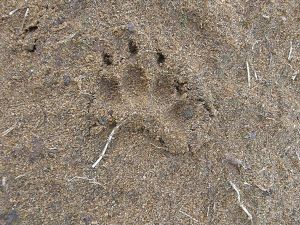
To give you a clue, here’s what you’re looking for:

Badger track

Badger track

No prizes, just a chance for you to try some tracking in the comfort of your own home.

Today, one of my chickens laid the first egg of the new year.

Happy free-range chickens

Happy free-range chickens

What has this to do with badgers, you ask?  Absolutely nothing.  But this is my diary after all, and this is a date I want to keep track of, so here it is for posterity.

For the curious, chickens stop laying in winter and resume in spring.  The mechanism for this is controlled by daylight, rather than temperature, so if you want eggs all year round you need to put a light in the chicken shed.  I’m not too bothered about intensive egg production, so I just leave my girls to get on with it the natural way.

Since we got the chickens almost two years ago I have refused to buy eggs from a shop.  We’ve got used to proper free-range eggs fresh from the garden, and the shop-bought ones are terrible, insipid things by comparison.  Hence I’m recording the date so that I know when I can expect to resume my Sunday morning fried breakfasts next year.

Badger cub

Badger cub

Thinking about the badger sett has got me thinking about badger paths.

Badger paths are an absolutely classic sign of an active sett.  Badgers are well-known to be creatures of habit, and will follow the same route night after night and even generation after generation until the vegetation is worn away and quite deep paths are formed.   The urge to follow paths is obviously very strong.  There are many examples of fences being erected across badger paths and the badgers simply barging through.

But why is this so?  Why do badgers follow such regular paths?

To understand why, you have to stop thinking like a human and think like a badger for a while.

I’ve already mentioned the senses of the badger (see About Badgers).  Badgers have poor eyesight, but a very good sense of smell.  Unlike humans, who rely on visual information to navigate, the badger ‘sees’ the world as a landscape of scents and smells.  This makes perfect sense for an animal that is active in the hours of darkness.

Badger paths then, are not visual paths, but scent paths.  Each path carries the scent of the badgers that have used it.  When a badger is following a path, it is literally following the badgers that have gone before.  As a system it is simple and effective – the badger can find its way around a completely dark wood by using these trails, and in times of danger it can always follow them back to the sett.  It is difficult for humans to understand a landscape of smells, but to the badger, these paths must stand out like a bright shining road would to us.

But nothing with badgers is ever simple.   Many mammals have interdigital glands.  These are glands between the toes that leave scent when the animal walks.  Cats have them,  for instance.  When a cat scratches a tree it is not sharpening its claws.  It is leaving scent from its interdigital glands to mark its territory.

It seems likely that badgers also have interdigital glands.  This means that every time a badger uses a path it is not only leaving a signpost for itself and for other badgers, it is using the path to mark out the territory of the clan. Badgers use scent to identify members of their own clan, so a badger can easily tell which paths belong to them, and which belong to the neighboring clans.

So badger paths are not just the result of ingrained habits or an easy way for the badgers to get from one place to another.  Seen in conjuction with other territorial markers such as the latrine sites and scratching trees, paths are a sophisticated part of the social behaviour of badgers.

The weather today has been much warmer than of late.  It was a cold night, but the sun came out and the temperature went up to 8 degrees or so.  It doesn’t sound much, but compared to the last couple of weeks it feels almost tropical!

Rabbit tracks in frost

Rabbit tracks in frost

I went on my usual Sunday morning dawn stroll today.  When I set off it was still very frosty.

Here’s an example of tracks that you won’t find in a tracking book.

The pavement was very frosty, although the road had been gritted.  At some point in the night a pair of rabbits had crossed the road, hopped up onto the pavement and then gone through the railings to the field beyond.

They had picked up the salt from the road on their feet, and this salt had melted the frost where their feet had touched it, leaving this perfect set of tracks in the ice.

I decided to make the most of the day and went for a longer walk than usual.  I let my feet carry me in a big loop around the woods.  The Chinese Water Deer were out again, and the local buzzard seems to have found a friend, as there were two buzzards swooping and calling over the fields.  Either that or he was having a territorial dispute with the neighbour.

I thought it was time I checked in at the sett to see how the badgers were doing.  Of course, there was no chance of them being out at 9.30am, but I wanted to have a look round.  It gave me a good chance to look at the different parts of the sett.  In summer, when I’m actively watching the badgers, I don’t like to get to close to the sett for fear of disturbing them as scent can linger for a long while.  Today though, I thought I’d have a look, since the badgers would not be active until much later in the evening.

Everything seemed to be in order at the sett.  There were two entrances that looked to be in very active use.  Here’s a picture of one of them – note the relatively clean hole, without many fallen leaves or other debris.  You can also see how the sides have been polished by the coming and going of many badgers.  This is obviously well-used at the moment.

Badger sett entrance (1)

Badger sett entrance (1)

Very encouragingly, a couple of entrances showed signs of recent digging and of having been cleared out.  In the picture below you can see a furrow pointing directly to the hole, made by badgers dragging out spoil.  This is another classic sign of an active badger sett.

Badger sett entrance (2)

Badger sett entrance (2)

In the picture below, you can see that the badgers have dug out large amounts of dead leaves from this entrance.  This is a sign that they’re clearing out an old chamber for re-use.

Badger sett entrance showing signs of clearing out

Badger sett entrance showing signs of clearing out

Why is this encouraging?  Well, badgers re-dig parts of the sett at this time of year to make ready for the birth of cubs in February.  The sow prepares a separate ‘maternity suite’ where she can get away from the other badgers and won’t be disturbed.  The signs of activity at the sett all point to there being cubs on the way!

The interesting thing is that there is clear activity at both ends of the sett – the east and west sides.  This implies that badgers are in residence at both ends.  There is re-digging going on at both ends too.  Does this mean that there will be two separate litters of cubs from separate mothers?  Has there been a split in the badgers, so that different groups have taken to living in different parts of the sett?

All the books I’ve read suggest that all the badgers in a sett should be part of one single group, with only the dominant male and female breeding.  This wasn’t the case last year, as there were at least two litters of cubs, and the signs seem to indicate that there will be separate litters again this year.

I’ve also been thinking about the number of badgers in the sett at the moment.  If all the cubs survived (and I have no reason to think that they haven’t) then there will be at least 10 badgers in residence.  Do some of them leave home at some point, or do they stay in the group permanently?  Might this account for the active use of different parts of the sett?  If they leave, what is it that determines who leaves and who stays, and where do the badgers that leave go?  Do they join another sett, or start their own?

You see, this is the great thing about badgers.  We’re only in January and already they’ve got me confused.  I’m going to start the badger watching season as I finished the last one – with more questions than answers!

This is a mystery that needs solving.  Does anyone know where I can get a cheap copy of Hans Kruuk’s The Social Badger?  Even better, if anyone knows anything about the clan structure of badger groups and how they change over time, then please do leave a comment and enlighten me.

Frosty fields

Frosty fields

Well, we’re ten days into 2009, and so far the only way to describe the year is ‘cold’.

The temperatures have not been much above freezing for two weeks, with night-time temperatures as low as -10 degrees Celsius.

I spent the New Year on the North Wales coast.  Normally this part of the country is quite mild, as the sea acts as a huge storage heater and keeps the temperatures up.  This year, however, the sand on the beach was frozen solid, and even the rock pools had a thick layer of ice.   It was really cold.
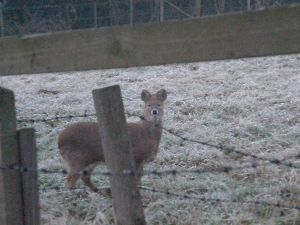
Chinese Water Deer in a frosty paddock

Chinese Water Deer in a frosty paddock

Back in Bedfordshire, the weather has been even colder.  Since most of our house has no heating we’re regularly having to scrape the ice from the inside of the windows in the morning.  We go out each day with a kettle of hot water to defrost the water in the chicken’s drinker, as it freezes solid overnight.

I’m not complaining,
mind you.  It’s quite fun to dress up in warm clothes and get outside, and I’d much rather have this sort of cold, clear weather than the murky drizzle we get so often.

Tracking is almost impossible at the moment, as the ground is like stone.  I came across a fresh fox track on December 27th, just before the frost started.  It is still there today, and looking almost as fresh, fossilised in the hard, icy ground.

The best thing that happened this week was on Monday, when it snowed.  It was only a couple of inches or so, but it got me more excited than you can imagine.  This is the first snow since I started learning tracking, and I was itching for the opportunity to go out and look at the tracks.  I had visions of being able to follow perfect crisp tracks for mile after mile, and to see the full pattern of animal movements written across the snowy ground.

I was working for a long day on Monday, but on Tuesday I managed to get out for an hour or so in the early morning before work.  There were already thousands of tracks from the previous 24 hours.

Here’s an easy one to start with.  Here’s the tracks of our cat, Mayfield.  She was originally a farm cat, and she’s not at all put off by cold weather.  Here you can see the print of her back legs as she sat in the snow.

The cat sat on the... snow

The cat sat on the... snow

Our local fox has been quite active lately.  As long as he keeps away from my chickens then I’m happy to have him around.  Since the chickens have a de-luxe high security run (which they still escape from every now and then), there isn’t much danger to them.

Here’s the fox’s tracks.  Note that the fox, unlike the dog, has an almost perfect register.  This means that the rear feet go into the tracks left by the front feet, so the track looks like they have two feet rather than four.  You can see here that there is only slight overlap to show that there are two prints on top of each other.

Fox tracks

Fox tracks

The vast majority of tracks were from rabbits.  In fact, there were so many rabbit tracks that they obscured almost all the others.  Here is a classic rabbit track.

Rabbit track

Rabbit track

The direction of travel in this case is from left to right.  The two small prints close together on the left are the front paws, and the larger tracks on the right are the rear paws.  When hopping, the rear paws ‘overtake’ the front paws, leaving a track that seems backwards.

Some of these rabbit tracks are quite impressive.  Look at the tracks immediately above the stick.  There are two sets of rabbit tracks – one at either end of the stick – representing a single bound.  Ignore the trail going from bottom left to top left, and the one across the top of the picture.
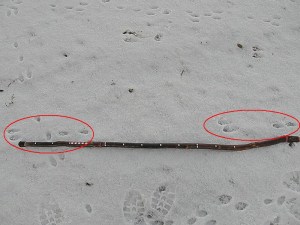
Bounding rabbit tracks

Bounding rabbit tracks

The direction of travel is from right to left, with the rear paws quite far ahead of the front ones. This rabbit was obviously bounding along at a fast pace.  The stride length was 120cm, which is a big distance for a rabbit to travel in mid-air.  Actually, the guidebooks give a stride length of 80cm for a rabbit, so this one must have been really sprinting.  It may even have been a hare, as hares have strides of up to 250cm, but the tracks themselves looked like the other rabbit tracks, so perhaps I’ve got a record-breaking rabbit on my hands.

Frustratingly, there were no badger tracks in the area.  I was longing for the chance to trail a badger through the snow, and to try and build up a picture of it’s nightly movements, but it was not to be.  Perhaps badgers don’t like snow.  The hard frost would mean that even a badger would find it difficult to dig up food.

I decided to have one last try at finding badger tracks before the snow melted, and after work I set off for the wood where the main badger sett is.  I had an idea that I might be able to find tracks in the pasture field, as I know they forage there and I’ve seen them in that area before.

I walked up to the wood at about 10.00pm (I worked late!).  The half-moon and the snow on the ground made it quite possible to wander around without a torch.  Unfortunately, by the time I arrived, the pasture field had been trodden over by the resident sheep, countless rabbits, and a solitary human.  Finding individual tracks was almost impossible.

On the borders of the wood though, I came across a trail that looked right for a badger, and I was able to follow it into the wood itself.  There, on the undisturbed snow, were two lines of badger tracks – one going away from the wood and one going back into it.

Badger track in snow

Badger track in snow

And there they were – a little distorted, but unmistakeably badger tracks.  It seems that only a single badger had been out foraging – the others probably had more sense and stayed warm underground.

I didn’t get the chance to follow badger trails as they wandered across a pristine field of snow, but it was fun to go out and look for them.  I hope that we get more snow this winter – ideally at the weekend – so I can go out and spend hours literally following in the footsteps of the wildlife.  In the meantime, may the Protector of All Small Beasts look after the animals and birds and see them safely through the cold spell.