Feeds:
Posts
Comments

Well, today is the shortest day of the year.  Today, the Oak King of Summer has got the upper hand in his endless battle with the Holly King of Winter, at least until the the summer solstice when their fortunes will be reversed.  The Holly King is not beaten yet – the warm weather won’t be here for a good while – but we’ve turned the corner of the year.  After tonight the days will start to get longer.  It’s a time for celebrating, for eating and drinking and shutting the dark outside.  A time to think about the unfolding of the seasons and to be thankful for the year that has gone.

So bring in the mistletoe, put another log on the fire and raise a glass.

Seasons greetings to everyone!

snowy-lane

For years, my wife and I have put food out in the garden for the birds, and since it is the coldest December for 30 years they really seem to appreciate it.  I made point of saving some windfall apples from the autumn and the blackbirds love them.

Last weekend we went upmarket and bought some niger seed.  Niger seed (also known as nyjer seed or thistle seed) is a small black seed that is supposed to be very attractive to linnets, siskins and goldfinches.  I’m very fond of our usual tits, sparrows, chaffinches and starlings, but this seemed like a good opportunity to have some ‘classier’ birds in the garden.

So out went the niger seed on Saturday.  By Monday, my wife reported new birds in the garden.  And there they were, a very handsome pair of goldfinches!  They really are very striking birds to see – very colourful.  Almost like having a tropical bird in the garden.

Goldfinch feeding on niger seed

Goldfinch feeding on niger seed

All in all, a good result for the niger seed.  Incidentally, as I was thumbing through my book of birds last night, I came across the page on long-tailed tits.  I’d never seen one of these, and I decided to keep an eye out for them.

Strangely enough, I was in my car down the lane this afternoon, when a small flock of birds starting working their way up the hedgerow towards me.  Yes, you’ve guessed it – they were long-tailed tits!   It’s odd how this sort of thing keeps happening…

I’ve always wanted to try plaster casting animal tracks.  I don’t know why, it just seems like an interesting thing to do.  I suppose it would be a useful skill if I ever come across a really rare track of say, a bigfoot or puma.  Neither is very likely in Bedfordshire, but you never know.  Anyway, today I gave it a go.

There isn’t much information on the internet on how to make plaster casts, so here’s a guide if you want to try it yourself.

Firstly, be prepared.  I used plaster of paris (available from the Hobbycraft chain of stores) but I’ve heard of people using decorating filler instead.  You’ll need plaster, water, a bowl to mix it in, and something to stir it with.  You’ll also need some way of making a dam around the track to contain the plaster.  For this I used strips of cardboard and rings cut from a plastic bottle.

Plaster casting kit

Plaster casting kit

A lot of these things could be improvised in the field, but I wanted to be sure that I had everything I needed, and I wanted it to be clean, so I took it with me.

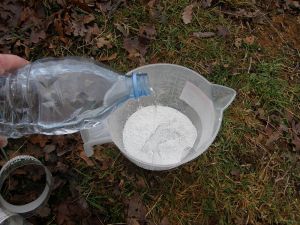
The next step is to mix the plaster.  I feel that this is a bit of an art and may take some practice.  Put the plaster in the bowl first.  It is best to add a little bit more than you think you’ll need.

Plaster first...

Plaster first...

Now add the water and stir slowly.

...then add water

...then add water

The aim is to get a smooth and even consistency.  Add enough water to make it slightly runny.  You’ll need to stir it to get all the lumps out, but don’t stir it too vigorously or you’ll introduce air bubbles that may spoil the cast.

Stir carefully

Stir carefully

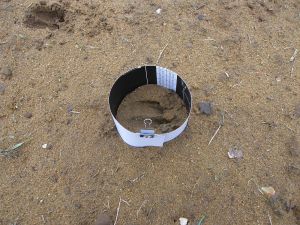
Next, put a dam around your track.  Here’s one made from a strip of cardboard clipped together around a deer track.  Push it into the ground slightly, but be careful not to distort your track.

Cardboard dam ready for plaster

Cardboard dam ready for plaster

Then add the plaster.  This dam is made from a section of plastic bottle and is around a badger track.

Plastic dam

Plastic dam

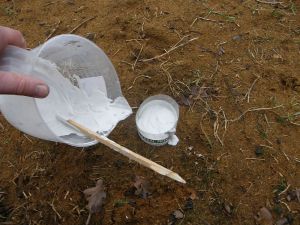
Pour the plaster in carefully so it runs into all the little nooks and crannies of the track, and don’t pour it in from a height in case you damage the track.

Leave for 30 minutes or so until the plaster is hard, and then it should be ready to carefully lift out.  It’ll bring some soil with it.  Leave this soil in place for the moment.

Lifting off the cast

Lifting off the cast

Wrap the cast carefully and bring it home.  You’ll need to remember to bring a lot of plastic bags, as you’ll need to wrap up your messy bowl too.  If you’ve used a plastic bowl you can easily clean this when the plaster has dried by flexing it to break off the plaster.

After a couple of hours you can clean the track.  Brush it softly under the tap to get the loose soil off it.  Don’t scrub, or you risk damaging the detail.  The cardboard dam was easy to remove, but the plaster stuck to the plastic one.  Unless you can grease the plastic dam somehow it may be best to use cardboard.

Finished casts - fallow deer on left, badger on right

Finished casts - fallow deer on left, badger on right

And there you have it – a permanent record of the track to study at your leisure.

Last night – Saturday night – a small herd of fallow deer does crossed the road in front of my car.  Fallow deer are easy to recognise from the car because of their obvious tails and rump patches as they disappear into the hedgerows.  It happened just a few hundred yards from my house, and close to the field where I usually go for my Sunday morning dawn walks.  Knowing that they were in the vicinity gave me a great opportunity to see if I could track them.

Winter field - no tracks here!

Winter field - no tracks here!

On the face of it, it didn’t seem promising for any tracking on Sunday morning.  It rained heavily all night, so much so that severe weather warnings were in force for much of the UK.  Nevertheless, with an effort I got out of bed to find a cold but clear dawn.  The rain had stopped at some point in the early hours.

Much of the field was too wet for clear tracks.  The lower half of the hill is on clay, and was almost underwater, although a few isolated fallow deer tracks were visible, alongside those of the ubiquitous muntjac and Chinese Water Deer.

On the better drained sandy part of the hill it was a different story.  There, spread out before me was the full story of the morning.  A clear line of tracks showed where the deer had crossed the field from the northwest.

The trail of the fallow deer herd

The trail of the fallow deer herd

The deer were walking calmly, as the tracks had a perfect register.  In other words, the rear foot had come down exactly on top of the track of the front foot.  Measuring the stride of the deer gave me a distance of 50cm on average.  This is shorter than the 60cm that the guidebooks suggest, but maybe it’s because my deer were does, or maybe they were not yet fully grown.

The trail of the deer led across the sandy soil and into a pasture field.  Unlike the deer, I respected this as private property, and I walked around to the next arable field where there was a convenient footpath.  I was able to pick up the trail in this field.  The deer had crossed it at an angle, still heading southeast, before crossing the main road and disappearing into the pathless woods beyond.

Fallow deer track - note the perfect register

Fallow deer track - note the perfect register

Fallow deer are not uncommon in the area, but it was quite exciting to be on the trail of a herd, and particularly satisfying as I had seen them the previous night.  If I was a more experienced tracker I’m sure that I could tell a lot from trail like this – how the individuals are spaced out, which one takes the lead, which ones follow behind and so on.  It was quite confusing to have a mass of tracks all together.  As always, there’s so much still to learn, and I’m enjoying every moment of it.

To end on a happy note, there were badger tracks in the field too.  I hadn’t seen any definite badger tracks here since September, and I was beginning to fear that the badger that was making them (I’ve only ever seen one set of tracks at a time) was the road casualty of early October.  Happily though, it seems not, and the badger is back to it’s regular haunts again.  I’ve only ever seen it’s tracks, but it’s kind of an old friend to me now.

I don’t know what it is, but I always find this time of year a bit melancholy and dreary.  The leaves are gone from the trees, the woods are quiet, the vegetable garden is sleeping and there is a cold, damp stillness over everything.  Summer seems a long way off.

Because of this, I decided that I needed to shake off the urge to sit in front of the fire for the next three months and get out and do something.  Over the last week or so the lack of badger-watching has been nagging at me, and I made up my mind to try and get a peep at the stripey devils.

As I’ve said before, I am not keen on the idea of using artificial lights by the sett for fear of disturbing the badgers, so I hatched a plan to try and see them as they foraged in the big pasture field.  There would still be a risk of disturbance, but not so great as there would be by shining lights on them as soon as they poked their noses above ground.  So – it was time for another late night excursion to the fields.

I’d seen a badger here the last time I tried it (see Fieldnotes: 2nd August 2008) so I was at least partly confident.  The problem was that sitting in a field for half the night in August is one thing.  Doing it in November is quite another.

As anyone who has spent time outdoors will know, it is perfectly possible to keep warm when you’re walking around.  Indeed, the challenge is often to avoid getting too hot.  When you’re just sitting in one place though, the chill seems to seep into your bones and even a mild night can be very cold.  Tonight was a cold night to begin with, with a sharp wind and a damp mist hanging over the fields.

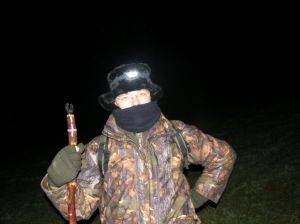
What every badger watcher is wearing this season...

What every badger watcher is wearing this season...

In anticipation of the cold, I dressed up in almost every article of clothing I possess – fleece trousers, thermal T-shirt, mountain walking fleece top (which I never wear when mountain walking because it gets too hot), army extreme cold weather shirt, jumper, waterproof jacket, mittens and fleece neckwarmer.  To top everything off I put on the furry Russian hat that my wife gave me.  I was all dressed up with somewhere to go, and at 10.30pm I headed off towards the fields.

God only knows what I looked like.  A couple of cars passed me as I walked through the village.  To the drivers I must have appeared in the headlights like a cross between a German soldier in the last days of the siege of Stalingrad and some strange Bedfordshire sasquatch!

Sitting on a log at the top of the field I was surprisingly warm and cosy.  As well I should have been, given the amount of gear I was wearing!  In an odd way it was nice to be there in winter, especially after having spent quite a bit of time on the same log over the summer.  It seemed to be taking things full circle in some way.

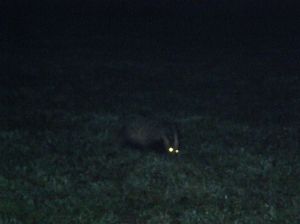
Night-time badger

Night-time badger

I sat there for an hour or so, occasionally shining a torch around the field.  And then, just before midnight, a badger appeared.

It seemed quite unconcerned about me being there as it snuffled about finding worms in the grass.  I turned on my red torch and crept closer, until I was about 20 feet away.  This is the first badger I have seen for a few months now, and it was good just to stand there and watch it.  It was particularly interesting to watch it feeding, working methodically across the field with its nose to the ground, obviously sniffing out the next earthworm.

I took a couple of photos.  They aren’t the best badger pictures ever taken, but they are a first for me.  The badger didn’t seem too put off by the flash, but I didn’t want to make a nuisance of myself.

Night-time badger 2

Night-time badger 2

After about five minutes it ambled off and I let it go.  For me, it was enough to have been out and about on a winters night, and to get a glimpse of one of these fascinating creatures.  I had satisfied my badger cravings for the time being.

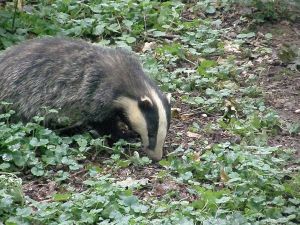
A badger in summer

A badger (in summer!)

I’ve been asked this question quite a lot recently.

People say “I’ve looked at your blog, and there doesn’t seem to be any badger-related activity since late summer.  There’s all sorts of stuff about tracking deer and seeing sparrowhawks and so on, but no badgers.

In a nutshell, Badger Watching Man, why are you not watching badgers?

Have they hibernated?

The truth is that badgers do not hibernate, but badger watchers do.

Badgers remain active all year round, although a very hard frost may keep them underground if it stops them from digging out worms or other food.  They’ll put on weight in autumn when food is plentiful to help them through the leaner times of winter, but they do not go to sleep in winter.

As I write this in November, the badgers will still be emerging each night and going about their usual foraging.  You can check this by looking for tracks and for fresh dung at the latrine sites.  The reason why I am not watching them is because they will be emerging from the sett at about 6.00 or 7.00pm, long after it has got dark.  In the summer months this isn’t a problem as dusk falls after the badgers emerge, but now it is fully dark and there would be no chance of me seeing anything.

The only options for a badger watcher in winter is either to illuminate the sett with some sort of artificial light, or to use night vision goggles.  I don’t have any night vision goggles (yet), and I’m very reluctant to start shining lights on the badgers.  According to most people it does them no harm and doesn’t really disturb them, but I’d still rather not take the chance.

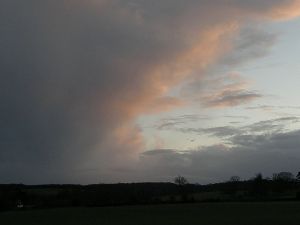
Stormy winter sunset

Stormy winter sunset

So, the badgers are still going strong but I’ve hung up my badger watching hat until the spring, when the days will grow longer and the new cubs will emerge.  Rather than hibernate fully myself I’ve become engrossed in deer and tracks and all manner of wild things for the winter, but don’t worry, the badgers will return!

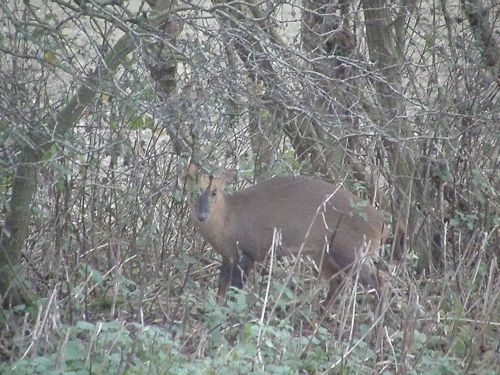
Muntjac

Muntjac

Once again, things are busy at work, and I’ve been all over the country in the last couple of weeks, bringing business psychology to the masses and having little time for wildlife at home.

Today being Sunday though, I had time to get up early and go on my regular ‘dawn patrol’ walk around the fields and woods just as it is getting light.  It’s a great time to be out watching wildlife, and as long as you don’t mind getting out of bed it gives you a whole extra part of the day.

7.00am found me sitting with my back to a tree, looking over a ploughed field.  The usual gaggle of rabbits were out and about, a muntjac peered at me from the hedge, and a large flock of rooks was circling over the woods.  As the light grew though, the main object of interest was a trio of Chinese Water Deer meandering around the field.  Their tawny coats were surprisingly well camouflaged against the sandy soil.

Chinese Water Deer seem to be figuring in my thoughts a lot at the moment.  They seem to be more numerous in the local area than I imagined.  I think some of this has to do with my familiarity with them – a few years ago I would have classed all small deer as ‘muntjac’ and thought no more about it.  Now I can recognise the CWD for what they are and distinguish them easily, and I smile at my past foolishness.

Unfortunately, when it comes to tracking, I’m still quite naive.  I still tend to class all small deer tracks as ‘muntjac’ and think no more about it.  In fact, I’m doing exactly what I used to do with visual sightings.

The problem is, the tracks of muntjac and CWD do look very similar. I could be looking at a field full of what I think are muntjac tracks, and they may actually be CWD.  Or vice versa.  For someone like me, who likes to be accurate, even on meaningless things, this is an important point.

Chinese Water Deer Tracks

Chinese Water Deer Tracks

The classic reference book of tracks, Animal Tracks and Signs, by Bang and Dahlstrom, doesn’t even mention CWD – I suppose they aren’t really common outside the Southeast of England (and China, of course).

The Hamlyn Guide to Animals – Tracks, Trails and Signs, my other preferred guidebook, says that CWD prints are very wide and splayed.  The problem with this is, it’s wrong.  The prints are actually quite small and neat.  I know.  I’ve spent the morning watching the deer and then walking up and looking at their tracks.

So, I’ve got a problem.  It is difficult to tell the deer apart from their tracks alone.

The answer, I think, is to look at the trail as a whole, not at individual tracks.  The trail of an animal is as characteristic as the shape of its feet.  This is the approach recommended by Paul Rezendes in his book Tracking & The Art of Seeing.

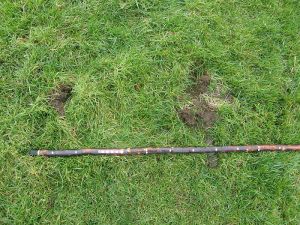
This is where my tracking stick starts to come into its own.  A tracking stick is a walking stick used in tracking.  The main use of a tracking stick is to establish the stride length of a given animal, and knowing this, predict where the next track should be.  The tracking stick helps you to narrow down the search area so you can find every single track. I tend to use my tracking stick as more of a simple measuring tool.  I have marked it in 10cm intervals and it has a 10x1cm scale attached.  This allows me to make rough and ready (but reasonably accurate) measurements in the field.

Measuring deer tracks with my tracking stick

Measuring deer tracks with my tracking stick

Here’s the clever part.  Having come across a new set of tracks, I can measure the stride length.  I did this for one trail, and found the strides to be 32cm to 38cm long, with most around the 36cm mark.

Looking at the guidebooks, they give a typical stride length for muntjac as 25-30cm, and for CWD as 30-40cm.   This means that my deer, with a stride length of about 36cm, falls outside the range for muntjac, but well within the range for CWD.  Based on stride length alone, we can say with some confidence that the trail has been made by a CWD rather than by a muntjac.

This is exciting stuff.  Although I would struggle to differentiate between the two deer based only on the shape of their footprints, measuring and comparing stride length makes it quite easy to do.

As with anything, there are complications to using stride lengths and gait patterns to identify a species.  Is the deer running or walking?  Is it full size or half-grown?  And so on.  But I like it as a technique.

An awful lot of the information available about tracking today seems very ‘spiritual’ and mystical.  I have no problem with this, and I respect anyone who can use it in this way, but it is not for me.  I earn my bread and butter as a scientist, and although I like to get away from work as often as I can, I can never quite turn off my scientific reasoning.

This is why I like this measurement approach – it is scientific and can easily be applied and tested (unlike many ideas connected to tracking) and it appeals to my use of data and facts.  I’ll see if I can make more use of it over the coming months.
Lately I’ve taken to getting up at dawn on Sundays and going for a walk around the local area.

I’d recommend it for anyone interested in wildlife.  You are up and about before the human world has woken up, the nocturnal animals – and those that are shy – are still around, and any tracks from the night before are still fresh and untrampled. It’s a rare occasion when I’m not rewarded with views of hares, muntjac and roe deer in the fields.

Badger snuffle holes on pasture

Badger snuffle holes on pasture

Besides, it gives me some extra time before the day really begins.  Of course, dawn is not very early in the morning at the moment – 6.30 to 7.00am – let’s see if I’m still so keen in May when I have to get up at 4.00am!

Today I thought I’d go up to the wood and see what the badgers have been up to.  There was no chance of seeing them, of course, they’d all be tucked up and asleep underground, but I thought I’d have a look.

The good news is that they seem to be thriving.  The pasture field was full of snuffle holes where they’d been foraging for worms and insects, and the usual latrine sites showed evidence of lots of activity.

Unfortunately it had been tipping down with rain for the last 24 hours, so any tracks were either washed away or underwater.  It was definitely a day for wearing wellies!  The only track I found was a fallow deer print under an overhanging tree, but other than that the ground was a clean slate.

Down at the sett the badger paths were well trampled, so they are obviously still very active.  I may try a night time trip with a red torch one of these evenings and see if I can spot anything.  I’m beginning to get badger withdrawal symptoms, so I’d like to try and watch them again before spring.

My fascination with badger dung continues.  The main latrine site by the sett contained large amounts of dung, some that was a mass of seeds, and some that was mostly sweetcorn.  The sweetcorn probably comes from patches of maize that are grown as food and cover for pheasants.

Badger dung with seeds

Badger dung with seeds

There seems to be a pattern here, in that separate piles of badger dung can contain entirely different food.  It suggests that the different badgers in the sett may be feeding on completely different things, and not all foraging together, which is an interesting insight into their behaviour.

I’m sorry to say that I don’t know what the seeds were in the dung.  If I was a proper naturalist I’d have brought some home and looked at it under the microscope, but I didn’t.  My wife seems to tolerate my naturalist ramblings (in every sense of the word).  Bringing home poo would, I feel, be a step too far even for me.

By this time it was time for my other Sunday ritual, bacon and eggs, with fresh free range eggs from the garden.  A good walk in the woods is surely the best way to work up an appetite for breakfast.

In my post of the 20th October I predicted that having seen one one Sparrowhawk, I’d soon see more.

Well, I was driving through the village a couple of days ago and I saw another.  It flew out of a small wood and along the road, so I had a good view of it.

Two years of wanting to see a Sparrowhawk, and then I see two in less than two weeks!  It really is strange how this happens…

Another badger was killed on the road yesterday, about a mile away from my house in a small wood.  There must be another sett around there.  A couple of years ago there was another badger killed in almost the same spot, and my wife has had badgers run across the road in front of her there.  There must be a fairly active sett nearby.

I told you this was a bad time of year for road casualties…