I’ve spent the evening watching the fox cubs by the sett. I counted five of them (I think) and they’re great fun.
Here’s a short fox cubs video compilation. Altogether now – “Awwww!”
I’ve spent the evening watching the fox cubs by the sett. I counted five of them (I think) and they’re great fun.
Here’s a short fox cubs video compilation. Altogether now – “Awwww!”
Posted in Fieldnotes, That's not a badger!, Video | Tagged fox, fox cubs | 3 Comments »

Sniffing the air after leaving the sett
I still haven’t managed to get a good look at any badger cubs this year, so once again I climbed the hill to the woods.
The badgers had obviously been busy around the western part of the sett, so I set myself up there and waited. The wait was made easier by a great-spotted woodpecker that worked its way up the trees in the area. I’ve been hearing woodpeckers for weeks, but this is the first time I’ve managed to see one.
At 8.14pm a pair of badgers came out of one of the eastern entrances, followed quickly by a third. Frustratingly, this part of the sett is hidden in undergrowth, so although I could get glimpses of black and white faces, I couldn’t tell if any of them were cubs.
For the next half hour or so I sat and listened to the badgers happily playing and whickering just out of sight. Then my attention was diverted elsewhere.
Remember the fox I mentioned a few posts ago that was living in one outlying
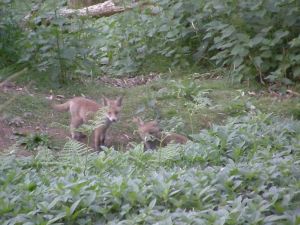
The fox cubs (damn that autofocus!)
hole of the sett? Well, it seems that ‘he’ is a ‘she’, because at 8.40 two adorable fox cubs appeared outside the hole. These little chaps were very cute indeed! Difficult to photograph, but still very cute. Sod the badgers, I thought. If they’re going to play hard to get then I’ll watch the foxes instead.
As if in answer, two badgers ambled over to the western sett entrance and in quick succession another six emerged from the hole. In no time there were eight badgers grooming and playing in front of me.
A few things stand out from the evening. Firstly, there were no cubs. All the badgers seemed adult size with adult behaviours, so unless this year’s cubs are very quick to mature then these are all last years. The main reason for keeping this diary is so that I can compare notes, and looking at the pictures from the end of May last year there is no way the cubs would be so grown up. The cubs (I’ve only seen one) must still be out of sight.
The badgers were in a playful mood – running, play-fighting and climbing trees. There is a tree at the sett that grows at an angle of 45 degrees, and I’ve seen the badgers climb up it a few times. The end of the tree is about 12 feet off the ground yet they don’t seem bothered. I walked up it once and it scared the hell out of me.
There was a lot of social behaviour going on. I noticed that as each new badger emerged from the sett it would musk (scent mark) the others, which implies that musking is a group behaviour and not just done by dominant individuals. I took some video, but the evening was a little too dark for it. Nevertheless, I’ve uploaded some because there’s a good example of musking going on. Watch how the badger coming in from the right lifts his tail when he rubs against the others. He (or she) is marking them with scent from the sub-caudal gland.
Talking of dominant individuals, I was treated to another fine display of badger sex. I really should stop watching things like this, but since the badgers in question were surrounded by six of their fellows and didn’t seem embarrassed, then neither should I be. The mating was interesting, because it was the first time I’ve ever been sure of the gender of individual badgers. It also implied that the badgers doing the mating were dominant in the clan, so these are obviously badgers of importance to watch out for in the future. I tried to see any distinguishing features so I could recognise them again, but they looked the same as any other badgers, dammit!
Ernest Neal distinguishes between short- and long-duration mating in badgers, where the long variety is a more serious attempt to breed. My pair were at it for 10 minutes, which seemed quite long, although Neal records instances of up to 90 minutes. Badger mating seems to involve a certain roughness, with the male biting the neck of the female to stop her running away, and she in turn trying to bite him when he gets too agressive.
Another thing of note was that a number of badgers rolled on the ground in exactly the same spot. This seemed like more than just coincidence. Do badgers scent-mark the soil, and then other badgers pick it up? Another thing to look out for in the future.
After an hour or so the badgers wandered off to begin the night’s foraging. By 9.45pm the sett was quiet again and I gracelessly climbed down from my tree. It was a fine evening, and the playfulness and the complexity of the social behaviour reminded my why I enjoy watching these remarkable creatures.
Posted in Fieldnotes | Tagged badgers, fox, fox cubs | 1 Comment »
Today I bought a new camouflage shirt to wear in the summer when my jacket gets too hot.
Everyone knows that your clothes should be a drab green or brown (or in my case a mixture of the two with pictures of leaves on) so that you blend into the background and the wildlife can’t see you.
While I was out I also bought some batteries for my red LED torch, because everyone knows that badgers cannot see red light.
Hang on a minute. These two statements don’t really go together. If badgers don’t see the colour red, does that mean that red is the best colour for badger watching clothes? Why didn’t I just buy a red shirt and trousers? I’d be invisible to badgers then. I wonder if anyone has ever tried this?
The truth is that camouflage is a complicated subject, and I’m sure a lot of it comes down to personal preference. Is camouflage really necessary for watching badgers and other wildlife? I honestly don’t know. All I can say is that I wear it because I feel more confident that I can’t be seen, and that confidence is important if you’re going to spend hours in a tree waiting for a wary animal to show itself.
Posted in Thoughts and Musings | Tagged badgers, camouflage | 1 Comment »
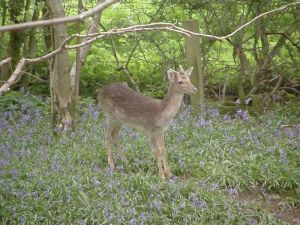
Fallow deer buck among the bluebells
After taking some pride in my fieldcraft a couple of weeks ago, tonight was a lesson on what not do when badger watching.
The wind was blowing briskly from the south west today, so I approached the sett from the north east to keep myself downwind. There’s a climbable hornbeam tree at this end of the sett and this was my objective.
I say that it’s climbable. It is, but it’s difficult. I’d say it’s a Grade IV or Grade V on my tree climbing scale, with a tricky crux halfway up. Unfortunately, when I got up to a branch I could sit on, I found that the wind was eddying round and blowing from me to the sett. Back down I went.
I crept around the sett with a view to sitting with my back to a tree. The wind was wrong here too.
By 7.40pm I’d covered a wide circle 180 degrees around the sett, yet wherever I sat it seemed the wind was blowing in the wrong direction. As I’ve said, the wind does funny things in a wooded valley. I’d been careful to avoid going to near the sett entrances, or even the main paths, but even so I’m sure I must have caused all sorts of disturbance.
On reflection I should have just gone home when I first realised what the conditions were like, but ‘badger fever’ had gripped hold of me. There were signs of serious badger activity all around – fresh digging, tracks and trails where they’d gathered bedding – and I still haven’t seen this year’s cubs properly.
The highlight of the evening was a young fallow deer buck that wandered through the wood. Perhaps I wasn’t making as much disturbance as I thought, as the fallow deer here are very shy. They have sensitive noses and unlike badgers they can see very well. This buck was perfectly at ease as he stood among the bluebells, the first stage velvet antlers showing on his head.
Nevertheless, I walked home in frustration, not having seen any of the badgers. May the Protector of All Small Beasts give me at least one day with a decent steady wind so I can get back to some serious badger watching soon.
Posted in Fieldnotes | Tagged fallow deer | 1 Comment »
It’s always the way. You wait for ages for one Red Kite, and then three turn up at once.
On Sunday I got up early, packed up a flask of tea and some food, and went out for an early stroll and a picnic breakfast. I sat under the big oak tree and looked across the valley, drinking tea and watching the antics of a Chinese Water Deer in the field below.
At 7.40am three Red Kites rose up from the woods on the other side of the valley. They circled slowly, gaining height, and then soared away in different directions. Within five minutes the valley was empty again.
It was as fine a view for breakfast as you could hope for. The Red Kite is now definitely ticked off my local species list. I need to find something else to focus on.
Posted in That's not a badger! | Tagged Bedfordshire, birdwatching, red kite | 1 Comment »
I picked up a book in a charity shop the other day (I’m a cheapskate!) and I’d wholeheartedly recommend it to anyone interested in the same sort of things as me.
The book is Simon King’s Wildguide, published by the BBC in 1994. This is the same Simon King off the TV, the star of Springwatch and similar.
Now I’m not as a rule impressed by people just because they’re celebrities, and normally I stay clear of TV tie-in books as they are usually nice and glossy but light on content, but this one really is excellent. It is basically a practical guide to observing, photographing and filming British Wildlife. It’s packed full of useful information, from how to camouflage yourself with mud (and why you shouldn’t go to the shops afterwards) to equipment and techniques.
The book covers a wide range of species, from mammals to birds, with details of how to find, track and watch them. All of these are brought to life with refreshingly honest stories and examples.
You can get it from Amazon at an exorbitant price, or check out your local library, but it’s worth the effort to track down a copy if you can get it at a decent price. It’s certainly earned a place on my crowded bookshelves.
Posted in Background | Leave a Comment »
It’s been a day of firsts. I heard my first cuckoo of the year today and I also saw my first swallow. I know that one swallow doesn’t make a summer, but it’s been a glorious day. Everything is green and growing, and the air has that beautiful, lush foliage smell of early summer.
I went up to the wood in the evening, but the badgers were in a jittery mood. The wind plays funny tricks on warm days, often changing direction around dusk. The sett is on a hillside, and on warm, still days there tends to be a slight breeze uphill as the warm air rises. As the sun goes down the colder air starts to sink and the wind direction reverses. I think this happened tonight and the badgers picked up my scent.
 One of the adults came out of the west entrance a few minutes before 8.00pm and gathered bedding, but it did not hang around. At 8.15 another pair came out of the eastern entrance and gathered more bedding. The undergrowth in the wood is getting quite lush, and the badgers are taking advantage of it. It is thought by some people that badgers deliberately gather green bedding as this ‘ferments’ in the sett and gives off warmth.
The badgers were on edge though. They would pause every now and then and sniff the air. I called it a night at 8.30, not wanting to cause them any disturbance. It is still a bit dark at this time for decent photographs, but I snapped a quick shot anyway.
I’ll be back soon, and hopefully the cubs will be out too.
Posted in Fieldnotes | Leave a Comment »
I’ve been asked the question a few times when I’m wandering about the countryside. It’s a reasonable conclusion for people to make. The green jumper and binoculars must be a dead giveaway. The truth is, I’m not really a birdwatcher. I’ll watch anything, me – bird or beast. It’s all part of getting to know my local area.

There are two chinese water deer in this picture. Can you spot them?
I went for my Sunday stroll this morning – not quite at dawn – I couldn’t get out of bed early enough. Since the crops have grown up the Chinese Water Deer have taken to hiding in the middle of the fields, only their ears visible, like the periscope of a submarine. CWD seem to prefer the middle of fields. As a rule, if you see a small deer in a hedgerow it’s likely to be a muntjac; if it’s in the middle of the field it’s a CWD.
If the mammals were quiet today, then the birds were full of life. It’s spring and they’re putting their heart and soul into defending territories and finding mates. I spent an hour or so wandering around watching birds and listening to birdsong. It seemed like every tree had it’s resident bird, sitting somewhere near the top and singing away for all they were worth.

Thrush
Have you ever really listened to birdsong? I’m mean really listened, not just been aware of it as background noise? Here’s a challenge for everyone then. Take a walk outside – in the countryside, in a wood or in a park – and listen to the different birds as you go. Look at the trees and bushes they are calling from. Find out how far they are away from each other. Listen how they interact with each other. I guarantee that if you pay attention then you’ll be amazed.

Chaffinch
I’m trying to learn the songs of different birds at the moment, and it makes a real difference to get out and actually see the birds as they sing. Today there were thrushes, robins, chaffinches, great tits, blue tits, a cuckoo (first one of the year for me) and – oddly – a peacock. None of these are rare birds (the peacock was a bit unusual, I assume it was a pet in a garden), but being aware of them gave a whole new dimension to the walk. I’d recommend it.
This morning was another first for me in birdwatching terms. I saw a hawk being mobbed by crows. I’ve heard of this happening but had never seen it before. An aerial dogfight was played out before me, with the hawk and crows twisting and turning across the sky. They were unfortunately too far away for me to identify the hawk, but impressive nonetheless.
So am I a birdwatcher? Well, I can’t recognise many birds, and I don’t feel the urge to travel the country looking for rarities, but yes, I think I must be.
Posted in That's not a badger! | Tagged Birds, birdsong, birdwatching, Chinese Water Deer | 2 Comments »
This started off as a reply to a comment on my last post, but it got a bit long so I thought I’d convert it into a post of its own right. It is an interesting subject, and this isn’t really a reply to the comment so much as the train of thought it triggered off in me.
I talked about trying to keep hidden from the badgers. As Undergrowth commented, I’m sure that the badgers are perfectly aware of my presence, even if it is just from coming across my scent as they forage in the wood. I live in hope that one day they’ll get used to me being there!
And it would be perfectly possible to use food to get the badgers to accept me. You can train animals to do just about anything with food. The famous psychologist B. F. Skinner once trained a cat to play the piano. Skinner trained animals to do all sorts of things – he created the world’s first guided missile using trained pigeons to home in on the target (thankfully never used, not least for the sake of the pigeons!)
I’ve seen how badgers make full use of available food resources, and I’m sure that regular feeding would get them literally eating out of my hand. I know that many people feed badgers. The extra food can be a real benefit to the badgers as well as providing some great views for the watchers. When you think about it, it’s no different to feeding the birds, and I certainly do that.
But the problem is that once you start feeding animals, you lose the natural behaviour. I’m not saying it’s wrong to feed them – lord knows we’ve messed around with our wildlife in far more serious ways – but I don’t want to go down that route. I have put out some peanuts for the badgers in the past, but I’ve stopped doing it now. I want to be able to see the badgers in their natural state.
In other words, I don’t want to just watch them, I want to understand them. I want to understand what they do, and how they live.
This is also why I go to so much trouble to stay out of sight. Even though the badgers are sure to know that I’ve been there, I still want to make as little impact as possible. I don’t want the badgers to associate me with fear or danger. If they come to associate my scent with someone crashing about the undergrowth or blundering into view, then they’ll learn to avoid me in the future. I don’t want them to become friendly with me, just kind of neutral.
It sounds like a lot of trouble, but it means that ‘my’ badgers are truly wild. What I see is as close to natural behaviour as possible. That’s important for me.
As always, these are my own views. I know that some people will disagree and that’s fine. There are many situations where feeding badgers is a good thing for all concerned. Just not for me any more and not at this sett.
Posted in Thoughts and Musings | Tagged badgers | 21 Comments »
I’ve been busy laying a new floor this weekend, but I took a couple of hours off this evening to see what the badgers were up to. In particular, I was keen to see if the cub (or maybe cubs) made another appearance.
A good breeze was blowing so I made for my usual tree. At 8.05pm the fox wandered past. It seems very regular in its habits, this fox.
By 8.25 it was getting dark and there were no badgers to be seen. At this time last week there were at least five of them out and about, but for some reason tonight they were having a lie-in. I don’t think it was my presence. I’d arrived carefully and early, so I don’t think they could be aware of me.
Just before 8.30 a badger came out of the western entrance, stopped, scratched a couple of times and then went back underground. I waited for a good while but it didn’t reappear.
I can take a hint. This was obviously not going to be a great night of badger watching, so I climbed down the tree and headed for home. Just as I touched the ground, however, the badger popped its head out of the sett again. I was standing in full view not 30 feet away. I was caught in the act!
But there were four things acting in my favour, and it was a good reminder how important they all are.
Because of all these factors I was able to stand there in full view of the badger yet remain effectively invisible (although it did feel horribly exposed to be on the ground – I’m like a fish out of water when I’m out of my tree!)
After a minute of two the badger was joined by another, and they sat there scratching merrily. I crept away as slowly and as quietly as I could so as not to disturb them, and when I looked back they were still blissfully unaware of me. I had got away with it.
At times I do feel that I get a little obsessive about not disturbing the badgers, but I really do believe that it is these little details that mean the difference between success and failure when watching wildlife.
Posted in Fieldnotes | 2 Comments »

Tales from the Wood is a proud winner of...
 | Badger Watching Man on Tortoises and Dung Beetles… |
 | Anonymous on Tortoises and Dung Beetles… |
| Badger Watching Man on A Walk through Woburn Deer… |
 | S Howe on A Walk through Woburn Deer… |
 | Daniel on Last of the snow tracks… |

 Tales from the Wood - The Diary of a Badger Watching Man