On my reconnaissance of the Pine Tree sett a few weeks ago I identified three separate holes spread out a hundred or so yards apart along a line roughly north-south. I’ve watched at the southern hole a couple of times but seen no badgers, and I’ve seen a single badger both times I’ve watched at the northern hole.
Where are the other badgers? I decided to spend a couple of hours watching the middle hole.
And now it’s time for a confession. The bracken has grown up over the past couple of weeks, and although I looked for the middle hole I couldn’t find it. Some outdoorsman I am!
Rather than go back home again I settled down to watch the southern hole. This is the one with the biggest spoil heap, so it should be occupied, and the spoil showed recent tracks. Perhaps I could clear up the mystery of why I’ve never seen any badgers there.
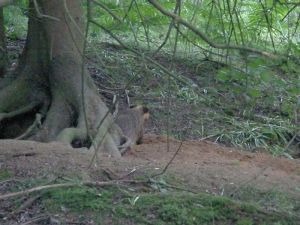
At 9.03pm a badger appeared. But it did not emerge from the hole, it came from the woods behind and then went into the hole. After another ten minutes or so it emerged again. This hole is under the roots of a pine tree, and the badger emerged from between the roots, just like a badger in a picture book.
Unfortunately the light had faded and my camera was struggling. The only decent picture I got is the one at the top of the post, and that isn’t very good. Shame. It would have been great to get a picture of the badger emerging from beneath the tree.
After a minute or two the badger trotted off into the depths of the wood. Nothing else happened.
I’m starting to suspect that there is only one badger at the sett. When I last saw the badger at the northern hole it emerged at 8.50pm and walked towards the southern hole. This is exactly the same thing I saw tonight. I need to get a clear picture and see if I can recognise it as the same badger.
It seems odd that there should be only one though. Is it normal for one badger to have three holes? Nor does this square the evidence I got from tracking, which showed multiple tracks on this side of the pasture field, or the well-worn paths in the area. Perhaps there are more and they still haven’t shown themselves, but I don’t think so.
If nothing else, this highlights my continuing ignorance of what constitutes a main sett and what is merely a subsidiary sett, and how these relate to clan relationships between different groups. As soon as I’ve worked it out I’ll let you know.
I had been getting a little perplexed by the behaviour of my badgers; in particular I was worried that they had been driven to eat bark by the recent dry weather. However, the more I looked at the problem, the less sure I became.
Thanks very much to everyone who shared their experience with me here. Spiney, for instance, sent me a picture of bark-eating near a badger sett in Yorkshire. This looks like a beech tree – another tree with quite a sugary bark.
Bark eating - picture by Spiney - thanks!
John from Badgerpics.org.uk very helpfully supplied information on the bark-eating habits of different animals, whilst on a related topic Josie was very helpful with further details of the badger ‘nests’. Thanks everyone – it’s great to have this sort of assistance.
To try and settle the matter I spent the evening down at the Pine Tree sett. My plan was to lurk around and see if I could catch the culprit in the act.
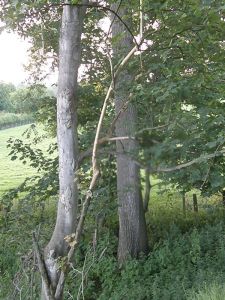
When I arrived I realised that it was even less likely that badgers were to blame. The bark-eating had spread to the neighboring trees and extended far up into the branches. There is no way a badger could get so high on such a thin branch.
More bark damage
In fact, the only animal I know that can reach these branches is a squirrel. This seems to be the only possible explanation. It is far too high for deer, rabbits, badgers or even voles. The toothmarks on the high level damage are the same as on the ground level damage, so the same animal is responsible for all of it.
Bark tooth marks
There were indeed squirrels in the area, and they were feeding in the sycamore trees, but I couldn’t quite see exactly what they were feeding on.
To make sure, I sat well back from the area and waited, just in case a badger came out and had a quick nibble on a tree. I was sitting far back from the bank so I couldn’t see the hole, but at 8.50pm I heard the unmistakable sound of a badger scratching, and then a few seconds later the badger itself ambled into view. Before I could even raise the camera it trotted off towards the southern end of the sett. It walked past the freshly gnawed tree without even a second glance.
So there you have it. Two hours of sitting in a wood for one 15 second view of a badger. It was worth it though. The bark was a mystery, but it’s been an interesting challenge to work out what was going on.
So, to conclude, it seems that badgers can and do eat bark, particularly sycamore. However, on this occasion it looks like I have one or more rogue squirrels in the area who have taken a liking to it. The fact that they started to eat the bark at ground level and right outside a badger sett put me on the wrong track for a while, but the true facts emerged.
The hot dry spell ended with a vengeance on Sunday. I went for my customary walk at 7.00am and the rain was torrential. I splashed happily through the rivers of rainwater that were running down the road.
I went for a walk more out of habit than in any hopes of seeing any wildlife. I thought that they’d have more sense than to be out in a downpour. And so it proved. There was one solitary Chinese Water Deer in the field (do they like to be wet?) but apart from that I was on my own.
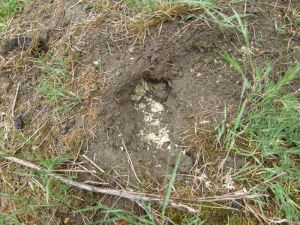
I did find one interesting thing. In the field behind my house was a wasps’ nest that had been dug out. The nest had obviously been dug out overnight as there were a few dazed and confused wasps wandering over the wreck of their home. This is a classic badger feeding sign, but one I’ve never seen before. The badgers dig out the nest to get at the larvae inside, and by all accounts they are not bothered too much by the stings.
Fine by me. I have no love for wasps. As far as I’m concerned it was a good night’s work by the badger. That’ll do, badger. That’ll do.
Most people in Britain have never seen a badger. Many have seen a dead badger by the side of the road, but few ever see a live one. Of those that do, I suspect that most are content to enjoy the experience, to enjoy the badger as an impressive yet endearing part of our wildlife. As I’ve said before, once people see a badger they seem to become hooked. Even Ernest Neal, the undisputed authority on badgers, first came across one by accident and this led to a lifetime of work studying these creatures.
But for me it is not enough to just watch badgers. I’ve gone past the “wow – there’s a badger!” phase. I want to understand them. I think I’m becoming obsessed.
Now don’t get me wrong – it’s not a bad obsession to have. It’s quite healthy. I could be addicted to drink or drugs, but instead I’m becoming addicted to badgers. It’s a pleasant diversion from work, it keeps my mind active and stops me getting up to mischief, and most importantly it encourages me to get out and enjoy the countryside on my doorstep.
What started out as a good excuse to go for a walk in the woods has now got me learning about animal behaviour, territoriality, social bonding and the whole ecology of woodlands. As soon as I think I’ve understood how badgers work, I discover something new and realise I actually don’t know very much at all.
All of this philosophical musing has been triggered by a short walk in the woods this morning. I wanted to go out and have a look at the Pine Tree sett, specifically to see if there was any more evidence of badgers eating the sycamore bark.
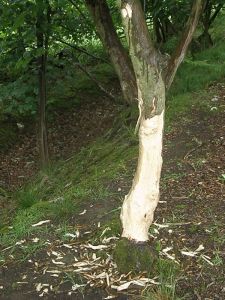
Sycamore with gnawed bark
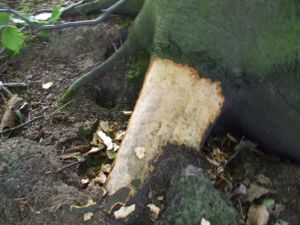
When I got to the sett I found that there was a lot more evidence of bark eating. Another tree had been ‘attacked’ and more bark was missing from the original tree. But from what I’ve seen, I’m not sure that badgers are the culprits.
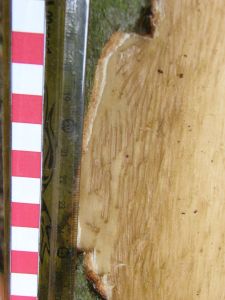
The bark shows clear toothmarks – lots of them and quite small – rather than a few large claw marks that I’d expect from a badger. More conclusive was that the damage to the bark now extends to about 8 feet off the ground. Badgers are actually surprisingly good at climbing trees (and they seem to enjoy it as a game) but I think that this height is beyond them. I now need to research squirrel feeding, and see if that fits the bill. Even better, I need to spend an evening here and see if I can catch the culprit in the act.
Bark damage close up - scale in cm
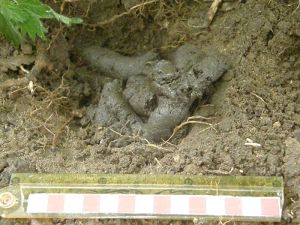
Acting on suggestions from people on the Wild About Britain forum, I examined the badger dung in the latrine nearby. It seemed a bit more green than usual but there were no clear signs of bark in it. And no – I didn’t bring any home for analysis. I’m not that obsessed yet!
Badger Dung
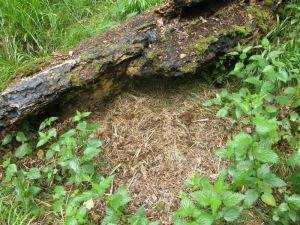
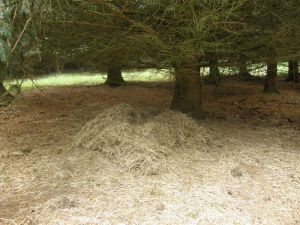
Walking back through the woods, I came across more puzzling animal signs. For want of a better word I’ll call these ‘nests’. They were substantial piles of grass that had been pulled up and shaped into a mound, sometimes with a hollow in the middle. They are undoubtedly the bedding of some animal.
I’ve come across these before, and I wondered if they were piles of bedding that a badger had collected and then for some reason abandoned on the way back to the sett. After seeing more of them today I think that they are more likely to be nests in their own right, where an animal sleeps. I found them in dry, sheltered spots. Here’s one under a fallen tree:
Here’s one under the shelter of a pine tree:
The nests were associated with paths, but whether these were badger paths I could not say. The whole area is criss-crossed by badger paths and deer paths, and to confuse matters the badgers use deer paths and the deer use badger paths.
Are these nests made by badgers? What other animals deliberately gather bedding from distance? If they are badger nests, why are they there? Why are the badgers not safely underground in their sett? Are they used as temporary shelter? Are these badgers part of a sett, or are they some sort of homeless, ‘hobo badgers’, sleeping rough? If so, how do they fit into the territories of the other badgers?
Do you see now how this whole badger business can become obsessive? If anyone has any answers, please do let me know.
On Tuesday I went to the wood and, as recorded below, I didn’t see any badgers. In the absence of badgers, I spent the evening watching birds, and I want to make some notes on these – hence the separate post.
It always amazes me what you can see if you sit quietly and unobtrusively somewhere for an hour or so. I had a pair of bullfinches working the tree in front of me. These are far less common now than when I was a lad, so it was good to see them. There was also a pair of robins with a nest about 50 feet away, and they spent the whole evening going backwards and forwards with food for the young – it was a proper Springwatch moment. I always find it slightly strange to see robins in the wild. I am so used to seeing them in the garden that I tend to forget that they exist outside.
One of the most interesting things for me personally was the effect of a tawny owl on the local birds. As it was getting dark, a tawny owl called from the deep woods somewhere behind me – kee-wick,kee-wick. Instantly, a blackbird nearby started up its chattering alarm call – chink-chink-chink-chink-chink. Then another blackbird did the same a little further away, and then a third.
The blackbirds had obviously heard and seen the owl and they were raising the alarm. What made it so interesting was that although I could not see the owl myself, I could locate its position and track its progress by the alarm calls of the blackbirds.
Some trackers regard this as a higher form of tracking – following a predator through the reactions of other species. Jon Young discusses it in detail in Animal Tracking Basics (probably the least basic book on tracking I’ve ever read, incidentally). I’ve noticed blackbirds responding to foxes in this way, but this was the first time I’ve really been able to follow the progress of a predator through alarm calls. I was quite pleased with myself.
So although there were no badgers that evening, I still had a great time. All of this happened in a little patch of woodland that 99% of people would drive past without a second thought.
If you’re interested in nature and wildlife then I strongly recommend you find somewhere outside – a wood, a field, a park, anywhere – and just sit there quietly for at least an hour. I think you’d be surprised at what you see and hear.
On Saturday I watched the southern entrance of the Pine Tree sett without seeing any badgers. It looks as though there should be badgers in residence – there’s plenty of fresh spoil and well-used paths – so maybe it was just an odd coincidence that they came out late, or maybe I disturbed them somehow.
To make sure, I went back to this part of the sett on Tuesday. Once again, I saw no badgers. I’m coming to the conclusion that there are no badgers in this particular hole.
I’m trying to make sense of all this in terms of used and unused holes and the way a clan of badgers organises itself into main, outlying and subsidiary setts. I know that sows with cubs will take themselves off to an unused hole, and that boars new to an area will do the same. Perhaps these are outlying holes and there’s a main part of the sett here that I haven’t observed yet.
Sycamore tree with stripped bark
It was still a worthwhile outing, with plenty to see. I noticed that at the northern hole the badgers have stripped the bark off a young sycamore tree and eaten it. At least, I presume it was badgers – the tree is right next to the sett and it was stripped of bark up to 3 feet high, so I don’t think anything else could have done it.
Neal and Cheeseman mention that badgers will sometimes eat sycamore bark in early spring when the sap is rising. It is almost midsummer now, but perhaps the recent dry spell has made other food less available, so the badgers are having to expand their diet. I’ll keep an eye on this. I’d rather not feed them, but I don’t want them to go hungry either.
If you read my last post you’ll know that I’m being unfaithful to ‘my’ badgers and investigating the neighboring sett – the Pine Tree sett. This sett seems to have three main holes spread widely apart. Last night I watched the southernmost hole without a sign of any badgers. Tonight I decided to have a look at the northern hole.
This hole is at the bottom of short but steep bank, about 8′ high. Because of the wind direction I elected to lie in the grass on the top of the bank and peer over the edge, with the wind blowing directly up the bank towards me. To begin with this was quite a luxury – badger watching while lying in grass, instead of sitting on a thin tree branch or in a patch of nettles. After an hour of lying motionless though I had pins and needles in my legs and the blood was pooling uncomfortably in my head. And I do this for fun?
At 8.35pm the stripey head of a badger popped out of the hole. Success! So there are badgers here after all! A few seconds later it popped back down again.
I was sure it hadn’t scented me, as I’d been very careful to take the long way round when I walked in so the sett was always upwind. I was also pretty sure it hadn’t spotted me, partly because I was fully camouflaged and hidden behind the grass, but mostly because a badger that sees something suspicious will usually try and sniff the air to make sure, and this one just disappeared. There was nothing for it but to wait and see.
About 10 minutes later the badger reappeared, and to my horror it started climbing the bank towards me. Another few feet, I thought to myself, and you’re going to get a surprise! Luckily the badger wasn’t climbing to the top of the bank. It was gathering grass for bedding, pulling it out with its mouth and shuffling back to the sett once it had got a reasonable load. I always enjoy watching badgers doing this, there’s something strangely endearing about it.
Here’s a brief video of the badger:
The badger made three bedding trips in all and then stayed underground, no doubt arranging things in its chamber. I decided not to push my luck and sneaked off. It had been a great close-up view, but I didn’t want to spoil things on my first visit to the sett.
As ever, questions remain. I only saw one badger. Are there more in this part of the sett? Is it just a solitary bachelor in residence? Why are the holes in this sett so far apart? How do the badgers from each hole interact? The paths between the holes suggest that they do, but the behaviour seems very different from the communal get-togethers I’ve observed at the other sett.
I shall do what I always do – go back to the textbooks and keep watching!
I’ve tried to make a point of watching one group of badgers rather than flitting around here, there and everywhere, the idea being that I should be able to learn more by getting to know one group very well.
OK. Today I changed my mind slightly, and decided to go and have a look at the neighbouring badger sett.
Regular readers may remember that I found this sett a little while ago (see Fieldnotes 7th September). I hadn’t forgetton it.
In fact, this sett has been central in my efforts to understand ‘my’ group of badgers. I was able to predict its position by mapping latrine sites, badger latrines being sited on the boundaries of their territories. When I followed the badger tracks in the snow in January I was able to see how badgers from both of these setts interacted on the boundary between them.
A great deal of badger behaviour is related to establishing and maintaining a territory, so understanding the relationship between neighboring clans is important. For instance, last year I wondered what happened to the ‘excess’ badgers at the sett, since as a group they seemed to reproducing faster than they were dying. After reading Hans Kruuk’s The Social Badger I now know that the non-dominant males leave and typically mate with females from another sett, but only ever with those from a neighbouring sett. They don’t seem to travel any further. The females almost always stay in their home territory.
(Interestingly, this happened to me too. I grew up in the north of England, but I left there and married my wife. My wife is from Bedfordshire, where we now live, so I migrated away from my clan whilst she stayed in her home territory. Perhaps the principle works for humans as well…)
Anyway, I digress. Today, I decided I fancied a bit of a change so I went to see the other sett. It needs a name to distinguish it from the main sett I watch, and since there are pine trees around the entrance let’s call it the Pine Tree sett.
The Pine Tree sett is not as big as the main one. Like the main sett it adjoins
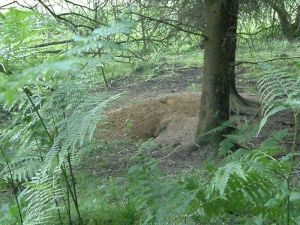
The Pine Tree sett
the pasture field, so the badgers have access to the main food resources (hence the territorial boundary that divides the pasture field between them). There are three entrances spread out over a hundred yards or so, with a well-used path between them. The entrances are the classic sideways D shape, with large spoil heaps and used bedding outside. Nearby were fresh dung pits. In short, it was as badgery a place as you could ever wish for.
The only problem was that although I watched it for three hours, I didn’t see any badgers. Very frustrating.
The holes are quite far apart and not intervisible, so it is only possible to see one of them at a time. I chose to watch at the hole with the largest and freshest spoil heap, but perhaps the badgers were at another one.
It’s a mystery. It is obviously a badger sett, and obviously in use, so the badgers must be somewhere. I was at the sett from 6.30pm to 9.30pm, so I imagine the badgers would have come out during that time. In the other sett half a mile away they’re coming out consistently between 8.00pm and 8.30pm.
I think I need to put in a few more trips to this sett and try watching the other holes. Hopefully that will clear up the mystery.
I’ve been writing this diary for a year now, and do you know what the most popular post has been? Has it been my insightful and, dare I say, scholarly comments on badger behaviour? Has it been the videos and fieldnotes that make the experience of badger watching available to all? Has it been my adventures in tracking, discovering the wildlife of my local area?
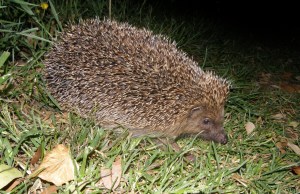
Nope. None of these things. The most popular post, by a significant margin, has been my picture of a hedgehog (see Fieldnotes: 2nd August 2008). It seems the hedgehog is the real star of the show.
So, for all the hedgehog fans out there (including the Hedgehog Fan), here’s a picture of another urchin I came across this evening. Right click and save as to get the full size picture.
Things have been busier than usual at work and around the house lately, hence I’m late in writing up my notes. It’s been a gloriously hot bank holiday weekend, and I’ve been taking the opportunity to thrash the garden into shape. Where there was a jungle there are now neat rows of vegetables and trimmed hedges – what a difference a few days can make.
And by the way, this blog is now a year old, so happy birthday to me! The main reason for writing it is to keep a diary so that I can check back on things and compare my experiences over the years. It’s working already. I can see from my records that this time last year was cold and wintry, so I’m starting to build up an archive of what has happened. Besides, keeping a diary online is much more fun than doing it on paper.
So without further ado, here’s the compressed diary entries for the weekend.
Saturday 23rd May
Being busy in the garden, I only had time for a quick trip up to the woods. I set myself up at the western side of the sett, mostly because it is clearer here and the view is better.
At 8.00pm exactly a badger left the eastern side of the sett and ambled over the western entrances. Five minutes later it wandered back again. A social visit, I presume. The eastern end of the sett is where I’ve seen the only cub of the season so far, so I’ve been keeping an eye on it to try and see some more.
The vixen and the fox cubs came out at 8.20. There are five of them. They suckled their mother for a few minutes before she suddenly ran off across the wood, five little cubs in tow. For a moment there were fox cubs everywhere, but they soon sorted themselves out. Perhaps she is starting to teach them to hunt, or just encouraging them to be more independent.
I could hear badgers at the eastern end of the sett at 8.35, but the undergrowth hid them from me. I still want to find out if there are any more cubs, so it looks like a trip to this end of the sett is called for.
Sunday 24th May
The eastern end of the sett presents a challenge, as there are no easily climbable trees nearby so you have to sit on the ground. It is also on a slight rise, so to get any sort of view you need to be pretty close. It was time for some extreme stealth badger watching!
Getting close to truly wild badgers is difficult because they are very nervous. I did everything I could to prepare. I brought my full camouflage outfit – my new camo shirt, gloves and two face veils. I even made sure that the shoes I wore had dark soles! The face veils are very important, as your face really does stand out. In particular it is useful to cover your eyes. Animals (and birds) seem to have an uncanny knack of knowing when you’re looking at them, and I think a lot of this comes from seeing your eyes. The ability to recognise eyes is built into almost all animals – a human baby will smile at two dots on a piece of paper if they are the same size as its mother’s eyes. One company in the US even makes camouflage sunglasses; these may seem like a gimmick but I’m convinced they are useful because they disguise your most noticeable feature.
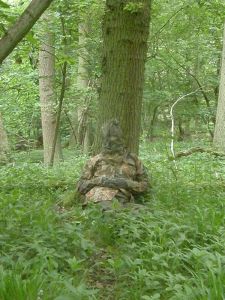
Here’s what I look like in full camo gear – needless to say I don’t pop into the pub dressed like this.
The BWM in full camouflage
All my badger watching clothes are washed in hot water without soap, and to make sure I get rid of any possible washing powder scent I soak them in the rainwater butt overnight and then let them dry outside. I myself took a shower in hot water without soap, but I’m afraid I didn’t jump in the rainwater afterwards. I draw the line at some things. Never mind, I was as scent-free as I could possibly make myself.
All this camouflage may seem excessive, but I think it does help. It certainly gives me confidence to get close to the badgers.
Taking note of the wind direction I crept slowly up to the sett and sat with my back to a tree to hide my silhouette. I sat absolutely still, like a statue or a piece of wood. The local mosquitoes came out in force and bit my hands and ankles (the only vulnerable places) but I kept still.
At 8.00pm or so two badgers emerged – an adult and a cub. I was sitting in full view no more than 12 feet or so away. What a fantastic sight! I felt I could almost reach over and touch them. No chance of any pictures, of course. If I’d have moved even an inch they would have been scared off.
They sat and groomed and scratched for ten minutes or so as I sat and watched, hardly daring to breathe. When they ambled off I crept away as quietly as I could.
It was a great experience. Apart from the sheer boyish pleasure of dressing up and creeping around in a wood I had one of the best views of the badgers ever.
Still only the one cub though. Could it be that there is only one this year?
Monday 25th May
Back again at the western end of the sett. Two badgers came over from the eastern side at 8.25pm, and were joined by others from the western entrances. At 8.35 the mother and cub came over from the eastern sett. This was the first time I’ve seen the cub joining the adults over here.
The badgers were all very busy. At least three of them were engaged in some energetic digging in two separate entrances. Interestingly, one of these was a badger from the eastern side. It seems that it was living in a separate part of the sett yet it was still helping to excavate over here. Very community-spirited! You could tell the badgers that had been digging because they were a muddy red colour from the soil rather than the usual grey and black.
Other than that it was a typical relaxed badger evening. All the badgers sat around grooming contentedly, and the air was filled with scratching noises. Occasionally one badger would musk another, or help out with some mutual grooming. In short, it was a happy scene of a badger clan at ease.
Here’s a short video to give you a flavour of the evening:
And what about the cubs? Well, there was only the one. It played alongside the adults, but it was very much an only child. I’m coming to the conclusion that there is only this one cub this year. Is this because of the hard weather we had at the start of the year? Is it because we had a lot of cubs last year? Let’s see if an answer presents itself. In the meantime, it’s good to be out in the woods on a warm evening in the company of badgers.






 Tales from the Wood - The Diary of a Badger Watching Man