Feeds:
Posts
Comments

Getting even further away from badgers, but another date for the diary.  I left my job today.  I’d been there nearly ten years, so it was a wrench to go.  They are good people.

On Monday I start a new job as Director of Talent Management for a well-respected firm of business psychologists in London.

Busy, busy, busy, as we Bokononists say…

I’ve been writing this blog for a little over a year, and I enjoy it a lot.  It started out as a way to record wildlife observations (it’s a good thing to do but I’m terribly undisciplined at keeping paper notes) as well as way to prove to my wife that I’m not up to mischief when I sneak out of the house in the evening carrying a camouflage jacket and a pair of binoculars.

The thing about a blog, though, is that it gathers its own momentum.  I feel duty bound to write things that are interesting because people like you, gentle reader, are willing to give up your time reading them.  I want to make it worthwhile for you.

Sometimes though, a diary is just a diary.  Sometimes I have to make a note of an important date or event so that I’ll be able to go back and check it later.  Most of the time I try to sneak these little facts into the posts so that you don’t notice, but sometimes I’ve just got to come out and tell it like it is.  This is one of those occasions.

Yesterday, on the 29th June, we started picking the raspberries.  We should have enough for a jar or two of jam.  The cherries on the tree in the chickens’ enclosure are almost (but not quite) ripe, and the blackcurrants will be ready for picking at the weekend too.  Mind you, we’ve had some very hot weather so that may have speeded things up a little this year.

There you go.  It may not mean much to you, but it is important for me that I record this.  I’m sure you understand.

Badger 1It’s been a weekend of extremes as far as the weather has gone.  It has been very hot and very humid, with long periods of sunshine giving way to thunderstorms in the evenings.  Although we haven’t had any rain ourselves, it has been torrential in places nearby.  One friend had his car alarm set off repeatedly by intense hailstorms, while the house of another was actually struck by lightning!

The badgers seemed to respond to the sluggish weather too.  I went up to the wood on Sunday evening.  I was relieved to find that it was slightly cooler in the wood – I had imagined that it would be even more humid and oppressive under the trees, but the opposite was the case.  I am constantly surprised by the differences in microclimate between woods and nearby fields.  If any ecology student is looking for a subject for a project I suspect that there’s an interesting field of study here.

Two badgers came out of the western side of the sett at 8.20pm, including a light coloured individual.  They groomed for a bit, wandered around in a desultory way and eventually mooched off towards the east.  I don’t know if it is the weather, but they did seem a bit lethargic.  They weren’t in any hurry to rush off and forage, but at the same time they weren’t in the mood for playing or interacting.  Perhaps it was just too hot, especially for a badger with a thick coat of hair.

I don’t know where the other badgers in the sett were.  They may be staying underground until later to escape the heat (I only stayed until 9.30).  They could even be sleeping above ground somewhere, perhaps in one of the nests I discovered a few weeks ago.

The evening was notable because I actually managed to get a half-decent photograph of a muntjac.  These little deer are a real contradiction: they are very common in this area, but surprisingly difficult to get close to.

Muntjac buck

Muntjac buck

If I’m driving to or from work in the early morning or evening then I see them regularly by the side of the road.  I saw one at 6.00am this morning about 100 yards from my house.  But although they’re common, they are wary.  They have an uncanny sense of whether you’re interested in them.  They’ll let you drive or walk past, but if you slow down the car they’ll be off like a shot.   If you pause or raise a camera then they notice immediately.  I try to practise my deerstalking on the local muntjac, but rarely with any success.  All of this means that I’ve never got a close-up picture of one.

Last night though a muntjac buck walked past the tree where I was sitting, giving me some great close-up views.  In terms of fieldcraft, camouflage and wind direction I was in just the right spot and it wandered about, blissfully unaware of me as it browsed on the vegetation.

Notice the small antlers with the long pedicles (the tissue at the base of the antlers), the pronounced brow ridges and the long canine teeth.

Muntjac 1

Not a rare species by any means, but a challenge to get close to.

My wife came home from a late shift tonight and told me that there was a badger dead on the main road, not more than 100 yards from the end of our road.

I’m not particularly keen on going out at 11.30pm and examining dead badgers, but I couldn’t leave it there.  Plus, now that I’m part of the Bedfordshire Badger Network I have a responsibility to monitor road deaths in the area.  Packing camera, tape measure and disposable gloves, off I went.

The badger was very close to our house, and fairly close to the one that was killed back in October.  I regularly track a badger in the field next to this spot (I followed a lovely long trail here only two weeks ago) so I guess that it was either this badger or one from the same sett.  I suspect that the sett is in a private wood on the other side of the road, hence the badgers seem to cross the road regularly.

I dutifully moved the badger to the verge and examined it, recording length (59cm excluding tail) and sex.  Determining the sex proved more difficult than I imagined, and I resorted to taking pictures and then comparing them to books when I got home.  I’m pretty sure it was a female, and the relatively small size and condition of the teeth suggests an immature one (fully mature sows average 72cm, apparently).

In some ways it was interesting to get a close view of a badger, but I hope I don’t have to do this sort of thing too often.

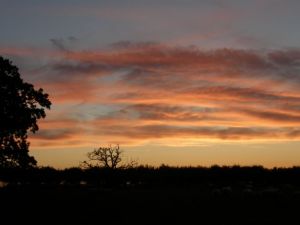
Summer sunset

Summer sunset

I’ve been in Scotland for a few days, but today I was most definitely back in England.  As I walked through the village there was a game of cricket being played on the village green, while the church bells rang out in the summer evening air.  It was the quintessential English scene.  If I was John Betjeman I would have written a gentle poem about it.

But I’m not.  Just a simple (very) amateur naturalist.  I was on my way up to the wood to see how the badgers at the main sett were getting on.  It’s been a while since I looked in on them, having been spending time at the Pine Tree sett.

As it turned out it was a frustrating evening.  At 8.53 a badger emerged from the west end of the sett and promptly trotted off into the impenetrable jungle at the east end.  Another badger emerged and did the same, then another.

I waited for another half an hour but nothing else happened.  The badgers did not come back and no more emerged.  I could hear nothing from the eastern part of the sett – normally if the badgers are congregating there you’ll hear rustling or whickering noises.

Perhaps the recent dry weather has got the badgers more preoccupied with food than with sitting around or playing.  They have to work harder and longer for worms in these dry spells, which means they tend to start foraging earlier.

One point to note is that all three badgers were quite small.  I can’t confidently say they were cubs because I didn’t see them for that long, but they had that look about them.  The third badger also had a noticeably long tail, which I can’t remember seeing before.  If this is a distinguishing feature I’ll have to look out for it in the future.

I’ve spent the last couple of nights wandering around the fields and green lanes of our village looking for glow worms.

It is just over a year since I saw glow worms in Berkshire.  I was very impressed by them and I’d like to see more.  The trouble is that my village isn’t quite the right habitat for glow worms (they seem to prefer fairly large areas of unimproved grassland) and none have ever been reported here before.

Nevertheless, I decided to follow the lead of those enthusiastic volunteers at Loch Ness and not let the certain prospect of utter failure put me off.  Besides, there is something particularly satisfying about going for a walk on a June night.

The air has been warm and still and filled with the scent of elderflowers, cow parsley and lush vegetation.  We have a family of young tawny owls in a clump of trees nearby, and the sound of them calling to each other carries a long way on a windless night.  Moths flutter around the grass and the bushes, while overhead the bats flit past, dark shadows against the deep blue of the sky.  Best of all are the countless rustling noises from the undergrowth as you walk past.  These could be made by anything from a mouse to a deer – even a hedgehog makes a surprising amount of noise as it snuffles along the hedgerow – but they give you a primal thrill of excitement from knowing you’re close to a wild animal in the dark.  It’s a fine time to be out of doors, to be awake and alive when everyone else is safely in their homes.

Did I see any glow worms?  Of course I didn’t.  But it doesn’t really matter.

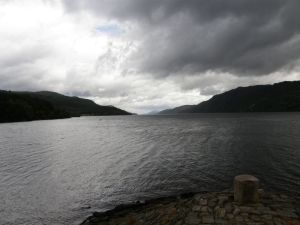
Loch Ness from Fort Augustus

Loch Ness from Fort Augustus

For more years than I care to remember I’ve celebrated the summer solstice in true and outrageously pagan style at one of the great stone circles of Avebury and Stonehenge.  This year, however, I swapped the ritual of standing slightly bleary-eyed and hungover, waiting for the Wiltshire dawn to peep over the horizon, for the celebration of a friend’s wedding.

The wedding festivities took place near Inverness in Scotland.  The main venue was an enormous old country house, where we had the run of the place for three whole days.  It was a great place and a great wedding – the toasts were drunk in decent scotch whisky, which gives you an idea of the kind of night it was.

Despite my hopes of running into red squirrels or scottish wildcats, it was not to be.  I did take a stroll around the estate on the morning after the wedding to get a breath of fresh air while most of my fellow guests were still slumbering away.   In the woods of the estate I came across a pristine set of badger tracks on a muddy path, and I was able to follow these back and locate the sett – a grand affair with at least half a dozen active entrances.  It just goes to show that you can dress me up in a suit and try to make me civilised but once a tracker, always a tracker!

But for me, a trip to Inverness had to involve a visit to Loch Ness.  I borrowed a car (thanks Sam!) and spent a day there.

When I was much younger I was fascinated by the idea of the Loch Ness Monster.  As I grew older and developed faculties of critical thought I realised that there wasn’t actually a plesiosaur in a lake in Scotland – come on guys, what on earth were you thinking! – but the story is still a great one.
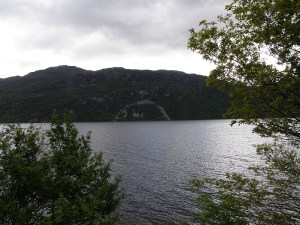
The Horseshoe Scree on Loch Ness where Torquil MacLeod saw the monster

The Horseshoe Scree on Loch Ness where Torquil MacLeod saw the monster on the shore

The best time to be at Loch Ness must have been in the late 60s and early 70s, when it was home to an assortment of different expeditions.  There was a tremendous enthusiasm about the place, a feeling that there was a genuine discovery to be made, and that if established science was not interested then it was up to the amateurs to show them the way.  It must have been great – the shores of the loch manned by student volunteers with cameras, binoculars and surplus World War II searchlights, while on the water a strange assortment of boats fussed around, playing tapes of mating whales on underwater speakers or ferrying American technicians as they tested their latest sonar gear.  In those heady days anything must have seemed possible.

Where Tim Dinsdale filmed the Loch Ness Monster

Where Tim Dinsdale filmed the Loch Ness Monster

I’ve never been to Loch Ness before, but I have read almost every word ever written about it.  I took my poor, long-suffering wife on a trip around the loch, stopping at obscure places of interest.  I found the layby where in 1960 Torquil MacLeod watched the monster as it basked on the Horseshoe scree on the opposite shore.  I found the approximate location from which Tim Dinsdale filmed the monster in April of the same year, and I was able to follow the route of his thrilling dash to the loch shore in a desperate attempt to get closer to the beastie.  I travelled the road where the Spicers had their classic 1933 land sighting, although it has changed out of all recognition now.

I enjoyed my pilgrimage to the loch immensely, but isn’t it all a bit sad?  I mean, people don’t really believe in it any more, do they?

Ironically, even though the enthusiastic volunteers of days gone by used to battle against mainstream science, they turned to mainstream science and in so doing they proved that the monster doesn’t exist.  Adrian Shine, monster-hunter turned respectable scientist, has spent years building up a picture of the ecology of the loch, starting from nutrient levels and plankton and working up the entire food chain.  The results of this work show that the loch cannot support a single large monster, let alone a breeding population of them.

Although I’d secretly like the monster to be real, I think I am reassured by this.  It shows what amateurs can do.  They didn’t find a plesiosaur, but the slow, patient study – starting from first ecological principles, establishing facts and building on them – has finally answered the question of the beastie in the loch.  In the process it has shown what enthusiasm, resourcefulness and some basic scientific principles can achieve.  It is a story that I, as a very amateur naturalist, still find inspirational.

There may not be a monster, but the story of the search for it deserves to be remembered.

Don’t worry – back to the badgers later this week…

It’s confession time again.

I’ve been guilty of occasional birdwatching for many years.  Nothing too serious – putting out food in the garden, listening to birdsong, watching the buzzards over the fields – the usual stuff.  I thought I could handle it.

But now I’ve crossed a line.  I’ve joined the hardcore of birdwatching.  I’ve become a twitcher.

There is something about birds that seems to affect men of my age (no 1970s sexist pun intended!), and we seem to get strangely obsessed by ticking them off lists.  There are people who take this to extremes, attempting to see every single bird species in the world (seriously), and many more that will travel across the UK to see a rarity that has been blown to these shores by freak winds or got badly lost while migrating.

I’m not in this category, but I have developed the list-ticking habit.  I’ve been looking at the birds in my local area, and idly wondering how many different species there are, and how many I’ve seen.  One thing led to another, and I downloaded the county bird list from the Bedfordshire Bird Club.  Birdwatchers keep many lists, so there are lists for each county as well as for the UK as a whole.  A bird that may be commonplace in one area may be a rarity in another, so there is a challenge to ticking off these county lists.

I’m not at the stage yet where I’m prepared to jump in the car and dash off to the other end of Bedfordshire to tick off a Siberian Lesser-Spotted Gronky Bird or some such rarity that has just arrived, but I am working my way through the list, ticking off the species as I see them in the course of my usual rambles.  As a very novice birdwatcher, the challenge for me is not so much spotting a rare bird, it’s identifying the common ones that are all around me.  There’s an awful lot of birds out there, and ticking off the list helps me to learn to recognise them, particularly the little brown ones that all look the same to me.

So how am I doing?  Well, I’m afraid I’m not going to have Bill Oddie knocking on my door any time soon.  There are 292 birds on the Bedfordshire county bird list.  So far, as the title of this post suggests, I’ve seen and positively identified 45 of them.  I have some way to go yet!

Dunnock

Dunnock in my garden

This is the 45th bird on my list – the Dunnock.  Not a great picture, but you get the idea.  The Dunnock is a small, brown bird that looks pretty much like a sparrow to the novice.  In fact, I’ve probably had them in the garden for years without noticing.  The defining features are the orange legs and the row of pale spots on the wings.  Dunnocks also tend to keep low, and they are happy to hop around the garden and flit from bush to bush.

You see, not only can I tick off number 45 on my list, but the list itself is encouraging me to learn more about my local birds.  Bird lists are good things!

Now, where was that Siberian Gronky Bird reported…

I came across this site the other day, and I think that it’s definitely worthy of  a mention.

Ampthill Wild

Steve writes about the local wildlife here in Bedfordshire, backed up with some great pictures.  More importantly, he’s out there getting people interested in the animals on their doorstep.   You don’t have to be in Bedfordshire to enjoy it.

Check out his site.  In particular, check out the excellent pictures of the College Lake polecats – probably the most famous polecats in the country since they were featured on Springwatch!

Well worth a look…

Having watched badgers for a few years now, I’ve decided that I want to do my bit for the badgers in my area.  I am pleased to say that I have joined the Bedfordshire Badger Network.

Affiliated to the Bedfordshire Natural History Society, the Network is run by volunteers who give up their time to monitor and help conserve badgers in the county. As well as dealing with day-to-day badger-related matters such as giving advice to on what to about badgers in their garden, the Network has a history of research, including some fascinating (and very broad-ranging) bait marking studies.

I will be helping to check and map setts in my local area, helping to maintain the already impressive register of badger activity.  This is pretty much what I’ve been doing already, but now my badger watching will be contributing in a small way to the overall body of knowledge.  The added benefit for me is that I’ll be able to learn from people far more experienced than me.

I’ll still be the same rough, tough independent badger watcher, but it’s good to know that I’m doing something to help out.