Feeds:
Posts
Comments

The tiny badger cub foragingOn the face of it, it wasn’t the best of days. The wind was gusty and the dark clouds threatened rain, as if a summer storm was brewing. But it had been a couple of weeks since I’ve been down to the wood, so I went anyway. A short (but very enjoyable) walking holiday and the inevitable long hours at work have conspired to keep me away until this evening.

One of the fields I walk through on my way to the wood has wheat in it this year, and there are signs that the badgers are already starting to feed on the ripening grain. Feeding on cereals is often seen as something that badgers do in drought conditions when worms are hard to come by. This year hasn’t been especially dry, so I imagine the worms must still be fairly plentiful, yet they seem to be eating the corn anyway. Perhaps it is just an easy source of food. Perhaps they just like it.Badger dung showing cereal diet

The best indicator of cereal eating in badgers is to examine their dung. I’ve never stooped so low as to start poking around in it, but you can tell a lot about what the badger has been eating just by looking at it. I took this picture this evening. The dung is green and full of cereal grains, in clear contrast to the brown, earthy dung you typically get with an earthworm diet.

The wind was blowing from an odd direction, so I had to approach the sett from a different way to usual. I’ve mentioned before that you should always approach a sett quietly and from downwind. This proved to be very true today, since one of the badgers was out and about early. I arrived at about 7.00pm, and since the badgers have usually been emerging about 8.00pm or so, this one was very early.

With my best attempt at cat-like stealth I crept up behind a tree about 20 yards from the sett. I was downwind, so I was pretty safe from discovery, and if I didn’t make any noise the badger was unlikely to notice me.

It was a badger cub, and from the size of it, it was the tiny cub I had noticed last time. It was busy foraging, pushing its nose into the leaf mould and grubbing about; indeed the ground all around was pock-marked with dozens of little snuffle-holes where it had rooted out worms or bugs. I don’t know if it is the runt of the litter. Do badger litters have runts? Is its small size connected to the fact that it was out early, and obviously feeding with some enthusiasm? Perhaps it is a younger cub from another litter and has some catching up to do before the lean months of winter. I have a lot of questions, but no answers yet.

I peered out from behind my tree and took a quick video. It became clear to me now I was here that the wind was entirely wrong for any decent badger watching tonight. There was nowhere downwind that offered me any cover and yet allowed a view of the sett. The only cover available was virtually on top of the sett, or nearly as bad, right next to the main badger paths. If I stayed there until the rest of the family came out I was certain to disturb the badgers in one way or another, so reluctantly I backed away and left the little cub to it.

Click here to visit YouTube and click on ‘watch in high quality’ for a better view.

It was frustrating not to get my fix of badger watching for the night, but that’s how it goes. There was no point in staying and trying to make the most of a bad situation.

As a consolation I sat in the field for a while and watched the local buzzard performing acrobatics, swooping and diving in the strong wind. All buzzards are quite spectacular birds, looking as they do like little eagles, but this individual is quite a show off. I’ve watched it before as it’s flown through the wood itself, swerving and dodging around the tree trunks and crying out its mewing call, and that’s a sight to see.

I watch the buzzard slowly disappear eastwards, and for a change I walk home while it is still light.
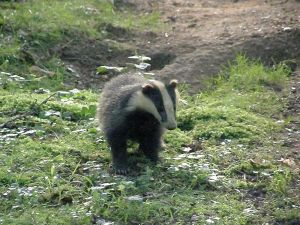
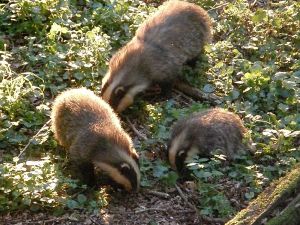
My wife was unexpectedly working late, so I seized the chance for a quick trip to the woods. I’m glad I did,One of the cubs because it turned into one of the best evenings of badger watching I’ve ever had.

My aim was to try and spot the badger with the white patch behind his ear and see if I could recognise him again. In the event I didn’t, but I got to see a whole lot more.

I arrived at the wood quite late, and worried that the badgers would be out already, I stalked the last few hundred yards to the sett so I wouldn’t disturb them if they were. There is an art to walking silently through a wood, and although I’m not perfect at it I’ve definitely improved over the years. In the event it proved unnecessary, but you can never be too careful. I’ve made that mistake in the past – strolling along to the sett confident that badgers would still be underground, only to come face to face with an early riser.

Two of the cubs emerged first, just before 8.00pm. They spent the next 40 minutes happily scuffling about, noses firmly to the ground. They don’t seem to be going great distances yet, but they have got the hang of foraging around the vicinity of the sett.

After a while they were joined by the adult I think of as their mother, a long, lean badger. Of course, she’s unlikely to be the mother of all the cubs (and she may not even be female) but she seems to show more interest in them than the other adults. Shortly after, the three of them were joined by another four cubs.

Wait a minute, there are five cubs at the sett. I’ve said so in the past. Well, it seems I was wrong. There are definitely six. One of them seems smaller than the others, so it may be a separate litter and have come out later, but it was foraging along happily so it has obviously been out many times before. I may well have missed it when the whole family has been at the sett entrance. I guess I don’t know everything about these particular badgers – not by a long way!

The \'mother\' with two of the cubsIn a very short space of time I had eight badgers wandering about under my tree. I was not more than 8-10 feet away from them. If I had dropped a peanut from my pocket I could have hit a badger on the nose. Being so close meant that I had a great view of different behaviours. There was the usual musking going on, both from the ‘mother’ to the cubs, and strangely, from one of the cubs onto another adult. I don’t know what that means for the hierarchy.

I saw another social behaviour up close. The ‘mother’ would go up to the cubs, and it looked like she was biting them on the neck. It was actually social grooming of some sort, and the interesting thing is that she went methodically from cub to cub, grooming each of them for about ten seconds and then moving on. I’ll have to check up on what this means.

All the badgers were feeding constantly, grubbing around in the undergrowth. For the first time I saw theCubs Foraging creation of ‘snuffle holes’ close up. Snuffle holes are classic signs of badger activity. They are conical holes in the earth, anything up to six inches deep, caused by the badger rooting out food. The badgers would push their nose into the soft leaf-mould and dig a little with their claws, and within seconds they had dug a perfect little hole.

It seems that most of these holes were dug in search of worms. At one point the ‘mother’ unearthed a huge worm. As she lifted her head, with the worm dangling like a piece of spaghetti, one of the cubs rushed in, took from her and ate it. She didn’t seem too upset. I’ve seen this before, and I’m not sure whether it is the adult feeding the cubs, or perhaps the adult is teaching them how to find food. Perhaps she was just a little slow and the cub stole her titbit.

There were badgers all around me by this point, and the undergrowth was full of scuffling and scratching. There were badgers in front of me, badgers behind me and badgers on each side. One even tried to climb the tree I was in! I was in the centre of a maelstrom of badgers. An owl hooted in the distance. I looked at my watch – 9.20pm. A new thought struck me. How was I going to get down from my tree? My number one rule of badger watching is ‘Do not disturb the badgers’, yet if I tried to get down I would literally be on top of them. It looked like I was stuck there for the duration.

At that moment a couple of adult badgers by the sett entrance started fighting. This was much different to the usual play-fighting of the cubs; a lot of biting around the neck, accompanied by a constant whickering. At least, I thought they were fighting. Neither seemed in a hurry to get away. When social animals fight, the loser normally backs off quickly. No-one is hurt and the hierarchy is maintained. It occurred to me that these badgers were perhaps not fighting, they were maybe getting amorous with each other.

I’ve never seen badger courtship before, but if that’s what it was, it didn’t look very gentle. This is something else I’ll have to check up on, and see if can find out what they were really doing.

After a while the cubs moved off to the east, and the two fighting/courting adults went back in the sett. I don’t know whether it was a case of ‘not in front of the children’ or whether one of them just wanted some peace. It gave me a chance to get down from the tree and stalk carefully off, relieved at getting away without disturbing them. I’d had a great couple of hours of absolutely pure and undisturbed badger antics – the best you could wish for – and the least I could do was to leave them in peace to carry on with it.

I’ve been exploring my fascination of badgers, and why I keep getting the urge to spend perfectly good evenings sitting in a wood watching them. In Part 1, I decided that badgers are impressive beasts, and that their size and wildness make them something special in Britain.

My next reason is quite simple: badgers are fun. This may seem like a trite comment, but it isn’t. Badgers, to me, are far more interesting than a lot of the UK’s wildlife.

Badgers are social animals. They live in family groups, which is unusual for UK mammals, particularly because badgers are social carnivores. Can you think of any other carnivores that live in social groups? Lions, wolves, hyenas perhaps. Maybe wild dogs. The fact is that there aren’t that many, and certainly not in the UK.

This means that by watching badgers you can observe and study a whole range of behaviours that you do not see with other animals. You get to see how they interact with each other, how the group stays together, how dominance is established and how relationships are reinforced. You can watch the cubs grow up in the family, and the way that different badgers react to them. And this is my point – badgers do things! For someone like me who is curious about animals, no other species offers so rich and deep an opportunity for study.

Other animals, although interesting, seem a little bland by comparison. Take rabbits, for instance. I watched rabbits for a couple of hours last night, and they hopped about a bit, nibbled some grass, and occasionally stood up to have a good look round. I’m not saying that rabbits are not a worthwhile species to study – I’ve read Lockley’s The Private Life of the Rabbit and I’m sure that they have hidden secrets – but to me they are just not as rewarding.

So there is another reason for watching badgers. Not only are they physically impressive and intriguing in their wildness, but they repay the dedicated watcher with a truly rich and detailed family life.

Picture the scene. It is 8.00pm on a Saturday evening. Across the country, people are sitting down to dinner and relaxing in their living rooms watching the football; or maybe they’re getting ready for a night on the town, an evening of drinking and dancing and laughing and loving and fighting.

I’m doing none of these things. I’m sitting perfectly still in a patch of nettles under an oak tree, somewhere in a field in Bedfordshire.

Let me backtrack. It being a Saturday, and having spent the day buying and installing a new washing machine, the sensible and normal thing to do would be to kick back and relax for a bit. Happily though, being sensible and normal were never my strong points. I decided to have a crack at spotting the stoat I’d seen the other day (see Stoat Crossing, 7th June), partly out of curiosity, partly to give the badgers a bit of a rest.

The problem is that I don’t know very much about stoats. I’ve seen them crossing the road a few times, and this has always been near a small copse about 500 yards from my house. This copse is home to numerous rabbits, the main prey of stoats. Since it provides food, shelter and protection, the copse seems like a good place for stoats to live.

One approach would be to walk around the area on a regular basis, and sooner or later I’d come across a stoat. But this isn’t very satisfactory. I want to observe them properly, to watch their behaviour and not just get a glimpse of their rear ends as they scurry away. So – some sort of static observation is called for.

Michael Clark, in his excellent book Mammal Watching, says that stoats and weasels tend to follow boundary lines such as hedges and walls. My plan was therefore to sit in the corner of a field and watch the hedgerows where the rabbits congregate.

The task was made simpler because most of the fields around here are full of oilseed rape, which is about two feet high now. There could be whole legions of stoats cavorting in these fields and I’d never spot them, so I chose a nice grass pasture and settled down in that.

The plan worked splendidly, apart from the bit that involved seeing any stoats. I spent a couple of hoursNot a stoat but a rabbit doing guard duty watching rabbits hopping contentedly about in the field. These rabbits were, unknowingly, both my bait and the canaries in my coal mine. If a stoat approached and I failed to see it, I hoped that they would spot the predator and alert me by their reaction.

Perhaps they failed in their duty. I sat under my tree for two hours and saw no stoats. Nor, it seems, did they, for they carried on grazing happily. I’m not too disheartened. My first few badger watching trips ended in utter failure too. I imagine that stoats are relatively scarce, so the odds were against me seeing one the first time I looked. I’ll keep on trying and hopefully one day I’ll be able to report a success.

Despite the threatening rain clouds I decided to pay a visit to the wood on Friday evening. It’s a good way to unwind after the working week. Like most people, I spend my time rushing everywhere: rushing to work, rushing to meetings, rushing home. Watching wildlife forces you slow down, to stop and listen and think.

The slight wind was blowing in an unusual direction. Wooded valleys seem to have an uncanny influence on the wind. It is not uncommon to have the wind blowing one way outside the wood, and in another direction entirely when you’re actually inside it. The practical upshot of this was that all of my usual trees would put me upwind of the badgers. This would not do at all, so I circled around the sett and sat on the ground with my back to a large oak.

The first thing I noticed was how many nettles there were. I was sitting on a few, but being a rough, tough badger watcher I couldn’t let myself be too put off by that. The nettles also grew around the sett entrance, putting a bit of a screen between me and the badgers. Not good for a clear view, but good for keeping the badgers relaxed.

The cubs came out at about 8.15pm. They are getting very independent now, and seem perfectly happy foraging around the area of the sett. The adults emerged about 45 minutes later. The whole group seems very relaxed and content at the moment. I suppose that life must be good for a badger just now. The wet weather means that the worms that make up most of their diet are plentiful and easy to catch, and that must take some of the pressure off the food gathering.

One of the advantages of being on the ground was that I was closer to the badgers than usual, which gave a new perspective on things. I sat there for a good hour and a half, my legs slowly going numb underneath me and a small cloud of mosquitoes gathering about my head, but with a great view of the sett.

The downside of being on the ground was that I was more likely to come into contact with the badgers. As I’ve said before, one of my rules for badger watching is to avoid disturbing the animals. Sitting in front of the tree it was surprising how little notice the badgers took of me. I was wearing full camouflage gear including gloves and face net, so I should have been quite inconspicuous. However, eventually the inevitable happened. One of the foraging badgers circled round and approached me from the side. From this position my silhouette must have been visible, because it stopped, stared and then trundled quickly back to the sett.

Not wishing to put the badgers off their foraging, I slowly straightened my cramped legs and crept away as quietly as I could. After 30 yards I turned round and I could see the cubs ambling about, so they seemed happy enough.

All in all an interesting evening. I think I still prefer my trees. They offer so much more concealment.. There’s been many times when I’ve had badgers scuffling around the roots of the tree I’ve been sitting in, and they’ve never suspected.

One good thing from the night is that I think I’ve finally got an individual badger I can recognise. The coats of most badgers are greyish-black, with a reddish-brown tint beneath, but the fur of this one was quite white underneath the grey. He also had a patch of white fur visible below his left ear. I say he, because he looked well-built like a boar, but I could be mistaken. I’m no expert on sexing badgers, except when I see them with cubs or exposing their undercarriage as they scratch. I shall look out for this particular badger on subsequent visits.

My efforts to build up a video archive of the badgers continue. I’ve discovered how to set my camera to take high quality video, but it only does it for 15 seconds at a time. I’ve spliced all the footage for the evening into one montage. I’ll have to read the camera manual, but I guess in the meantime I’ve got a video that is ideal for people like me with 15 second attention spans!

For a better look at the video, click here to go to YouTube and select ‘Watch in high quality’.

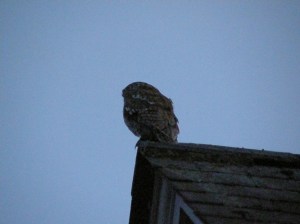
For the last couple of nights we’ve had a visitor to the garden in the form of a tawny owl. My wife and I were sitting in the living room at dusk when we saw something big fly past the window. We’re used to bats but this was much bigger, so being curious people we went outside for a look.

It turned out to be a tawny owl. It was sitting on our telephone wire, and over the next 20 minutes or so we watched as it flitted around the nearby roofs and trees. It was calling and we could another owl answering in the distance, together with what sounded like a chick a little nearer – a much higher pitched call. We could only assume that it had a nest nearby and the chick had just fledged.

I’ve heard owls calling many times when I’ve been out and about, but this is the first time I’ve had one in the garden. I enjoy going out into the country to watch wildlife, but it makes things much easier when it comes to you!

Today I’ve figured out how to embed video, so there’s no stopping me!

I discussed musking on the last post, and I’ve got an example on video. This is the first video I ever took, so the quality is not brilliant, but you can get the idea.

I’d put down a small patch of peanuts and the adult badger found them first. The two young cubs then came rushing in. Badgers have a neat trick of shoulder-barging each other out of the way, and then sitting down on the food so no others can get to it.

The adult boar was having none of it. He gets up and then musks on each of the cubs in turn before moving off. Whether this was a show of dominance or fatherly affection I don’t know, but it’s a good example of the behaviour.

It’s been a while since I’ve been to the wood, what with work commitments and other matters, so I was keen to see how the cubs were getting on.

The last two weeks have seen a lot of rain, but today was quite sunny. The rain has given us a lot of lush vegetation and the wood is a bit like a rain forest at the moment. The nettles at the gate are now as high as my shoulder!

The badgers emerged en masse at about 7.45pm, and for the next hour so they milled around the area, quite content and relaxed. One of my problems is that as yet I haven’t been able to recognise individual badgers at the sett. I can recognise the cubs – they’re small and cute and fluffy – but the adults are harder to tell apart. This is one of the reasons for taking photographs and video, so that I can try and learn their features and so tell them apart. The other reason for the pictures is to explain to my wife what I do in the evenings…

Anyhow, there were very soon at least ten badgers at the sett entrance, the five cubs and at least five adults. They were all quite happy, enjoying the pleasant evening, sitting around grooming and playing. The older cubs are getting to be quite a handful, but there are two who are still smaller and quieter. Are these females? Do females develop slower? Or are they just late developers?

The cubs are ranging further afield now, and going off foraging on their own. They still stay within about 100 yards of the sett, but they are definitely getting more independent. There is still the usual play-fighting and wrestling going on, but they seem to have calmed down a little and are getting on with the business of finding food. Interestingly, I saw one of the cubs musking another cub, so it seems as if they are already defining relationships in the group.

Musking is an activity that may need some explaining. The badger belongs to the mustelid family, which also includes weasels, stoats, otters, polecats and martens. One of the key features of these animals is that they communicate by scent, having a musk gland under the tail that secretes a powerful-smelling oil. This is used to mark out a territory, and in the case of badgers, to mark out family members.

Badgers mark their territory through the use of specific ‘latrine’ sites or dung pits. These areLatrine Site located at the edge of their patch, and are visited regularly. The scent at these sites warns other badgers out of the area. These dung pits are a useful way to identify the territory of different badgers. You can also use them to find out what the badgers have been eating. I’m not dedicated enough for detailed analysis, but as a rough guide badgers that have been eating their usual diet of earthworms will leave ‘earthy’ dung. In late summer, the dung is often crammed with wheat from the fields, showing the change in diet. There are a few cherry trees in our area, and in the autumn the badger dung is often dark red and a mass of cherry stones.

A badger musks another badger by pressing its backside against it, so that it rubs the musk gland on the other badger. Musking indicates the hierarchy of the group, so that dominant badgers musk the less dominant ones. It marks them out as ‘belonging’ to them. As I was watching the sett there was a disturbance in the undergrowth (caused by one of the cubs, I think). Alarmed, all the badgers bolted back to the sett. It was like a firework exploding in reverse – badgers raced back from all points of the compass. When they had settled down again, one of the adults came over and musked two of the cubs. It was if it was saying ‘Don’t worry, you’re one of us. You’re part of the gang. You’re safe now.’

I’m curious to see what happens to the family. Will all the cubs stay at the sett, or do they go off and make their own way in the world? I guess I need to work on identifying individuals and keep watching over the year to answer that question.

At the end of the evening, one of the cubs started exploring in a whole new direction. There is a tree at the sett that grows at an angle of about 45 degrees. The cub managed to climb onto this tree, and proceeded to amble upwards. Very shortly it had climbed about 25 feet along the tree, and was about 12-14 feet off the ground. I wondered if it would get stuck. We had a cat once that would climb trees, but could only climb upwards. When it came to coming down again she was much less graceful. The badger cub on the other hand seemed quite at home in the tree, and when it reached the end of the trunk it turned round and ambled down again. I’ve seen badgers climbing trees before, and they always seem a bit out of place, being low-slung, solid animals, definitely suited to life on the ground. I suppose they are related to Pine Martens after all, so it may be a family trait.

As it was getting too dark to see, a muntjac barked loudly nearby and all the badgers scrambled down the nearest sett entrance. I took that as my cue and slipped down from my tree and headed home.

Here’s a short video of the badgers at the sett.

Today I saw a stoat as I was driving into town. It crossed the road in front of me, about 200 yards from my house. You can tell a stoat by the black tip on its tail. Weasels’ tails are the same colour all along.

OK, I know it isn’t a badger, but I find stoats and weasels fascinating. I’ve seen badgers hundreds of times, but only a handful of stoats. Anyway, they’re the same family as badgers (mustelidae) so they’re not that far off.

Now that I know there’s one in the area I’ll have to make a few trips to the copse at the end of our road and see if I can’t get a better look. Who knows, this could be the start of a whole new career as the Stoat Watching Man…

The question has to be asked. Why do people watch badgers? Why do I watch badgers?

Watching badgers might be seen by some people as an odd, even eccentric, pastime. It probably is. But then other people spend their evenings and weekends watching football, and that has always seemed strange to me.

But why watch badgers? I’ve asked myself this question many times, and there is no simple answer. It is easy to say that watching badgers is mildly addictive, but there must be some reward in it for me because I keep doing it. This series of posts is an attempt to explore my reasons for going out to the woods time and again.

First of all, I’d love to be able to say that I’m going to make some startling scientific discoveries about badgers, but this probably isn’t true. As a species they have been studied by far more capable and experienced people than me, so it is unlikely that I will add any wholly new chapters to the book of badgers. I flatter myself that I may gain a few small insights into their behaviour and habits, but I don’t think I’ll be adding much to the sum total of badger knowledge.

So, to be honest, my interest is driven mostly by personal curiosity. I imagine that an interest and curiosity about nature in general is probably necessary if you are going to get excited about watching badgers.

In Britain we are lucky enough to have a whole spectrum of wildlife, from the tiniest invertebrates to the largest whales, but the badger occupies a special place for me. Badgers are secretive and relatively rare animals – most people never see them except for a quick glimpse as they run across the road – yet at the same time they live almost in our midst. The badgers I watch regularly are little more than a mile from my house, and many people are lucky enough to have badgers visit their garden. I take a strange delight in the idea that these animals are living almost unknown and unsuspected alongside us. The badger is living proof that no matter how much we have tried, we have not yet fully tamed our countryside.

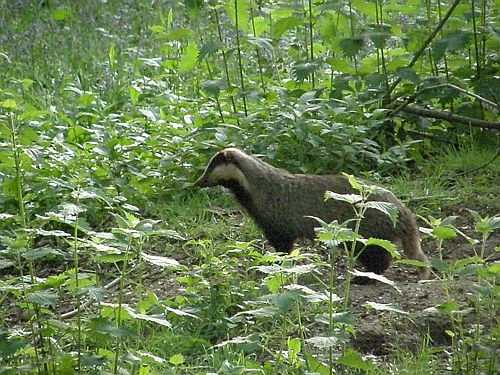
This feeling is even stronger when you meet a badger face to face. To put it bluntly, they are physically impressive animals. Although not huge, they are Britain’s largest native carnivore. Their black and white face is instantly recognisable. They have presence.

Over the centuries, we have gradually exterminated most of the large animals in Britain (with the exception of deer, which, being tasty to eat, have been jealously protected). If I could travel back in time two thousand years or so, then I would find my badgers sharing their wood with wild boar, wolves, beavers and even bears. And who now remembers the Irish Elk? We’ve wiped out these animals so thoroughly that few people think of them as British species. They were here and they are gone but the badger remains. The last of the truly wild big mammals, badgers have stubbornly stayed put despite everything we have done to them. In some ways, the badger is a creature of the past. How can such a big, bold animal still be living wild in Britain’s ordered and controlled countryside? Yet here they are.

Good for the badgers, I say.  I think that this is one of the reasons why I like to watch them.