Having failed to see any badgers in the evening, I decided to take another approach. I was confident that the badgers feed in a large pasture field next to the wood, and it’s always been at the back of my mind to take a trip up there one night and see if I can spot them feeding. It being a damp and mild night with ideal conditions for the worms the badgers feed on, I decided to give it a go.
1.45am (way past my bedtime!) saw me walking slowly through the pasture with a dim torch. And there, snuffling around in the grass, was one of the adult badgers!
It didn’t seem too bothered by the torchlight, but carried on snuffling contentedly. I watched it for about five minutes and then left it to get on with its dinner. I was happy to have seen a badger in its own element, and proved that this method of watching them was possible. I may well stay up late on the next full moon and try this again.
Finally, an answer to those readers who think there should be more hedgehogs on this site (you know who you are!). Folk wisdom says that where there are badgers there are not usually many hedgehogs, presumably because one eats the other. I don’t know if that’s true, but I haven’t seen many hedgehogs around here.
Hedgehog!
So, especially for you, here’s a picture of an urchin that was feeding contentedly on the village green when I walked past. By the time I’d gone home and got the camera he was sitting in the middle of the road, which says a lot about hedgehogs.
I did try and pick him up and move him off the road, but I found out that the spines on a hedgehog are not just there for show – they really are sharp and spiky! This may sound obvious, but I’d never tried to pick up a hedgehog before. I did manage to move him to the side of the road, and left him there out of harm’s way, spiny and verminous, but safe.
I seem to have developed an unhealthy interest in badger dung.
Let me explain. When I first started watching badgers, I made a conscious decision to stick with one sett and focus on that. There are at least two, possibly three, other setts that I know of (or strongly suspect) in the local area, although I don’t know their exact locations. I know they are there because I’ve seen badgers on the roads or other signs, and they’re too far off to be ‘my’ badgers.
I decided to stick with the one sett because I wanted to really get to know one clan of badgers. Only by fully understanding how this sett works as a social group could I learn about the details of badger behaviour. Jumping from one sett to another and watching different groups of badgers would be fun, but I’ve always felt that it would dilute my understanding.
I’ve reached the point now though where I want to understand how ‘my’ sett fits into the bigger picture of setts in the area – how they interact, movement between setts and so on. Hence I’ve just spent an afternoon looking for badger dung.
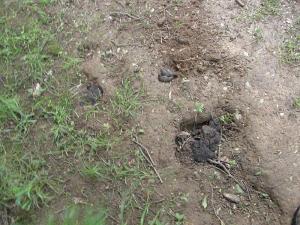
Badgers are territorial. Each family or clan controls its own territory, marking it out as its own property. This marking is most visibly done with dung. Badgers are quite fastidious, and they tend to deposit their dung in specific ‘latrine sites’, typically located on the boundaries of their territory. If you can locate these sites, you can map the boundary points and hence the area controlled by a particular sett.
Badger latrine site
I spent about three hours wandering up and down the footpaths around the wood, and I’ve mapped out six latrine sites to the east, south west, west and north east of the sett. The distance from these the sett is 300 to 400 metres, with one outlier in the wheat field 600 metres away. This suggests that my badgers are controlling the territory for a radius of 300-400m from their sett.
Of course, this is probably a gross oversimplification. It is most unlikely that the badgers have a perfectly circular territory. Territory size is governed by availability of resources, so it is interesting to note that the latrine sites enclosed an area of woodland (which provides cover and security), plus significant areas of pasture and cereal fields (which provide food). It seems that my badgers are pretty well organised here.
If the latrine sites do represent a boundary between badger territories, this suggests that the neighbouring setts will be something in the order of 600m away, in other words an equal distance from the boundary, assuming the availability of resources is similar. This distance is somewhat higher that the 350m quoted by Neal and Cheeseman, but they were studying badgers in the Cotswolds where resources are likely to be more abundant, and so territories smaller.
So there you have it. An afternoon of looking for dung has allowed my to predict (albeit very roughly) the size of the badgers’ territory and the possible location of neighbouring setts. I’ll carry on working on this idea and see if I can add more detail in the future.
Something else I intend to do more of in the future is tracking. I’ve become intrigued by the idea of tracking mammals, partly as an activity in its own right, but partly also as a way of finding out more about their movements and locations. This could be particularly useful for the rare and shy species, as I can find out what they have been doing without having to be there at the time.
I’ve bought a book on tracking and I’m reading through it at the moment, but I’ve already discovered that it is more difficult than it looks. It rained heavily this morning so any tracks outside the wood have been washed out, and inside the wood the patches of ‘printable’ ground are few and far between. The best I could do was to find a few confused deer tracks (the tracks were confused, not the deer!) and the odd partial badger print.
These badger prints were the closest I got to the stripeys all evening. I watched the eastern side of the sett from 7.00pm to 8.40pm without seeing so much as a black and white nose. They may have come out of another entrance without me being able to see them, as the view is limited on this side of the sett. Perhaps they’re playing more tricks on me. Either way, no pictures of badgers for this post!
It’s been a good day though. Like I said, there’s enough to learn about badgers to keep you busy for years!
This post continues my thoughts about watching badgers. I’ve examined my reasons for doing it, and so far
Seeing the wood for the trees
I’ve discussed the fact that badgers are amongst the most striking and impressive wildlife to be seen in Britain (Part 1 – click here to jump to it).
I also think that for those people who are curious about wildlife, there a few better animals to study than badgers. As social carnivores they have such a wide and fascinating range of behaviour that you could watch them for years and still not fully understand them (Part 2 – click here to jump to it).
In this final post I discuss some of the more personal reasons why I watch badgers, or more particularly, why I enjoy being out in the woods at night.
There is something deeply rewarding about spending time in a wood. It is something that few people do, and I’ve always got a perverse enjoyment out of doing things that other people can’t, or won’t, do. More than that, watching badgers is so different, so far removed from my everyday life that it provides a welcome change. During the day I wear a pinstripe suit and talk to people about high matters of business strategy. In the evening I put on a tattered pair of green trousers and a camouflage jacket and lie in the mud. Oh, if my clients could see me then!
Watching badgers gives me time to think. I spend large chunks of time sitting waiting for badgers, just patiently watching as the sun goes down. In our modern fast-paced lives, how often do we get the chance to just sit and think? Really think, I mean. No television. No mobile phone. Nothing. I don’t think very intelligent or deep thoughts, but that isn’t the point. I just sit and think and that’s enough.
There’s also all the other experiences of nature that I’ve had while badger watching. I’ve sat and watched herds of wild deer as they’ve foraged through the woods. I’ve watched a fox stalk and catch rabbits. I’ve listened to tawny owls as they call to each other. I’ve watched in amazement as a buzzard skims between the trees. To me, all these experiences are priceless. They are out there for everyone to see, if only they’d go out and look for them.
Badger tracks on a fallen tree
Being ‘close to nature’ is a hideously trite and overused phrase, but watching badgers has helped me to be just that.
Think about it. Who, in today’s modern world, really takes notice of the time of sunset, or thinks about the direction of the wind or when the berries will ripen? I think about all these things now as a matter of course, and I wonder why other people do not. When other people see a wood they see a patch of trees. For me the wood comes alive and I see it for what it is – a great web of interconnected plants and animals all working together. I don’t claim this as a great spiritual insight, by the way. It’s a natural result of spending time watching wildlife.
Finally, there’s something deeply and fundamentally satisfying about creeping around in woods, trying to outwit wild and wary animals. It talks to something ancient and primal within you. Maybe this is because I grew up reading Jim Corbett’s tales of stalking man-eating big cats, or the stories of Victorian poachers, but I believe it goes deeper than that. For hundreds of thousands of years man lived as a hunter, and that sort of background is hard to shake off. We’ve only had two hundred or so generations of farming and twenty generations of civilised life. The wild still calls to something in all of us.
G.K. Chesterton wrote that every modern European was made up of three separate men – three separate parts to our character. I suppose he meant women too, but he wrote in different times.
The first man is the Christian. Whether we believe in it or not, we are the products of a thousand years of Christian thought, and our view of the world is always coloured by this. Man and God, heaven and earth – it is all there in the back of our minds somewhere.
The second man Chesterton called the Roman. This is the logical side of our character, the man who values order and reason and laws and straight roads.
And Chesterton’s third man?
‘And the third man: he has no name, and all true tales of him are blotted out; yet he walks behind us on every forest path and wakes within us when the wind wakes at night. He is the origins — he is the man in the forest’.
We all hear the call of the wild. I’ve found my way to answer it.
At last, the summer is back, and it’s been a long, hot day. Having done my chores in the garden, it was time for a trip to the woods for a spot of badger watching.
“You’ve got to watch badgers”, I explained to my wife, “badgers need watching! If you don’t watch them, they’ll get up to all kinds of mischief!” How true this turned out to be!
It being a nice day, and inspired by reading Pablo’s Woodlife Blog, I decided to have a bushcraft adventure and spend the night in the wood. I stuffed my hammock and a light sleeping bag into my small rucksack and I was off.
It was a warm, airless evening in the wood. I climbed my favourite tree, sat on my cushion, and waited. And waited. And waited a little bit longer. By about 8.15 the sun was sinking and there were no badgers in sight. By this time they should be up and out and sitting around the sett entrance. Where have all the badgers gone?
Eventually, a badger ambled into view. Not from the sett entrance, but from the east side of the sett. It was the little tiny cub, and as usual it was busy foraging. I couldn’t see what it was eating, but every now and then it would pounce on something, much like a fox pouncing on mice. It didn’t seem to eating anything large, so it could have been catching beetles or insects.
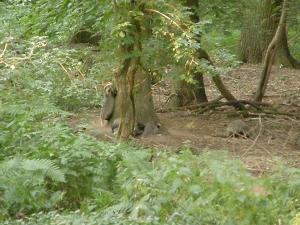
The tiny cub (which is less tiny now) seems to be out on its own quite often, but where was the rest of the clan? On an impulse, I turned round and looked behind me. There, about 50 yards away, was the whole pack of badgers.
Curse these stripey fiends! They had obviously come from one of the eastern sett entrances, and there they
Badgers a long way off, by the eastern sett entrance
were, rolling around in silent badger laughter, no doubt delighted at having tricked me into watching an empty piece of woodland for the last half an hour!
Obviously, they have moved back into the other part of the sett. When I first started watching this sett, three years ago, this was the main area of occupation, but since then the badgers had moved to western end. Now they seemed to have gone back. Is this normal? Did they move to the western end because of the cubs? Had I disturbed them? I shall have to check up on this.
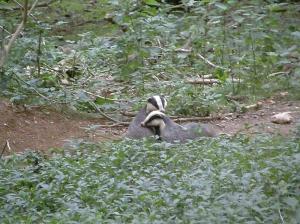
Anyway, the badgers were making the most of the fine evening. There was plenty of running around, play fighting and general high spirits. The annoying thing for me was that I was too far away to get a very good view except through binoculars, and several large patches of nettles hid the badgers from sight a lot of the time.
Badgers playing
They all seemed happy and healthy enough, which was good. The little cub still seems to be a bit of a loner, staying away from the main pack. It’ll be interesting to see if it comes back into the main group later in the year.
Of course, because the badgers were in a different place, they were potentially downwind of me. There wasn’t much breeze, but probably enough. Having satisfied myself that all was well, I left them to it and ambled off myself.
Here’s a video montage of the badgers this evening:
Having decided to spend a night out of doors, I circled around so that I was upwind of the badger sett, found a couple of suitable trees, and put up my hammock. This is a very comfortable way to camp, especially in a wood where the ground is littered with fallen trees and debris. I chose a spot overlooking a deer trail in the hope of spotting some deer in the morning.
I’d love to say that I spent a restful and refreshing night in the wild, but it would be a lie. No sooner had I turned off my light and put down my copy of Jim Corbett’s The Man-eating Leopard of Rudraprayag (a book describing nights spent stalking man-eaters in the jungles of India, and possibly the best thing to read in a wood after dark), than the muntjac started.
Generally, I like muntjac. I’ve a soft spot for these little deer. With two exceptions – firstly, they have a habit of sneaking into my garden and nibbling my sweetcorn plants, which I take very personally. Secondly, the barking.
If you have never heard a muntjac bark before, then it is hard to describe what it is like. The sound is a cross between a bark and an unearthly scream, and in a quiet wood it is unbeliveably loud. It is hard to imagine that such a small deer could create such a loud noise. I was walking out of the wood one day when a muntjac started barking, and I could still hear it when I reached my house, three-quarters of a mile away as the crow flies. The terrible thing about muntjac barking is that they bark about every five seconds, regular as clockwork, and they can keep it up for hours.
A munjac track - I've been trying my hand at tracking
I honestly don’t know why muntjac bark. It may be as an alarm call, or a way of attracting other muntjacs, or a way of warning them off. I suspect it may be for all of these reasons.
So there I was. I had one muntjac barking away about a hundred yards to my left, and another barking back at it about a hundred yards to my right. To add to the cacophony there was a tawny owl crying somewhere overhead.
I may sound a bit churlish. You would think that as a naturalist I would enjoy this. This is what being close to nature is all about. Perhaps you’re right, I should appreciate it more. Nevertheless, it wasn’t the best night’s sleep I’ve ever had. I’ll have to work at this bushcraft thing.
OK – I haven’t posted any wildlife-related activity for a couple of weeks, but the truth is that I’ve been very
The vegetable garden earlier in the year
busy. Partly I’ve been busy at work, both at work itself and with some extra-curricular stuff too. I’m working towards some professional qualifications and they are taking up a fair bit of my time.
I’ve also been busy in the garden. My poor vegetable garden had been a little bit neglected during the wet weather, with the result that the weeds were reaching impressive proportions. It is perfectly possible to weed the garden in the rain, of course, it’s just that I don’t like doing it. A bit of TLC was called for here, and I’m glad to say that the vegetable beds are looking quite civilised again.
More importantly, the time had come to harvest some of the fruit and veg. Now, we in the modern world have become very insulated to the cycles of nature. We can go to the supermarket at any time of year and buy what we want. It may have been flown in from the far corners of the world, but it’s there.
I’ve been growing my own fruit and vegetables for a few years now and this has given me a different perspective. Two weeks ago I had nothing to eat. Last week I had six pounds of blackcurrants and redcurrants and a whole sack of broad beans. The trick is to make the best use of them.
Of course, I could have eaten them, but there’s a limit to how many broad beans and currants even I can eat. Another answer would be to put them in the freezer, but this seems like cheating somehow. I have a long-term interest in traditional farming practices, and a freezer wouldn’t have been an option for most people even 50 years ago. There has to be a better way.
Hence I have re-discovered jam. Jam, in my opinion, is the best way of preserving this glut of fruit. Hence I’ve spent a good few evenings slaving over a hot stove, and I now have enough jam to keep me going for the rest of the year. The blackcurrant jam in particular is very tasty, and it should prevent me from getting scurvy over the winter months!
Now, I don’t actually need the jam to survive – I go to the supermarket like everyone else – but I get pleasure from growing the berries myself and finding a traditional, low-tech way to use them. The same goes for the large jar of dried cherries and the basket of broad beans I’ve got drying in the greenhouse. Sustainable living at its best!
The summer monsoon weather has been continuing, with rain all week. I swear that the vegetables in my garden have all grown a foot since last weekend, and everywhere the plants are lush and green. On the downside, the fields are muddy and the roads have been flooded for half the time, but at least there are now some sunny intervals in the rain.
I made a quick visit to the wood this evening. There was a party going on in the village somewhere, and they’d obviously hired a DJ and a PA system. I could hear the music clearly from the wood, which is about 3/4 of a mile away. I’m not sure whether the badgers were affected by the noise. They came out as usual just before 8.00pm. It was slightly surreal to be sitting in the trees amongst the timeless wonders of nature, watching badgers frolicking to a soundtrack of Macarena, Reach for the Stars and Is this the way to Amarillo?. They didn’t seem to show a preference for any particular tunes, so a golden opportunity for research into badgers’ preferences for cheesy pop music was lost.
To be honest, the badgers were in a jittery mood, but I put that down to my presence and the possibility that they could smell me. The damp weather and a slight wind meant that there was every possibility that my scent was being carried around unpredictably. Nick (see last post) was out and about, so it was good to recognise a particular badger. He was obviously suspicious. He would pace up and down, stopping to sniff the air every few seconds. I think that by moving backwards and forwards he was obviously trying to track down a particular scent – no doubt mine.
I left early, not wishing to disturb the badgers. I wonder how long it would take for the badgers to get used to my presence? I mean, I’ve been coming to this sett for a couple of years now, so they must know about me. You’d think that the fact that I’ve never lunged out of a tree and attacked them would put them at their ease a bit, but they still seem very wary. Perhaps they will one day learn that I’m not a threat, or perhaps they won’t. I suspect that badgers, like many wild animals, are strongly ‘neophobic’ – in other words they are afraid of anything new or different. Being quite a remote and undisturbed sett, they don’t see many people, so we’re all still quite new to them. On the other hand, I’ve watched them bolt in fear when a muntjac has barked nearby or when a wood pigeon has crashed through the trees, so maybe they are just timid by nature.
Today was a miserable day for July, with gusting winds and intermittent rain, but I went up to the wood anyway, feeling guilty no doubt for being stuck in the house all day. Besides, I was curious to see if the badgers were back to normal after their unusual behaviour yesterday, and I was anxious to see if the cubs were all right, since they hardly put in an appearance last time.
It was a damp evening, and the wind was still gusting in odd directions. Such days are often bad ones for badger watching, as your scent carries much further on damp air. I needn’t have worried. Four of the cubs emerged from the western sett entrance at about 7.45pm, and spent the next hour or so contentedly foraging. They were utterly oblivious to me as I sat ten feet above them in my tree. I think that when they’re pre-occupied with food, badgers rarely look up. All their attention is fixed on the ground and what is at the end of their nose.
The cubs are acting all grown up now, with much less of the boisterous play fighting of previous months. At one point though they all ran off and started an all in wrestling match near the entrance of the sett. Even this seems a bit more serious, with a fair amount of biting at the neck and hindquarters. I suppose they are more actively establishing a hierarchy in the group.
I think that all six cubs were there in the end. This sounds terribly vague, but the truth is that it is very difficult to keep track of individual badgers when they are either rolling around in one big heap, or spread out and foraging over half an acre of woodland. I often found myself with badgers on all sides, and disappearing and reappearing from the undergrowth.
One highlight of the day was that I noticed an unusual facial feature one one of the cubs – a notch or nick in
Nick the badger - note the notch in the black stripe under the ear
the black stripe, just under the ears. This may not sound very unusual, but none of the other cubs had a similar mark, so I think I’ve found a way to identify one of the cubs as an individual. In an act of no imagination at all I christened him ‘Nick’ (although it could equally well be a Nicola). Here is a picture showing the facial markings. This badger is one of the three in the picture at the top of this post, and you can see how the nick in the stripe stands out from the others.
Having done this, I was able to go back through previous pictures and see if I could track the same individual. Here is a picture of Nick from the 16th June. Once again, I’ll keep an eye out for him (or her) in the future.
Interestingly, all the cubs came out from the western entrance again, and the sole adult to come out while I was there emerged from the centre hole. Is there a significance to this?
Nick from an earlier picture taken on June 16th
At 9.00pm the sky grew black, and the dusk got suddenly darker. A moment later the heavens opened in a terrific downpour. I was sitting in a chestnut tree, which I’ve always found to be a pretty good tree to be under when it rains. Not as good as a nice thick holly or a yew, but pretty good nonetheless.
The rain lashed down. I could see it bouncing off the bare earth of the sett entrance. Although I was relatively dry in my tree, the badgers were evidently none too impressed. Within a minute they’d all trotted back into the sett. I speculated that they don’t like rain because the sound drowns out the sounds of potential predators, but the truth is that they probably don’t like getting wet.
Taking their lead I sneaked off home, with all the delights of walking through a soaking wet wheat field in the rain. I really must get some waterproof trousers one of these days…
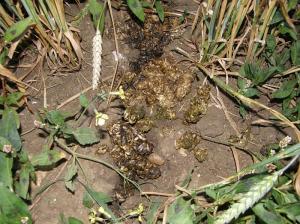
As I walked up the field to the wood it was apparent that the badgers have been feeding more on the wheat in the field. From the look of it, they trample down the stalks and then strip the grain from the heads. There were small patches of bent stalks and eaten heads of wheat all up the path, with a few heads evidently carried off into the next field as a snack. There was even more grain in the dung in this field, suggesting that it forms a substantial part of the diet for at least some of the badgers. Perhaps one night when there’s a full moon I should come down here and see if I can spot them at it.
In case you feel bad about the spoiled grain, I’d point out that it represents a tiny, tiny fraction of one percent of the wheat in the field. There’s no chance that these badgers will be the ruin of any farmers.
More badger dung with cereal
It turns out that the badgers were in an odd mood this evening. To explain what went on I need to paint you a picture of this particular sett. The sett is evidently quite an old one. The main part of the sett is a mass of mounds and craters, resembling an overgrown first world war battlefield, that has evidently been produced by the spoil heaps and collapsed tunnels of many generations of badgers.
This part of the sett is on the east of the site, and although it has been the main scene of activity in previous years, it appears not to be used at the moment. The badgers this year having been using another cluster of three entrances about 60-70 yards to the west, and also a single entrance in between the two sites. For simplicity, I’ll refer to the east, west and central holes in my diary. There may be an underground link between the west and central holes, but it is difficult to say for sure. It seems that all the badgers use both the west and central holes at times, with the west being the most popular at the moment.
After my experience with the little cub last week I arrived early, and was sitting comfortably in a tree well before 7.00pm. Usually the cubs have been the first to emerge, but this time it was an adult from the central hole. This badger seemed to have a light patch of fur on its hindquarters, but whether this is a permanent feature I don’t know. It trotted off to the east, where in addition to the unused sett there is the main latrine site for the group, and then returned a few minutes later and disappeared underground again. Perhaps it was just an urgent call of nature.
For the next hour and a half nothing happened. I watched the local rabbits and a squirrel, and the buzzard came swooping through the wood, but there were no badgers.
One of the cubs emerged from the west entrance at about 8.45, followed shortly after by another. They seemed to be sticking close to the sett entrance. A few minutes after this, three adults came out of the central hole, and sat around for a few minutes having a bit of a mutual grooming session.
All the badgers seemed a bit on edge. I wonder if they’d caught a sniff of my scent. The wind was quite strong, but it was gusting from all directions, now one way, now the other, so it was possible that my scent was being carried around. Not enough to make them bolt, but enough to make them wary.
The light was fading too, so I decided to call it a night. As usual, I’ve come away with more questions than answers. Why were the badgers all out late tonight? Where has the little cub gone? Is there a reason why the adults were coming out of one hole and the cubs another? I guess I’m going to have to put some more watching time in to try and answer these.
The good news this week is the the government has abandoned plans for a badger cull as a response to Bovine TB.
The sad news is that a badger cull was ever contemplated in the first place. I’ve mentioned before that badgers are the largest of the truly wild animals left in Britain. I honestly believe that people won’t rest until we’ve sent them the same way as the wild boar and the bear. If we don’t get them one way, we’ll get them another.
The fact is that Bovine TB, like BSE and foot and mouth, is another product of our wasteful and inefficient farming practices. The reservoir of the disease is cows, and it is spread through cattle movements and a lack of proper monitoring. Culling badgers will make no difference – look at Ireland, where they tried it and Bovine TB rates didn’t change.
Anyway, the plans for the cull have been dropped, which is a relief. I don’t have to become an eco-terrorist in defence of the badgers just yet.tb
This is getting even further away from badgers, but it was an unusual experience so I feel I should make a note of it in my diary.
I was walking with a friend along the Ridgeway footpath over the Berkshire Downs at about 10.00pm on the 19th of June. Although the sun had set it was still light enough to see – one of the advantages of walking in midsummer.
On Blewbury Down I saw a bright, greenish spot of light in the long grass at the edge of the path, looking for all the world like the luminous paint you have on your watch dial, only much brighter. It was clearly visible from about 20 feet away. It was a glow worm, and my friend soon found another a few yards up the path.
I was quite astonished, partly because I didn’t know that glow worms could be found in the UK. We’d also walked along this path many times before, at all hours of the day and night, and never seen anything like it.
A little bit of research reveals that glow worms are indeed found all over the UK. The females glow for a few hours to attract a mate, usually on damp nights in June. I suppose we happened to be in the right place at the right time to see them. It seems they’ve not been recorded from this precise location before, but they are known to be found a few miles up the path.
I shall have to keep an eye out as I’m walking around in the dark from now on. Click here to go to an excellent glow worm website








 Tales from the Wood - The Diary of a Badger Watching Man