Feeds:
Posts
Comments

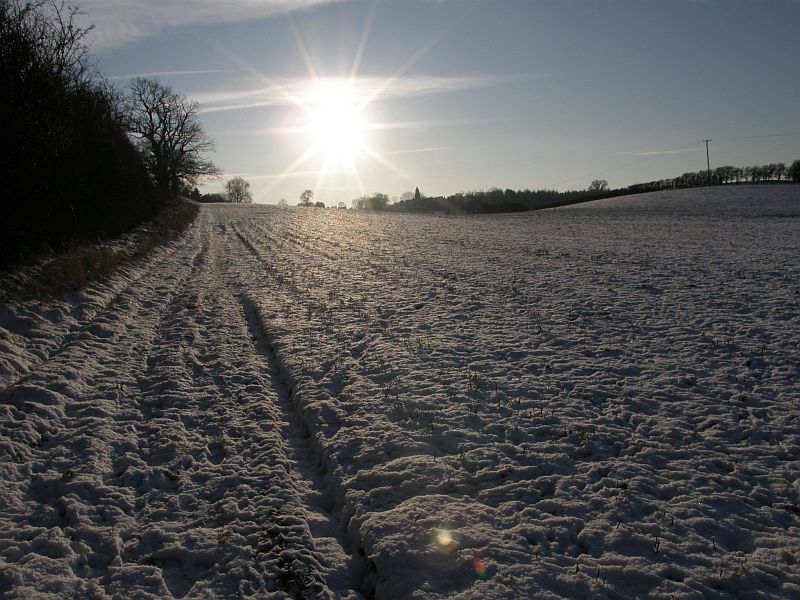
Snowy landscape in BedfordshireLast year I had the opportunity to visit Toronto, in Canada, on a fleeting business trip.  I must say, it’s a very nice city and the people were wonderful.  But one thing puzzled me.  The whole downtown area was connected by miles of subways.  It was possible to walk from one side of the city to other, to shop, to eat, to sit and drink coffee – all underground. It’s a strange subterranean world.  When I commented on this architectural oddity to a local resident she just gave me a knowing look. “When you have six feet of snow for six months of the year, why would you want to walk outside?”

This seems to me to be a very sensible way of dealing with a harsh climate. Unfortunately in Britain we have neither the common sense nor the fortitude of the people of Toronto.  The South East of England received 10-20cm of snow this week and, predictably, everything ground to a halt.  I don’t know whether all the stressed-out workers are looking for any excuse to take a day off or whether we’ve lost any sort of self-reliance,  but either way it’s a pretty poor show.

And me? I love snow.  I like nothing better than getting out and exploring after a decent fall of snow, and since I became interested in tracking I like it even more.  Tracks in the snow offer a real window into what’s been happening, what animals have been out and what they have been doing.  Naturalists have used all sorts of techniques to record the movements of wild animals, from radio transmitters to long pieces of string.  A couple of inches of snow will do the same job in a much more interesting way.

On Saturday I wrapped Scarlett in her warmest clothes and headed out.  I couldn’t take her too far, but we had a nice walk around the fields.  Long enough for me to show her the common tracks in the area.

Here’s the most common – rabbit tracks.  Every now and then I come across someone who says they’ve found strange and enormous paw prints, but what they’ve seen is not the marks of giant toes but the tracks of all four feet of a rabbit.
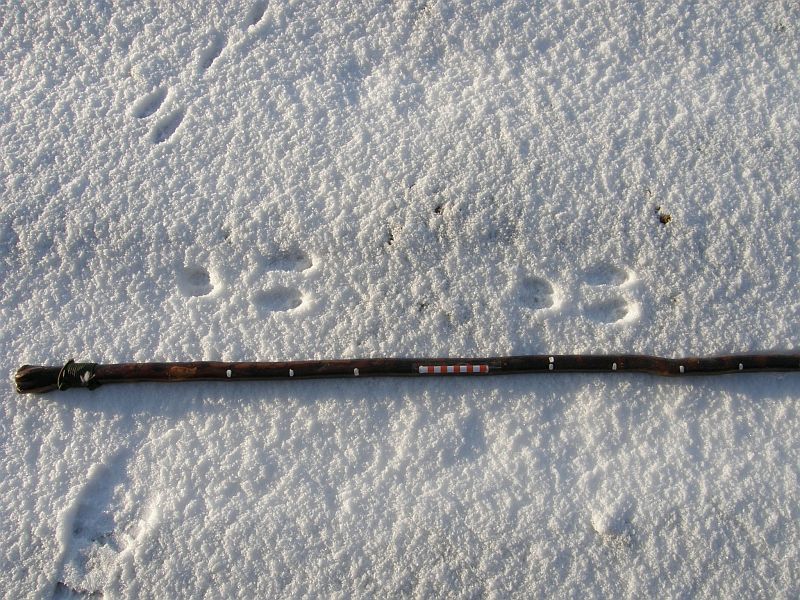
Rabbit tracks in snowRabbit tracks

Which way was the rabbit travelling?  That’s right – left to right.

There seemed to be a lot of fox tracks around.  We live in an area where there is a lot of rearing (and shooting) of game birds, so foxes are not exactly popular.  We used to see far more of them when we lived in London.

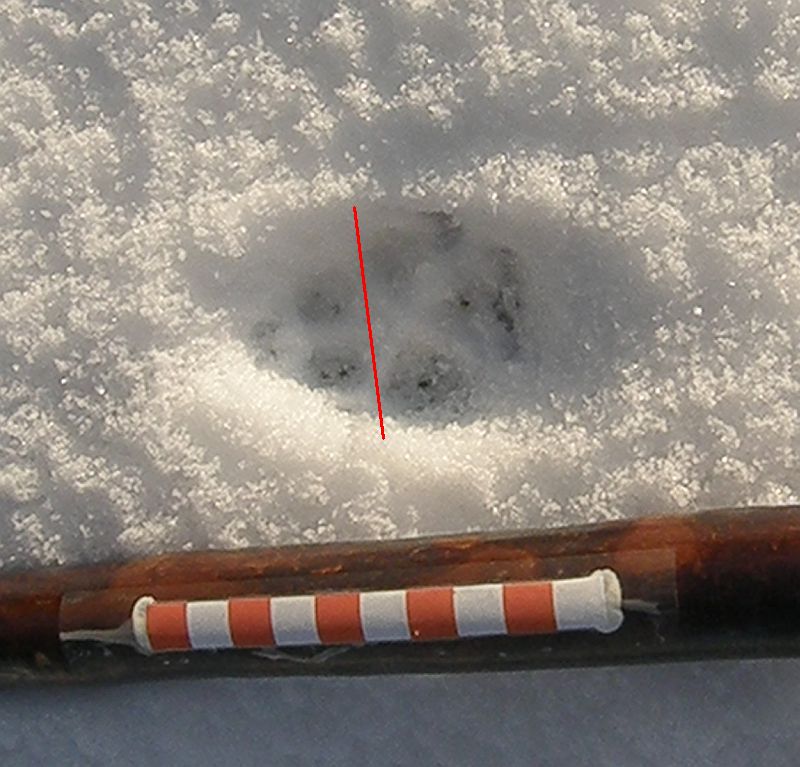
Fox tracks are small, neat and diamond-shaped, with four toes and a heel pad.  Notice how the small heel pad forms a straight line at the back of the track, almost like a straight bar.

Fox track in snow

Fox track

It can be easy to confuse fox tracks with those of dogs.  Most dog tracks are broader than fox’s, with the toes more widely-spread.  The heel pad is usually larger too.

Dog track in snow

Dog track - note the wider shape and the spread of the toes

However, dogs come in all shapes and sizes.  Some dogs are bigger than others.  The tracks of small, terrier-like dogs can look very similar in shape to fox tracks.   The way to tell them apart is the spacing between the front and rear toes.  Look at the fox track again.  The front toes are forward of a line drawn across the ends of the rear toes.  In a dog, the front toes overlap with this line.
Fox track - key features

Fox track - front toes forward of rear ones

Another quick way of telling fox and dog tracks apart is to look at the trail – the series of tracks.  Fox trails always seem to be very purposeful.  Foxes seem to walk in a straight line, one track in front of another.  The tracks have a direct register, in other words the fox puts its hind feet into the tracks of its front feet.  To the novice, it can look as if the fox is walking on its hind feet like a human.

Dog tracks, on the other hand, don’t quite register, so you’ll get front and rear tracks close to each other but not quite overlapping.  Dogs don’t seem to have the same sense of purpose as foxes – dog tracks will often meander around as the dog wanders this way and that.  With a bit of practice you can tell dog tracks from fox tracks without having to look closely at the individual prints.

The temperature hasn’t risen much above freezing all weekend, so hopefully the snow will last for a while yet.  That suits me fine.  Tracking in snow is absolutely fascinating.  Put it this way, if I lived in Toronto I’d happily venture above ground to spend months tracking the local wildlife.

Snowy woods

Actually, there hasn’t been any wine.  But I have been getting into the spirit of the season and collecting mistletoe.

I find mistletoe fascinating.  There is such a lot of folklore attached to it, dating back to the Roman Pliny and his account of druids collecting sacred mistletoe from the sacred oak with a golden sickle at full moon, catching it in a white sheet before it hits the ground or else its magic is lost.

The mystery of mistletoe for me was perhaps made greater because it was very rare in the north of Britain where I grew up.  This means that when I come across it in the wild I feel that I have to get a closer look.

Mistletoe is a parasitic plant that lives on trees.  Apart from the obvious traditions of kissing under the mistletoe it seems to fit this time of year very well.  Firstly, it produces its berries very late in the year, so they are out at Christmas time.  Secondly, when the leaves are off the trees it becomes much more visible and obvious as one of the few sources of green foliage in the wood.

Today I took a walk with the family through the woods in Ampthill and I was pleased to see some very healthy bunches of mistletoe on many of the trees.  Obviously the conditions for it are just right in this area.

This may look like a normal tree, but the foliage is actually all clumps of mistletoe – huge amounts of it.  The only other time I’ve seen it in this amount was almost exactly a year ago when driving through Herefordshire.  It’s good to see it here in Bedfordshire too.

Further on down the path I came across a branch that had been blown down in the recent high winds that had a decent clump of mistletoe attached, so now I have some to decorate the house for Christmas.  Picking it from a fallen branch was perhaps not as effective as using a golden sickle, but an awful lot easier.

And yes, before you ask, Mrs BWM and I did have a brief kiss underneath the tree…

Baby carrier and camouflage umbrella - you saw it here first!

Things have been quiet around here for a while.  Actually, that isn’t quite true.  I haven’t been out much lately, but things have been busy at home.  Having a small baby takes up a lot of time, but things are starting to ease up a little.  I’ve also been busy with DIY in the house.  In particular I’ve been restoring our living room door.

This may not sound like a big task, but it’s turned into one.   I thought the door was a fairly naff 1970s one that looked out of place in a 140 year old house.  After some investigation it turns out that it was the original plank-built door that dates back to the building of the house in 1868, but the previous owners had stuck on plywood on both sides to make it look like a 1970s one.  A major campaign of reconstruction and painting, and it’s now back in its proper place – blocking the huge draft into the living room.  The practical upshot of all this is that we can now turn on the heating in the room, so at least we’re a bit warmer.

The other thing that has kept me indoors is the weather.  Like most people we’ve had a lot of heavy rain.  I don’t mind rain too much myself, but it makes it almost impossible to go for a walk with Scarlett.  In her baby carrier she’s exposed to the elements.  I can keep her warm with fleece suits, but I can’t keep her dry.  I don’t think they make gore-tex baby suits yet.

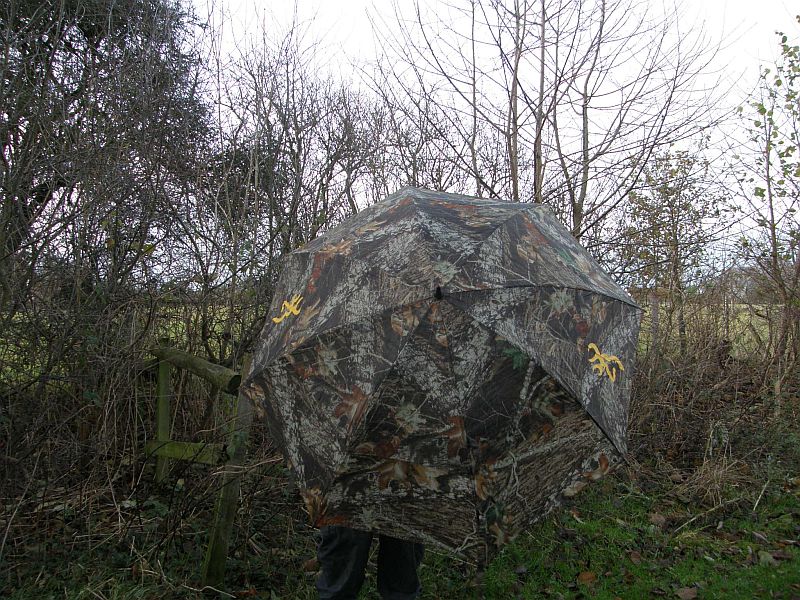
But I think I’ve found the answer.  Being a proper English gentleman I have taken to walking about the countryside with an umbrella.  But not just any umbrella.  I’ve found an American one in Mossy Oak camouflage.

Mossy Oak camouflage umbrella

OK.  So this is probably totally unnecessary.  Having a camouflage umbrella is taking the whole ‘blending into the background’ thing a little bit too far.  Who cares – I like it.

And when you think about it, perhaps it isn’t such a daft idea after all.  I like to think that it isn’t so much an umbrella as a portable hide or blind.  If ever I need to get out of sight of the wildlife, all I need to do is to pop up the umbrella and hide behind it – hey presto – virtually an invisibility cloak!

Whatever.  It means I’ve got more chance of getting outside with my daughter over the winter, and that’s the important thing.

Monitoring Badger Setts near Ampthill

Monitoring Badger Setts near Ampthill

According to the news it was the UK’s worst storm this year.  Heavy rain and gale force winds, gusting up to 70mph and causing damage in exposed places.  This was the weather forecast for Saturday, coincidentally the date of the long-planned field trip of the Bedfordshire Badger Network.

In the event, the rain eased off on Saturday morning, and although the wind was still strong it was a bright, clear day.  The plan for the field trip was to visit and monitor the badger setts in a wood near the town of Ampthill.  Unfortunately the wood is on top of a high ridge and exposed to the full force of the wind, which meant that there was a significant risk of falling branches.  In fact, members of the network had been visiting this wood under similar conditions on a field trip last year, when a full-sized oak tree had come crashing the ground.  They wisely decided to beat a retreat.

Common sense prevailed again this year.  Instead of visiting the wood we elected to drop down off the high ridge and visit the known setts in the more sheltered valley below.   This area is well known to the committed members of the network as it was the site of their large-scale bait marking study, which over ten years mapped the territories of badger clans across a wide area (see the Bedfordshire Naturalist 2007 for details, available from the Bedfordshire Natural History Society).  The full story of the study, and how the badger territories changed over time, makes fascinating reading and is a tribute to the hard work that went into it.

If the setts in the area are well known, why did we need to visit them?  Well, for me it was a chance for a walk in the countryside, to get some fresh air and talk about badger-related matters.  On a more serious note, although badgers will stay in the same territories and setts for hundreds of years, they are rarely static.  Setts become more or less active over time as the populations change and shift.  Regular monitoring helps you to understand these changes.

We visited a dozen or so locations and looked for evidence of recent activity.  New setts and new holes were mapped using GPS (this is real high-tech badger watching), and other evidence such as dung pits was examined.  Individually, each observation doesn’t mean much, but the network has been monitoring the area for years and these little snippets build up into an impressive record of badgers in the environment.

We enjoyed the bracing wind and clear skies for most of the morning until, as we headed home, the clouds rolled in and the torrential rain came down (or rather sideways).  Nevertheless, it was a very good way to spend a day, and it was good to get back amongst badgers again.

Nocturnal Deer

I’ve just got back from a fascinating little night-time walk around the fields behind my house.

Scarlett has been a bit unsettled and grizzly this evening, so in an attempt to calm her down and bring some peace to the house I put her in the baby carrier, grabbed a torch and went out into the dark for a stroll.  At the top of the field the torchlight picked up the eyeshine of a small group of animals.

Spotting wildlife after dark can be easier than during the day, provided you have a torch, as the eyeshine is visible at long distances and even in quite thick undergrowth.  Nocturnal animals have an extra reflective layer called the tapetum lucidum at the back of the eye to capture all available light.  This helps them to see better in the dark but it also makes them more visible.  The exact colour of the reflection varies with species, and experienced observers can identify animals solely from the colour of their eyeshine.  Non-nocturnal animal such as humans do not have this reflective layer, so in a strong light their eyes will tend to reflect the red of the blood vessels at the back of the eye, hence the familiar ‘red eye’ effect in flash photography.

I had no camera, binoculars or any of my usual wildlife watching kit with me, but for the sheer fun of it I decided to see how close I could get to these animals.  It seemed odd to be stealthily stalking animals at night while shining a light in their faces, but they were remarkably unbothered by it.  As I got closer I was surprised to see that the animals were five Chinese Water Deer.  I’ve always thought of these as a solitary species.  You sometimes see two in the same field, but they tend to maintain an air of indifference to each other.  Yet there they were, five of them clustered together and looking and acting for all the world like a small herd.  This was definitely new behaviour to me.

Despite the torchlight they were feeding happily – content but still wary.  They’d graze for a few seconds and then raise their head to check around them.  Either by chance or design there was always at least one deer in the group scanning for danger at all times.  Over a space of ten minutes or so I managed to get within 50 yards of them, which is closer than I could do in daylight, before a muntjac barked a few fields away and they all bolted.

It was an interesting little walk that opened up all sorts of possibilities.  I learnt that deer are much more approachable after dark.  I learnt that Chinese Water Deer seem to have a more complex social life than I’d suspected.  Most importantly I learnt that going out for a stroll is a good way to get a grizzly baby to settle down.  I suspect there’ll be a few more of these short nocturnal walks over the coming months.  Next time I’ll remember to take a camera.

Baby carrier - this season's must-have outdoor accessory

Baby carrier - this season's must-have outdoor accessory

The weather has been beautiful for the past couple of weeks – dry and warm during the day, with a pleasant, cool crispness in the evenings.  Perfect autumn weather.

To celebrate the season of mists and mellow fruitfulness, we’ve been making cider in the village.  It turns out that a lot of us have got surplus apples that tend to go to waste, so we’ve got together and formed a cider collective.  Everyone has pooled equipment, knowledge and labour.  A couple of days of enthusiastic effort involving a garden shredder (!), two cider presses and many willing hands have given us 240 pints of home-made cider brewing away nicely.  It’s been a great way to bring people together and use the local produce, although I suspect there’ll be some sore heads when we have our Cider Festival at some point in the spring.

As predicted, I haven’t had much time for the badgers lately.  Having a young baby (that feeds every three hours, regular as clockwork) takes up a lot of my free time.  However, one of my duties is to give mummy some time off at the weekend, so I’ve been taking some gentle strolls outside.  Nothing too strenuous, you understand, just around the local fields and footpaths near the house.  For obvious reasons I don’t want to be going too far away juCountry Trackst yet.

The baby carrier makes it easy to walk around and Scarlett is quite happy in it – she just falls asleep and stays asleep, even though I point out interesting things such as muntjac deer, badger tracks and fox poo.  Not to worry – I have a nice walk outside, the gentle rocking motion of walking seems soothing for Scarlett, while Mrs BWM gets some time to unwind and relax with the rest of us out of the house.

When I drove to work on Wednesday there was another dead badger on the road through the woods on the outskirts of the village, almost exactly the same spot as the casualties of October last year and April this year.  I had a train to catch so I couldn’t stop to check the sex, but it looked fully grown.  When I came home at the end of the day it had been moved from the road (hopefully just onto the verge, but you hear odd rumours of people taking dead badgers away.  I don’t even want to think what for…)

This makes three badgers in a year killed here, almost certainly from the same sett.  I hope the sett is big enough to withstand the losses.  It must be a fairly active one – I’ll have to see if I can locate it when I get time.

So it goes…

I’m aware that anyone visiting this site will be confronted by depressingly regular tales of dead badgers.  I’m sorry about this.  It isn’t my intention to focus on unpleasant matters just for the sake of it.  What I want to do is to build up an archive of badgers in my local patch.  By recording the road casualties here in my diary (and I only include the ones in or immediately around my village), it means that I’m saving the information.  Perhaps it is just the scientist in me, instinctively collecting data, but in years to come it may reveal a pattern.  Nevertheless, if we get many more road deaths I may need to find a less public way to record them.

Things have been a little quiet around here since we’ve got the new addition to the family.  Scarlett and I have been out for a few walks already, but I’ll wait until she’s settled into more of a routine before I get back to any serious badgerology.  In the meantime, here’s a post from the vaults.

This is a short essay on setting up a track trap in my garden.  This is a simple and fun thing that anyone can do to try tracking in any small space.  The originally appeared as a discussion on the Tracking Group of the Woodlife Network, but if you’re not a member of the network (and it’s highly recommended to anyone interested in the subject) hen you may be interested in seeing it here.

I’m quite fond of hedgehogs, but we rarely get them around here. When I found some hedgehog poo in the garden in June this year I was quite pleased. It would be good to get a resident hedgehog around the place.

Hedgehog poo

I bought myself some hedgehog food to try and entice the urchin to stay, but the problem is that it might get eaten by birds (or by my cat – she does things like that). How would I know that the hedgehogs had been eating it and not some other animal?

Hedgehog food

I decided to set up a track trap – in other words I would place the food so that whatever eats it will have to leave their tracks. I’m going to make them work for their supper by leaving me tracks in return.  This is an established technique for unobtrusively identifying and monitoring animals.

First I took an 18″ square plastic tray. We use these trays in the greenhouse to put plants in.

18 inch tray

I added a 2″ deep layer of moist sand. I used silver sand from the garden centre because I’m lazy, but I could have just dug some sand or soil out of the ground. If you want really high definition you could use damp clay, but I was happy with sand. It’s cleaner too.

Add the sand

I smoothed the sand off with a piece of wood.

Smooth the sand

This will make sure that any tracks show up.

Nice and smooth

And finally I placed bowls of food and water in the centre of the tray.

Track trap baited with food and water

And there it was – a completed track trap. Any animal or bird that eats the food would leave its prints in the soft sand. The only drawback of using the tray is that it may prevent very small animals from reaching the food, but that suits me since the aim was to feed the hedgehogs.

The next morning I rushed out to see if there were any hedgehog tracks.  It was actually quite exciting – there was a real sense of anticipation.

The track trap had worked perfectly, but sadly there was no sign of a hedgehog.  The only tracks were from my own cat.

Cat tracks 1

Cat tracks 2

The fact that the cat tracks showed up so clearly did at least demonstrate that the trap was an effective way to identify the animal that had eaten the food.  I consoled myself with the fact that at least the cat hadn’t used it as a litter tray!

There was no sign of the hedgehog the next day either.  Nor the day after that.  In fact, after three weeks, the only tracks I found in the trap were from the cat, blackbirds, slugs and a squirrel.  No hedgehogs.

It seems that the hedgehog had left my garden.  Apparently, hedgehogs can walk for up to two miles in a single night, so it is quite possible that it was covering a large area.

Not discouraged, I continued to put the hedgehog food down.  Eventually, after two months, my patience was rewarded.  I finally got hedgehog tracks in my hedgehog track trap!

Hedgehog Track

Hedgehog Track 2

OK, so it was a long wait to get tracks from what is, after all, quite a common animal.  But that’s not the point.  I set out to deliberately target a particular species based on its tracks, and in the end it worked.  The trap was fun to make, and it gave me the chance to collect and study animal tracks in the comfort of my own garden.  It’s a simple technique that anyone can use, and one that can be applied in the field too.

For the past few months, while I have been wandering the countryside and pondering the mysteries of badgers, my wife has been quietly and patiently getting on with something much more important.

At 4.00am this morning our first child was born.  I’d like to introduce Scarlett Elizabeth to the world.  She’s beautiful.  I simply cannot express how happy I am, and how proud I am of my wife.

Scarlet ElizabethSo I’m now a dad!  Blimey.   It’s either time for me to grow up or an excuse to act like a kid again.  To my wife’s amused horror I’ve started searching the internet for camouflage baby slings.   I’m looking forward to taking a few gentle strolls around the countryside with my daughter.

In the meantime, things may go a bit quiet on here for a little while.  At least now you know the reason why.

Right, time to get some sleep while I have the chance…

Just a quick note to record that I moved another dead badger off the road this morning.  This one was a fully grown female (I’m getting better at sexing them!) on the road about a quarter of a mile from my usual woods.  I think it is from the next sett along from the Pine Tree sett, the location of which is near the spot.

So it goes…