Feeds:
Posts
Comments

Archive for the ‘Fieldnotes’ Category

Road Casualty

In my last post I said that I got closer to a live badger than ever before.  The emphasis on ‘live’ was deliberate.  One of the more onerous tasks I set myself is monitoring dead badgers in the area, particularly road casualties.  We had another dead badger on the road today, about a mile from my house and just down the road from the wood where most of the casualties have occurred over the past two years.

For the record, the badger was male and seemingly in the pride of life.  It measured 73com from nose to base of tail, so slightly smaller than average.  From the state of its teeth it was relatively young, or at least not elderly (I’m not very good at telling the age of mammals – immature ones are significantly smaller than the average adult size, and very old ones tend to have bad teeth, but this still leaves a large gap in between.  I’ll have to see if there are any more clues to age to look for).  Near the badger was a very well worn path crossing the road between the wood and some pasture fields, so this is obviously a regular route to the feeding grounds.  One of these days I really must get permission to enter these woods, as there is at least one and probably two active setts in there.

Read Full Post »

Thanks very much to everyone who has commented on the badgers and infra-red debate.  I’m sorry I haven’t had the time to reply to you individually, but your comments really are appreciated.

To tell the truth, I’ve been busy lately with work, social events and general pater familias stuff.  In particular, I’ve been busy knocking my poor neglected vegetable garden into shape.  Let me be more specific – I’ve been dashing out and working in the garden in between the freezing downpours, only to dash indoors again when the next one comes along.  It may officially be spring, but we’ve had a lot of cold, nasty, squally weather lately.  But tonight I braved the weather to go to the badger sett, and I’m pleased that I did – I had a great experience to kick off the badger watching season.

I arrived at the wood at about 8.20pm, by which time it was getting dark.  The wet weather has turned the ploughed fields into sticky, sucking mud.  I started the walk looking like a dapper country gent.  I entered the wood looking like a First World War soldier returning from a gruelling stint in the trenches.  Never mind, it’s still nice to get outdoors.

Regular readers will know that I prefer, when possible, to watch badgers from a tree.  It gets you above them and you get a better view without having to worry as much about scent or badgers blundering into you.  To be honest, though, climbing a tree in the dark while wearing muddy wellies is a complete pain, so I elected to sit at the base a tree, facing the sett with the wind in my face so my scent wouldn’t be carried to the badgers.

My plan was to try to observe the badgers using the night vision (NV) scope, both in passive mode and with infra-red, and see if there was any pattern to their responses.  At 8.50pm I heard the unmistakable sound of scratching from the sett that meant that a badger was above ground.  There was still a little light, so I was able to use the NV scope without the infra-red.  There, by the sett, was a badger.  Success!  A moment later it ambled off.  So far, so inconclusive.  It may have been disturbed by the NV scope, it may have just been a badger with things to do.  I sat and waited.

About 10 minutes later there was a scuffling noise from the sett.  I raised the scope to see what it was.

(At this point, I should confess that I have a strange and irrational fantasy fear about using the NV scope.  I worry that one day I’ll be sitting happily in a dark but otherwise peaceful wood.  I raise the scope to my eye, and there, sitting no more than 10 feet away, is a tiger – of which I was previously blissfully unaware.  It’s wholly irrational, I know, but sitting alone in a dark wood does strange things to your mind after a while.  Once the thought entered my mind I couldn’t seem to get rid of it.)

In this case, I raised the scope to see three badgers running full pelt directly towards me.  You have to understand that I’m used to watching badgers from a tree, not from the ground.  I’m not used to seeing badgers from this angle – full frontal, face to face and eye to eye – let alone three of them, nose to tail and running full speed at me.  It was a new experience, and a very impressive one.

At the last moment, just when I thought the badgers would run straight into me, they stopped.  They were no more than three feet away and clearly visible in the twilight.  I hardly dared to breathe.  Two of the badgers started having sex right in front of me (what is it with me, badgers and sex!?), while the third starting sniffing towards my wellies.  If I had leaned forward I could have tickled any one of them behind the ears.  After 30 heart-stopping seconds they sensed my presence somehow and dashed off towards the sett, except one brave fellow who came back to within a few feet of me and circled round, sniffing, before running off.

What a fantastic experience!  I think this is the closest I’ve ever been to a live badger, and it was absolutely breathtaking.  In one way I had broken my cardinal rule of badger watching – I had let the badgers become aware of my presence.  These badgers are absolutely wild and unaccustomed to humans, and I’ve taken pains to keep them this way. On the other hand, I thoroughly enjoyed it.  Despite all my scientific theorising, I still find the sight of badgers to be both thrilling and compelling.  I’ve said it before, there is something about an encounter with badgers that has an effect on people, and this was a very close encounter.  It was a great way to start the badger watching year.

And the effect of the NV scope on the badgers?  The scope was on (in passive mode) during the whole encounter and the badgers showed no signs of noticing me until the very last moment, to the extent of returning to check me out more closely.  This was nothing like the fear I’ve observed when using the infra-red at a far greater distance, which suggests that the scope itself doesn’t bother them.  I’ll need to experiment further to see if the infra-red provokes any consistent responses.  After my close encounter I didn’t have the heart to risk disturbing the badgers any more tonight, and I quietly left them to go about their business.

Read Full Post »

After pondering the infra-red question for a week, I decided to try and get some answers in the field.  I decided to pay another visit to the sett, to observe the badgers as best as I could without using the infra-red and then, once I was sure that the badgers were comfortable and that there was nothing I was doing that was disturbing them, I would turn on the IR and observe any reactions.

It was a great plan.  The problem is, to paraphrase Helmuth von Moltke, no plan survives contact with badgers.  I made my way through the wood as stealthily as possible and arrived at the sett by 8.00pm.  Unlike last week, when the weather was very clear, the night was quite cloudy.  This meant that there was more of a glow in the sky – the horrid orange reflections of the streetlights in distant towns.  This glow was enough to make it possible to use the night vision scope in passive mode, without the infra-red illuminator.  There was just enough light for it to work properly – I could see trees, undergrowth and the spoil heaps of the sett.

Unfortunately I couldn’t see any badgers.  I waited for 40 minutes but saw and heard nothing.  If the badgers had come out I would have seen them.  Maybe they were frightened by my approach, but I don’t think so.  Maybe they had left already and were out foraging.  Maybe they didn’t emerge until after I had left.

It was a pleasant enough evening, listening to the lambs in the field and the tawny owls in the wood behind me, but I didn’t get to test my theory.  I’ll try again next week and see what happens.

Read Full Post »

When Labour MP Ron Davies was asked to explain what he was doing visiting the countryside at night in a well-known gay meeting area, he famously replied that he was ‘watching badgers’.  I mused on this as I walked through our village last night.  If for some reason I had been stopped and asked to explain what I was doing, how would I explain why I was carrying a red light and a night vision scope while wearing (among other things) a camouflage jacket and a pair of ladies’ tights?  I expect I would have weakly stammered out the same reason that Ron did.  I can’t vouch for him, but in my case it happened to be true.

It has been a while since I have seen a badger.  Partly this is due to family commitments, partly because I’ve confined my badger watching to the summer months when it is possible to observe them in daylight in the long evenings.  I’ve always tried to keep the main badger sett I watch as wild and undisturbed as possible, and for this reason I’ve never used artificial lights there.  However, I bought myself a night vision scope last year, so it should be possible to watch the badgers in complete darkness.  Everything came together at the same time – I now have time to go out in the evenings, I have the means to watch the badgers in the dark, and I had an itch to see a real, live badger again.  I know from visiting the sett in the daytime that the badgers have been busy – it was time to get out and see what they were actually doing at this time of year.

This explains why I was out after dark and why I was carrying the night vision scope.  The reason I was wearing ladies’ tights was purely and simply to keep warm.  Last night was beautifully clear – the stars of Orion were shining brightly over the wood as I walked up the hill – but it was very cold and frosty with a bitter wind that seemed to be blowing straight from the arctic circle.  If you’ve ever sat still in very cold weather then you’ll know how the cold can seep into your bones after a while.  And if you’re up a tree watching badgers then you can’t even move around to keep warm.  Hence I was wearing as much warm clothing as I could.  I got the tights for an impromptu fancy dress outfit a while ago (Superman – they’re thick, blue tights) and I was struck by how warm they were.  Despite the possible cross-dressing implications I wore them under my normal trousers, and very effective they were too – warm yet lightweight.  This may become a habit…

Arriving at the wood I picked my slowly through the trees.  I use a small red LED headtorch, which is just bright enough to see by but is less intrusive than a white light.  Badger folklore says that badgers cannot see red light very well and are not as disturbed by it.  It also adds a wonderfully other-worldly feeling when walking through a dark wood.

I arrived at the sett at 8.00pm, none too stealthily, I’m afraid.  Walking through a winter’s worth of dead leaves and fallen twigs by the light of dim torch without making a noise is pretty much impossible.  As I neared the sett I could see the red eyeshine of an animal at the edge of the torchlight – a badger!  With no real stealth at all I climbed up my favourite tree to get a good view over the sett.  I set up the night vision scope and turned off the red torch.

Now, the last time I used the night vision scope it seemed to cause a reaction in the badgers (see Fieldnotes: 25th July 2009 – First night vision session).  Although the infra-red light from the scope is supposedly invisible, the badgers seemed to be spooked by it.  Last night, the exact same thing happened.  When I looked at the badger through the scope it froze, looked straight at me and bobbed its head up and down.  This is the classic sign of a nervous badger trying to scent something that it is suspicious of.  After a few seconds it turned around and fled underground.

I am now convinced that badgers can see the infra-red light from my NV scope.  Think about it – the badger was not put off by my noisy approach, it was not put off by the red light of my headtorch, nor by the noise of my climbing the tree.  It was only when I was sitting quiet and still with my torch turned off that it bolted; and this at the exact moment I shone the infra-led light on it.  I’ve spent a lot of hours watching badgers, and the way that this one looked straight at me tells me that it was aware of me, and this could only be due to the infra-red.

I sat for 40 cold minutes to see if the badger reappeared but it didn’t.  I could hear the rhythmic scuffling noises of a badger gathering bedding from the other end of the sett, but I didn’t see anything else.  It was a little frustrating:  there I was, all dressed up, and I seemed to have scared off the only badger in sight.  I can confirm that the badgers were out at 8.00pm and that there was bedding being gathered (the east end of the sett seems to be active, based on what I heard and from inspecting the sett in the daylight) but I can’t add much more than this.

The business with the night vision scope was frustrating too.  I am sure that the badgers react to the infra-red light, and this makes it much less useful.  In fact, they seem more disturbed by the night vision scope than by an ordinary red light.  I can use the scope in ‘passive mode’ so that it gathers ambient light rather than illuminating the scene with infra-red, but it isn’t very effective in the darkness of a dark wood.

There is definitely an opportunity for more winter badger watching, but I need to sort out the night vision first…

Read Full Post »

After all this high-level, scientific badgerology I felt the need to get back down to earth.  On Sunday I took Scarlett on her first trip to see a badger sett.  I also wanted the chance to see how they are doing after the cold weather and whether they are preparing for spring.  Donning the baby carrier and camouflage umbrella I set off into the drizzle.

Now, I had planned to turn this trip into a photo-guide on what to look for at a badger sett, as a guide to people who want to know if they’ve got badgers in their local area.  Unfortunately, after snapping pictures of everything in sight – holes, paths, dung pits etc – I got home to find that my camera settings had mysteriously changed and none of the pictures I took show anything at all.  Damn it.

Never mind.  It gives me an excuse to go back next week.  Scarlett enjoys these walks, and I do to.  For the record I can say that the badgers seemed to be positively thriving.  The dung pits were all full, showing a lot of feeding.  The sett was very active, with no fewer than six of the holes showing significant signs of fresh digging and tracks.  This is a good sign, as sow badgers will take up residence in their own part of the sett to give birth and rear their young, so at least one or two of these holes are probably ‘maternity suites’.

Stay tuned for next week, when I’ll hopefully be back with a fully-illustrated guide to badger setts.

Read Full Post »

Alder tree by the brookThe snow has finally melted.  Today has been a balmy 7 degrees and beautifully sunny.  It may not sound very warm, but compared to the past weeks when the temperature didn’t rise above freezing for days on end it feels positively spring-like.  I took advantage and headed out for a stroll in the (slightly soggy) countryside.

I had no particular aim in mind, but with a vague idea of looking at the birds I headed over to the lake.  I don’t go there very often, but there is always the chance of visiting waterfowl.  As it happened the lake was still iced over with not a bird in sight, but the hedges were alive with blue tits, great tits, chaffinches and sparrows.   My personal favourites were a flock of long-tailed tits working their way through the trees.  These are delightful birds but absolutely impossible to photograph.  They are always on the move, flitting about from branch to branch as they forage, never staying in one place for long.  One of these days I’ll be in the right place and get a picture as they travel past.

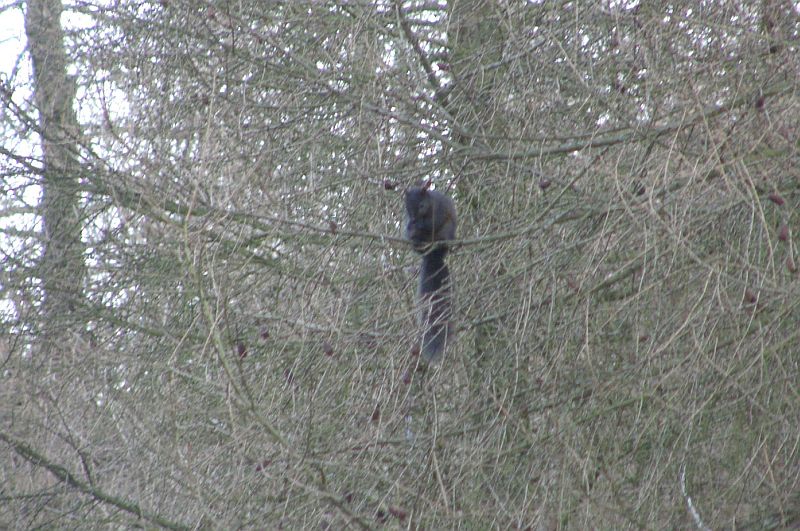
Talking of ambitions, there is one animal that I’ve been quietly trying to photograph for a while now, and that is the black squirrel.  The black squirrel is the melanistic (black) version of the common grey squirrel.  There are populations of black squirrels in a number of places around the country, and some experts believe that the black coat is genetically dominant and will eventually replace the ordinary grey colour.  This hasn’t happened yet, or shown any signs of doing so, so black squirrels are still fairly uncommon.

There is a known population of black squirrels centred on Woburn in Bedfordshire.  I’ve only seen one once before, and it was very striking – a squirrel, but with a black coat.  Ever since then I’ve wanted to get a picture of one.  Today, I got my chance.

Black Squirrel

The almost legendary Black Squirrel of Woburn

Unfortunately the squirrel was quite distant so it was at the very limit of my camera zoom, but it is unmistakeably a black squirrel. I feel a little bit like those people who photograph Bigfoot, only to get home and find the picture only shows a dark blur in the distance, but at least I know it was there.

Black Squirrel

NOT a Bigfoot, but a black squirrel...

I walked home along the brook.  Halfway down I came across a clear animal path running from an old, disused little quarry into the fields.  Now, this looked to me like a classic badger path.  The old quarry was a perfect spot for a badger sett – they love places like this where they can dig sideways into the side of a bank, and the soil is usually dry and well-drained.  There were signs of digging and spoil heaps in the quarry, so something was burrowing there.  In short, it looked exactly like a badger path, except it ran across a 6″ deep fast-flowing brook.

Brook crossed by a badger path

The brook crossed by a badger(?) path

Could this really be a badger path?  Would the badgers really wade across the brook every night to get to the fields?  There were no really conclusive tracks so it is difficult to be sure either way.  Something had made the path, but I don’t know what.  Since the brook is close to my house it looks like an ideal place to make a track trap – to spread some sand and see what tracks I can get.  If it is a badger path then I’ll be back in the summer to see if I can stake it out and get a picture of an aquatic badger.  Remember, you heard it here first!

Read Full Post »

For the past week the country has been gripped in a little ice age.  An area of high pressure has settled over Britain, trapping cold air and snow, blocking out the prevailing warm south-westerly winds.  Temperatures as low as -20c have been recorded (my family in Cheshire experienced -14c) coupled with up to a foot of snow.  Predictably, the whole country has ground to a frozen halt.

Personally, the only problem I have with the snow is that I haven’t had enough time to go out and play in it.  Unlike this time last year (see Fieldnotes: 4th-10th January 2009), I’m limited by work and family commitments.  It’s one thing to go out and freeze myself following badger tracks in the snow.  It’s another thing entirely to do it while carrying a five month old baby!  Back in the old days I’d have packed up a tent and sleeping bag and headed out into the woods, just for the challenge of it.  Can’t really justify that now.

Nevertheless, today I drew upon Mid-Bedfordshire’s tradition of polar exploration (there is one, honestly) and went out into the snow to see what is happening.

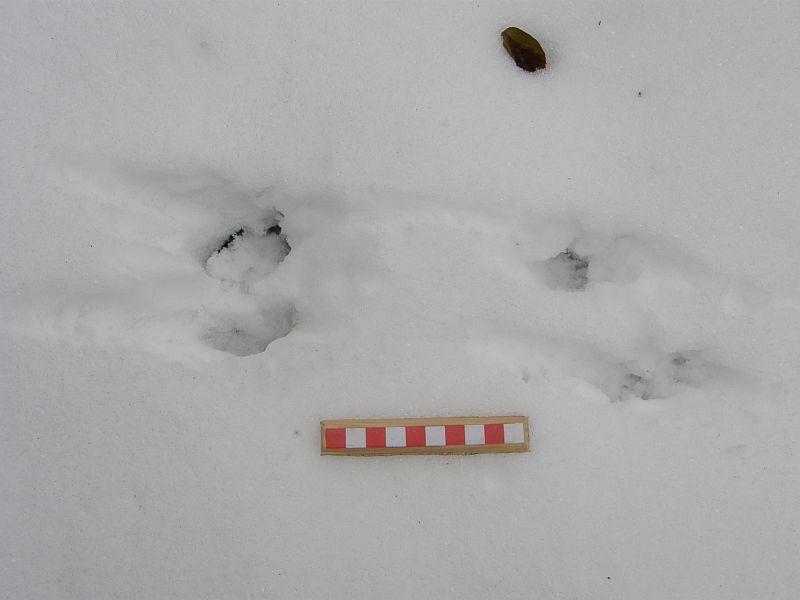
Here’s some new tracks to have a look at.  These are squirrel tracks.  I watched the squirrel as it bobbed around in our garden and then went out to look at the tracks.  The pattern is similar to that of a rabbit – the same bounding gait – but smaller.

Squirrel Tracks in Snow

Squirrel Tracks in Snow

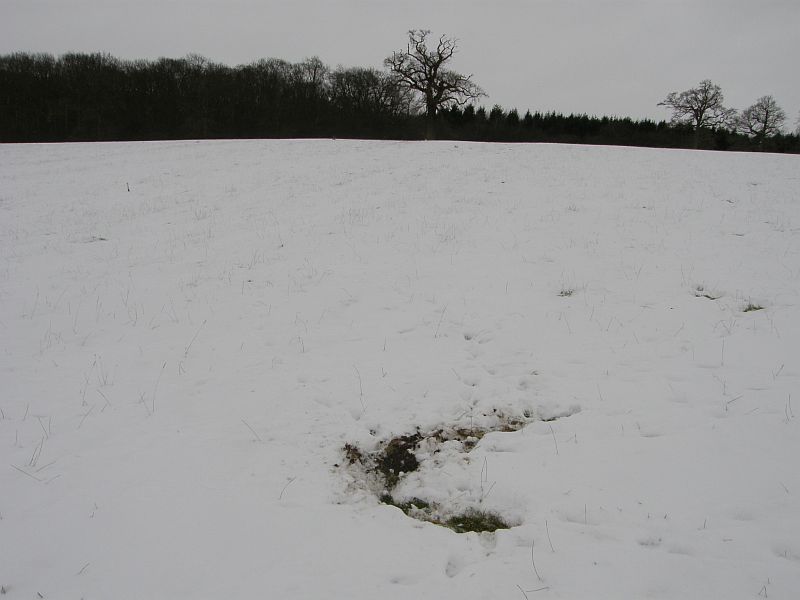
I walked on up to the pasture field to look for evidence of the badgers.  The snow last year was a priceless help in deepening my understanding of badger habits and how the local territories interacted.  This year the picture was much more confused.  There was almost a weeks worth of tracks, of animals and humans, and recent falls of snow have complicated matters still further.  Nevertheless, it was possible to trace the movements of individual badgers.  Clearly visible were the patches where they had dug through the snow into the soil.  I couldn’t see any dung, so I assume it was for food.  Badgers don’t hibernate, but they do slow down.  It’s a useful thing to know that badgers will still come out and forage, even in these extreme weather conditions.

Badger Snuffle Hole in Snow

Badger Snuffle Hole in Snow

Inside the wood there was more evidence of badger activity.  I didn’t get to visit the sett itself (like I said, there is a limit to how far I’ll take my daughter in these conditions – sturdy girl though she is) but I did add a few more snippets to my badger map of the area.  The wood is criss-crossed by paths, but it is difficult to know for sure that they are badger paths. Very often the only tracks you’ll find on them are for deer.  Today, however, there were clear badger tracks, showing that these are indeed badger paths.  I’ve tried to follow them in the past, as I suspect they lead to the almost mythical ‘third sett’ in the area, but I’ve always lost the paths among the trees.  If the snow persists I’ll have the perfect chance to follow them to their source.

Badger Tracks in Snow

Badger Tracks in Snow

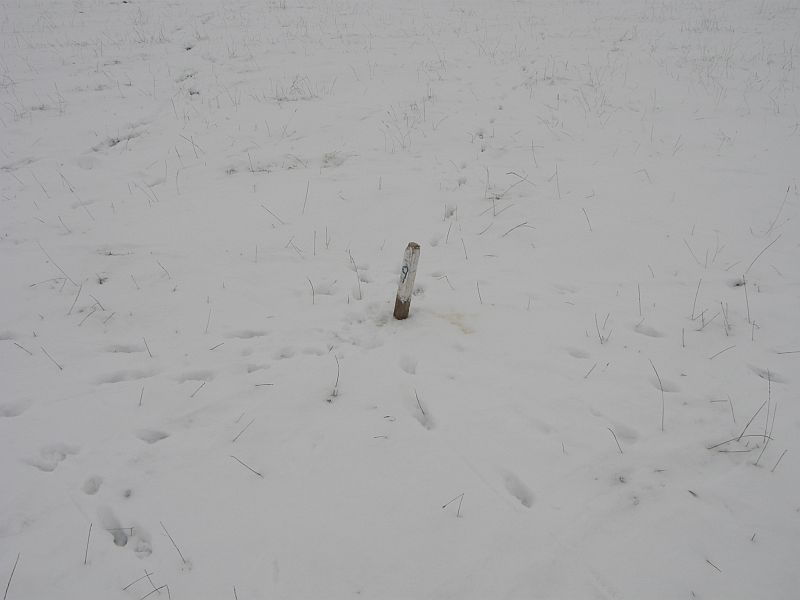
The snow told other stories too.  There were plenty of fox tracks in the field.  They all converged on a post where the foxes had obviously scent-marked.  Just like dogs, I guess.  It’s all part of the territory marking.  Foxes will tend to leave dung in exposed places such as tufts of grass for the same reason.  It’s a nice little insight into fox behaviour.

Fox Tracks and Scent-Marking Post

Fox Tracks and Scent-Marking Post

Lastly, here’s a bit of a mystery.  These tracks were in the middle of the field.  It’s a bounding gait again, with the tracks in groups of four like a rabbit or squirrel, but only a few centimetres across.  The individual prints were not visible in the snow, but the gait can be more revealing.  Something the size of a mouse would surely have burrowed under the snow, not bounded over it.  I’ll need to look this one up, but in the meantime any ideas are welcome.

Unidentified Tracks in Snow

Unidentified Tracks in Snow

Hope you’re making the most of the snow too!

Read Full Post »

Monitoring Badger Setts near Ampthill

Monitoring Badger Setts near Ampthill

According to the news it was the UK’s worst storm this year.  Heavy rain and gale force winds, gusting up to 70mph and causing damage in exposed places.  This was the weather forecast for Saturday, coincidentally the date of the long-planned field trip of the Bedfordshire Badger Network.

In the event, the rain eased off on Saturday morning, and although the wind was still strong it was a bright, clear day.  The plan for the field trip was to visit and monitor the badger setts in a wood near the town of Ampthill.  Unfortunately the wood is on top of a high ridge and exposed to the full force of the wind, which meant that there was a significant risk of falling branches.  In fact, members of the network had been visiting this wood under similar conditions on a field trip last year, when a full-sized oak tree had come crashing the ground.  They wisely decided to beat a retreat.

Common sense prevailed again this year.  Instead of visiting the wood we elected to drop down off the high ridge and visit the known setts in the more sheltered valley below.   This area is well known to the committed members of the network as it was the site of their large-scale bait marking study, which over ten years mapped the territories of badger clans across a wide area (see the Bedfordshire Naturalist 2007 for details, available from the Bedfordshire Natural History Society).  The full story of the study, and how the badger territories changed over time, makes fascinating reading and is a tribute to the hard work that went into it.

If the setts in the area are well known, why did we need to visit them?  Well, for me it was a chance for a walk in the countryside, to get some fresh air and talk about badger-related matters.  On a more serious note, although badgers will stay in the same territories and setts for hundreds of years, they are rarely static.  Setts become more or less active over time as the populations change and shift.  Regular monitoring helps you to understand these changes.

We visited a dozen or so locations and looked for evidence of recent activity.  New setts and new holes were mapped using GPS (this is real high-tech badger watching), and other evidence such as dung pits was examined.  Individually, each observation doesn’t mean much, but the network has been monitoring the area for years and these little snippets build up into an impressive record of badgers in the environment.

We enjoyed the bracing wind and clear skies for most of the morning until, as we headed home, the clouds rolled in and the torrential rain came down (or rather sideways).  Nevertheless, it was a very good way to spend a day, and it was good to get back amongst badgers again.

Read Full Post »

I’ve just got back from a fascinating little night-time walk around the fields behind my house.

Scarlett has been a bit unsettled and grizzly this evening, so in an attempt to calm her down and bring some peace to the house I put her in the baby carrier, grabbed a torch and went out into the dark for a stroll.  At the top of the field the torchlight picked up the eyeshine of a small group of animals.

Spotting wildlife after dark can be easier than during the day, provided you have a torch, as the eyeshine is visible at long distances and even in quite thick undergrowth.  Nocturnal animals have an extra reflective layer called the tapetum lucidum at the back of the eye to capture all available light.  This helps them to see better in the dark but it also makes them more visible.  The exact colour of the reflection varies with species, and experienced observers can identify animals solely from the colour of their eyeshine.  Non-nocturnal animal such as humans do not have this reflective layer, so in a strong light their eyes will tend to reflect the red of the blood vessels at the back of the eye, hence the familiar ‘red eye’ effect in flash photography.

I had no camera, binoculars or any of my usual wildlife watching kit with me, but for the sheer fun of it I decided to see how close I could get to these animals.  It seemed odd to be stealthily stalking animals at night while shining a light in their faces, but they were remarkably unbothered by it.  As I got closer I was surprised to see that the animals were five Chinese Water Deer.  I’ve always thought of these as a solitary species.  You sometimes see two in the same field, but they tend to maintain an air of indifference to each other.  Yet there they were, five of them clustered together and looking and acting for all the world like a small herd.  This was definitely new behaviour to me.

Despite the torchlight they were feeding happily – content but still wary.  They’d graze for a few seconds and then raise their head to check around them.  Either by chance or design there was always at least one deer in the group scanning for danger at all times.  Over a space of ten minutes or so I managed to get within 50 yards of them, which is closer than I could do in daylight, before a muntjac barked a few fields away and they all bolted.

It was an interesting little walk that opened up all sorts of possibilities.  I learnt that deer are much more approachable after dark.  I learnt that Chinese Water Deer seem to have a more complex social life than I’d suspected.  Most importantly I learnt that going out for a stroll is a good way to get a grizzly baby to settle down.  I suspect there’ll be a few more of these short nocturnal walks over the coming months.  Next time I’ll remember to take a camera.

Read Full Post »

Another road casualty

Just a quick note to record that I moved another dead badger off the road this morning.  This one was a fully grown female (I’m getting better at sexing them!) on the road about a quarter of a mile from my usual woods.  I think it is from the next sett along from the Pine Tree sett, the location of which is near the spot.

So it goes…

Read Full Post »

« Newer Posts - Older Posts »