I’ve been exploring my fascination of badgers, and why I keep getting the urge to spend perfectly good evenings sitting in a wood watching them. In Part 1, I decided that badgers are impressive beasts, and that their size and wildness make them something special in Britain.
My next reason is quite simple: badgers are fun. This may seem like a trite comment, but it isn’t. Badgers, to me, are far more interesting than a lot of the UK’s wildlife.
Badgers are social animals. They live in family groups, which is unusual for UK mammals, particularly because badgers are social carnivores. Can you think of any other carnivores that live in social groups? Lions, wolves, hyenas perhaps. Maybe wild dogs. The fact is that there aren’t that many, and certainly not in the UK.
This means that by watching badgers you can observe and study a whole range of behaviours that you do not see with other animals. You get to see how they interact with each other, how the group stays together, how dominance is established and how relationships are reinforced. You can watch the cubs grow up in the family, and the way that different badgers react to them. And this is my point – badgers do things! For someone like me who is curious about animals, no other species offers so rich and deep an opportunity for study.
Other animals, although interesting, seem a little bland by comparison. Take rabbits, for instance. I watched rabbits for a couple of hours last night, and they hopped about a bit, nibbled some grass, and occasionally stood up to have a good look round. I’m not saying that rabbits are not a worthwhile species to study – I’ve read Lockley’s The Private Life of the Rabbit and I’m sure that they have hidden secrets – but to me they are just not as rewarding.
So there is another reason for watching badgers. Not only are they physically impressive and intriguing in their wildness, but they repay the dedicated watcher with a truly rich and detailed family life.
Despite the threatening rain clouds I decided to pay a visit to the wood on Friday evening. It’s a good way to unwind after the working week. Like most people, I spend my time rushing everywhere: rushing to work, rushing to meetings, rushing home. Watching wildlife forces you slow down, to stop and listen and think.
The slight wind was blowing in an unusual direction. Wooded valleys seem to have an uncanny influence on the wind. It is not uncommon to have the wind blowing one way outside the wood, and in another direction entirely when you’re actually inside it. The practical upshot of this was that all of my usual trees would put me upwind of the badgers. This would not do at all, so I circled around the sett and sat on the ground with my back to a large oak.
The first thing I noticed was how many nettles there were. I was sitting on a few, but being a rough, tough badger watcher I couldn’t let myself be too put off by that. The nettles also grew around the sett entrance, putting a bit of a screen between me and the badgers. Not good for a clear view, but good for keeping the badgers relaxed.
The cubs came out at about 8.15pm. They are getting very independent now, and seem perfectly happy foraging around the area of the sett. The adults emerged about 45 minutes later. The whole group seems very relaxed and content at the moment. I suppose that life must be good for a badger just now. The wet weather means that the worms that make up most of their diet are plentiful and easy to catch, and that must take some of the pressure off the food gathering.
One of the advantages of being on the ground was that I was closer to the badgers than usual, which gave a new perspective on things. I sat there for a good hour and a half, my legs slowly going numb underneath me and a small cloud of mosquitoes gathering about my head, but with a great view of the sett.
The downside of being on the ground was that I was more likely to come into contact with the badgers. As I’ve said before, one of my rules for badger watching is to avoid disturbing the animals. Sitting in front of the tree it was surprising how little notice the badgers took of me. I was wearing full camouflage gear including gloves and face net, so I should have been quite inconspicuous. However, eventually the inevitable happened. One of the foraging badgers circled round and approached me from the side. From this position my silhouette must have been visible, because it stopped, stared and then trundled quickly back to the sett.
Not wishing to put the badgers off their foraging, I slowly straightened my cramped legs and crept away as quietly as I could. After 30 yards I turned round and I could see the cubs ambling about, so they seemed happy enough.
All in all an interesting evening. I think I still prefer my trees. They offer so much more concealment.. There’s been many times when I’ve had badgers scuffling around the roots of the tree I’ve been sitting in, and they’ve never suspected.
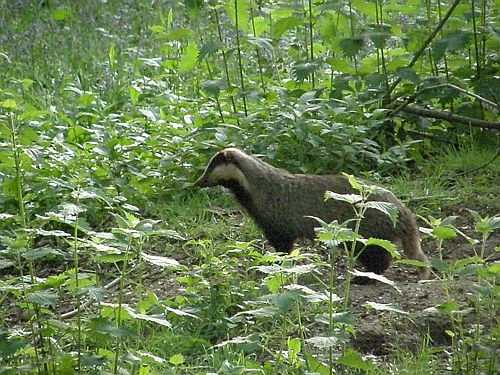
One good thing from the night is that I think I’ve finally got an individual badger I can recognise. The coats of most badgers are greyish-black, with a reddish-brown tint beneath, but the fur of this one was quite white underneath the grey. He also had a patch of white fur visible below his left ear. I say he, because he looked well-built like a boar, but I could be mistaken. I’m no expert on sexing badgers, except when I see them with cubs or exposing their undercarriage as they scratch. I shall look out for this particular badger on subsequent visits.
My efforts to build up a video archive of the badgers continue. I’ve discovered how to set my camera to take high quality video, but it only does it for 15 seconds at a time. I’ve spliced all the footage for the evening into one montage. I’ll have to read the camera manual, but I guess in the meantime I’ve got a video that is ideal for people like me with 15 second attention spans!
For a better look at the video, click here to go to YouTube and select ‘Watch in high quality’.
The question has to be asked. Why do people watch badgers? Why do I watch badgers?
Watching badgers might be seen by some people as an odd, even eccentric, pastime. It probably is. But then other people spend their evenings and weekends watching football, and that has always seemed strange to me.
But why watch badgers? I’ve asked myself this question many times, and there is no simple answer. It is easy to say that watching badgers is mildly addictive, but there must be some reward in it for me because I keep doing it. This series of posts is an attempt to explore my reasons for going out to the woods time and again.
First of all, I’d love to be able to say that I’m going to make some startling scientific discoveries about badgers, but this probably isn’t true. As a species they have been studied by far more capable and experienced people than me, so it is unlikely that I will add any wholly new chapters to the book of badgers. I flatter myself that I may gain a few small insights into their behaviour and habits, but I don’t think I’ll be adding much to the sum total of badger knowledge.
So, to be honest, my interest is driven mostly by personal curiosity. I imagine that an interest and curiosity about nature in general is probably necessary if you are going to get excited about watching badgers.
In Britain we are lucky enough to have a whole spectrum of wildlife, from the tiniest invertebrates to the largest whales, but the badger occupies a special place for me. Badgers are secretive and relatively rare animals – most people never see them except for a quick glimpse as they run across the road – yet at the same time they live almost in our midst. The badgers I watch regularly are little more than a mile from my house, and many people are lucky enough to have badgers visit their garden. I take a strange delight in the idea that these animals are living almost unknown and unsuspected alongside us. The badger is living proof that no matter how much we have tried, we have not yet fully tamed our countryside.
This feeling is even stronger when you meet a badger face to face. To put it bluntly, they are physically impressive animals. Although not huge, they are Britain’s largest native carnivore. Their black and white face is instantly recognisable. They have presence.
Over the centuries, we have gradually exterminated most of the large animals in Britain (with the exception of deer, which, being tasty to eat, have been jealously protected). If I could travel back in time two thousand years or so, then I would find my badgers sharing their wood with wild boar, wolves, beavers and even bears. And who now remembers the Irish Elk? We’ve wiped out these animals so thoroughly that few people think of them as British species. They were here and they are gone but the badger remains. The last of the truly wild big mammals, badgers have stubbornly stayed put despite everything we have done to them. In some ways, the badger is a creature of the past. How can such a big, bold animal still be living wild in Britain’s ordered and controlled countryside? Yet here they are.
Good for the badgers, I say. I think that this is one of the reasons why I like to watch them.




 Tales from the Wood - The Diary of a Badger Watching Man