Feeds:
Posts
Comments

Posts Tagged ‘badger’

Things have been busier than usual at work and around the house lately, hence I’m late in writing up my notes.  It’s been a gloriously hot bank holiday weekend, and I’ve been taking the opportunity to thrash the garden into shape.  Where there was a jungle there are now neat rows of vegetables and trimmed hedges – what a difference a few days can make.

And by the way, this blog is now a year old, so happy birthday to me!  The main reason for writing it is to keep a diary so that I can check back on things and compare my experiences over the years.   It’s working already.  I can see from my records that this time last year was cold and wintry, so I’m starting to build up an archive of what has happened.  Besides, keeping a diary online is much more fun than doing it on paper.

So without further ado, here’s the compressed diary entries for the weekend.

Saturday 23rd May

Being busy in the garden, I only had time for a quick trip up to the woods.  I set myself up at the western side of the sett, mostly because it is clearer here and the view is better.

At 8.00pm exactly a badger left the eastern side of the sett and ambled over the western entrances.  Five minutes later it wandered back again.  A social visit, I presume.  The eastern end of the sett is where I’ve seen the only cub of the season so far, so I’ve been keeping an eye on it to try and see some more.

The vixen and the fox cubs came out at 8.20.  There are five of them.  They suckled their mother for a few minutes before she suddenly ran off across the wood, five little cubs in tow.  For a moment there were fox cubs everywhere, but they soon sorted themselves out.  Perhaps she is starting to teach them to hunt, or just encouraging them to be more independent.

I could hear badgers at the eastern end of the sett at 8.35, but the undergrowth hid them from me.  I still want to find out if there are any more cubs, so it looks like a trip to this end of the sett is called for.

Sunday 24th May

The eastern end of the sett presents a challenge, as there are no easily climbable trees nearby so you have to sit on the ground.  It is also on a slight rise, so to get any sort of view you need to be pretty close.  It was time for some extreme stealth badger watching!

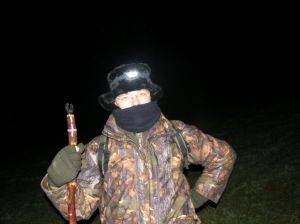
Getting close to truly wild badgers is difficult because they are very nervous.  I did everything I could to prepare.  I brought my full camouflage outfit – my new camo shirt, gloves and two face veils.  I even made sure that the shoes I wore had dark soles!  The face veils are very important, as your face really does stand out.  In particular it is useful to cover your eyes.  Animals (and birds) seem to have an uncanny knack of knowing when you’re looking at them, and I think a lot of this comes from seeing your eyes.  The ability to recognise eyes is built into almost all animals – a human baby will smile at two dots on a piece of paper if they are the same size as its mother’s eyes.  One company in the US even makes camouflage sunglasses; these may seem like a gimmick but I’m convinced they are useful because they disguise your most noticeable feature.

Here’s what I look like in full camo gear – needless to say I don’t pop into the pub dressed like this.
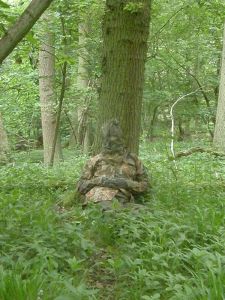
The Badger Watching Man in full camouflage clothing

The BWM in full camouflage

All my badger watching clothes are washed in hot water without soap, and to make sure I get rid of any possible washing powder scent I soak them in the rainwater butt overnight and then let them dry outside.  I myself took a shower in hot water without soap, but I’m afraid I didn’t jump in the rainwater afterwards.  I draw the line at some things.  Never mind, I was as scent-free as I could possibly make myself.

All this camouflage may seem excessive, but I think it does help.  It certainly gives me confidence to get close to the badgers.

Taking note of the wind direction I crept slowly up to the sett and sat with my back to a tree to hide my silhouette.  I sat absolutely still, like a statue or a piece of wood.  The local mosquitoes came out in force and bit my hands and ankles (the only vulnerable places) but I kept still.

At 8.00pm or so two badgers emerged – an adult and a cub.  I was sitting in full view no more than 12 feet or so away.  What a fantastic sight!  I felt I could almost reach over and touch them.  No chance of any pictures, of course.  If I’d have moved even an inch they would have been scared off.

They sat and groomed and scratched for ten minutes or so as I sat and watched, hardly daring to breathe.  When they ambled off I crept away as quietly as I could.

It was a great experience.  Apart from the sheer boyish pleasure of dressing up and creeping around in a wood I had one of the best views of the badgers ever.

Still only the one cub though.  Could it be that there is only one this year?

Monday 25th May

Back again at the western end of the sett.  Two badgers came over from the eastern side at 8.25pm, and were joined by others from the western entrances.  At 8.35 the mother and cub came over from the eastern sett.  This was the first time I’ve seen the cub joining the adults over here.

The badgers were all very busy.  At least three of them were engaged in some energetic digging in two separate entrances.  Interestingly, one of these was a badger from the eastern side.  It seems that it was living in a separate part of the sett yet it was still helping to excavate over here.  Very community-spirited!  You could tell the badgers that had been digging because they were a muddy red colour from the soil rather than the usual grey and black.

Other than that it was a typical relaxed badger evening.  All the badgers sat around grooming contentedly, and the air was filled with scratching noises.  Occasionally one badger would musk another, or help out with some mutual grooming.  In short, it was a happy scene of a badger clan at ease.

Here’s a short video to give you a flavour of the evening:

And what about the cubs?  Well, there was only the one.  It played alongside the adults, but it was very much an only child.  I’m coming to the conclusion that there is only this one cub this year.  Is this because of the hard weather we had at the start of the year?  Is it because we had a lot of cubs last year?  Let’s see if an answer presents itself.  In the meantime, it’s good to be out in the woods on a warm evening in the company of badgers.
Read Full Post »

Damp, still nights aren’t the best for badger watching.  The moist air carries your scent further, and since badgers rely heavily on their sense of smell there’s a greater chance of them detecting you.  Nevertheless, 7.30pm found me in my favourite tree.

It was good to be back again, to put on the camouflage jacket and assume my secret identity.  There’s something liberating about it.    I was the Badger Watching Man once more.  I imagine that Superman must feel the same way when he casts away Clark Kent and becomes himself again.

At 7.58pm a fox appeared from one of the holes in the middle area of the sett.  This is an interesting development.  I wonder if he’s taken up residence permanently?  I’ll see if this is a regular occurrence.

At 8.20pm the first badgers appeared.  Two adults ambled across from the eastern end of the sett, joined almost immediately by three others from what looks like a very active entrance on the west.

I am pleased to say that I still get a thrill from seeing badgers.  This is my fourth year of badger watching, but the sight of these big, bold beasts still impresses me.  The idea that such animals can exist almost under our noses is amazing.

In no time at all there were at least seven adult badgers outside the sett (badgers are notoriously difficult to count).  There were at least ten badgers last year, including cubs, so I’m curious to see how the number has changed.  This time of year is when the male badgers tend to leave the sett, so I’ll see if I can get a better idea of numbers and try and work out if this has happened.  I’ve got a better understanding of how badgers leave and join other setts since reading Hans Kruuk’s The Social Badger, so when I get a chance I’ll put a brief summary on here.

As well as the usual scratching and rolling round, I was treated to a view of badger sex.  At the risk of being labelled as some sort of wildlife peeping tom, I watched this with interest.  Badgers have a complex reproductive life, but the females are fertile very soon after cubs are born, and badgers can mate at any time of year.

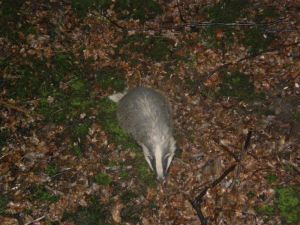
Badger under my tree

Badger under my tree

By now it was getting dark, and I had badgers all around me.  It was still just possible to see them using binoculars (binoculars gather more light than the naked eye, hence you can often see more with them when the light is failing). I took my first ever picture of a badger using the flash on my camera.  I’ve never done this before for fear of spooking them, but after taking a few flash pictures in the pasture field in November without any serious impact on the badger, I decided to give it a go.  Luckily, the badger didn’t seem bothered.

The badgers were still snuffling around me quite happily, which put me in a dilemma.  My number one rule of badger watching is ‘don’t disturb the badgers’.  Unfortunately, if you’re up a tree with badgers all around, this means that you’re pretty much stuck there.  To climb down and appear in the middle of them would be very bad style.

By the time the snuffling and scuffling sounds had moved away it was pretty much dark.  If you’ve ever been in a rural wood on a dark and misty April night then you can imagine just how dark it gets.  Of course, it is just these occasions that make it a good idea to take a torch when badger watching.  I had one with me, but out of a perverse desire to avoid disturbance I didn’t use it.  Climbing down the tree by feel wasn’t elegant, but I got down in one piece.  Luckily I know these woods very well, but even so there were a few Blair Witch Project moments as I crept out, using my tracking stick in front of me like a blind man.

But that’s the joy of the whole thing.  To be out in a wood at night, with the deer barking and the tawny owls crying – I wouldn’t have missed it for anything.

Read Full Post »

It’s been a beautiful spring day – warm and sunny.  It’s a great feeling after the cold winter we’ve had.  The daffodils and the blackthorn are blooming, the hazels and hawthorns are in bud, and the first butterflies are up and about.  There was even a skylark up in the clear blue sky, giving a wonderful summer feel to the day.

I decided that today would be the perfect day for my first badger watching session of the year.  It is still a little early, as the badgers will only be emerging just as it is getting dark, but I thought I’d give it a go and see.

It was good to be back in the wood again.  A small herd of fallow deer crossed the path a hundred yards or so ahead of me, and the buzzard was flying round the trees.  I can never tire of watching the buzzard when it does this; there is is something truly wild about seeing and hearing such an impressive bird of prey at close quarters.

The wind was blowing from the right direction for me to sit in my favourite tree.  The good thing about watching badgers at this time of year is that the undergrowth has not yet grown up to block the view, so I could see the whole sett from my perch.  It looked like a number of sett entrances were in regular use, and the paths and play areas looked well trodden.  The badgers have obviously been busy.

I sat in the tree from 6.30pm until just after 8.00, but sadly the badgers did not oblige.  I did not see so much as a whisker on a stripey nose.  I guess they are still emerging after dusk.

By 8.10pm it was getting too dark to see, even with binoculars, so I called it a night.  Even without the badgers it was good to get out again, to just sit in a tree in a wood and do nothing.  And besides, it shows that even after four years of watching badgers I still can’t guarantee anything.  I’ll try again in a week or so.

Note to self: even though it’s a warm day, and you’re too hot when walking, after the sun has gone down and you’ve been sitting still for an hour it gets bloody freezing.  Wear your waistcoat or an extra jumper next time!

Read Full Post »

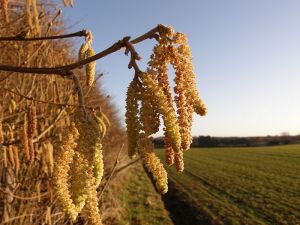
Catkins - spring is coming!

Catkins - spring is coming!

Well, it seems that spring is here at last.  I’ve been keeping busy travelling the world with work lately.  When I went away everything was frozen solid, and now that I’m back it’s thawed out, and allowed the first signs of spring to peep through.

Snowdrops are flowering down the lane, and the hazel catkins are out.  The hawthorns in the hedgerows have the first small buds.  In the vegetable garden I’ve finished the first planting of the year, so the potatoes, onions and beans have all gone in.  Unfortunately one of my chickens (Clarissa) escaped and ate my winter cabbage.  Frustrating, but a fairly regular occurrence in my kitchen garden.

The badgers and the foxes must be busy with young at the moment.  I’ll wait until the end of the month and then I’ll see what they’re up to.  The badger cubs won’t appear above ground until towards the end of April, but it will be good to get out and get up a tree again.

On a sadder note, there has been another badger killed on the roads.  This makes it three that I’m aware of in the last year around our village.  This latest casualty occurred in exactly the same place as the one in October (see The Grim Tithe Part 2).  There’s been some discussion on the Wild About Britain forum on the subject of badger road deaths, and it seems that there is a peak at this time of year.  I wonder if I can get the council to put up a sign?  Given the speed that people drive down this particular road it probably wouldn’t do any good, but you never know.

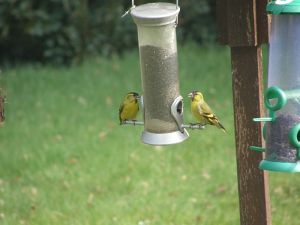
Siskins on the niger seed feeder

Siskins on the niger seed feeder

To end on a happier subject, my garden bird twitching list has increased slightly.  For the last month or so a woodpecker has been hammering on an oak tree just down the road.  I guess he’s getting territorial for spring.  I can hear him well enough, but I’m damned if I can spot him.  There’s been a fieldfare hanging about recently, and my niger seed feeder has been taken over by a gang of siskins.  Not particularly rare, but good-looking birds and new for me.

Read Full Post »

Another day, another fall of snow.  I took a stroll up to the pasture field tonight.  The snow is 20cm deep at the top of the hill, and yet there were still the tracks of a couple of badgers.

One of these tracks followed the same general route as one on Monday – out of the wood and down the hill, following the footpath across the pasture.  The other came out of the wood from some distance away, went up to the first track and then doubled back on itself.

As I said, the general line of the first set of tracks follows the footpath up to the wood, and there are three separate badger latrine sites within half a mile along this path.  This has got me thinking.

Badger latrines generally act as territory markers, and it is common for two neighboring badger clans to share a latrine on the border (see my post on mapping badger latrines for more details).  Suppose the badger tracks mark the boundary between two territories, and that the two badgers were from neighbouring setts?  This would explain why the tracks came from opposite directions, and why so many tracks on Monday all converged on this area.  The badgers were walking along the boundary line – staking out their territories from both sides.

If this is true, it also explains why the latrine sites are on the same line, and why the badgers on Monday were taking such an interest in each others’ tracks – they were from different clans.

Such ‘border patrol’ activities are mentioned in the literature.  For instance, I’ve finally read Hans Kruuk’s The Social Badger (and excellent it is, too), and he describes witnessing aggressive encounters between badgers on these shared paths between territories.

Lastly, on Monday I thought that the badger tracks showed that the territory of my badgers is much bigger than I thought it was.  This may not be the case.  If I was walking along a boundary between territories, I was looking at tracks from two different badger clans, one on either side of the border, rather than one big territory covering the whole area.

Curiouser and curiouser.  This means that my tracking in the snow may have pinpointed the precise line between two badger clans.  As a theory, this boundary idea fits all the facts.  I wonder how I could prove it?

Read Full Post »

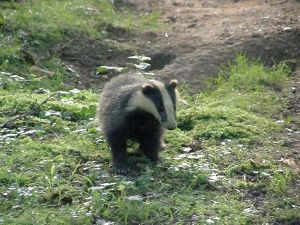
Badger cub

Badger cub

Thinking about the badger sett has got me thinking about badger paths.

Badger paths are an absolutely classic sign of an active sett.  Badgers are well-known to be creatures of habit, and will follow the same route night after night and even generation after generation until the vegetation is worn away and quite deep paths are formed.   The urge to follow paths is obviously very strong.  There are many examples of fences being erected across badger paths and the badgers simply barging through.

But why is this so?  Why do badgers follow such regular paths?

To understand why, you have to stop thinking like a human and think like a badger for a while.

I’ve already mentioned the senses of the badger (see About Badgers).  Badgers have poor eyesight, but a very good sense of smell.  Unlike humans, who rely on visual information to navigate, the badger ‘sees’ the world as a landscape of scents and smells.  This makes perfect sense for an animal that is active in the hours of darkness.

Badger paths then, are not visual paths, but scent paths.  Each path carries the scent of the badgers that have used it.  When a badger is following a path, it is literally following the badgers that have gone before.  As a system it is simple and effective – the badger can find its way around a completely dark wood by using these trails, and in times of danger it can always follow them back to the sett.  It is difficult for humans to understand a landscape of smells, but to the badger, these paths must stand out like a bright shining road would to us.

But nothing with badgers is ever simple.   Many mammals have interdigital glands.  These are glands between the toes that leave scent when the animal walks.  Cats have them,  for instance.  When a cat scratches a tree it is not sharpening its claws.  It is leaving scent from its interdigital glands to mark its territory.

It seems likely that badgers also have interdigital glands.  This means that every time a badger uses a path it is not only leaving a signpost for itself and for other badgers, it is using the path to mark out the territory of the clan. Badgers use scent to identify members of their own clan, so a badger can easily tell which paths belong to them, and which belong to the neighboring clans.

So badger paths are not just the result of ingrained habits or an easy way for the badgers to get from one place to another.  Seen in conjuction with other territorial markers such as the latrine sites and scratching trees, paths are a sophisticated part of the social behaviour of badgers.

Read Full Post »

The weather today has been much warmer than of late.  It was a cold night, but the sun came out and the temperature went up to 8 degrees or so.  It doesn’t sound much, but compared to the last couple of weeks it feels almost tropical!

Rabbit tracks in frost

Rabbit tracks in frost

I went on my usual Sunday morning dawn stroll today.  When I set off it was still very frosty.

Here’s an example of tracks that you won’t find in a tracking book.

The pavement was very frosty, although the road had been gritted.  At some point in the night a pair of rabbits had crossed the road, hopped up onto the pavement and then gone through the railings to the field beyond.

They had picked up the salt from the road on their feet, and this salt had melted the frost where their feet had touched it, leaving this perfect set of tracks in the ice.

I decided to make the most of the day and went for a longer walk than usual.  I let my feet carry me in a big loop around the woods.  The Chinese Water Deer were out again, and the local buzzard seems to have found a friend, as there were two buzzards swooping and calling over the fields.  Either that or he was having a territorial dispute with the neighbour.

I thought it was time I checked in at the sett to see how the badgers were doing.  Of course, there was no chance of them being out at 9.30am, but I wanted to have a look round.  It gave me a good chance to look at the different parts of the sett.  In summer, when I’m actively watching the badgers, I don’t like to get to close to the sett for fear of disturbing them as scent can linger for a long while.  Today though, I thought I’d have a look, since the badgers would not be active until much later in the evening.

Everything seemed to be in order at the sett.  There were two entrances that looked to be in very active use.  Here’s a picture of one of them – note the relatively clean hole, without many fallen leaves or other debris.  You can also see how the sides have been polished by the coming and going of many badgers.  This is obviously well-used at the moment.

Badger sett entrance (1)

Badger sett entrance (1)

Very encouragingly, a couple of entrances showed signs of recent digging and of having been cleared out.  In the picture below you can see a furrow pointing directly to the hole, made by badgers dragging out spoil.  This is another classic sign of an active badger sett.

Badger sett entrance (2)

Badger sett entrance (2)

In the picture below, you can see that the badgers have dug out large amounts of dead leaves from this entrance.  This is a sign that they’re clearing out an old chamber for re-use.

Badger sett entrance showing signs of clearing out

Badger sett entrance showing signs of clearing out

Why is this encouraging?  Well, badgers re-dig parts of the sett at this time of year to make ready for the birth of cubs in February.  The sow prepares a separate ‘maternity suite’ where she can get away from the other badgers and won’t be disturbed.  The signs of activity at the sett all point to there being cubs on the way!

The interesting thing is that there is clear activity at both ends of the sett – the east and west sides.  This implies that badgers are in residence at both ends.  There is re-digging going on at both ends too.  Does this mean that there will be two separate litters of cubs from separate mothers?  Has there been a split in the badgers, so that different groups have taken to living in different parts of the sett?

All the books I’ve read suggest that all the badgers in a sett should be part of one single group, with only the dominant male and female breeding.  This wasn’t the case last year, as there were at least two litters of cubs, and the signs seem to indicate that there will be separate litters again this year.

I’ve also been thinking about the number of badgers in the sett at the moment.  If all the cubs survived (and I have no reason to think that they haven’t) then there will be at least 10 badgers in residence.  Do some of them leave home at some point, or do they stay in the group permanently?  Might this account for the active use of different parts of the sett?  If they leave, what is it that determines who leaves and who stays, and where do the badgers that leave go?  Do they join another sett, or start their own?

You see, this is the great thing about badgers.  We’re only in January and already they’ve got me confused.  I’m going to start the badger watching season as I finished the last one – with more questions than answers!

This is a mystery that needs solving.  Does anyone know where I can get a cheap copy of Hans Kruuk’s The Social Badger?  Even better, if anyone knows anything about the clan structure of badger groups and how they change over time, then please do leave a comment and enlighten me.

Read Full Post »

I don’t know what it is, but I always find this time of year a bit melancholy and dreary.  The leaves are gone from the trees, the woods are quiet, the vegetable garden is sleeping and there is a cold, damp stillness over everything.  Summer seems a long way off.

Because of this, I decided that I needed to shake off the urge to sit in front of the fire for the next three months and get out and do something.  Over the last week or so the lack of badger-watching has been nagging at me, and I made up my mind to try and get a peep at the stripey devils.

As I’ve said before, I am not keen on the idea of using artificial lights by the sett for fear of disturbing the badgers, so I hatched a plan to try and see them as they foraged in the big pasture field.  There would still be a risk of disturbance, but not so great as there would be by shining lights on them as soon as they poked their noses above ground.  So – it was time for another late night excursion to the fields.

I’d seen a badger here the last time I tried it (see Fieldnotes: 2nd August 2008) so I was at least partly confident.  The problem was that sitting in a field for half the night in August is one thing.  Doing it in November is quite another.

As anyone who has spent time outdoors will know, it is perfectly possible to keep warm when you’re walking around.  Indeed, the challenge is often to avoid getting too hot.  When you’re just sitting in one place though, the chill seems to seep into your bones and even a mild night can be very cold.  Tonight was a cold night to begin with, with a sharp wind and a damp mist hanging over the fields.

What every badger watcher is wearing this season...

What every badger watcher is wearing this season...

In anticipation of the cold, I dressed up in almost every article of clothing I possess – fleece trousers, thermal T-shirt, mountain walking fleece top (which I never wear when mountain walking because it gets too hot), army extreme cold weather shirt, jumper, waterproof jacket, mittens and fleece neckwarmer.  To top everything off I put on the furry Russian hat that my wife gave me.  I was all dressed up with somewhere to go, and at 10.30pm I headed off towards the fields.

God only knows what I looked like.  A couple of cars passed me as I walked through the village.  To the drivers I must have appeared in the headlights like a cross between a German soldier in the last days of the siege of Stalingrad and some strange Bedfordshire sasquatch!

Sitting on a log at the top of the field I was surprisingly warm and cosy.  As well I should have been, given the amount of gear I was wearing!  In an odd way it was nice to be there in winter, especially after having spent quite a bit of time on the same log over the summer.  It seemed to be taking things full circle in some way.

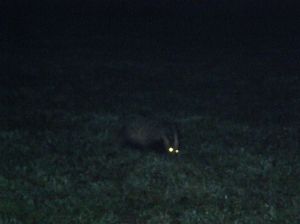
Night-time badger

Night-time badger

I sat there for an hour or so, occasionally shining a torch around the field.  And then, just before midnight, a badger appeared.

It seemed quite unconcerned about me being there as it snuffled about finding worms in the grass.  I turned on my red torch and crept closer, until I was about 20 feet away.  This is the first badger I have seen for a few months now, and it was good just to stand there and watch it.  It was particularly interesting to watch it feeding, working methodically across the field with its nose to the ground, obviously sniffing out the next earthworm.

I took a couple of photos.  They aren’t the best badger pictures ever taken, but they are a first for me.  The badger didn’t seem too put off by the flash, but I didn’t want to make a nuisance of myself.

Night-time badger 2

Night-time badger 2

After about five minutes it ambled off and I let it go.  For me, it was enough to have been out and about on a winters night, and to get a glimpse of one of these fascinating creatures.  I had satisfied my badger cravings for the time being.

Read Full Post »

Lately I’ve taken to getting up at dawn on Sundays and going for a walk around the local area.

I’d recommend it for anyone interested in wildlife.  You are up and about before the human world has woken up, the nocturnal animals – and those that are shy – are still around, and any tracks from the night before are still fresh and untrampled. It’s a rare occasion when I’m not rewarded with views of hares, muntjac and roe deer in the fields.

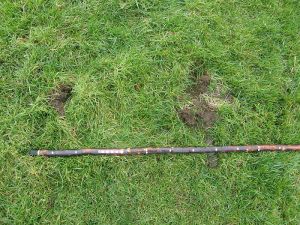
Badger snuffle holes on pasture

Badger snuffle holes on pasture

Besides, it gives me some extra time before the day really begins.  Of course, dawn is not very early in the morning at the moment – 6.30 to 7.00am – let’s see if I’m still so keen in May when I have to get up at 4.00am!

Today I thought I’d go up to the wood and see what the badgers have been up to.  There was no chance of seeing them, of course, they’d all be tucked up and asleep underground, but I thought I’d have a look.

The good news is that they seem to be thriving.  The pasture field was full of snuffle holes where they’d been foraging for worms and insects, and the usual latrine sites showed evidence of lots of activity.

Unfortunately it had been tipping down with rain for the last 24 hours, so any tracks were either washed away or underwater.  It was definitely a day for wearing wellies!  The only track I found was a fallow deer print under an overhanging tree, but other than that the ground was a clean slate.

Down at the sett the badger paths were well trampled, so they are obviously still very active.  I may try a night time trip with a red torch one of these evenings and see if I can spot anything.  I’m beginning to get badger withdrawal symptoms, so I’d like to try and watch them again before spring.

My fascination with badger dung continues.  The main latrine site by the sett contained large amounts of dung, some that was a mass of seeds, and some that was mostly sweetcorn.  The sweetcorn probably comes from patches of maize that are grown as food and cover for pheasants.

Badger dung with seeds

Badger dung with seeds

There seems to be a pattern here, in that separate piles of badger dung can contain entirely different food.  It suggests that the different badgers in the sett may be feeding on completely different things, and not all foraging together, which is an interesting insight into their behaviour.

I’m sorry to say that I don’t know what the seeds were in the dung.  If I was a proper naturalist I’d have brought some home and looked at it under the microscope, but I didn’t.  My wife seems to tolerate my naturalist ramblings (in every sense of the word).  Bringing home poo would, I feel, be a step too far even for me.

By this time it was time for my other Sunday ritual, bacon and eggs, with fresh free range eggs from the garden.  A good walk in the woods is surely the best way to work up an appetite for breakfast.

Read Full Post »

The Grim Tithe

Newborough Forest, Anglesey

Newborough Forest, Anglesey

As I write this it’s blowing a gale outside, with squalls of cold rain gusting about.  I was supposed to be harvesting the last of my potatoes today, but I’ve retreated in the face of the weather and the hope that tomorrow will be better.

It is odd to think that two weeks ago I was sitting on a beach basking in the sunshine, and even more remarkable when that beach was in North Wales.  It was a very pleasant holiday – lots of fishing, walking and generally taking things easy.

The elusive red squirrels, alas, eluded me.  I spent a couple of days walking around Newborough forest, and though there was plenty of sign in the form of gnawed pine cones, the squirrels themselves were nowhere to be seen.  Still, it gives me an excuse to go back there.

Back home, there’s sad news for me.  A badger was killed this week on the main road, about a quarter of a mile from my house.  This is not one of ‘my’ badgers, or at least it isn’t from the sett that I watch – that’s on the other side of the village.  It is however in the area where I take my regular tracking walks, and may even be the badger that I’ve tracked in the field behind my house.

Road accidents account for a large proportion of badger deaths; they are possibly the biggest cause of death.  Every year there is a grim toll of casualties.  Unfortunately, badgers seem to have little road sense.  I’ve twice had badgers run across the road in front of my car, and both times they’ve dashed across without even seeming to look.

Since I moved here five years ago I’ve seen three dead badgers by the side of the roads in this area.  The accidents all seem to occur at this time of year.  I think that as the nights get longer, the badger’s routines come into conflict with those of humans.  During the summer, it gets light before anyone is up and about, so the badgers are safely home before the morning traffic starts.  Now the mornings are getting darker their paths are more likely to cross ours, with tragic results.

I took a walk down the road to have a look.  I get particularly annoyed when I walk along road verges, as they always seem to be littered with crisp packets, fast food wrappers and plastic bottles thrown away by the ignorant and vulgar motorists.  I can’t understand what makes people drive through the countryside tossing out crap from their car windows.  If I could only catch them in the act I’d learn them a lesson, believe me.

A sad end

A sad end

The dead badger was on the verge.  It is a sad end for such a creature, but then I can’t really blame anyone.  I drive a car and I drive down this road, so it could well have been me.  There was a badger path a little way off, so it seems like the badger was returning home after foraging when the accident happened.

I walked home along the route I use on my regular tracking walks, hoping to see fresh badger tracks that would prove that it wasn’t the badger I have been tracking lying there.  Unfortunately the wind and the rain had polished the sandy ground smooth, so there were no tracks at all to be seen.  I’ll have a look tomorrow, weather permitting, and see if any animals have been down there overnight.

Read Full Post »

« Newer Posts - Older Posts »