Feeds:
Posts
Comments

Speaking of books, I bought myself another good one recently.   It’s called The Nocturnal Naturalist by Kelvin Boot.  Published in 1985 it’s out of print now (I bought mine, an ex-library copy, for £2 on Amazon), which is a shame as it’s a good book.  Let me quote you a paragraph from the opening page:

‘My interest in the night stemmed from a combination of curiosity and necessity – I wanted to study wild creatures but had to work for a living during the day.  The result was a revelation.  I was astounded at how much could be seen within a small radius and am now convinced that a thorough understanding of an area can only be gained by studying it at night.’

Here, clearly, is a man after my own heart.  Not only does he share my desire to understand the wildlife on his local patch, but he also has no time to do it in daylight.  The obvious course of action was to follow his example and make more use of the hours of darkness.

Tonight I put the theory into practice.  Unfortunately the weather was filthy; strong winds – the tail-end of the recent gales – and a steady drizzle blowing sideways across the fields in the gusts.  Not ideal for any wildlife, and certainly not ideal for me.  Nevertheless, I wanted to put the whole nocturnal thing into practice, and besides, there is always a pleasure in being out when everyone else is tucked up inside.

It’s a good thing that everyone was inside, because I spent an hour and a half and a shuffling slowly around the local area dressed in my camouflage jacket and peering through my night vision scope.  Anyone seeing me would have probably called the police.  It’s a sign that I’ve grown soft lately, but I couldn’t face the mile-long walk up to the wood in these conditions.  Instead, I settled for the circuit of the fields and copses behind my house – the same route that makes up my usual short tracking walk.  I know from the signs that I’ve found here that there are foxes, badgers, a range of deer species and at least one stoat that all frequent this area, so it’s a good a place to start as any.

I decided to use the NV scope instead of a torch.  Walking while using the scope was almost impossible, but I found it was easy enough to scan the area, walk a few yards and then stop and scan again.  The infra-red illuminator meant that any animals showed up by their eye-shine, so it was quite an effective way of searching an area.

Did I see foxes, badgers, deer or stoats?  No.  I saw a total of 14 rabbits.  I probably see more (and more interesting) wildlife on my drive to the station each morning, but that’s not the point.  I was outdoors and I was enjoying myself.
The Handbook

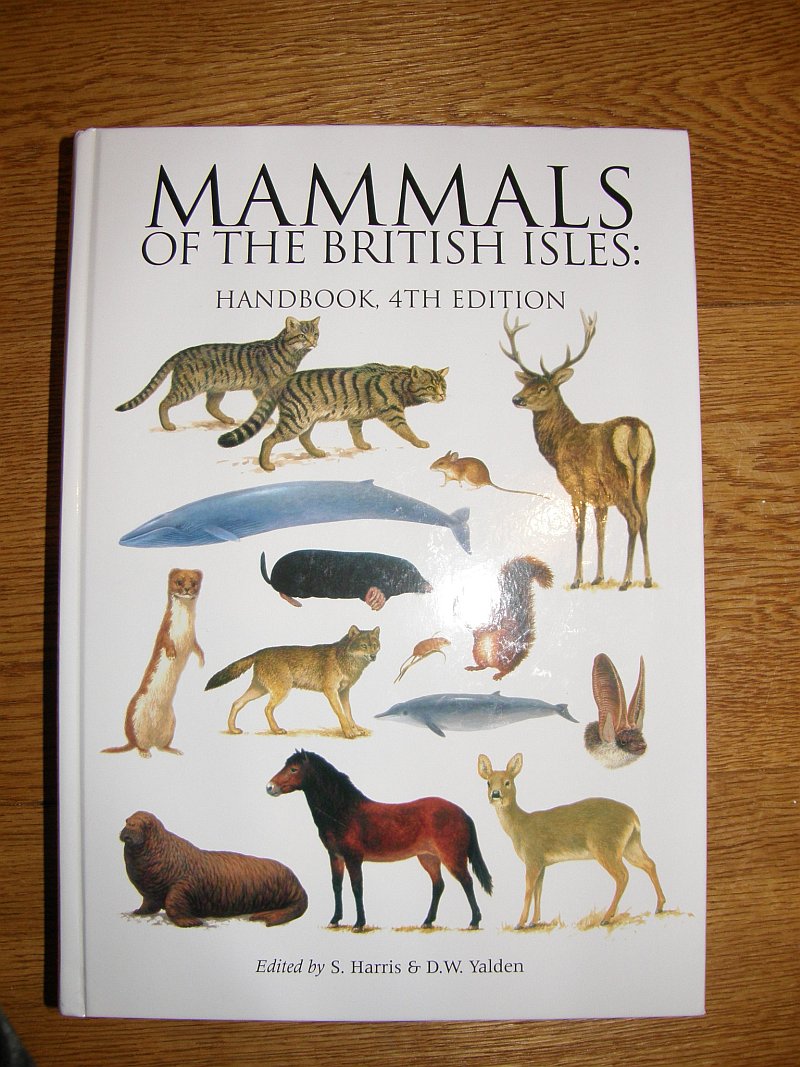
Mammals of the British Isles Handbook.jpgChristmas may seem a long time ago as I sit writing this in late January, but I bring it up because my Christmas present has arrived.  After some amalgamation of gifts from various people over the last few years I have bought myself a copy of Mammals of the British Isles: Handbook by S. Harris and D.W. Yalden.

And I want to share the moment with you.

Published by the Mammal Society, the Handbook is the guide to all the mammal species of Britain, from the Pygmy Shrew up to the Blue Whale.

In its 799 luxuriously glossy pages it details each species, including recognition, signs, measurements, distribution, history, social organisation, feeding, breeding, mortality and even parasites; all with copious references to the scientific literature.  This really is the definitive guide.  There is now nothing that I won’t know about any UK mammal species.

It’s gorgeous too.  If you’re going to be an armchair naturalist, this is the book to have by your side.  It comes with a hefty price tag (£76.99) which makes it the second most expensive book I’ve ever bought*, but like I say, Christmas presents made it possible.Mammals of the British Isles Handbook - Badgers

So, I may not be getting outside much, but at least in the meantime I can sit at home with my book, caressing its pages and whispering “my precious…” over and over.

A big ‘thanks’ to Paul and Joan for their kindness..

.

(*the most expensive was a good copy of the rare 1937 edition of the RCAHMW An Inventory of the Ancient Monuments of Anglesey, but that’s another story)

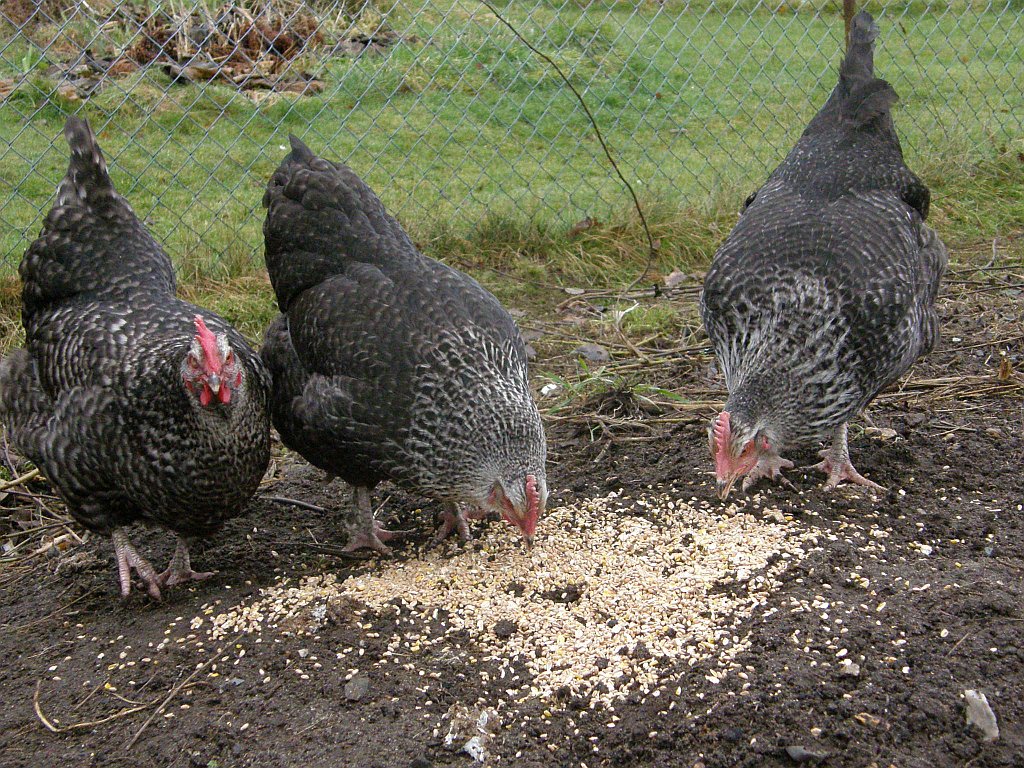
Clarissa, Mabel and Henrietta - our three Speckeldy hens

Clarissa, Mabel and Henrietta - our three Speckeldy hens

It’s nice to think that although we’re in the middle of the dark and the cold of winter, warmer and brighter days will come again.  One of the key dates each year is the winter solstice, when the days start getting longer.  Another is the first egg of the new year.

Chickens stop laying in late autumn when the long nights begin, and they start laying again in the new year when the days have reached a particular length.  I had the first egg today from my three chickens – Clarissa, Mabel and Henrietta.

I’ve kept a note of this date for the past three years now, and it is consistently in the last week of January.  I now know when I can expect to have eggs again.  It may not sound very important, but we’ve grown accustomed to tasty, fresh eggs from our free-range hens.  I don’t like having to buy eggs from the supermarket.  They’re not the same, believe me.

Aspley WoodsToday I joined the Bedfordshire Badger Network on a field trip to Aspley Woods.

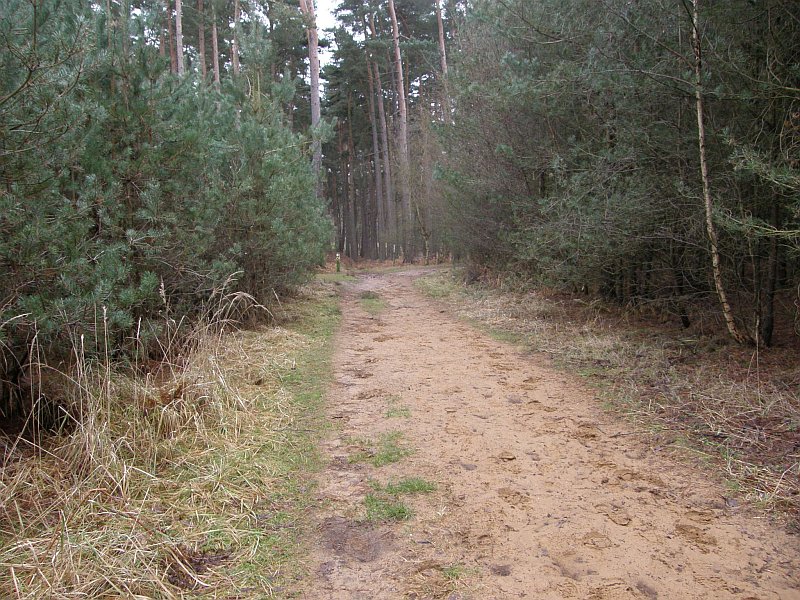
Aspley Woods is on the Bedfordshire/ Buckinghamshire border.  It’s a fantastic place – acres of woodland and miles of paths and trails.  There’s even an Iron Age hillfort, a rare antiquity in this part of the country.   The nearby village of Woburn Sands gives you a clue to the underlying geology: the trails are mostly fine sand and the perfect place to spend a day if you want to improve your tracking skills.  It’s like walking through a giant sand pit.

We were looking for signs of badgers in the woods.  Unfortunately, the group I was with found no trace of them whatsoever.  Perhaps the poor, sandy soil isn’t ideal for badgers – perhaps there isn’t enough food.  Perhaps the popularity of the woods with walkers, horse riders and mountain bikers has discouraged them.  Still, badgers are fairly common in the area so you think there would have been some sign.  Perhaps we were just looking in the wrong place.

Whatever.  It was nice to get out for a walk in the woods with like-minded folk.  A very enjoyable morning.

Chinese Water Deer in the garden

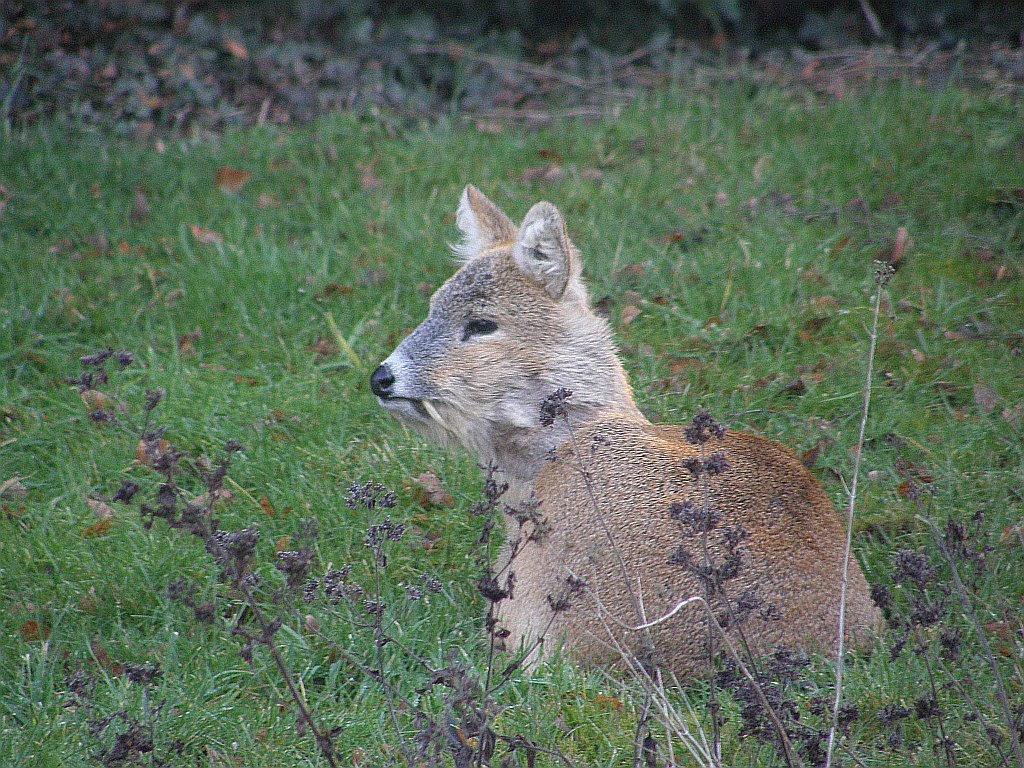
The Chinese Water Deer in the garden

I’ve been laid up with the ‘flu for a few days so I’m taking it easy at the moment.  Fortunately the wildlife seems to be coming to me today.

We often sit in our living room and watch the birds on the feeders.  Today, the usual tits, goldfinches, blackbirds and robins have been joined by a new visitor.  A Chinese Water Deer has taken up residence on my lawn.  It’s been sitting there for the last hour or so at least, quietly chewing the cud.

Chinese Water Deer are fairly common around here.  They’re scarce outside Bedfordshire and Cambridgeshire, but they are slowly expanding their range.  They are yet another foreign species that escaped from the Woburn Estate.

Chinese Water Deer at the bird table

Feeding under the bird table

This one is a shaggy old beast.  I don’t know if CWD grow a winter coat, but this one certainly seems to be hairier than most.  It is difficult to tell males from females with CWD (i.e. I can’t do it) as they both have the same tusks.

I like this.  I can now watch the local wildlife from the comfort of my sofa, so the deer is welcome to stay if it wants somewhere peaceful to sit and digest.  On the other hand, perhaps this is just a reflection on how much of a wilderness my garden is at the moment.

It’s a belated Happy New Year actually, as we’re three days into 2011 already.  I’ve had a great time with friends and family over Christmas and the New Year and things are settling back into a more normal routine.

The cold weather broke a couple of days after Christmas.  Christmas day was on Saturday; by Monday the temperature had risen above freezing for the first time in weeks, and by Wednesday the fields were clear of snow.  It was a relief (not least to my heating bills) but after a thaw everything is muddy, damp, foggy and just dirty.  Part of me misses the crisp cleanness of the ice.

I have been even quieter than usual in terms of getting out and about in the countryside.  This isn’t just laziness, it’s the way my life is organised at the moment.  Mrs BWM works a shift pattern that includes weekends, so as often as not I look after Scarlett at the weekend.  Scarlett gets up at 7.30am or so, has lunch at 12.30, an afternoon nap between 2.00 and 4.00pm, and then off to bed at 7.00 or 7.30pm.  This means I have two ‘windows’ to go out with her during the day, one in the morning and one after 4.00pm.  Unfortunately, at this time of year, it is too dark to go wandering around with a small child at 4.00pm, hence we haven’t been out much.  Besides, it really has been too cold for a toddler.  Much better to stay in and watch In the Night Garden on TV.

We had a little stroll today though, just around the local fields in expectation of the longer and warmer days to come.  The local birds seem to be waking up after the cold.  We saw thrushes, finches, blackbirds and tits.  I always think of blue tits in particular as garden birds, so much so that it seems odd to see them in the wild.  At one point I swear I heard a green woodpecker ‘yaffling’ in the trees, but this may have been just wishful thinking.

Badger tracks - front and hind feet

Badger tracks - front (with claws) and hind feet

The damp, muddy ground was ideal for tracks.  Not as good as snow, but I was able to get a good idea of the animals that had been about.  The fallow deer had passed through, plus the normal muntjac.  There were many rabbit tracks – these look quite different in sand to the way they do in snow.  Often all you will see is the clawmarks, quite unlike the broad pads that show up in snow.

Encouragingly, the badgers are still present in this field.  I followed the tracks of a fairly small badger for half a mile or so along the path.  It’s sort of comforting to know that they’re still out there, even when I’m too busy to get out and see them.

It was only a short stroll, but it’s given me the impetus to try to get out more.  My family takes priority, of course, but I need to find a way to make time to get outside.  My interest in the local wildlife was originally stimulated by the desire to get outside and experience the countryside on my doorstep.  I think I need to re-discover that.

This being New Year, what I think I will do is to put together a list of  wildlife ‘resolutions’ that I want to achieve over the coming year.  I’ll need to give these some thought, because I need to be realistic (let’s face it, I’m not going to see a Golden Eagle or a Scottish Wildcat here in Mid-Bedfordshire), but at the same time I think it would be good to have a goal.

Let me ponder this for a while, and then I’ll come back with my list.  Let’s see what I can come up with.

More Waxwings

A few days after I went to see the waxwings in Woburn the flock finished eating the berries on that particular tree moved on, so I saw them at just the right time.  Mind you, there have been reports of waxwings from all across the UK, so this definitely seems to be a ‘waxwing winter’.  I came across another flock myself a couple of days before Christmas, 30 or so birds in a tree by the industrial estate on the A507 in Flitwick, Bedfordshire.  Unfortunately the snow and ice made it impossible to stop (and it is a busy main road), but it gave me a quiet sense of satisfaction to have found my own flock.  Following the paparazzi is one thing, but finding your own flock of waxwings is somehow better.

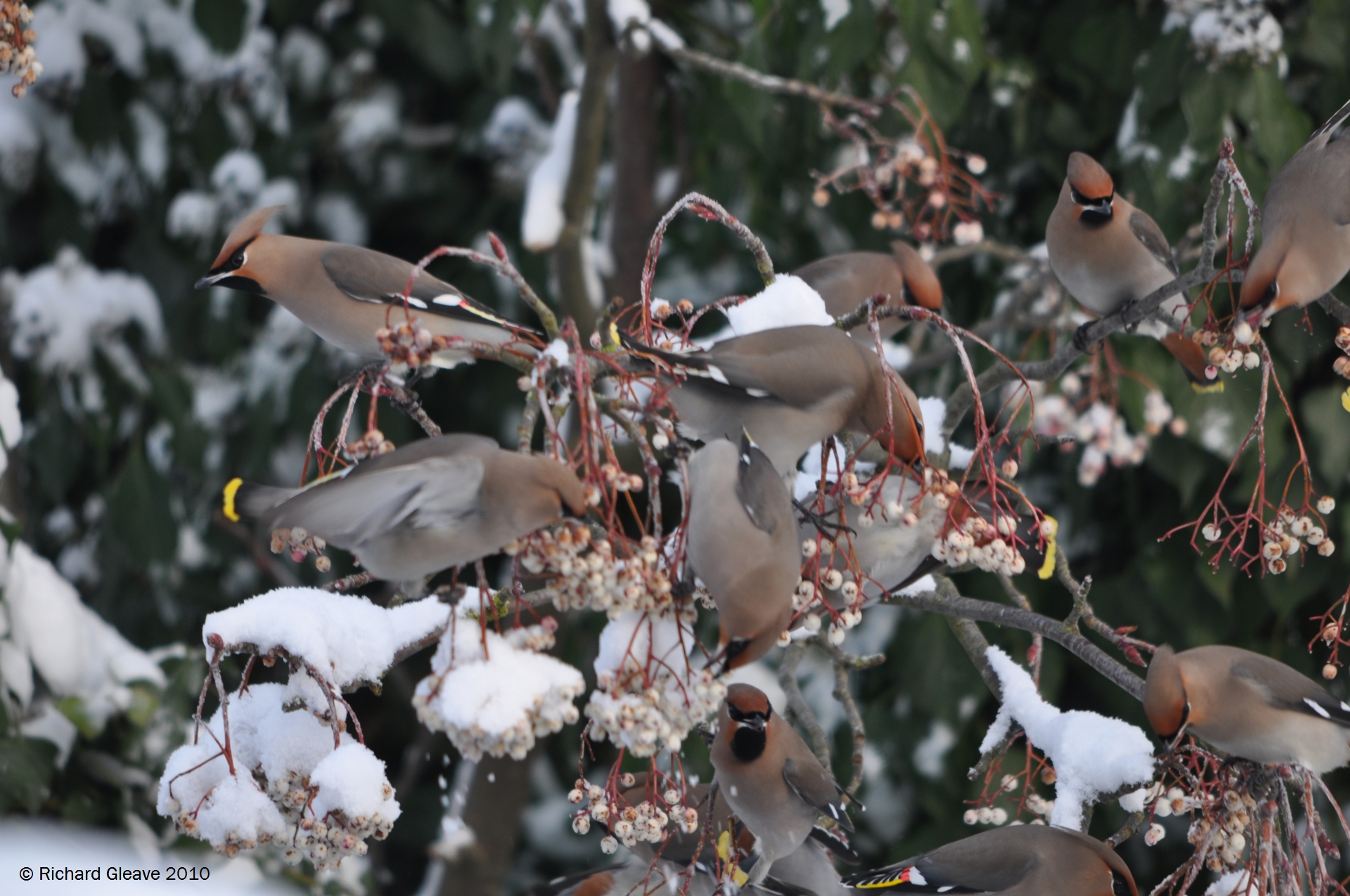
On the same subject, one of my fellow watchers in Woburn found the post and got in touch.  Richard has taken some absolutely stunning pictures of the Woburn waxwings, and with his permission I’d like to post them up here.  Click on the pictures to see the larger versions – you won’t be disappointed, these really are excellent photographs of truly stunning birds.  The copyright of these pictures belongs to Richard Gleave.

Waxwing by Richard Gleave

Waxwing by Richard Gleave

Waxwing flock in Woburn by Richard Gleave

Waxwing flock in Woburn by Richard Gleave

Happy Winter Solstice! - Robin in SnowWell, here we are again.  The shortest day of the year.  And it really does feel like midwinter with the snow and the deep frost outside.  It’s definitely a night for staying inside in the warmth and light, for celebrating turning the corner of the year. From tomorrow, the days start to get longer again.  After summer is winter, and after winter summer.

However you celebrate it, season’s greetings from Tales from the Wood!

Scarlett - Dreaming of a wild christmas

Look at this.  You wait ages for a post and then three come at once…

I’ve just driven home from the station after a particularly bad commute on the train from London.  I’m driving Mrs BWM’s Ford Fiesta at the moment while she uses the executive motor (she has further to drive).  How come a little car like this can cope with the snow perfectly well, yet the full engineering resources of First Capital Connect trains are utterly overwhelmed?

Now I’ve got that off my chest, what I wanted to say was that my journey home was brightened up when I arrived home.  There, on the hedge by the driveway, sat a tawny owl.  We have a lot of tawny owls around here but you hear them much more often than you see them.  I drove my car right up to this one, so we sat looking at each other for a minute from a distance of no more than three feet until I pulled into the drive and it flew away.  What a magnificent bird to see up close on a dark and snowy night.

Perhaps I shouldn’t be too pleased though.  This was obviously not normal behaviour, otherwise I’d see owls on the hedge much more often.  It got me thinking about how owls cope with the snow and the cold weather.

We feed the birds in the garden.  Mrs BWM and I regularly sit on the sofa and look out at the bird table – it’s better than the TV a lot of the time.  We have three robins (Mrs BWM knows each one by sight – they have some territorial issues but they seem to have come to a truce to share the bird table at the moment), blue tits, great tits, the odd greenfinch and chaffinch and a regular ‘charm’ of goldfinches.  The bird table is popular at the moment, and so it should be – the birds seem to get more expensive food than I do!  But we’re happy to feed them and happy to watch them, and they’re happy to eat the food we put out, so everyone benefits.

But what about owls?  Tawny owls mainly eat small mammals.  When there is four inches of snow on the ground these must be hard to find.  They’ll either be keeping underground or, like voles, they may spend their time tunneling under the snow.  Either way, with their main prey out of sight a prolonged period of snow must be a lean time for an owl.

If I put out food for the other birds, can I put out food for owls?  And what would this be?  Would I need to get hold of some mice and leave them on the bird table?  Is this ethical?  And where do you get mice from anyway?

It was good to see the owl this evening but it has got me thinking.  If anyone knows anything about feeding wild owls, please do let me know.

Waxwings in Woburn

Waxwings in Woburn

So the snow fell yesterday and it’s still here today.  The warmest it got was minus 4 degrees at midday, so the snow is still crisp and powdery.  I took Scarlett for a quick walk to the field behind my house this morning.  There were the usual rabbit tracks and quite a few fox tracks, but the main thing I discovered was that hauling an all-terrain baby buggy through 4 inches of powder snow really is as difficult as it sounds.

In the afternoon, despite all the warnings not to travel unless it was absolutely vital, I got in my car and went for a drive along the snow-covered, icy roads to the village of Woburn.  I was risking life and limb to witness a great wildlife spectacle: the Woburn waxwings.

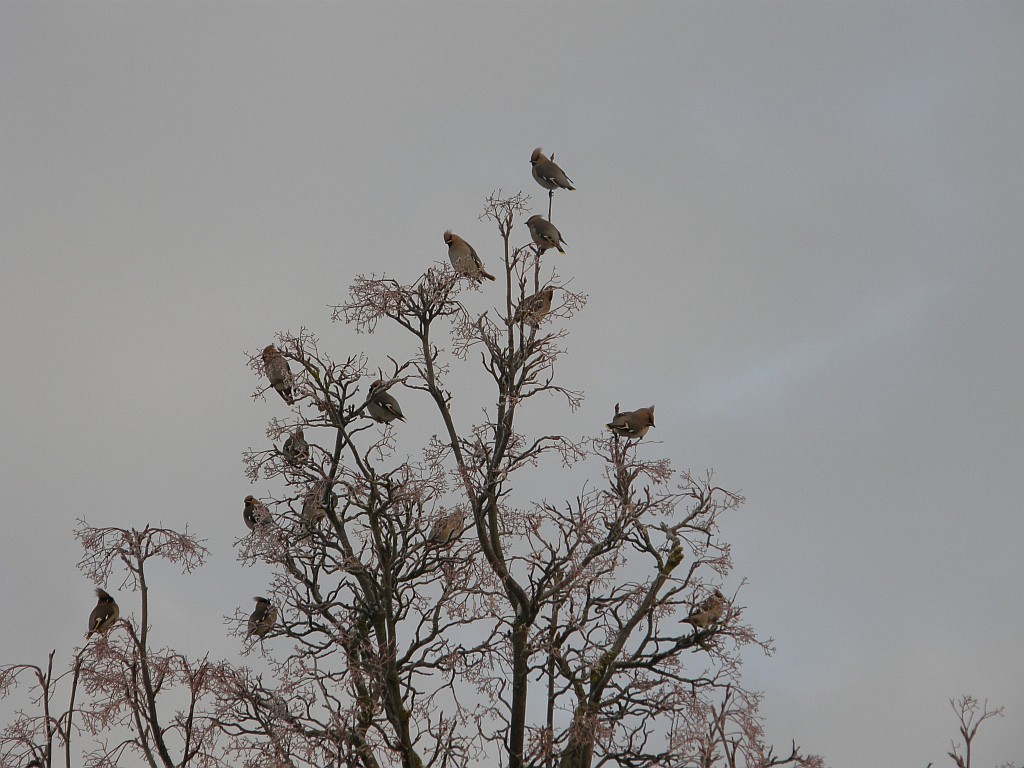
Waxwing flock

A small part of the waxwing flock

Waxwings are birds, related (I think) to larks.  They are residents of Scandinavia but sometimes come to Britain in winter, to feed on berries.  These invasions – ‘waxwing winters’ have apparently been recorded since as long ago as 1679.

For a week or two now the birdwatching grapevine has been humming with reports of waxwings in the area.  The biggest flock is in Woburn, where 350 birds have been reliably counted.  This is a big number of waxwings.  Now, you must understand that I don’t class myself as a twitcher.  I’ve always made a point of sticking to the area around my house, looking for birds and animals but not travelling far from home just to tick off a species.  For me, understanding my local patch has always been the important thing.  At least, I did until we got a huge flock of unusual migrants a few miles away.  This was enough to get me skidding my way along the treacherous, icy roads.

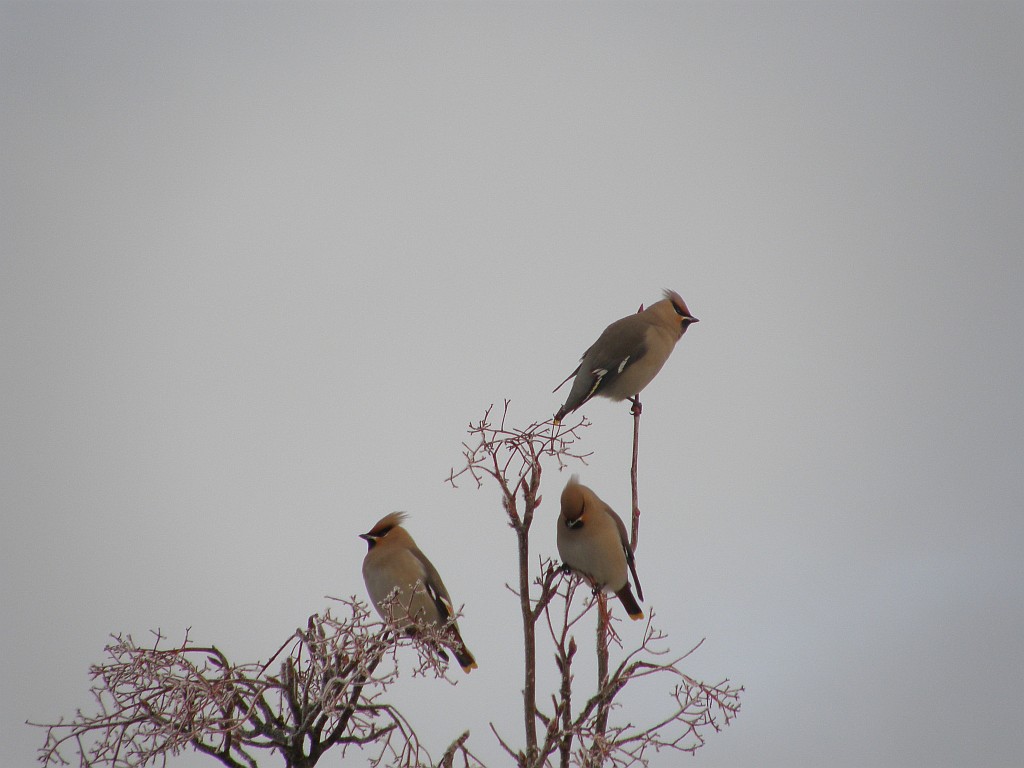
The waxwings were easy to find.  A small gaggle of birdwatching paparazzi was gathered to watch and photograph them.  My RSPB Pocket Birds book says of that waxwings are “exotic looking and very tame”.   The book is very accurate on this.  Firstly, waxwings are very handsome birds.  Dark pink, with black and white bars on the wing tips and a charming crest.  They do look exotic.  To see a whole flock – hundreds together – was a fantastic sight.

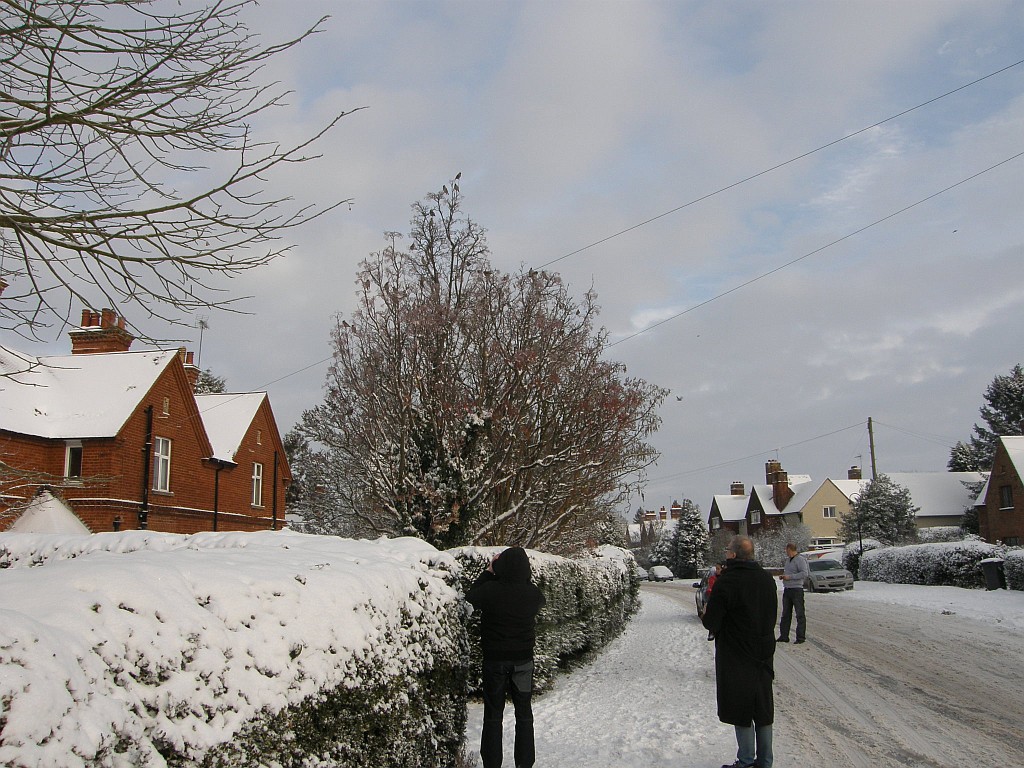
Watching the waxwings in Woburn

Waxwing paparazzi - the birds are in the bush in the centre

Secondly, the main waxwing flock in Woburn was concentrated in a berry bush in the front garden of a house by the main road.  This was very convenient for birdwatchers as it meant we could get a real close view.  Every now and then the flock would scatter a little but they’d come back almost immediately.  They were not in least bothered by the passing cars, the photographers, or even people walking past on the pavement a few feet away.  It made for a great spectacle.  In addition to the hardcore birdwatchers, many people stopped walking or even stopped their cars to find out what everyone was looking at.

I’ve crossed a line today.  I’ve gone from a casual local-patch birdwatcher to a proper twitcher.  But for the experience of seeing a whole flock of such good looking birds I was quite happy to make the journey.  Besides, if the waxwings have come all the way from Scandinavia to visit our corner of Mid-Bedfordshire, it would be rude for me not to welcome them in person.