Some good news! Having persisted with my sore toe for a week, in which the antibiotics made no impact whatsoever, I sought a second (and hopefully more competent) medical opinion.
The second doctor sent me for X-rays, so after a fun evening at the Luton and Dunstable Hospital, it was revealed that I have neither gout nor an infection, but a broken toe. The X-ray showed a fracture on the first joint of the toe. It wasn’t just a hairline stress fracture, but a significant piece knocked off the end of the bone at the joint. Hence the pain and swelling. I’ve broken toes before, but in this case I just woke up one morning in pain – I didn’t fall over or kick anything. I haven’t even been running for a while.
I’m relieved. It still hurts to walk, but at least it’s a one-off and explainable event. I don’t have a long-term problem.
Mostly explainable. One mystery remains, which has baffled both me and medical science. How the hell can I break a lump of bone off my toe without even noticing it…???
I may be just a grumpy old man with a sore toe, but there are some things that I can’t let pass without comment.
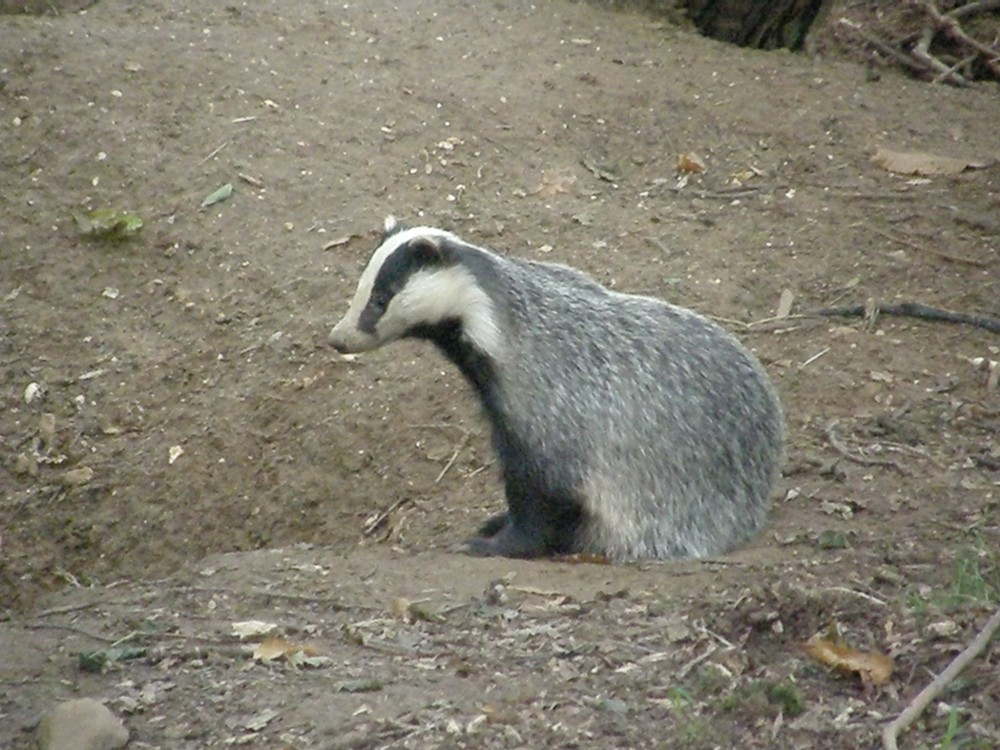
The government has announced that it will go ahead with the widely ill-advised badger cull. The details of how the government proposes to go about this cull are even worse than we imagined. They are relying on ‘ifs’ and making assumptions not based on evidence. At least 70% of the badger population in many areas will be killed, many of them healthy. This decision comes in spite of scientific evidence which shows that culling is a misjudged effort to control bovine TB, will be of little help in reducing the disease long term and could actually make things worse! The frustrating thing is that the science may only be proved wrong when the badgers have been slaughtered and the bovine TB (which is far more likely to be a product of poor farming practices) is still there.
The fact is, a badger cull didn’t work in Ireland. It won’t work here.
Not only is scientific evidence against the government, the public are too. A poll for the BBC (http://www.bbc.co.uk/news/science-environment-13684482) found unanimous opposition to the badger cull in all areas, rural as well as urban, including those areas worst affected by bovine TB. The arrogance of this government saddens me, but doesn’t surprise me any more. I think I’ll write to my MP again, except she – Nadine Dorries – is very rude and ignored me last time.
Most alarming is the government’s attempt to try to cull badgers on the cheap. They are planning to give farmers licences to shoot badgers on their land. The thought of essentially untrained amateurs going out and taking pot-shots at badgers is horrifying. Shooting badgers is difficult as badgers have a very thick skull, thick skin and a very thick layer of subcutaneous fat and because of the short, squat body and the way their legs work, free-shooting means a high risk of wounding the badgers instead of killing them, causing a slow, painful death.
The RSPCA believes that badgers are being made the scapegoats for a rise in bovine TB in cattle. They are asking supporters to express their outrage at the decision in their tagging campaign via their main facebook page which will act as a petition of sorts. It is vital that we all send a strong message to the government that bad science must not prevail. You can find more information at http://www.facebook.com/RSPCA.
Most of the time I’m generally upbeat about the state of wildlife in the UK. Look at the success stories, like the buzzards, the red kites and the polecats, right here in Bedfordshire. Look at the otters, which are now present in every English county. I never imagined that I’d be living 10 miles away from otters, not unless I moved to the wilds of Scotland or Wales. There are lots of encouraging signs out there that we’re finally starting to respect our natural world.
And then something like this happens. It makes me prostrate with dismal…
My attempts to live my life as a Victorian gentleman have taken another step forward this week. In addition to wearing a tweed waistcoat and a deerstalker hat (plus the mutton-chop whiskers that Mrs BWM won’t let me grow), I now seem to have developed gout.
Gout is a very Victorian illness, but somehow more respectable than cholera or typhoid. It’s something associated with living a proper, excessive gentleman’s lifestyle. I really must ask the cook to cut down on the devilled kidneys, and maybe limit myself to no more than two or three chops for breakfast. And I suppose the large glass of port with each meal will have to go.
Actually, there is still some doubt, so the roast beef and red wine may still be on the menu. It might be cellulitis (some sort of bacterial infection). I think the doctor’s approach is to give you antibiotics anyway – if they solve the problem then it was a cellulitis infection; if they don’t, it’s something else and you’ve endured a week of pain and a £14 prescription charge for nothing. We’ll have to wait and see.
Fascinating medical information, I’m sure, but to be honest it doesn’t matter whether I’ve got gout or cellulitis. The practical impact is that it’s damned painful. And so, gentle reader, I’m afraid I won’t be walking anywhere for a few days at least. I’m just going to be sitting in the house like a grumpy old man with a sore toe.
Sunday evening started off hot, humid and still. The brisk walk up the hill to the wood left me sticky and winded, while the dark clouds gathering overhead showed that the breathless weather would soon break.
The wheat in the wheatfield is ripening. I was pleased to see a new badger dung pit with fresh dung, showing that once again the badgers are using this food source, and also that there are enough badgers for them to mark it out as territory. Having had no luck in seeing badgers lately, I decided to head to the east end of the sett. It’s a risky strategy because the sett is on top of a small rise in the ground and from this side a good 75% of it is out of sight, particularly with the luxuriant growth of nettles, elder and dog’s mercury. Nevertheless, it was at this end of the sett that the badgers were to be found on the last couple of visits. I may see badgers or I may not, but if I were to see one here the chances are that I would get a good view.
It was good to be back in the wood again, to be lying in damp leaf litter instead of walking the streets of the City in a pinstripe suit. It’s a comforting feeling that the woods – the trees, the branches, the animals – are always here, come rain or shine, even when I’m not. It’s nice to think that life goes on without me.
I’d like to say it was peaceful, but the truth it is that the wood was a real cacophony of noise. The sheep in the pasture field baa-ed at each other, a buzzard ‘pee-arrr’-ed from a branch above me, a pair of muntjacs barked loudly at each other, and to cap it off a small flock of great tits chattered in the bushes. This was not an empty collection of trees, but an ecosystem in full flow. I shot a video to record the sound – it doesn’t show anything and it isn’t great quality but it gives you an idea. I should really bring my digital recorder out with me for occasions like this.
At 8.20pm the weather broke and the rain started – big heavy drops. I was sitting under an ancient sycamore coppice, which is as dry a spot as you’re likely to find, so it wasn’t too bad. Within minutes the warm, still air had been replaced by a freshening wind that was strong enough to move the trees around me. Quite surprising how quickly the weather can change.
At 8.40 a badger appeared. Annoyingly it was at the north-east end of the sett, while I was at the south-east, so no chance of pictures. Still, it was good to see a badger in the flesh again.
At 8.50 I heard the sounds of badgers yipping in the impenetrable undergrowth of the sett. This was good, as it meant that at least two badgers were playing happily, albeit invisibly.
By 9.10 no other badgers had appeared and I called it a night. I had to be in work the next day after all. With the wind and rain muffling my movements I headed off. And then, just as I was leaving the wood, I disturbed a badger no more than 20 feet away. We both stopped, surprised, before it crashed off into the undergrowth.
That makes at least three badgers at the sett, which is good. And you know what, I’d swear the badger I disturbed was a cub. I can’t be sure, as I find it very difficult to make snap judgements of badger size when they’re on their own. It’s easy when they’re in a group and you can compare sizes, but on their own it’s more difficult. I always get a little suspicious when I talk to people and they say ‘I saw a badger cub in the field last night’. I’ve spent many hours watching badgers and I still find it difficult to tell a reasonably-grown cub from an adult. But perhaps that’s just my lack of perception. Anyway, I digress. This badger looked cub-like in its size and it’s fluffy grey coat. It may be wishful thinking on my part, but I hope that it was.
I walked home in the rain, very happy despite the weather.
As I drove to work this morning a stoat dashed across the road in front of my car (know a stoat by its black-tipped tail). This was just over the road from the field behind my house, so it was close to home.
Stoats are, of course, members of the Mustelid family, along with badgers, weasels, pine martens, otters and polecats. The name ‘Mustelid’ comes from the latin mustela, meaning weasel. This name in turn comes from two words: mus – mouse, and telum – spear. In other words, mouse-like-a-spear.
Spear-mouse.
It’s a great name. When you see one of these long, slim, lithe creatures running along, it’s a surprisingly good description.
Update
As I drove home after work on Friday I had another stoat cross the road in front of me, on the main road about 100 yards away from the first. I drive to and from work each day for ages without seeing a stoat, and then there’s two in two days. It’s obviously stoat-time…
Hmmm. It seems I’ve been neglecting my badgers a bit lately. Sorry about that. Some sort of explanation is in order, I shouldn’t wonder.
I’ve been busy again. A few weekends ago I went down to Avebury in Wiltshire for the solstice (it was rubbish – the National Trust closed all the car parks and effectively killed any celebrations). The weekend after that we had friends round (very nice) and I spent last weekend digging and levelling the foundations of a play area for Scarlett (seemed to consist mostly of shovelling two tonnes of sand from one place to another), picking fruit and making jam (seedless raspberry, for Mrs BWM’s famous home-made jammie dodgers). Add to that the usual demands of being a pater familias and holding down a responsible job as the Senior Consultant in a firm of business psychologists in the City of London, well, it’s been busy.
I managed to see one badger last week. I had a late night at the HR Excellence Awards in London. I didn’t win an award, but driving home at 1.00am I did have a badger cross the road in front of me, on a small lane about half a mile from my house. I’ve seen paths on the roadside verges here, but this is the first time I’ve seen a badger on them. Only a brief sighting, but it adds another detail to my badger map of the area.
Anyway, one quick glimpse of a badger doesn’t make me a badger watcher. I made time on Sunday to get outside and see what the badgers were doing, without great results. I still haven’t got to grips with the badgers at the Hawthorn Sett, so that was where I headed.
I arrived at 7.30pm and left at 9.30pm, but without so much as a peep of a badger. My fieldcraft was sound. I was joined by a rabbit that sat for half an hour between me and the sett. Rabbits are, in my experience, more sensitive than badgers. If the rabbit wasn’t disturbed by my presence then the badgers wouldn’t be either. The sett is plainly in use – there are at least four active holes here. But there were no badgers in evidence.
Perhaps this is an odd sett, where the badgers don’t play by the rules. It is quite close to the road, so maybe they’ve adapted to disturbance by coming out late. Who knows?
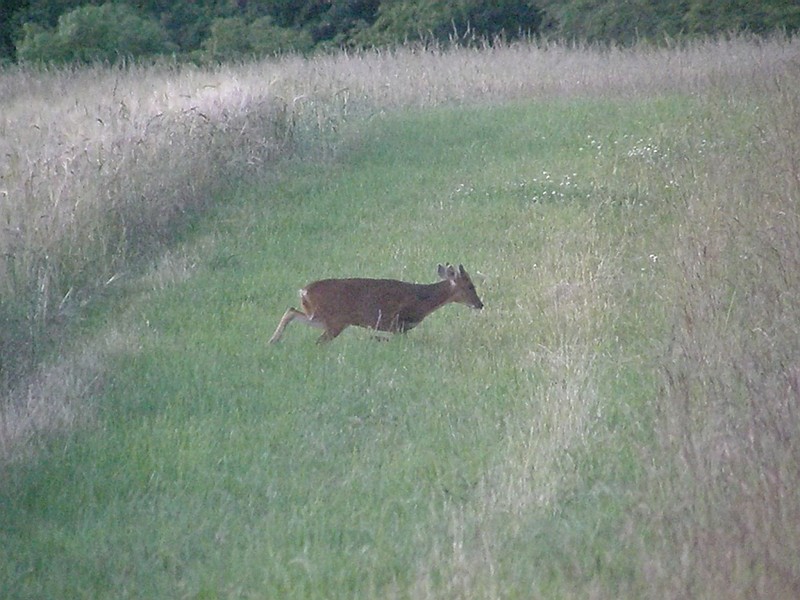
As a consolation I stopped to watch some deer on the way home. The wheat is ripening in the fields, and the muntjac and chinese water deer are almost hidden, which means you can almost walk past without seeing them. I really must get out more often. Perhaps I’ll make time one of these evenings to see how the barn owls are doing, or maybe check out some of the new setts I’ve found.
Every summer we get a visit from the local tawny owl. We have a lot of tawny owls in the area. For the last three years there has been a nest in a small copse about a quarter mile from our house. You can year the young owls (owlets?) calling as they start to fly from the nest.
This is a picture of the owl that sat on our roof on June 12th. Looking back through the archives, I note that I had taken similar pictures of the owl on June 12th 2008 and June 2nd 2009. It isn’t a very frequent visitor, and it only seems to come in early June. Clearly an owl of very regular habits!
So why does it only visit the house at this one time of year? Is it something to do with having young in the nest? Or is it that I only see it in the long evenings of June?
Well, I’m pleased to say that our tawny owl turned up again at 10.00 this evening, a year and a day since it last arrived. We’ve just been outside watching it. This makes it four years of visiting the house in early June. It’s astonishingly regular. If it had been around earlier in the month we’d have seen it, I’m sure. I don’t know why it comes at this time (assuming it’s the same one) but it does show the value of keeping records, if only for curiosity value.
I admit it. I haven’t been out much lately. In fact, the nearest I’ve come to taking a stroll in the deep dark wood is reading The Gruffalo with Scarlett each evening.
I’ve been busy at work, with big projects in exotic places like London, Paris and …Watford, with too much work at home in the evenings. I’ve been busy at home with various chores that have kept me going from dawn to dusk at the weekends, ranging from fixing the lawnmower (I am now an expert on servicing the Briggs & Stratton petrol engine, if anyone needs advice) to re-laying the block paving on our drive in the pouring rain yesterday. It’s been busy busy busy, but at least it’s keeping me out of mischief.
And what about the mole? Where is the mole in all of this? Well, I came home from work this evening to find a dead mole in the middle of my newly-laid block paving. How it got there I don’t know. I can only assume that it got flushed out by the torrential rain yesterday and the cat caught it. Maybe she left it there as a tribute to my paving skills. She does that sort of thing (remember the rat in the dining room?)
I can’t remember ever seeing a live mole. I’ve certainly seen molehills in my vegetable garden. As the latest in a long line of ‘dead animals I have found’ pictures, here’s the mole.
Do dead animals count as a tick on my mammal list? Not even if they’re on my own drive?
It rained on Sunday. I can’t remember the last time I saw rain, it’s been that long. Nevertheless, we went for a little walk in the field behind my house. It was a bit soggy for the wildlife, only the odd rabbit and a muntjac barking in the copse.
The persistent rain had washed out any tracks, but that doesn’t mean there was nothing to be seen. There was a little whodunnit mystery in the wheat. CSI Bedfordshire, if you will. Some animal had been eating the wheat stalks and stripping the green corn from the ears.
The evidence was lying on the path, but there were no tracks to be seen. Can we tell what animal did this?
The first rule in tracking is to think about what is possible and probable. Think about the species that are known to be in the area first. Whatever had eaten the wheat was a herbivore, but we can eliminate anything too exotic. Our local herbivores are mice, voles, rabbits and hares, and deer of various species. The field had no domestic species such as sheep or cows so we can rule them out too.
Voles and mice were a possibility – they are definitely to be found in this field, but the stalks were bitten off too high for such small animals. That leaves rabbits, hares and deer.
Examining the stalks of wheat revealed that they had been chewed off rather than bitten cleanly.
It’s a little detail, but important. Rabbits and hares are (sort of) rodents and have incisor teeth in both upper and lower jaws that meet like scissors. They snip off vegetation cleanly. They wouldn’t leave a mangled stalk like this.
Deer, on the other hand, have incisor teeth in the lower jaw only, and a horny pad on the upper jaw. They can’t bite as cleanly as rabbits and tend to tear what they eat. This wheat stalk is characteristic of a deer.
So who is the most likely suspect? Probably the muntjac deer I heard barking in the wood nearby. It fits the feeding signs and the location. Case closed. It was only a short walk in the rain but it gave me a little chance to practise some tracking skills. There’s always something to be found…








 Tales from the Wood - The Diary of a Badger Watching Man