Feeds:
Posts
Comments

Badger Cubs What does a badger sett look like?  Every now and then someone asks me this question, so it’s about time that I tried to answer it properly.  This is my guide to badger setts and what to look for.  I have hesitated a little before writing this.  After all, badgers are still persecuted in some parts of the country, and I don’t want to make it any easier for someone with bad intentions to find badger setts.  On the other hand, the more people that know about the badgers in their area the better.  If people are aware of their local setts then they can keep an eye on them, and besides, badgers have been a source of pleasure for me and I’d like to share the experience with other people if I can.

I’ve illustrated this post with pictures taken on a walk this afternoon.  This is a good time of year to go out and look for badger setts.  The badgers are active and the vegetation has not yet grown up.  Believe me, trying to find badger setts in head-high nettles is a daunting prospect.

The first step to identifying a badger sett is to find a likely area where they might be living.  Badgers are surprisingly widespread and they have a fantastic ability to live under people’s noses and yet remain out of sight, so don’t rule out any patch of countryside.  They do have certain preferences though, and to narrow down the search you have to understand a little about their habits and lifestyle.  It helps to be able to think like a badger!

People think of badgers as woodland creatures, and it’s true, they mostly do live in woods and that is where to look for them.  But they don’t spend all their time there.  In the UK, the main food of the badger is the earthworm, and the best place to catch earthworms is on short grass – ideally grass that has been grazed by livestock.  So the best place to find badgers is in woodland that borders on grassy fields.  They live in the wood and that gives them shelter and security; and they can feed in the fields.

But not all woodlands are good for badgers.  Badgers live underground, so they need somewhere suitable for digging.  Damp, marshy ground is definitely out and anywhere that is liable to flood (such as river valleys) is usually avoided.  In my part of Bedfordshire the badgers prefer the nice, dry sandy soil, but they also seem quite happy in clay.  Badgers definitely seem to prefer a sloping site rather than a very flat one.  This might be the slope of a hill, the side of a disused quarry or even a large hedgerow bank.  They like anywhere where they can tunnel in sideways rather than straight down.  I suppose that it is easier to dig, easier to shift the soil, better drained and presumably easier for them to walk out of a horizontal hole rather than climb out of a vertical one.

So we are looking for a piece of woodland with sloping ground with grassy fields nearby.  Should we now go into the wood and start looking for holes?  Well no. Not yet.

Badgers will cover a territory with a radius of 300-500m from their sett.  This means that there will often be many signs of badgers in the general area of the sett.  Finding these can give you confidence that there are badgers in the vicinity and help to narrow down your search.  Fortunately badgers are creatures of habit and leave some regular indications of their presence.

If you’re walking through pasture fields, keep a lookout for badger paths, snuffle holes and dung pits.  Badgers travel on paths whenever possible (see Why do badgers use paths?) and over time these paths can be quite pronounced.  If I recall, Pablo even managed to identify badger paths from satellite photographs on Google maps.  I’ve tried this myself, and it really is possible.

Here is a series of paths over the pasture field.  The trouble with paths is that you never really know who makes them, whether it is badgers or another animal (humans being another obvious cause).  In this case I have tracked badgers across this field when there has been snow on the ground and they consistently follow these paths.

Badger Path on PastureHere’s another example.  In this case the path crosses the field and then goes under a fence.  This means that it cannot have been made by humans, livestock or deer.  Other animals such as rabbits will make regular runs, but if you see a deep path like this, start suspecting badgers.

Badger Path through FenceIncidentally, if you ever come across a path under a fence, check the bottom strand of wire to see if any hairs have been caught.  This can give you a positive i.d. of the animal that made the path.  Badger hairs are grey or black and have a squarish cross section.  When you roll a badger hair between your fingers it feels irregular rather than round.

Snuffle holes are the holes made by badgers digging for food.  They are a good sign of badger activity, but other animals can leave similar holes and cause confusion.  Rabbits will often dig shallow scrapes, but rabbit scrapes are usually oval whilst badger snuffle holes are more conical.

Badger Snuffle HolesDung pits are a particular feature of badger territories.  Badgers do not deposit their dung just anywhere, they use special pits.  Badgers use dung as a territory marker, so you will often find dung pits on badger paths around the edge of their territory.  Dung pits look very much like snuffle holes, but with dung in them.
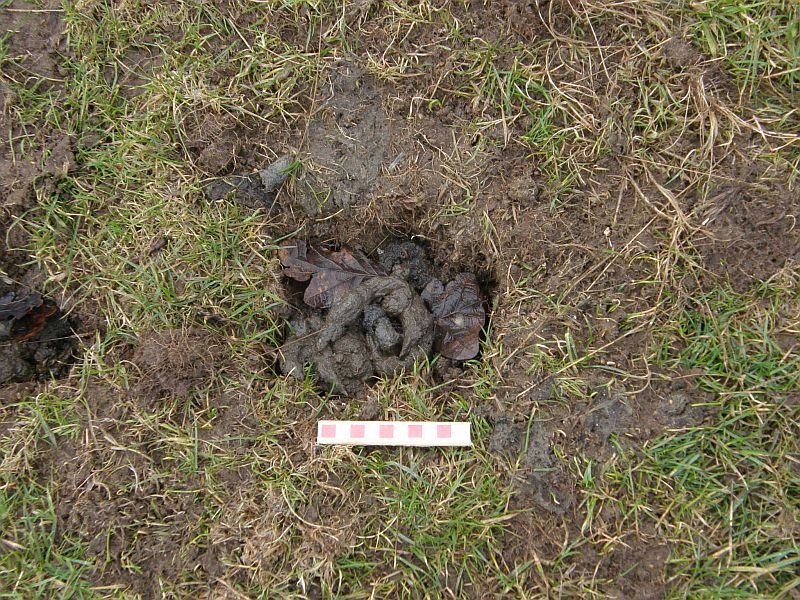
Badger Dung PitBadger dung is usually a dark greyish-green, which shows that they have been feeding on earthworms.  Badgers will cheerfully eat many other things too, so it is always interesting to inspect the dung pits and see what they have been feeding on.  Here’s the dung of badger that seems to have been gorging on cherries (I have no idea where it got them in February!)

Badger Dung Pit with CherriesWhere the territories of two badger clans meet the dung pits can be quite extensive as each side marks its territory.  Here’s a large latrine with many pits that badgers have somewhat inconsiderately dug into a main footpath in the wood.

Badger Latrine SiteSigns like these tell you that there are badgers in the area and that they are active.  Now you can start to look through the wood and try to find their sett.  Rather than looking at random, there are a couple of things that will help you.  Remember that badgers prefer a slope, so concentrate on areas of sloping ground, particularly on the outskirts of the wood.  The other thing you can do is look for paths and follow them.  Sooner or later a path will lead you to a sett.  It can be great fun to try to follow paths, as they usually twist and turn through the wood, sometimes clear and obvious, other times fading out altogether.  A frustrating but fun way to spend an afternoon.

Here’s a particularly clear badger path.  Note how generations of badgers have worn a deep path into the soil.
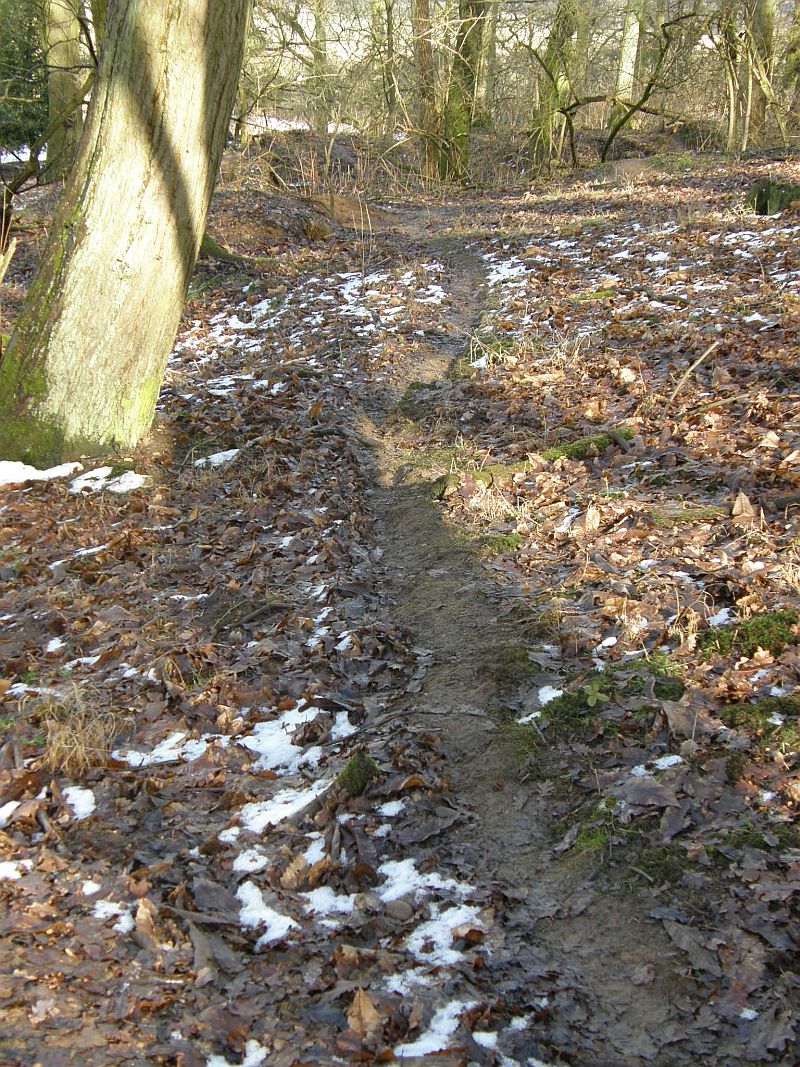
Badger Path in Wood

One way to tell that you are following a badger path is to look for tracks – often a difficult challenge in a wood.  Alternatively, here’s something you might see.  The path goes over a fallen tree and badgers have left clear claw marks as they climbed over.

Badger Claw Marks on a Fallen Tree

So what does an actual badger sett look like?  The obvious thing to look for is holes in the ground.  Depending on the size of the sett there may be anything between a single hole and twenty holes spread over a hundred yards or so.  Many animals live in holes, but there are some features of badger setts to look out for.

Badger setts are very extensive underground.  Some have up to 300m of tunnels – far more than rabbits or foxes.  The badgers have to shift a lot of soil, and this means that badger setts usually have substantial spoil heaps outside.  Over time these spoil heaps can literally change the shape of the landscape, creating large shelves or platforms outside the holes.  The main sett that I watch is obviously an old one, as the whole area is pock-marked by holes and hummocks so that it resembles a First World War battlefield.  Active setts are easy to spot because there will usually be fresh spoil outside.  Badgers are compulsive diggers, and although much digging is done in spring before the cubs arrive, they will tend to dig all year round.  Here is an entrance to a sett.  Notice the large spoil heap and the obvious path coming in from the right.

Badger Sett with Spoil Heap and PathThe spoil heaps will often contain dried grass or bracken that the badgers had dragged in as bedding and then subsequently cleared out at a later date.  In my experience this happens when they are preparing an old chamber for re-use, for instance when preparing for cubs.

The actual holes of a badger sett have a characteristic shape, usually referred to as a sideways D.  The key feature is that they are broader than they are tall.  This makes sense if you think of the shape of a badger – fairly wide and low-slung.  Rabbit holes, by contrast, are an oval shape that looks like an O.  Here is a classic badger sett entrance that shows the typical shape.
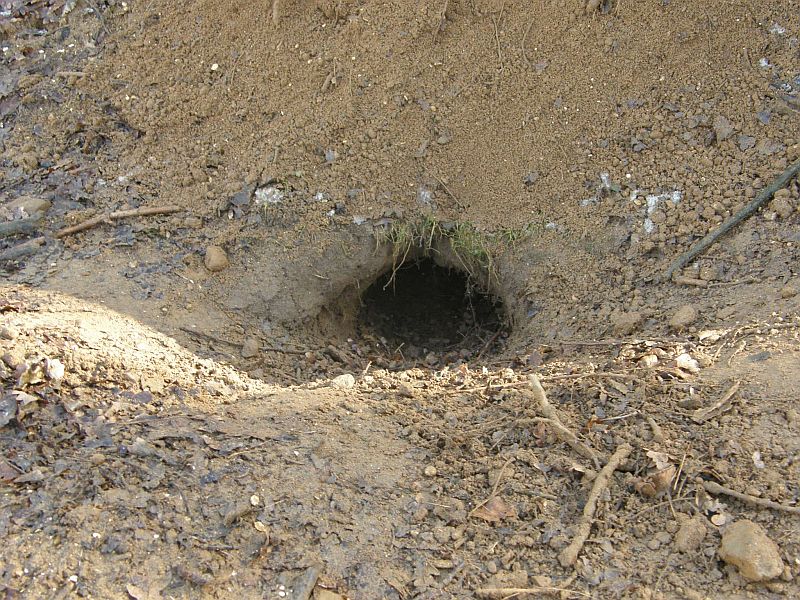
Badger Sett EntranceHere’s another sett entrance where the badgers have dug under a fallen tree, either by accident or on purpose, creating a nice sturdy lintel.  There are a couple of holes under trees like this at this sett, which makes me wonder whether it is a deliberate choice.  I’ve also seen a few setts that are in the roots at the base of a large tree.  Again, this gives the badgers the protection of a wooden roof, at least for the entrance to the sett.  Perhaps this is a widespread design feature.
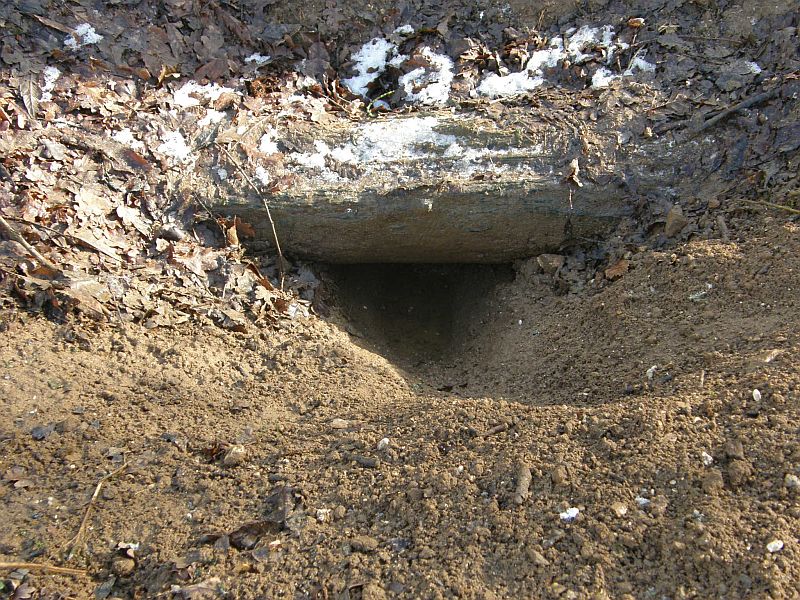
Badger Sett EntranceAgain, notice that the hole is still wider than it is tall.

Active holes will show signs of recent digging, but if you are lucky you can find badger tracks at the entrance to a sett.  This is the best evidence you can get that the hole is inhabited by a badger.  Note the mass of tracks at this hole, suggesting that a number of badgers are present.

Badger Sett Entrance with Badger TracksLastly, have a look around the immediate area of the sett.  Badgers will have a main latrine site nearby – like the dung pits on the edge of their territory but larger and more concentrated.  At many setts there will be patches of leaf mould that have been dug up and scuffled about as the badgers look for food.  There will often also be clear patches where the soil has been worn smooth.  These are ‘play areas’ where the badgers congregate, play and groom each other.  Sometimes there may be ‘play trees’ – tree stumps or fallen trees that the badgers climb and play over.  These are sometimes worn smooth too – the result of whole generations of badgers using them as a playground.

So now you know what to look for.  Look for the right sort of habitat – woodland near pasture, ideally with sloping ground.  Look out for the peripheral signs of badger activity – paths, dung pits and snuffle holes.  Through a combination of following paths and sensibly interpreting the landscape you will hopefully be able to find the sett and confirm that there are badgers in residence.  Of course, the best way to tell whether there are badgers present is to actually see one of the beasts, so once you have identified an active sett you can sit up and watch.  And that’s where it really starts to get interesting.

Good luck finding badger setts, and good luck watching!

After all this high-level, scientific badgerology I felt the need to get back down to earth.  On Sunday I took Scarlett on her first trip to see a badger sett.  I also wanted the chance to see how they are doing after the cold weather and whether they are preparing for spring.  Donning the baby carrier and camouflage umbrella I set off into the drizzle.

Now, I had planned to turn this trip into a photo-guide on what to look for at a badger sett, as a guide to people who want to know if they’ve got badgers in their local area.  Unfortunately, after snapping pictures of everything in sight – holes, paths, dung pits etc – I got home to find that my camera settings had mysteriously changed and none of the pictures I took show anything at all.  Damn it.

Never mind.  It gives me an excuse to go back next week.  Scarlett enjoys these walks, and I do to.  For the record I can say that the badgers seemed to be positively thriving.  The dung pits were all full, showing a lot of feeding.  The sett was very active, with no fewer than six of the holes showing significant signs of fresh digging and tracks.  This is a good sign, as sow badgers will take up residence in their own part of the sett to give birth and rear their young, so at least one or two of these holes are probably ‘maternity suites’.

Stay tuned for next week, when I’ll hopefully be back with a fully-illustrated guide to badger setts.

Badgers in a social group- but why?Following my thoughts on the evolutionary significance of delayed implantation, Pablo asked the very good question why (if my theory is correct)  badgers stopped being solitary and started living in clans.  Fortunately, I think I can answer this one.   What follows is not my own thinking, but based on the work of Hans Kruuk, a giant of badgerology upon whose shoulders I gratefully stand.  His The Social Badger is highly recommended reading for anyone interested in the subject.

Kruuk looked at the evolutionary advantages for badgers of living in social groups.  Social living is relatively common in mammals.  The usual benefit it gives is increased vigilance against predators (think of meerkats or rabbits – one or two individuals can keep watch while the others feed).  Social carnivores are more rare.  Lions, wolves, dogs and hyenas gain an advantage from hunting in packs – wolves and hyenas, for instance, can bring down prey much larger than themselves by attacking as a group.

Badgers don’t fit neatly into this scheme.  They are social carnivores but they do not hunt in packs.  In fact, for social animals they are actually not very sociable at all.  Badgers live together in a sett, and they will play and groom and interact with each other outside the sett, but once they leave the immediate area of the sett they forage as individuals.  For most of the time they are above ground they are alone, gaining the advantages of neither mutual vigilance nor pack hunting.  So why do they live in clans?

Kruuk’s theory is based on defending territory.  Badgers, in the UK at least, are omnivores.  They predominantly eat earthworms but will happily feed on anything from wheat and barley to rabbits and dead lambs.  Kruuk observed that badgers take advantage of different sources of food depending on weather conditions and time of year.  Success, for a badger, means making full use of these different ‘food patches’.  In order to have a guaranteed supply of food, the badger must have access to a wide enough range of food patches so that if one is not productive there will be others that are.

In order to have access to these food patches, the badger needs a large territory.  The problem is, a territory large enough to be productive is too large for a single badger to defend.  Hence, so the theory goes, badgers join together so that collectively the clan is able to defend a territory large enough to cover sufficient food patches.  Each badger plays a part in marking and patrolling the boundaries.  This makes perfect sense – many people have found a relationship between the size of badger territories and available food resources.  The territories in my fairly lush Bedfordshire landscape of woods, arable and pasture seem to be quite small, reflecting the good supply of available food.  Those in more sparse areas (such as Scotland, where Kruuk did a lot of his work) are much larger.

The theory accounts for why badgers live in clans today.  If my thinking is right, this clan living is a relatively recent evolutionary adaptation.   This does raise the question of why it should occur in the comparatively food-rich environment in Britain whilst badgers in other, poorer environments are solitary.  One would imagine that the advantage of defending food resources would be more pronounced where the is less food available.  Instead, the opposite seems to be the case.

Sorry Pablo – the answer to your question ended up a bit longer than I thought.  As ever, once I start to think that I understand badgers, I realise that actually I really don’t.

Badger - one of the mammals that practices delayed implantationAs I write this I can be quite confident that in badger setts across the country, female badgers are either giving birth or getting very close to doing so.  Up to mid-February is the peak time for badger births.

The reason I can be so confident is that badgers have amazing control over their reproduction via a process called delayed implantation.  The badgers can mate at any time of year (spring and late summer seem to be particularly favoured times) and yet give birth in February.

What happens is that the egg gets fertilised in the normal way.  Egg and sperm combine and the cells start to divide.   But the fertilised egg does not implant itself into the uterus and continue to develop as would be the case in most mammals.  Instead, the small ball of cells, called a blastocyst, stops developing and goes dormant, drawing just the small amount of oxygen and nutrition it needs to survive.  In late December the blastocyst attaches itself to the wall of the uterus and starts to develop into a full foetus, to be born in February.  This is delayed implantation.  It means that the badger mating I witnessed in August (see Fieldnotes: 8th August 2009 – Sex) could result in cubs being born now.

Delayed implantation is not unique to badgers.  It occurs in a number of other mammals such as stoats, bears, Roe Deer and Grey Seals.  The evolutionary advantages of the process are clear – it means that the young are always born at the optimal time to take advantage of the best food resources in spring.

For badgers, there a few interesting implications.  Ernest Neal speculates that delayed implantation allows the badgers to mate throughout the year, which may help to strengthen clan relationships.  Hans Kruuk makes the point that multiple matings with different males could result in multiple blastocysts, meaning that each cub in a litter could have a different father.  Badger families must get complicated sometimes!  This is even more interesting when you remember that the dominant female badger may kill the cubs of other females to maintain her position.  This control over the genetic make-up of the clan is very much a female thing.  It must be related to the fact that you can never be sure who the father is, but there’s never any doubt about the mother.

Now, I’ve been thinking about badgers, and about delayed implantation, and I’ve got my own little theory.  This is just my own idea, so if it’s wrong then I take full blame.  My line of thinking goes like this: most of the mammals that practice delayed implantation are solitary by nature.  This means that the males and females come into contact only irregularly.

Delayed implantation offers an evolutionary advantage to these species because it means that a male and female can meet up at any time of year, mate, and still have the offspring born at the best time.  It is a way of compensating for geographical and territorial dispersion.

But badgers are different.  Badgers live in social groups where males and females come into contact every day.  For clan-living badgers, delayed implantation offers no great advantages.  Why don’t female badgers simply come into season in December and have cubs via direct implantation?  Neal’s theory about the regular mating strengthening group bonds is one plausible explanation, and there may be a further advantage gained by the genetic diversity of litters sired by different fathers, but I think it tells us something about the evolution of badgers.

I think that delayed implantation is an evolutionary throwback to a time when the Eurasian Badger was a solitary animal.  I think it points to a period in the history of the badger when they didn’t live in social groups and therefore gained an advantage from it much as stoats and seals do today.  In turn, it suggests that clan living is a relatively recent development for badgers.

It isn’t as wild a theory as it sounds.  Other badgers around the world are still solitary – the American Badger, the Honey Badger, the Indonesian Stink Badger, and so on.  Even our own Eurasian Badger is solitary across large parts of its range.  In Mediterranean regions, where food is scarce, badgers are virtually solitary.  Rather than this being an adaptation to the dry conditions, it’s my belief that delayed implantation shows that this is their natural state, with clan living a relatively recent adaptation to the conditions of North West Europe.

First snowdrops of springDespite the freezing temperatures and the occasional snow flurries this weekend, there are signs that the winter won’t last forever and that spring is round the corner.

The first snowdrops have appeared at the edges of the woods and are peeping out from the frosty ground.   The first of the spring flowers, they are taking full advantage of the light that’s available on the woodland floor before the foliage of the trees and shrubs develops later in the year and puts them in shade.

We’ve also had the first eggs from the chickens this week (Monday, to be precise).  Chicken egg-laying is determined by light, not temperature, so the days are obviously getting long enough to stimulate them out of their winter break.

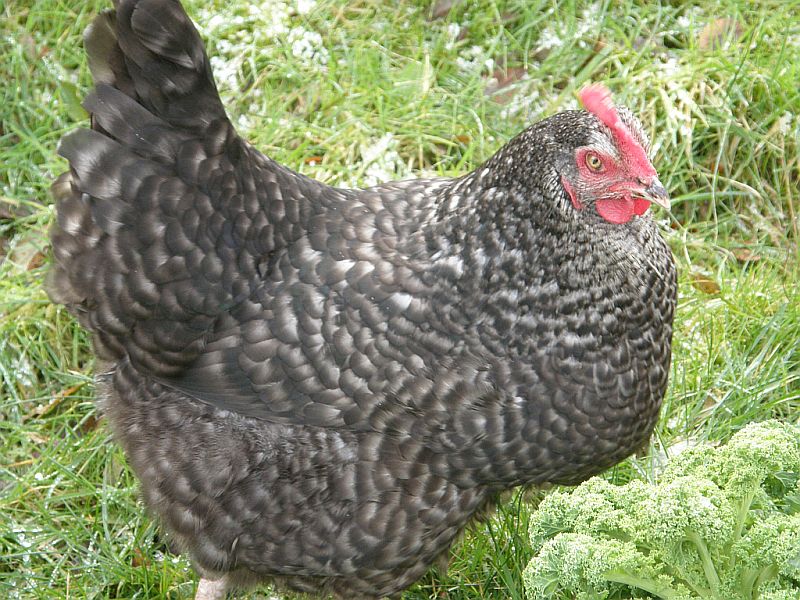
To celebrate, here is a wholly gratuitous picture of a chicken.  Meet Clarissa, everyone.

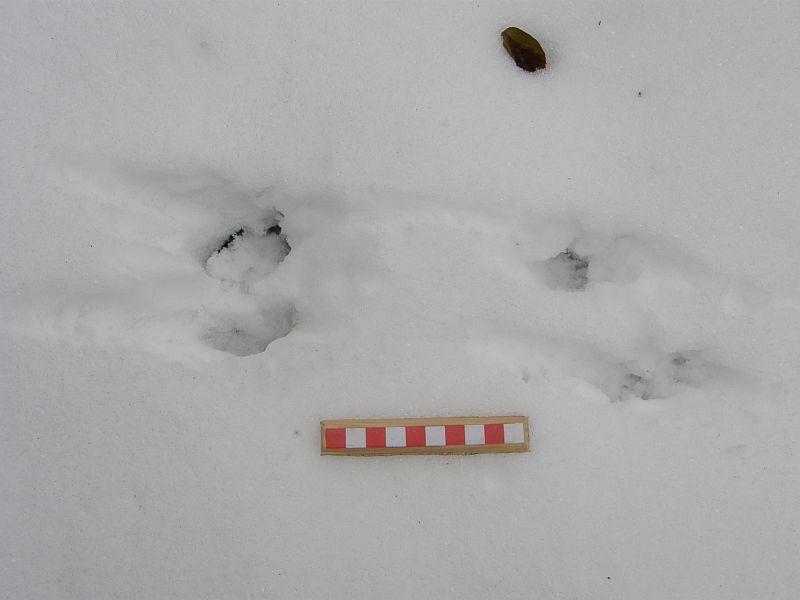
The weekend before last I went out into the snow, and amongst the tracks were a set that puzzled me.  The gait was very like a rabbit or a squirrel – a bounding gait with all four paws together in a group.  The size as very small though – bigger than a mouse (and a mouse wouldn’t bound) and yet much smaller than a rabbit or even a squirrel.

I have been consulting the guidebooks and I think I have a suspect.  Bang and Dahlstrom’s Animal Tracks and Signs has this to say about stoat tracks “Walking prints are very rare, as they move exclusively by jumping.  On reasonably hard ground, such as solid snow, the tracks in jump groups may be four and four, often similar to a small hare.”   The Hamlyn Guide to Animal Tracks, Trails and Signs, adds that the stride length for a bounding stoat is typically 30cm.  Weasel tracks are smaller with a stride of 25-30cm.

Tentative stoat tracks in snow

Tentative stoat tracks in snow

The stride length of my tracks is about 20cm, so a little short, but otherwise the size and gait fits a stoat or weasel.  I can’t find anything else that fits the tracks, so at the moment I’m settling for stoat or weasel as a tentative i.d.

This is exciting stuff.  I have a thing about stoats (and weasels).  I’ve only ever seen these secretive little mustelids a few times, and any evidence that they’re at large in the area is good news for me.

I must be the only person in Britain at the moment wishing for more snow so that I can go and look for more tracks…

Alder tree by the brookThe snow has finally melted.  Today has been a balmy 7 degrees and beautifully sunny.  It may not sound very warm, but compared to the past weeks when the temperature didn’t rise above freezing for days on end it feels positively spring-like.  I took advantage and headed out for a stroll in the (slightly soggy) countryside.

I had no particular aim in mind, but with a vague idea of looking at the birds I headed over to the lake.  I don’t go there very often, but there is always the chance of visiting waterfowl.  As it happened the lake was still iced over with not a bird in sight, but the hedges were alive with blue tits, great tits, chaffinches and sparrows.   My personal favourites were a flock of long-tailed tits working their way through the trees.  These are delightful birds but absolutely impossible to photograph.  They are always on the move, flitting about from branch to branch as they forage, never staying in one place for long.  One of these days I’ll be in the right place and get a picture as they travel past.

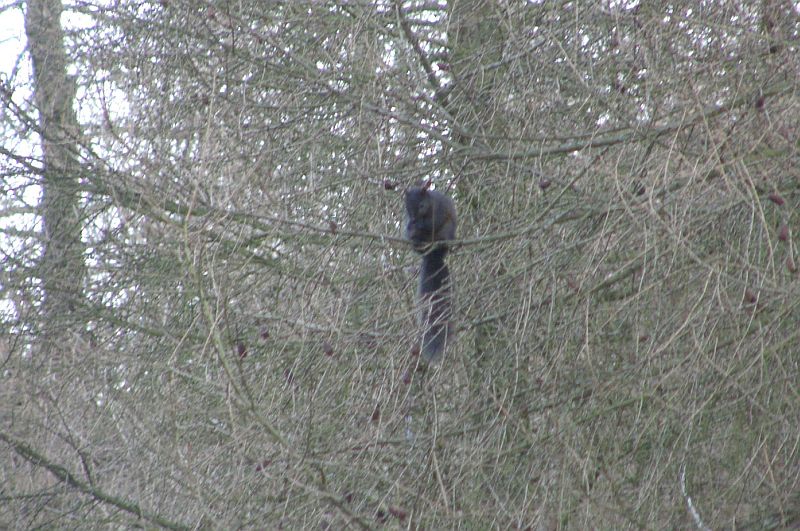
Talking of ambitions, there is one animal that I’ve been quietly trying to photograph for a while now, and that is the black squirrel.  The black squirrel is the melanistic (black) version of the common grey squirrel.  There are populations of black squirrels in a number of places around the country, and some experts believe that the black coat is genetically dominant and will eventually replace the ordinary grey colour.  This hasn’t happened yet, or shown any signs of doing so, so black squirrels are still fairly uncommon.

There is a known population of black squirrels centred on Woburn in Bedfordshire.  I’ve only seen one once before, and it was very striking – a squirrel, but with a black coat.  Ever since then I’ve wanted to get a picture of one.  Today, I got my chance.

Black Squirrel

The almost legendary Black Squirrel of Woburn

Unfortunately the squirrel was quite distant so it was at the very limit of my camera zoom, but it is unmistakeably a black squirrel. I feel a little bit like those people who photograph Bigfoot, only to get home and find the picture only shows a dark blur in the distance, but at least I know it was there.

Black Squirrel

NOT a Bigfoot, but a black squirrel...

I walked home along the brook.  Halfway down I came across a clear animal path running from an old, disused little quarry into the fields.  Now, this looked to me like a classic badger path.  The old quarry was a perfect spot for a badger sett – they love places like this where they can dig sideways into the side of a bank, and the soil is usually dry and well-drained.  There were signs of digging and spoil heaps in the quarry, so something was burrowing there.  In short, it looked exactly like a badger path, except it ran across a 6″ deep fast-flowing brook.

Brook crossed by a badger path

The brook crossed by a badger(?) path

Could this really be a badger path?  Would the badgers really wade across the brook every night to get to the fields?  There were no really conclusive tracks so it is difficult to be sure either way.  Something had made the path, but I don’t know what.  Since the brook is close to my house it looks like an ideal place to make a track trap – to spread some sand and see what tracks I can get.  If it is a badger path then I’ll be back in the summer to see if I can stake it out and get a picture of an aquatic badger.  Remember, you heard it here first!

I’ve been away for a while with work, so I’m late catching up with my correspondence.  Sheila, Rick and Mrs B – thank you for your comments and apologies for being so slow in replying.  I always enjoy hearing about other people’s experiences, so please keep them coming.

Somewhat accidentally, I now have an international perspective to the blog.  Steve has been kind enough to send pictures from the New York/New Jersey border.  He found the tracks after sighting a fox near his house.

Mystery Snow Tracks

Mystery Snow Tracks

The problem is, they don’t look like fox tracks to me, at least not the familiar British fox tracks.   Fox tracks are small and neat and diamond-shaped.  These are hand-shaped.

I’m not an expert on North American wildlife, but the closest match I can find in the guidebooks is Raccoon tracks.  Does this make sense?  Do you get Raccoons in northern New Jersey?  Do they walk around people’s houses?

This is just my best guess.  If anyone has any other ideas, please do let me know.

For the past week the country has been gripped in a little ice age.  An area of high pressure has settled over Britain, trapping cold air and snow, blocking out the prevailing warm south-westerly winds.  Temperatures as low as -20c have been recorded (my family in Cheshire experienced -14c) coupled with up to a foot of snow.  Predictably, the whole country has ground to a frozen halt.

Personally, the only problem I have with the snow is that I haven’t had enough time to go out and play in it.  Unlike this time last year (see Fieldnotes: 4th-10th January 2009), I’m limited by work and family commitments.  It’s one thing to go out and freeze myself following badger tracks in the snow.  It’s another thing entirely to do it while carrying a five month old baby!  Back in the old days I’d have packed up a tent and sleeping bag and headed out into the woods, just for the challenge of it.  Can’t really justify that now.

Nevertheless, today I drew upon Mid-Bedfordshire’s tradition of polar exploration (there is one, honestly) and went out into the snow to see what is happening.

Here’s some new tracks to have a look at.  These are squirrel tracks.  I watched the squirrel as it bobbed around in our garden and then went out to look at the tracks.  The pattern is similar to that of a rabbit – the same bounding gait – but smaller.

Squirrel Tracks in Snow

Squirrel Tracks in Snow

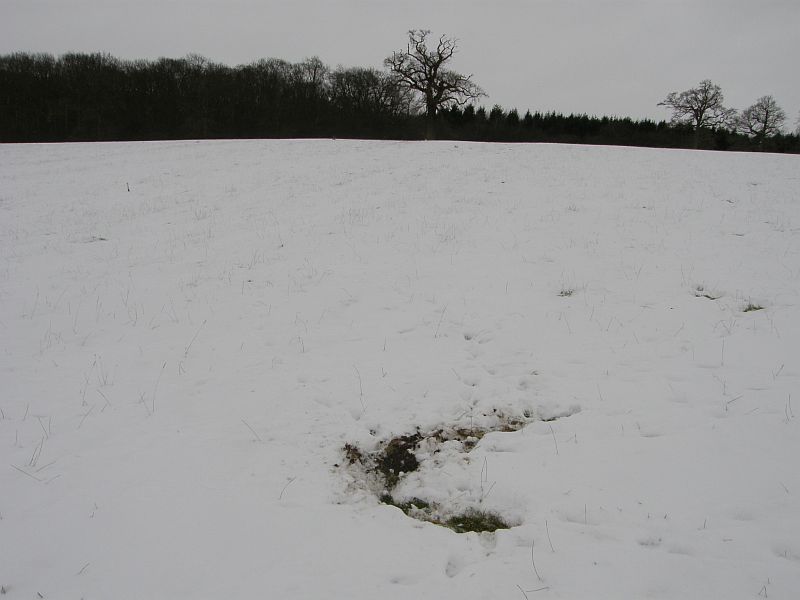
I walked on up to the pasture field to look for evidence of the badgers.  The snow last year was a priceless help in deepening my understanding of badger habits and how the local territories interacted.  This year the picture was much more confused.  There was almost a weeks worth of tracks, of animals and humans, and recent falls of snow have complicated matters still further.  Nevertheless, it was possible to trace the movements of individual badgers.  Clearly visible were the patches where they had dug through the snow into the soil.  I couldn’t see any dung, so I assume it was for food.  Badgers don’t hibernate, but they do slow down.  It’s a useful thing to know that badgers will still come out and forage, even in these extreme weather conditions.

Badger Snuffle Hole in Snow

Badger Snuffle Hole in Snow

Inside the wood there was more evidence of badger activity.  I didn’t get to visit the sett itself (like I said, there is a limit to how far I’ll take my daughter in these conditions – sturdy girl though she is) but I did add a few more snippets to my badger map of the area.  The wood is criss-crossed by paths, but it is difficult to know for sure that they are badger paths. Very often the only tracks you’ll find on them are for deer.  Today, however, there were clear badger tracks, showing that these are indeed badger paths.  I’ve tried to follow them in the past, as I suspect they lead to the almost mythical ‘third sett’ in the area, but I’ve always lost the paths among the trees.  If the snow persists I’ll have the perfect chance to follow them to their source.

Badger Tracks in Snow

Badger Tracks in Snow

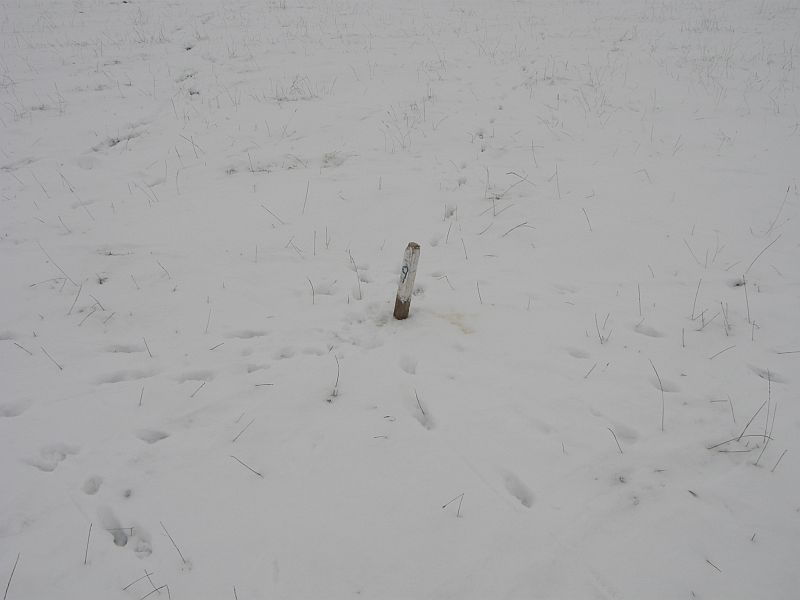
The snow told other stories too.  There were plenty of fox tracks in the field.  They all converged on a post where the foxes had obviously scent-marked.  Just like dogs, I guess.  It’s all part of the territory marking.  Foxes will tend to leave dung in exposed places such as tufts of grass for the same reason.  It’s a nice little insight into fox behaviour.

Fox Tracks and Scent-Marking Post

Fox Tracks and Scent-Marking Post

Lastly, here’s a bit of a mystery.  These tracks were in the middle of the field.  It’s a bounding gait again, with the tracks in groups of four like a rabbit or squirrel, but only a few centimetres across.  The individual prints were not visible in the snow, but the gait can be more revealing.  Something the size of a mouse would surely have burrowed under the snow, not bounded over it.  I’ll need to look this one up, but in the meantime any ideas are welcome.

Unidentified Tracks in Snow

Unidentified Tracks in Snow

Hope you’re making the most of the snow too!

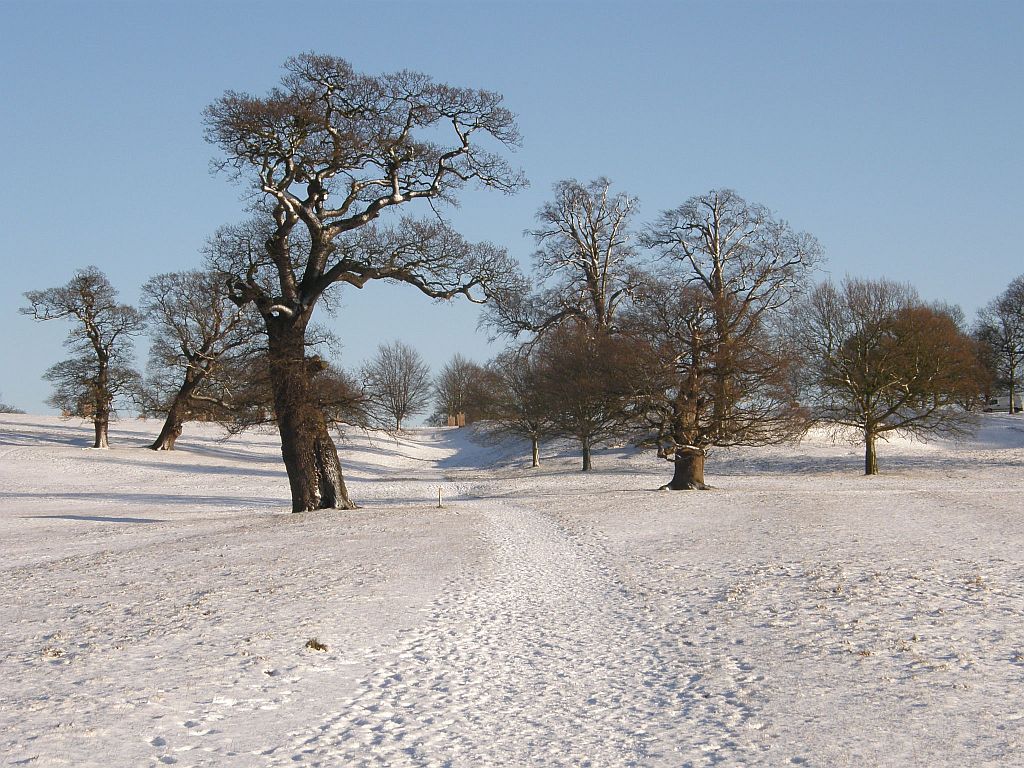
Woburn Deer Park in Snow

Once again we’ve arrived at midwinter’s day, and appropriately it’s snowing heavily outside at the moment.  Tonight is the longest night of the year.  After tonight, the days will start to get longer until the summer solstice next June.  Now that I live closer to nature (in other words, in a house with only limited heating) I really appreciate why people have celebrated midwinter for thousands of years.  It’s good to think that you’ve turned the corner of the year.

And the midwinter festival really is ancient.  Contrary to popular belief, Stonehenge was not originally oriented on the midsummer sunrise.  It was aligned on the midwinter sunset.  Every northern culture has its own midwinter celebration.  Our own Christmas is the descendant of one.  When you think about it in these terms, the drinking and feasting and merrymaking isn’t getting away from the true meaning of Christmas – it is the true meaning of Christmas.

It doesn’t feel like a whole year since the last midwinter.  This year has gone by very quickly.  It doesn’t even feel like six months since I was gallivanting around Loch Ness on midsummer’s day.  I guess that a lot of good things have happened since then.

It’s time to make plans for the year ahead.  It’s been a few months since I’ve seen a badger, so they’re definitely on my list, but I’ve got a few more (very) amateur naturalist goals for 2010.  I’ll tell you about these soon.

I hope that you have had a good year too, and I hope the coming year is even better for you.  Happy winter solstice from me, Mrs BWM and baby Scarlett.

Scarlett in her baby carrier