Feeds:
Posts
Comments
What made these tracks on the beach

Question: what made these tracks on the beach?

I’ve just got back from holiday, which explains why things have been a bit quiet on here lately.

We’ve been up in Anglesey, North Wales.  A beautiful part of the world, and we had beautiful weather to go with it.  We’ve been sitting on the beach in the sunshine, introducing Scarlett to the pleasures of making sandcastles (great fun) and paddling in the sea (a bit too chilly!)

I confess that I haven’t done much from a wildlife perspective.  I spent the days with the family and the nights fishing.  I don’t go fishing very often these days, so this was a treat for me – or at least it was until I became increasingly obsessed in my hunt for the fish.  At least I’ve got it out of my system for a while.

Beach Tracks

Answer: a one year-old with the urge to explore

I spent a very enjoyable day with a friend of mine who was carrying out a 3d laser scan of an ancient monument in the area.  The neolithic burial chamber of Barclodiad-y-Gawres dates back 5,000 years or so.  Although there are many similar prehistoric monuments on Anglesey, Barclodiad-y-Gawres is almost unique because of its decorated stones.  To protect these from vandalism, a concrete dome has been built over the site and entrance is highly restricted.  My friend was creating a full scan of the site, accurate to millimetres, to create a full virtual model of the monument.  This was being filmed for the TV series Hidden Histories, so watch out for that on the BBC later this year.  My role on the day was to carry the tripods, act as a general assistant and swap theories with the various archaeologists present.

Laser scanning at Barclodiad y Gawres

Does this have anything to do with wildlife?  Well, maybe a little.  For a start, we were accompanied on the day by a pair of choughs.  These delightful little crows are still rare, but they seem to be expanding along the sea cliffs of Anglesey.  It was the first time I’d seen them in this spot, anyway.

A second wildlife connection came from Barclodiad-y-Gawres itself.  The tomb is famous because the archaeologists who excavated the site found a collection of small bones from, among other things, wrasse, whiting, eel, grass snake, frog, toad and mouse.  They interpreted this as the remains of a strange ‘ritual stew’ that the stone age builders had made.

Filming for the BBC Hidden Histories programme

Filming for the BBC Hidden Histories programme

Personally, I don’t believe this.  I think that the bones were much more likely to have come from the dung (‘spraint’) of an otter.  I’ll write up my theory and the evidence for it in a proper paper one day.  It’s ironic really.  I was talking to some of the leading archaeologists in the field, and I managed to steer the conversation round to animal poo.

Chinese Water Deer

Chinese Water Deer

I’ve bought a new car.  All that remains is to siphon out the diesel from the old one, Mad Max-style, and it can go to the big scrapheap in the sky.

I made a quick trip to the wood on Sunday.  I decided to visit the main sett and see if there was any sign of more badgers.  I’m becoming certain that there are a lot fewer badgers in residence this year and not having been here for a while I wanted to make sure they were OK.  The dry spell has ended – it seems like we’ve had torrential rain and thunderstorms every other day this week – so at least the foraging should be easier for them.

I arrived at the sett just before 8.00pm, only to find my path blocked by a Chinese Water Deer browsing through the undergrowth.  I like watching deer and they’re great fun to try to stalk in a wood.  This one presented a challenge though.  It was very close to the sett, so if I frightened it, it would probably frighten any badgers that were above ground.  This is how it works with wild creatures: any disturbance to one tends to create a reaction in others, which is why it is so important to move stealthily even when you’re some distance from the animals you want to watch.

Predictably, despite my cautious approach the deer eventually caught sight of me and bounded off.  Interestingly, it had a big split in one of its ears, which should make it possible to identify in the future.  I can only assume that this was caused by a fight with another Chinese Water Deer.  The males have long teeth.  I don’t know for sure, but I’ll bet they fight each other over territory or females, despite their cute appearance.

I don’t know if the deer frightened off any badgers, but there weren’t any in sight.  I sat in my tree and watched for half an hour as the light gradually faded.  At 8.37 a badger emerged from the western end of the sett, showing that they’re back in residence at this end.  It wandered to and fro, foraging in the damp wood.  For a while it sat under my tree, directly underneath me (too dark for pictures, unfortunately).  It seemed healthy and happy, not bothered by any traces of my scent in the area.

After a while it ambled off into the gloom of the wood.  I gave it five minutes head start and left for home.  It was good to see the badger, but it was only one badger on its own.  There’s nothing so far to suggest that my idea that the badgers are much reduced is incorrect.

I’ve spent the weekend without a car.

I’d love to be able to say that this was deliberate and part of a return to a more sustainable way of life (in the manner of John from Musings of Murphyfish).  Unfortunately it wasn’t.  It was because the engine of my (admittedly elderly) car blew up on Friday.  I was driving home from Birmingham on the motorway when the crankshaft failed, with the end result that the engine welded itself into a lump of metal with smoke coming out of it.

So it goes.  I spent the weekend looking for a new car.  Mrs BWM feels that it is time for me to get a motor that reflects my smart executive status.  She also insisted – quite rightly – that I get a car with a heater.  My last car didn’t have this luxury feature and it caused some hardship during the winter.  As for me, the only requirement I have for a car is that I can fit a bale of hay into the boot!

Now, part of my philosophy as a (very) amateur naturalist is that I study the wildlife within walking distance of my house.  In that respect, not having a car shouldn’t have held me back.  However, the search for the perfect heated/executive/agricultural vehicle kept me preoccupied for the weekend and so I’ve had no time to get outdoors.

I’ll do better in the future, I promise.

‘Their habitation is even one with your guarded threshold … Man rules now where They ruled once; They shall soon rule where man rules now. After summer is winter, and after winter summer. They wait patient and potent, for here shall They reign again.’

The Dunwich Horror, H.P. Lovecraft

.

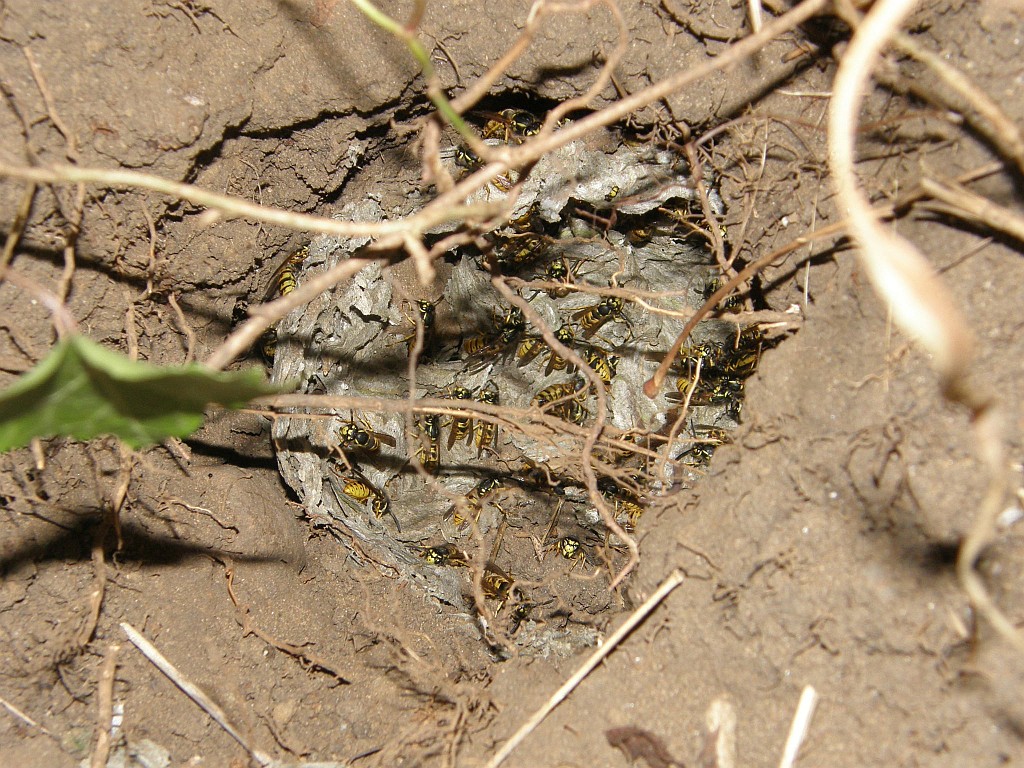
Another post about wasps’ nests and badgers, I’m afraid.  The badgers do seem to dig up these nests in dry weather, presumably as an alternative food source when worms are scarce.  At least, that’s what my limited records show (and those of Steve from Bedfordshire Wild). On the other hand, it may just be coincidence.  Decent-sized wasps’ nests only occur in summer.  Dry spells mostly occur in summer. Perhaps I’ll look back at the archives in years to come and find a definite connection.

A wasps nest dug out by badgers 3

Anyway, I mention this wasps’ nest mostly because of its location.  I spotted it when my wife and I were taking Scarlett to the park – it’s on the verge of the main road through the village.  I’ll admit it isn’t a huge road – it isn’t a huge village – and there is a nice mature hedgerow and pasture fields on both sides, but it was a surprise to see badger activity this close to the houses.  Anyone walking home late from the pub on Saturday night would have got a shock.

Their habitation is even one with your guarded threshold‘ indeed.  Very interesting.  I’ve had to re-draw my map of badger activity in the area because of this find.

Continuing in my efforts to understand the local badger population, I paid a visit to the Beech Tree sett this evening. It was a good reminder that successful badger watching involves more than just finding a sett and plonking yourself down and waiting for the badgers.

Packing my camouflage umbrella to keep off the steady drizzle I arrived shortly before 8.00pm.  The sett is on the side of a wide shallow dell, thick with bracken, but I found a nice spot with my back against an old coppiced hazel where I could look out over the sett.  I was quite a distance away, but I was here for observation and counting badger numbers rather than close-up photography.

About ten minutes after I arrived I heard a rustle in the undergrowth and a turned to see a badger trotting up the way I had come, disappearing into the bracken behind me.  This wasn’t how it was supposed to be – the badgers were supposed to come out of the sett!  These badgers are obviously not used to being watched: they don’t know the rules.

I stayed until 9.00pm, listening to a young tawny owl squeaking somewhere nearby, quite dry despite the rain under a double canopy of pine trees above and hazel below.  No more badgers appeared, so I assume they’d left early before I arrived.  Possibly they’re out early to get the most foraging time in the leaner dry weather.  As it stands, my count of badgers at this sett stands at just one.  I’ll need more visits to get a more accurate count, but it’s a pleasant spot to spend an evening so I expect I’ll be back soon.

Sparrowhawk

I got a pleasant surprise in the garden this evening.  I was checking my wasp trap (we have lots of wasps at the moment) when there was a frantic sound of wings flapping.  I looked up and there, not ten feet away on the lawn, was a sparrowhawk, a small bird clutched in its talons.

A brief second, a fierce stare from piercing eyes, and it was off, taking its prey with it.

It was hard luck on the poor sparrow, but great to have a sparrowhawk in the garden – and such a close view too.  I’ve been hoping to see one here for ages.

SheepIt’s been a strange evening.

I was busy during the day so I wasn’t able to get out early enough for a badger watching session.  In my experience, if you can’t get to the sett and be in position before the badgers emerge, it’s very difficult to watch without disturbing them.  But it was a fine, warm evening, and being smitten by the Barn Owl I went out again to try and get a picture.

There was a concert playing at Woburn Abbey, clearly audible even though it’s some distance away.  They started off with opera, which was pleasant to listen to as I sat in a field and waited for the owl.  By 9.15pm they’d moved onto more popular stuff, the owl hadn’t appeared and it was getting too dark for photography.  As a lady singer belted out Mambo Italiano I called it a day.

But it was still a fine evening.  Rather than go home, I decided to walk up to the pasture field in the hopes of seeing the badgers out foraging.  I’d brought my night vision scope for just this reason.  On the way I stopped by the Pine Tree sett.  No badgers were in sight, but in the twilight I could see signs of recent activity, which was good.  I’ll have to come here and watch properly soon.

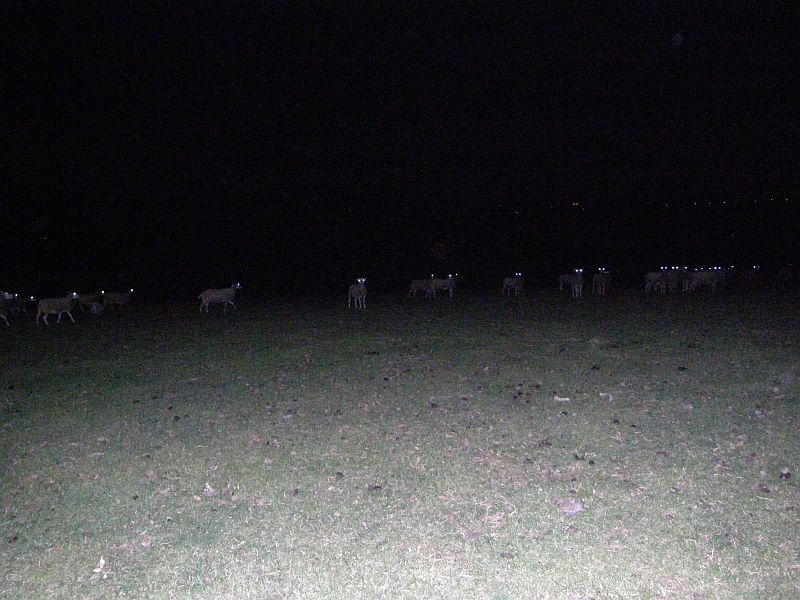
My hopes of seeing any badgers in the pasture field were dashed by sheep.  There are always sheep in this field, but today they were clustered at the top of the hill.  They ran away when I approached, as sheep do.  I settled down in my favourite spot at the base of the stag-headed oak and listened to the concert in the distance.  The sheep, meanwhile, had obviously decided that since I showed no signs of trying to eat them, I might be there to feed them instead.  The whole flock started to edge closer.  Soon I was surrounded by a perfect circle of 300 or so sheep, all staring at me, as the sound of Strangers in the Night drifted over the field.  The sheep stared at me.  I stared back at the sheep. It’s at times like this that I start to question my grasp on reality.

The sheep were not good for badger watching.  My approach depends on sitting still and staying alert for the sight or sound of badgers moving in the field.  Impossible when you’re surrounded by hundreds of coughing, belching sheep.  Incidentally, sheep coughs sound exactly like human coughs.  Once, when camping in the middle of nowhere in Wales, I was kept awake in my tent by what I thought was a crazed stalker with bronchitis. It wasn’t.  It was a sheep.  I left the oak tree and headed to the brow of the hill for a bit of peace and quiet.

It’s a lovely spot, this.  It isn’t a particularly high hill, but you can see for miles and miles – the whole of rural Mid-Bedfordshire spread out in front of you.  As I sat there, the concert moved towards its finale, Last Night of the Proms-style, with a stirring rendition of Jerusalem.

Jerusalem is my favourite hymn.  It has the rare quality of making the hairs on the back of my neck stand up.  I sat there in the warm summer night and listened, with England’s green and pleasant land before me; the fields and trees and woods and hedges.

And did those feet in ancient time.
Walk upon England’s mountains green:
And was the holy Lamb of God,
On England’s pleasant pastures seen!
And did the Countenance Divine,
Shine forth upon our clouded hills?
And was Jerusalem builded here,
Among these dark Satanic Mills?

Bring me my Bow of burning gold;
Bring me my Arrows of desire:
Bring me my Spear: O clouds unfold!
Bring me my Chariot of fire!
I will not cease from Mental Fight,
Nor shall my Sword sleep in my hand:
Till we have built Jerusalem,
In England’s green and pleasant Land.

This was obviously not meant to be a night for badger watching.  I turned for home, striding down the hill as the audience joined in with Land of Hope and Glory.


Crayfish?

crayfish remainsLast night, I popped up to the lake I mentioned in the previous post in the hope of spotting and photographing the Barn Owl again.  The owl was there, but I only got a brief view and no pictures.  It’s a great place, though.  There was a Green Woodpecker, a flock of geese on the stubble in the field, and a number of Muntjac and Chinese Water Deer around the field edges.  I should definitely come here more often.

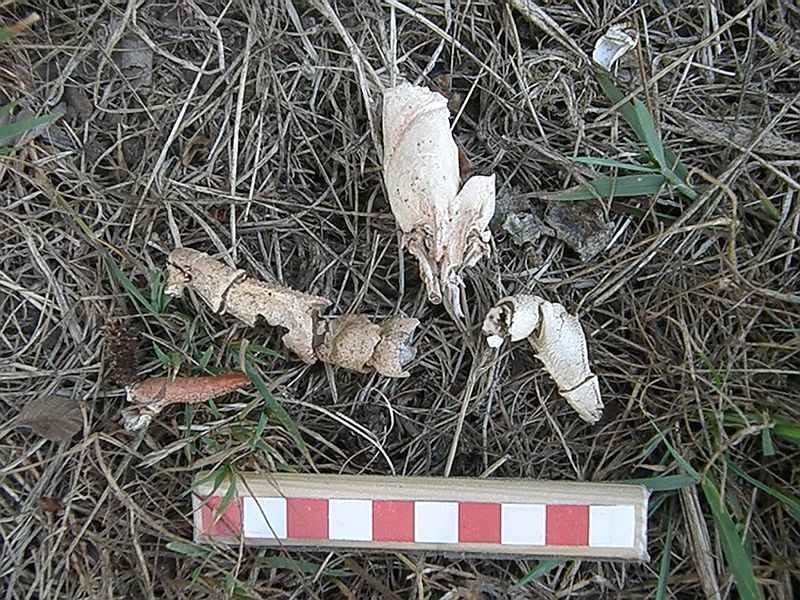
At the lake I came across evidence of a new species for the area – new to me, anyway. Other people have probably known about it for ages.  On the grass by the bank of the lake was the shell of a crustacean of some sort.  It had obviously been there a while, presumably caught and eaten by a heron or other predator.  I’m not an expert, not a crustaceanist, but I assume it is a Signal Crayfish. Either that or someone’s been dropping scampi.  We’re far too far away from the sea for any marine species, and from what I know of our native crayfish they like to live in clear running streams, not muddy old estate lakes.

The Signal Crayfish are spreading quickly across the UK, but it’s still a bit of a mystery how it got here.  This lake is pretty isolated.  It isn’t connected to any significant watercourses other than a very small stream, too small to have much an ecosystem.  No-one even goes fishing here (which is a shame).  Perhaps the crayfish arrived as eggs on the legs of waterfowl (the often-used explanation for fish spreading to new lakes)?  Perhaps someone with a taste for crayfish tail and rocket sandwiches put them in?  Who knows?

If anyone is a crayfish expert, feel free to shed some light.  Otherwise I’ll just file this away as one more species for the area.

Today we had a village get-together as part of the Big Lunch; and a very nice lunch it was too.  The food was excellent and the company even better.  We sampled the cider we made in the village last year (see Cider and Autumn Strolls) and it ranged from feisty but almost drinkable (the scrumpy) to quite horrible (the perry).  Still, it’s given the cider collective some ideas for this year’s brew.

I was talking to a neighbour and the conversation turned to owls.  He gave me a tip that there are barn owls living in a specific location on the other side of the village.  Now, I’ve not seen a barn owl here in Bedfordshire yet.  We have a lot of tawny owls (difficult to see but easy to hear as they call at night) and the occasional little owls (tend to sit on fence posts during the day) but I haven’t seen a barn owl.  This is a shame, as they’re spectacular birds, and they tend to come out in the evening while it’s still light.

I didn’t have time for a proper badger-watching session this evening, but it was clear and warm and I felt I could spend an hour or two looking for barn owls.  The location is near a small lake, actually a dammed stream – the last remnant of parkland from a long-vanished country house.  It’s a great spot for wildlife, particularly birds of different types, and one that I haven’t given the attention it deserves.

I arrived at about 9.00pm and – to my delight – there was the barn owl, quartering over the fields.  I followed it from one field to another as it patrolled, occasionally swooping down to get a closer look at something.    I sat down at the edge of the field and ten minutes later it flew low overhead, big but perfectly silent.  It was a sight worth the walk – as I said, a spectacular bird.

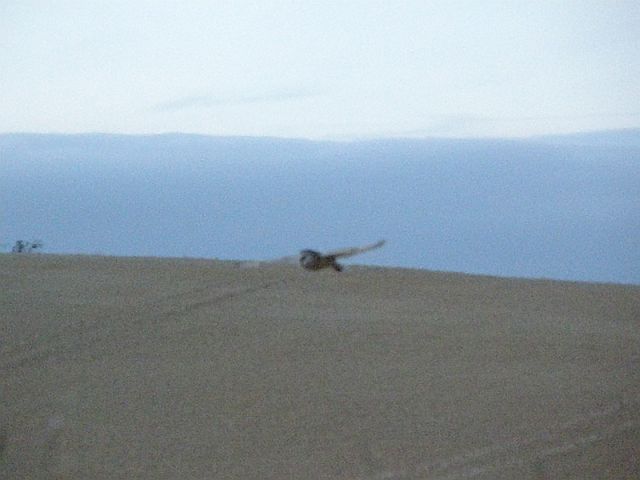
I took a couple of pictures.  I confess that these are probably the worst pictures of barn owls ever taken – blurred, out of focus and badly composed – but they’re the first I’ve ever taken of a barn owl so I’m sticking one up here.  If you stand some distance away and squint at it, with the eye of faith you can just about believe that it’s an owl.

Embarrassingly bad picture of a barn owl

I know, it’s embarrassing.  Now I know where to go, I’ll be back to try again soon.  And Simon, if you’re reading, thanks for the tip.  It’s rare for me to go out in search of a particular species and actually find it, so this was a good evening for me.

I’ve been thinking about the badgers at the sett, and how there seem to be much fewer of them than in previous years.  I’ve been rolling a plan around in my mind that may help me to understand what’s been going on.  Bear with me, and I’ll try to explain my train of thought.

1. The number of badgers has reduced.  This means either a number of badgers have died or they have left the sett.

2. If they have died, this could be due to coincidence (i.e. they all died of old age or unrelated accidents) or due to some catastrophe (disease, interference etc).  I need to have a look round the sett for bodies, but there is always the chance that if they died they did so underground and I might never find any remains.

3.  Based on the work of Hans Kruuk, if they left the sett then they are unlikely to have gone far.  Kruuk found that badgers leaving the clan only went to neighbouring clans, no further.  There won’t have been a long-distance ‘Watership Down’ style exodus.

Following me so far…?

4. So, by monitoring numbers at the neighbouring setts I should be able to get a better idea of what has happened at the main sett.

In other words…

5. If the numbers of adult badgers at the neighbouring setts have increased significantly, this will suggest that badgers from the main sett have left and migrated there (although it wouldn’t prove it).

If the numbers in the neighbouring setts have decreased significantly, it will suggest that some sort of wide-ranging mortality has affected badgers in the area.

If the numbers have stayed the same it will suggest that no major migration has occurred and the reason the badgers in the main sett have decreased is due to death.

Now, the logic of this seems pretty sound to me.  It won’t give definite proof (how do I account for migration to and from the next setts in the chain?), but it may help guide me in the right direction.  However, there is one major and probably fatal flaw in putting the idea into practice: I don’t actually know the number of badgers in all the neighbouring setts, either last year or this year.  This means that I don’t know whether the population has changed or not.  The sett to the west of the main one is the Pine Tree sett.  This had one badger in residence last year, so a big increase in numbers here will imply migration.

The sett to the east of the main sett is about 500 metres away as the badger runs.  Let’s call it the Beech Tree sett, after the vast and ancient specimen of that species nearby.  I’ve known of the existence of this sett for a while (I found it through mapping badger latrine sites) but I’ve never actually sat and watched it.

This evening I decided to have a look at it.  I wouldn’t be able to tell whether the number of badgers had increased or decreased, but the sooner I get some data the sooner I can start to build up a picture of the population in the area.  I arrived at 7.45pm and watched until 9.20pm, but I saw no badgers at all.  I may have arrived too late or disturbed them somehow.  In an ideal world I’d have surveyed the site properly in the winter before the bracken grew up so I knew the location of all the holes and could get a rough idea of how many were active.  I was lazy – I didn’t do this.  I may have been watching the wrong part of the sett for all I knew.

So I’m no further on in my thinking at the moment.  I’ll try to get back to the Beech Tree sett again soon and also to the Pine Tree sett, and see if I have more luck.

As a consolation, as I walked home down the pasture field a badger came bouncing up the path towards me, saw me, and dashed off.  In years gone by I’d have been happy just to see a badger going about its business.  Tonight though I found myself wondering which sett it had come from.  I’ve gone from wanting to see badgers to trying to work out the population dynamics of the whole area.  Perhaps I’m taking all this too seriously.  Perhaps I need to lighten up a little.  After all, a day when you see a badger in the wild can’t be an altogether bad day.