Feeds:
Posts
Comments

Archive for the ‘That’s not a badger!’ Category

I’ve been asked the question a few times when I’m wandering about the countryside.  It’s a reasonable conclusion for people to make.  The green jumper and binoculars must be a dead giveaway.  The truth is, I’m not really a birdwatcher.  I’ll watch anything, me – bird or beast.  It’s all part of getting to know my local area.

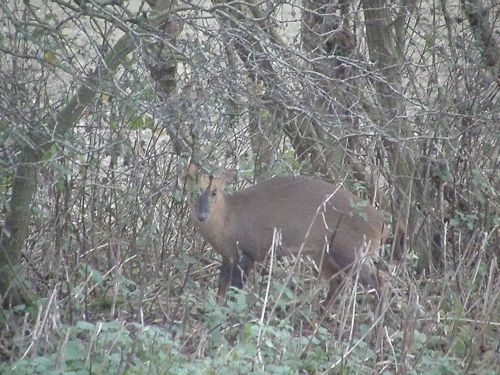
There are two chinese water deer in this picture. Can you spot them?

There are two chinese water deer in this picture. Can you spot them?

I went for my Sunday stroll this morning – not quite at dawn – I couldn’t get out of bed early enough.  Since the crops have grown up the Chinese Water Deer have taken to hiding in the middle of the fields, only their ears visible, like the periscope of a submarine.  CWD seem to prefer the middle of fields.  As a rule, if you see a small deer in a hedgerow it’s likely to be a muntjac; if it’s in the middle of the field it’s a CWD.

If the mammals were quiet today, then the birds were full of life.  It’s spring and they’re putting their heart and soul into defending territories and finding mates.  I spent an hour or so wandering around watching birds and listening to birdsong.  It seemed like every tree had it’s resident bird, sitting somewhere near the top and singing away for all they were worth.

Thrush

Thrush

Have you ever really listened to birdsong?  I’m mean really listened, not just been aware of it as background noise?  Here’s a challenge for everyone then.  Take a walk outside – in the countryside, in a wood or in a park – and listen to the different birds as you go.  Look at the trees and bushes they are calling from.  Find out how far they are away from each other.  Listen how they interact with each other.  I guarantee that if you pay attention then you’ll be amazed.

Chaffinch

Chaffinch

I’m trying to learn the songs of different birds at the moment, and it makes a real difference to get out and actually see the birds as they sing.  Today there were thrushes, robins, chaffinches, great tits, blue tits, a cuckoo (first one of the year for me) and – oddly – a peacock.  None of these are rare birds (the peacock was a bit unusual, I assume it was a pet in a garden), but being aware of them gave a whole new dimension to the walk.  I’d recommend it.

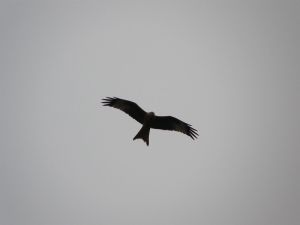
This morning was another first for me in birdwatching terms.  I saw a hawk being mobbed by crows.  I’ve heard of this happening but had never seen it before.  An aerial dogfight was played out before me, with the hawk and crows twisting and turning across the sky.  They were unfortunately too far away for me to identify the hawk, but impressive nonetheless.

So am I a birdwatcher?  Well, I can’t recognise many birds, and I don’t feel the urge to travel the country looking for rarities, but yes, I think I must be.


Read Full Post »

The Red Kite has been preying on my mind.

After my wife saw it, and after I saw it myself from my car, I just had to get a better view of it.  Like I said, it isn’t a great rarity, but it is unusual for this area, and for me that’s a good enough reason to try and track it down.  I resolved to get outside and find it.

I’ve got friends who live in the Chilterns who would be perplexed by this.  Over there the kites are almost as common as sparrows and it isn’t unusual to have ten or more in the sky at one time.

But as far as I know we’ve only got the one kite around here, and this makes it special.  So what are the chances of finding one individual bird?  I love a challenge so this is just the sort of thing I enjoy, and it gave me a perfect excuse to get out and about.  I was a naturalist on a mission!

Half past seven this morning saw me wandering the countryside, binoculars in hand.  I concentrated on the road where I saw the kite, and followed a big loop all around it.  The road itself is at the bottom of a broad, dry valley, so I followed the footpaths on either side of it.

Two hours and five miles later my breakfast was calling me, and I conceded defeat.  Perhaps looking for a single bird, one that could effortlessly cover a territory miles across, was a bit far-fetched after all.

But the idea wouldn’t go away.  By early evening I had finished what I needed to do around the house, so I grabbed the binoculars and headed out for a short walk.  It was a beautiful evening to be out, so it seemed a waste to be sitting indoors.

Half a mile or so from my house there is a large oak tree where you can sit and look out across the valley.  I sat and scanned the landscape slowly, and there, perched on a tree about 500 yards away, was a large bird of prey.  As I watched it slowly flapped off and glided into a patch of woodland.

I couldn’t see the shape of the wings or the tail as it was flying directly away from me, but it was a reddish brown colour with a distinctly pale head.  It was my Red Kite.  I had managed to find it.

The reintroduction of the Red Kite has been a phenomenal success story, and the rate at which they are spreading across the country means that they are likely to be commonplace here within a few years.  Nevertheless, I’ll always be able to think of the time when I tracked down the first Red Kite I saw in Bedfordshire.

Read Full Post »

Common toads mating by the pond

Common toads mating by the pond

I chanced to be walking past the pond this evening, when a strange noise caught my attention – a thin piping, like a cricket or similar insect.

When I shone my torch on the ground I found a dozen or so toads* scattered about, obviously enjoying the cool night.  The noise was coming from a pair of toads in – to put it politely – an amorous embrace.

I watched them for a few minutes.  I’m aware that staring at mating toads by torchlight is slightly voyeuristic, but there was a lot going on.  The female on the bottom (at least, I assume that’s how it works with toads) was walking about quite actively, despite the male on her back.  The male, on the other hand, was vigorously defending his position.  Every now and then another toad would creep up behind, obviously intent on taking over, whereupon the male would push him away with long strokes of his powerful back legs – all while he was still on top of the female.

Fascinating stuff.  I suspect there’ll be the patter of lots of tiny webbed feet soon!

(*The last time I saw a toad I mistook it for a frog.  I checked this time!)

Read Full Post »

causeway-bay-hong-kongThings have been very quiet on the wildlife front lately because I’ve been working in Hong Kong.  It’s been a fantastic experience in one of the world’s most dynamic and exciting cities, but at the same time it’s nice to be back in the green fields and quiet lanes of rural Bedfordshire.

Oddly enough, even in the bustling mega-city that is Hong Kong, there is still wildlife to be seen.  From my window on the 14th floor of my hotel you could see large birds of prey circling on the thermals.

The locals referred to them as ‘eagles’, but they’re a species of Black Kite.  Considering how scarce kites are across most of the UK, it was odd to see them in such an urban environment.    They were perfectly at home, riding on the air currents between the skyscrapers, and giving me some great views as they glided past my window.

kiteI’ve seen similar kites in India, in Delhi and Bangalore, where they are known as Pariah Kites.  Kites are carrion eaters, and they feed on the bodies of cows in the cities. These cows are sacred, hence the kites are seen as outcasts or pariahs for eating them, although they do perform a necessary function in cleaning up the remains.

It’s another great example of nature adapting.  Who knows, perhaps the day isn’t far off when we’ll have urban kites in the UK?

Read Full Post »

For years, my wife and I have put food out in the garden for the birds, and since it is the coldest December for 30 years they really seem to appreciate it.  I made point of saving some windfall apples from the autumn and the blackbirds love them.

Last weekend we went upmarket and bought some niger seed.  Niger seed (also known as nyjer seed or thistle seed) is a small black seed that is supposed to be very attractive to linnets, siskins and goldfinches.  I’m very fond of our usual tits, sparrows, chaffinches and starlings, but this seemed like a good opportunity to have some ‘classier’ birds in the garden.

So out went the niger seed on Saturday.  By Monday, my wife reported new birds in the garden.  And there they were, a very handsome pair of goldfinches!  They really are very striking birds to see – very colourful.  Almost like having a tropical bird in the garden.

Goldfinch feeding on niger seed

Goldfinch feeding on niger seed

All in all, a good result for the niger seed.  Incidentally, as I was thumbing through my book of birds last night, I came across the page on long-tailed tits.  I’d never seen one of these, and I decided to keep an eye out for them.

Strangely enough, I was in my car down the lane this afternoon, when a small flock of birds starting working their way up the hedgerow towards me.  Yes, you’ve guessed it – they were long-tailed tits!   It’s odd how this sort of thing keeps happening…

Read Full Post »

Last night – Saturday night – a small herd of fallow deer does crossed the road in front of my car.  Fallow deer are easy to recognise from the car because of their obvious tails and rump patches as they disappear into the hedgerows.  It happened just a few hundred yards from my house, and close to the field where I usually go for my Sunday morning dawn walks.  Knowing that they were in the vicinity gave me a great opportunity to see if I could track them.

Winter field - no tracks here!

Winter field - no tracks here!

On the face of it, it didn’t seem promising for any tracking on Sunday morning.  It rained heavily all night, so much so that severe weather warnings were in force for much of the UK.  Nevertheless, with an effort I got out of bed to find a cold but clear dawn.  The rain had stopped at some point in the early hours.

Much of the field was too wet for clear tracks.  The lower half of the hill is on clay, and was almost underwater, although a few isolated fallow deer tracks were visible, alongside those of the ubiquitous muntjac and Chinese Water Deer.

On the better drained sandy part of the hill it was a different story.  There, spread out before me was the full story of the morning.  A clear line of tracks showed where the deer had crossed the field from the northwest.

The trail of the fallow deer herd

The trail of the fallow deer herd

The deer were walking calmly, as the tracks had a perfect register.  In other words, the rear foot had come down exactly on top of the track of the front foot.  Measuring the stride of the deer gave me a distance of 50cm on average.  This is shorter than the 60cm that the guidebooks suggest, but maybe it’s because my deer were does, or maybe they were not yet fully grown.

The trail of the deer led across the sandy soil and into a pasture field.  Unlike the deer, I respected this as private property, and I walked around to the next arable field where there was a convenient footpath.  I was able to pick up the trail in this field.  The deer had crossed it at an angle, still heading southeast, before crossing the main road and disappearing into the pathless woods beyond.

Fallow deer track - note the perfect register

Fallow deer track - note the perfect register

Fallow deer are not uncommon in the area, but it was quite exciting to be on the trail of a herd, and particularly satisfying as I had seen them the previous night.  If I was a more experienced tracker I’m sure that I could tell a lot from trail like this – how the individuals are spaced out, which one takes the lead, which ones follow behind and so on.  It was quite confusing to have a mass of tracks all together.  As always, there’s so much still to learn, and I’m enjoying every moment of it.

To end on a happy note, there were badger tracks in the field too.  I hadn’t seen any definite badger tracks here since September, and I was beginning to fear that the badger that was making them (I’ve only ever seen one set of tracks at a time) was the road casualty of early October.  Happily though, it seems not, and the badger is back to it’s regular haunts again.  I’ve only ever seen it’s tracks, but it’s kind of an old friend to me now.

Read Full Post »

Muntjac

Muntjac

Once again, things are busy at work, and I’ve been all over the country in the last couple of weeks, bringing business psychology to the masses and having little time for wildlife at home.

Today being Sunday though, I had time to get up early and go on my regular ‘dawn patrol’ walk around the fields and woods just as it is getting light.  It’s a great time to be out watching wildlife, and as long as you don’t mind getting out of bed it gives you a whole extra part of the day.

7.00am found me sitting with my back to a tree, looking over a ploughed field.  The usual gaggle of rabbits were out and about, a muntjac peered at me from the hedge, and a large flock of rooks was circling over the woods.  As the light grew though, the main object of interest was a trio of Chinese Water Deer meandering around the field.  Their tawny coats were surprisingly well camouflaged against the sandy soil.

Chinese Water Deer seem to be figuring in my thoughts a lot at the moment.  They seem to be more numerous in the local area than I imagined.  I think some of this has to do with my familiarity with them – a few years ago I would have classed all small deer as ‘muntjac’ and thought no more about it.  Now I can recognise the CWD for what they are and distinguish them easily, and I smile at my past foolishness.

Unfortunately, when it comes to tracking, I’m still quite naive.  I still tend to class all small deer tracks as ‘muntjac’ and think no more about it.  In fact, I’m doing exactly what I used to do with visual sightings.

The problem is, the tracks of muntjac and CWD do look very similar. I could be looking at a field full of what I think are muntjac tracks, and they may actually be CWD.  Or vice versa.  For someone like me, who likes to be accurate, even on meaningless things, this is an important point.

Chinese Water Deer Tracks

Chinese Water Deer Tracks

The classic reference book of tracks, Animal Tracks and Signs, by Bang and Dahlstrom, doesn’t even mention CWD – I suppose they aren’t really common outside the Southeast of England (and China, of course).

The Hamlyn Guide to Animals – Tracks, Trails and Signs, my other preferred guidebook, says that CWD prints are very wide and splayed.  The problem with this is, it’s wrong.  The prints are actually quite small and neat.  I know.  I’ve spent the morning watching the deer and then walking up and looking at their tracks.

So, I’ve got a problem.  It is difficult to tell the deer apart from their tracks alone.

The answer, I think, is to look at the trail as a whole, not at individual tracks.  The trail of an animal is as characteristic as the shape of its feet.  This is the approach recommended by Paul Rezendes in his book Tracking & The Art of Seeing.

This is where my tracking stick starts to come into its own.  A tracking stick is a walking stick used in tracking.  The main use of a tracking stick is to establish the stride length of a given animal, and knowing this, predict where the next track should be.  The tracking stick helps you to narrow down the search area so you can find every single track. I tend to use my tracking stick as more of a simple measuring tool.  I have marked it in 10cm intervals and it has a 10x1cm scale attached.  This allows me to make rough and ready (but reasonably accurate) measurements in the field.

Measuring deer tracks with my tracking stick

Measuring deer tracks with my tracking stick

Here’s the clever part.  Having come across a new set of tracks, I can measure the stride length.  I did this for one trail, and found the strides to be 32cm to 38cm long, with most around the 36cm mark.

Looking at the guidebooks, they give a typical stride length for muntjac as 25-30cm, and for CWD as 30-40cm.   This means that my deer, with a stride length of about 36cm, falls outside the range for muntjac, but well within the range for CWD.  Based on stride length alone, we can say with some confidence that the trail has been made by a CWD rather than by a muntjac.

This is exciting stuff.  Although I would struggle to differentiate between the two deer based only on the shape of their footprints, measuring and comparing stride length makes it quite easy to do.

As with anything, there are complications to using stride lengths and gait patterns to identify a species.  Is the deer running or walking?  Is it full size or half-grown?  And so on.  But I like it as a technique.

An awful lot of the information available about tracking today seems very ‘spiritual’ and mystical.  I have no problem with this, and I respect anyone who can use it in this way, but it is not for me.  I earn my bread and butter as a scientist, and although I like to get away from work as often as I can, I can never quite turn off my scientific reasoning.

This is why I like this measurement approach – it is scientific and can easily be applied and tested (unlike many ideas connected to tracking) and it appeals to my use of data and facts.  I’ll see if I can make more use of it over the coming months.

Read Full Post »

Autumn dawn

Autumn dawn

A couple of days ago I saw my first Sparrowhawk.  I’ve been looking out for Sparrowhawks for a while now.  I know they’re found in my area, and I know the habitat around our village is perfect for them.  I’ve got friends who regard them almost as pests as they prey on the birds attracted to their bird tables.  I’m not a twitcher by any means – I don’t have list of birds to tick off – but I’ve got a thing about birds of prey and I’ve wanted to see a sparrowhawk.

The irony is, that after countless hours spent in the fields and woods, I saw my first Sparrowhawk sitting on the top of a lamppost on the outskirts of our local town, Bletchley.

In a way it was a little disappointing, but it’s got me thinking about urban wildlife in general and how resilient nature is.  After all, many species are adapting and living alongside man. When I lived in London I had dozens of urban foxes in my garden, but here in the country I’ve only seen a handful.  There are urban badgers in some places, and even reports of urban otters.  And what about the pigeons?  How many people have seen a proper wild Rock Dove, compared to the millions who see urban pigeons every day?  Not to mention the colonies of wild budgies living in South London.

I suppose it is all rather encouraging.  Although the urban landscape is spreading, the wildlife is adapting.  Sure, there are probably as many losers as winners, but it is adapting nonetheless.  The first Red Kite I ever saw was on a bleak mountain in a spectacularly remote part of Wales, four or five hours walk from the nearest road or house.  The last Red Kite I saw was over a dual carriageway off the Oxford ring road.  Perhaps you can’t compare the two experiences, but I’m glad to see the Red Kites flourishing in all areas.

Hopefully I’ll now see more Sparrowhawks, in more aesthetically pleasing surroundings.  I’ve noticed that once you’ve seen one example of a particular bird, or animal, or plant, you tend to see more.  Take Buzzards for example.  When we moved to the village I was convinced that it was the right environment for Buzzards.  I spent hours staring distractedly at the sky hoping to see one, yet it took me two years before I finally got my first sighting.  Now, of course, I see and hear them all the time.  I can take you to four or five spots that each have their own local Buzzard, all within walking distance of my house.

Did my village suddenly get overrun with Buzzards two years ago?  Of course not.  I think what happened was that I became more tuned in to the Buzzards.  Once my ‘Buzzard-sense’ had developed it allowed me to see them much more easily.  The same thing is happening now as I learn to track mammals.  I am seeing vole runs and badger latrines that I must have walked past a hundred times without realising, but now I’m tuned in they stand out clearly.

If there is a meaning to this story, I guess it’s that you should be aware of your local environment.  It’s fine to dash around to new places looking for new wildlife, but spending time getting tuned in pays dividends in the long run.

Here’s to more Sparrowhawks, whether they be urban or rural!

Read Full Post »

Things have been busy at work and home lately, and with the nights drawing in it has meant that I’ve had less time for wildlife.  Nevertheless, there was one spectacle I had no intention of missing, and that was the Red Deer rut.

Red Deer Stag

Red Deer Stag

Last Sunday I took a trip to Woburn Abbey, our nearest deer park.  You may think it’s cheating, watching the deer in a park instead of in the wild, but as an experience it was hard to beat.

The good thing about the deer park at Woburn is that it is criss-crossed by public footpaths.  If the Duke of Bedford should ever read this, I’d like to say thanks for this generous and far-sighted move.  It means that you can get close to the deer and also walk through the park in the afternoon when it is quiet.  Whilst the deer are by no means tame, they are habituated to people to a degree, so they are not as shy as their wild cousins.

This was the first time I’d spent any length of time in the park during the rut (I’ve been trail running through it during the rut before, but that’s a different story) and the experience was absolutely fantastic.  I deliberately went in the late afternoon, so I had the park pretty much to myself.  Even as I walked up to the gates I could hear the Red Deer stags bellowing.  The stags had spaced themselves out around the park and were calling to attract mates and challenge other stags.

Red Deer stags are truly impressive beasts.  With a full set of antlers, and charged up on testosterone, they seem even bigger than they really are.  The still evening air was full of bellows and grunts, giving an unreal and almost prehistoric feel to the situation.  They may have been park deer, but this evening they were as wild as any others.

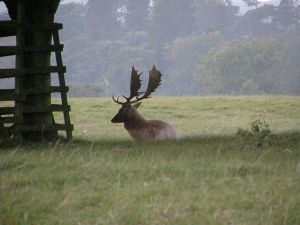
Fallow stag at Woburn

Fallow stag at Woburn

I stuck firmly to the paths and gave the stags as wide a berth as possible.  My second-worst fear was that they would somehow mistake me for another male deer and take offence.  I was carrying a walking stick, but I doubt it would help in a fight, and I wouldn’t want to be on the wrong end of those antlers.  I’ve seen the stags when they clash antlers, and it’s incredibly fast and ferocious.

My very worst fear was that they would somehow mistake me for a female deer…

In all, I spent a couple of hours in the park.  Like I said, it was an incredible experience, and I’d whole-heartedly recommend a trip to Woburn for anyone.  Make the effort and get out of your car and you’ll be amply rewarded.  I’ll certainly be a regular visitor over the winter months.

Chinese Water Deer

Chinese Water Deer

In passing, Woburn is the home to many other species of deer, including the odd-looking Pere David’s Deer, now extinct in their native China.  Another deer from that part of the world is the Chinese Water Deer.  I mentioned these a couple of posts ago.  Like the Muntjac they were originally brought to Britain by the Duke of Bedford and subsequently escaped and bred in the wild.  To make up for not getting a photo of a wild one, here’s one from the park.  Note the large canine teeth.  Even so, these little deer are much cuter (and far less intimidating) than rutting Red Deer.

Read Full Post »

Just to follow on from the last post, here’s another of the tracks I believe were made by a stoat.

I'm pretty sure it's a stoat track.  Scale in cm.

I'm pretty sure it's a stoat. Scale in cm.

This one was obviously made when the mud was very soft or even under water, as it lacks details of the claws etc. The shape, particularly of the rear pad, is very similar to the stoat tracks in the guidebooks. Of course, if anyone knows more, feel free to leave a comment.

Watch this space. I’ll see if I can get more after the next spell of wet weather. Shouldn’t have to wait too long…!

Read Full Post »

« Newer Posts - Older Posts »