Feeds:
Posts
Comments

Archive for the ‘That’s not a badger!’ Category

My wife called me up when I was at work the other day, and told me that she’d just seen a polecat crossing the road in front of her car as she drove through a nearby village.

Now, as I’ve mentioned before, my wife doesn’t quite share my obsession with the local wildlife, but she’s a sharp observer of things and she’s very familiar with the normal animals around here.  Make no mistake, she saw a polecat.  She described the ‘bandit mask’ on the face perfectly.

Polecats are not unknown in Bedfordshire, but they aren’t very common either.  They seem to be slowly re-establishing themselves.  I’d love to see a polecat.  The recent series of Springwatch that featured attempts to film polecats has really put them in the public eye.  It’s good to discover that they’re in the area.

Given my utterly unsuccessful attempts to locate the stoats that live down my road, I may well struggle to spot a polecat in another (unfamiliar) village, but if I can find the time then I’ll give it a go.

So, yet another new wildlife ambition for me then…

Read Full Post »

Here’s a short video of the muntjac buck I saw on the 28th June.

Watching the video again brings it home just how shy and wary these deer are.  Watch how the buck is constantly raising its head to check for danger, while those big ears swivel around to catch the slightest sounds.

Read Full Post »

Badger 1It’s been a weekend of extremes as far as the weather has gone.  It has been very hot and very humid, with long periods of sunshine giving way to thunderstorms in the evenings.  Although we haven’t had any rain ourselves, it has been torrential in places nearby.  One friend had his car alarm set off repeatedly by intense hailstorms, while the house of another was actually struck by lightning!

The badgers seemed to respond to the sluggish weather too.  I went up to the wood on Sunday evening.  I was relieved to find that it was slightly cooler in the wood – I had imagined that it would be even more humid and oppressive under the trees, but the opposite was the case.  I am constantly surprised by the differences in microclimate between woods and nearby fields.  If any ecology student is looking for a subject for a project I suspect that there’s an interesting field of study here.

Two badgers came out of the western side of the sett at 8.20pm, including a light coloured individual.  They groomed for a bit, wandered around in a desultory way and eventually mooched off towards the east.  I don’t know if it is the weather, but they did seem a bit lethargic.  They weren’t in any hurry to rush off and forage, but at the same time they weren’t in the mood for playing or interacting.  Perhaps it was just too hot, especially for a badger with a thick coat of hair.

I don’t know where the other badgers in the sett were.  They may be staying underground until later to escape the heat (I only stayed until 9.30).  They could even be sleeping above ground somewhere, perhaps in one of the nests I discovered a few weeks ago.

The evening was notable because I actually managed to get a half-decent photograph of a muntjac.  These little deer are a real contradiction: they are very common in this area, but surprisingly difficult to get close to.

Muntjac buck

Muntjac buck

If I’m driving to or from work in the early morning or evening then I see them regularly by the side of the road.  I saw one at 6.00am this morning about 100 yards from my house.  But although they’re common, they are wary.  They have an uncanny sense of whether you’re interested in them.  They’ll let you drive or walk past, but if you slow down the car they’ll be off like a shot.   If you pause or raise a camera then they notice immediately.  I try to practise my deerstalking on the local muntjac, but rarely with any success.  All of this means that I’ve never got a close-up picture of one.

Last night though a muntjac buck walked past the tree where I was sitting, giving me some great close-up views.  In terms of fieldcraft, camouflage and wind direction I was in just the right spot and it wandered about, blissfully unaware of me as it browsed on the vegetation.

Notice the small antlers with the long pedicles (the tissue at the base of the antlers), the pronounced brow ridges and the long canine teeth.

Muntjac 1

Not a rare species by any means, but a challenge to get close to.

Read Full Post »

I’ve spent the last couple of nights wandering around the fields and green lanes of our village looking for glow worms.

It is just over a year since I saw glow worms in Berkshire.  I was very impressed by them and I’d like to see more.  The trouble is that my village isn’t quite the right habitat for glow worms (they seem to prefer fairly large areas of unimproved grassland) and none have ever been reported here before.

Nevertheless, I decided to follow the lead of those enthusiastic volunteers at Loch Ness and not let the certain prospect of utter failure put me off.  Besides, there is something particularly satisfying about going for a walk on a June night.

The air has been warm and still and filled with the scent of elderflowers, cow parsley and lush vegetation.  We have a family of young tawny owls in a clump of trees nearby, and the sound of them calling to each other carries a long way on a windless night.  Moths flutter around the grass and the bushes, while overhead the bats flit past, dark shadows against the deep blue of the sky.  Best of all are the countless rustling noises from the undergrowth as you walk past.  These could be made by anything from a mouse to a deer – even a hedgehog makes a surprising amount of noise as it snuffles along the hedgerow – but they give you a primal thrill of excitement from knowing you’re close to a wild animal in the dark.  It’s a fine time to be out of doors, to be awake and alive when everyone else is safely in their homes.

Did I see any glow worms?  Of course I didn’t.  But it doesn’t really matter.

Read Full Post »

It’s confession time again.

I’ve been guilty of occasional birdwatching for many years.  Nothing too serious – putting out food in the garden, listening to birdsong, watching the buzzards over the fields – the usual stuff.  I thought I could handle it.

But now I’ve crossed a line.  I’ve joined the hardcore of birdwatching.  I’ve become a twitcher.

There is something about birds that seems to affect men of my age (no 1970s sexist pun intended!), and we seem to get strangely obsessed by ticking them off lists.  There are people who take this to extremes, attempting to see every single bird species in the world (seriously), and many more that will travel across the UK to see a rarity that has been blown to these shores by freak winds or got badly lost while migrating.

I’m not in this category, but I have developed the list-ticking habit.  I’ve been looking at the birds in my local area, and idly wondering how many different species there are, and how many I’ve seen.  One thing led to another, and I downloaded the county bird list from the Bedfordshire Bird Club.  Birdwatchers keep many lists, so there are lists for each county as well as for the UK as a whole.  A bird that may be commonplace in one area may be a rarity in another, so there is a challenge to ticking off these county lists.

I’m not at the stage yet where I’m prepared to jump in the car and dash off to the other end of Bedfordshire to tick off a Siberian Lesser-Spotted Gronky Bird or some such rarity that has just arrived, but I am working my way through the list, ticking off the species as I see them in the course of my usual rambles.  As a very novice birdwatcher, the challenge for me is not so much spotting a rare bird, it’s identifying the common ones that are all around me.  There’s an awful lot of birds out there, and ticking off the list helps me to learn to recognise them, particularly the little brown ones that all look the same to me.

So how am I doing?  Well, I’m afraid I’m not going to have Bill Oddie knocking on my door any time soon.  There are 292 birds on the Bedfordshire county bird list.  So far, as the title of this post suggests, I’ve seen and positively identified 45 of them.  I have some way to go yet!

Dunnock

Dunnock in my garden

This is the 45th bird on my list – the Dunnock.  Not a great picture, but you get the idea.  The Dunnock is a small, brown bird that looks pretty much like a sparrow to the novice.  In fact, I’ve probably had them in the garden for years without noticing.  The defining features are the orange legs and the row of pale spots on the wings.  Dunnocks also tend to keep low, and they are happy to hop around the garden and flit from bush to bush.

You see, not only can I tick off number 45 on my list, but the list itself is encouraging me to learn more about my local birds.  Bird lists are good things!

Now, where was that Siberian Gronky Bird reported…

Read Full Post »

I had been getting a little perplexed by the behaviour of my badgers; in particular I was worried that they had been driven to eat bark by the recent dry weather.  However, the more I looked at the problem, the less sure I became.

Thanks very much to everyone who shared their experience with me here.  Spiney, for instance, sent me a picture of bark-eating near a badger sett in Yorkshire.  This looks like a beech tree – another tree with quite a sugary bark.
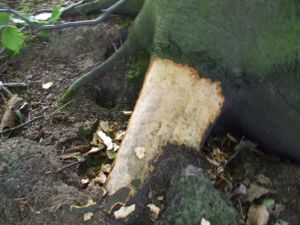
Bark eating - picture by Spiney - thanks!

Bark eating - picture by Spiney - thanks!

John from Badgerpics.org.uk very helpfully supplied information on the bark-eating habits of different animals, whilst on a related topic Josie was very helpful with further details of the badger ‘nests’.  Thanks everyone – it’s great to have this sort of assistance.

To try and settle the matter I spent the evening down at the Pine Tree sett.  My plan was to lurk around and see if I could catch the culprit in the act.

When I arrived I realised that it was even less likely that badgers were to blame.  The bark-eating had spread to the neighboring trees and extended far up into the branches.  There is no way a badger could get so high on such a thin branch.
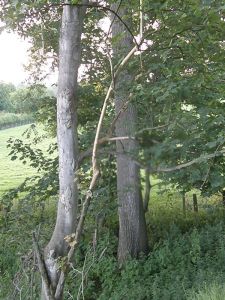
More bark damage

More bark damage

In fact, the only animal I know that can reach these branches is a squirrel.  This seems to be the only possible explanation.  It is far too high for deer, rabbits, badgers or even voles.  The toothmarks on the high level damage are the same as on the ground level damage, so the same animal is responsible for all of it.

Bark tooth marks

Bark tooth marks

There were indeed squirrels in the area, and they were feeding in the sycamore trees, but I couldn’t quite see exactly what they were feeding on.

To make sure, I sat well back from the area and waited, just in case a badger came out and had a quick nibble on a tree.  I was sitting far back from the bank so I couldn’t see the hole, but at 8.50pm I heard the unmistakable sound of a badger scratching, and then a few seconds later the badger itself ambled into view.  Before I could even raise the camera it trotted off towards the southern end of the sett.  It walked past the freshly gnawed tree without even a second glance.

So there you have it.  Two hours of sitting in a wood for one 15 second view of a badger.  It was worth it though.  The bark was a mystery, but it’s been an interesting challenge to work out what was going on.

So, to conclude, it seems that badgers can and do eat bark, particularly sycamore.  However, on this occasion it looks like I have one or more rogue squirrels in the area who have taken a liking to it.  The fact that they started to eat the bark at ground level and right outside a badger sett put me on the wrong track for a while, but the true facts emerged.

Like I said, it keeps me out of mischief!

Read Full Post »

Tawny Owl

Tawny Owl

On Tuesday I went to the wood and, as recorded below, I didn’t see any badgers. In the absence of badgers, I spent the evening watching birds, and I want to make some notes on these – hence the separate post.

It always amazes me what you can see if you sit quietly and unobtrusively somewhere for an hour or so.  I had a pair of bullfinches working the tree in front of me.  These are far less common now than when I was a lad, so it was good to see them.  There was also a pair of robins with a nest about 50 feet away, and they spent the whole evening going backwards and forwards with food for the young – it was a proper Springwatch moment.  I always find it slightly strange to see robins in the wild.  I am so used to seeing them in the garden that I tend to forget that they exist outside.

One of the most interesting things for me personally was the effect of a tawny owl on the local birds.  As it was getting dark, a tawny owl called from the deep woods somewhere behind me – kee-wick, kee-wick.  Instantly, a blackbird nearby started up its chattering alarm call – chink-chink-chink-chink-chink. Then another blackbird did the same a little further away, and then a third.

The blackbirds had obviously heard and seen the owl and they were raising the alarm.  What made it so interesting was that although I could not see the owl myself, I could locate its position and track its progress by the alarm calls of the blackbirds.

Some trackers regard this as a higher form of tracking – following a predator through the reactions of other species.  Jon Young discusses it in detail in Animal Tracking Basics (probably the least basic book on tracking I’ve ever read, incidentally).  I’ve noticed blackbirds responding to foxes in this way, but this was the first time I’ve really been able to follow the progress of a predator through alarm calls.  I was quite pleased with myself.

So although there were no badgers that evening, I still had a great time.  All of this happened in a little patch of woodland that 99% of people would drive past without a second thought.

If you’re interested in nature and wildlife then I strongly recommend you find somewhere outside – a wood, a field, a park, anywhere – and just sit there quietly for at least an hour.  I think you’d be surprised at what you see and hear.

Read Full Post »

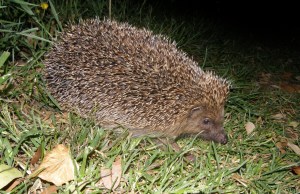
Hedgehog!

I’ve been writing this diary for a year now, and do you know what the most popular post has been?  Has it been my insightful and, dare I say, scholarly comments on badger behaviour?  Has it been the videos and fieldnotes that make the experience of badger watching available to all?  Has it been my adventures in tracking, discovering the wildlife of my local area?

Nope.  None of these things.  The most popular post, by a significant margin, has been my picture of a hedgehog (see Fieldnotes: 2nd August 2008).  It seems the hedgehog is the real star of the show.

So, for all the hedgehog fans out there (including the Hedgehog Fan), here’s a picture of another urchin I came across this evening.  Right click and save as to get the full size picture.

Hedgehog

Hedgehog

Read Full Post »

I’ve spent the evening watching the fox cubs by the sett.  I counted five of them (I think) and they’re great fun.

Here’s a short fox cubs video compilation.  Altogether now – “Awwww!”

Read Full Post »

It’s always the way.  You wait for ages for one Red Kite, and then three turn up at once.

On  Sunday I got up early, packed up a flask of tea and some food, and went out for an early stroll and a picnic breakfast.  I sat under the big oak tree and looked across the valley, drinking tea and watching the antics of a Chinese Water Deer in the field below.

At 7.40am three Red Kites rose up from the woods on the other side of the valley.  They circled slowly, gaining height, and then soared away in different directions.  Within five minutes the valley was empty again.

It was as fine a view for breakfast as you could hope for.  The Red Kite is now definitely ticked off my local species list.  I need to find something else to focus on.

Read Full Post »

« Newer Posts - Older Posts »