Feeds:
Posts
Comments

Archive for the ‘Fieldnotes’ Category

Last night I went for a walk around 11.00pm to see if I could spot the badgers foraging in the pasture field, although if I’m honest with myself this was just an excuse to get outside.

There is something truly magical about being outdoors on a summer night.  It was a beautiful, clear, warm night with a nearly full moon – it was the perfect night to be out and about.  Few people, I suppose, deliberately go out in the dark these days, but they’re missing out.  Just to be out in the countryside on a night like this is special in a way that I simply cannot put into words.

By 11.30 I was sitting with my back to the great old stag-headed oak on the top of the hill in the pasture field.  It seemed that I could look out over the whole of Bedfordshire – the woods and fields, houses and roads – stretching out before me in the moonlight.  Once again the whole world was asleep while I was joyously awake and alive.

At 11.45 a badger came trotting up behind me.  Poor thing.  I was sitting facing the wood with the wind in my face because for some daft reason I expected the badgers to come out of the wood, even though they would have started foraging hours ago.  This badger must have been out in the field already, and it must have come across my scent being blown behind me and decided to hurry past.  Ah well, let it go.  No point in disturbing it further.

On my way back home I came almost face to face with another badger in the cornfield at the bottom of the hill.  I know they use this field and they feed here, but this was the first time I’ve caught one in the act.

I had my camera with me but I didn’t take any pictures.  Taking pictures would have meant using the camera flash.  To have suddenly lit up the scene with a harsh, artificial light seemed somehow crass and insensitive and sacrilegious, almost like shouting in a cathedral.  I was content to sit and watch and to be a part of the night myself, to share the night with the creatures around me.

Perhaps the magic of a summer night can only be experienced first hand, and not captured and brought home.

Read Full Post »

Badger 3Yesterday was another beautiful warm evening.  7.45pm found me sitting contentedly up a tree at the main sett, drinking tea and making running repairs to my camouflage gloves with a needle and thread.  A more blissful domestic scene could not be imagined.

I’d taken a detour around the wood earlier in the evening to check out the badger day nests I found last month.  I’m curious to see whether the badgers are using them in this hot weather, particularly since the last time I was at the sett there were only two badgers to be seen.  Unfortunately the nests were all unoccupied and showed no signs of recent use, so there is another theory that will have to wait for another day to be proved.

At 8.35 a badger came trotting up from the inaccessible east end of the sett and disappeared into a hole at the west end.  Two more followed, and then another two.  In total, five badgers had come from the other part of the sett and gone straight back underground.

I waited for the badgers to re-appear, but nothing happened.  I would have thought they would be eager to start foraging, but they stayed underground.  Very odd.

As I was waiting another muntjac deer wandered onto the scene.  I’ve waited ages to get a good view of a muntjac, and now it’s happened twice in consecutive trips.  I’m getting a bit blasé now – the muntjac will have to start performing tricks if they want me to film them in the future!

After a little while I heard badger noises from the east end of the sett, whickering and the short, high-pitched bark that badgers make when play fighting has got out of hand.  Once again, this area is now an impenetrable mass of vegetation – elder, nettles and bracken.  The sounds were confirmed when three badgers came into view at the very far east side of the sett and started foraging through the wood.  These three plus the five I’d seen at the west end makes at least eight badgers, which is good.  I was worried because I’d only seen two last time.

A few minutes later a fox trotted past with a baby rabbit in its mouth, unfortunately too far away to photograph in the fading light.  I think it was the vixen that had the cubs here, but it could conceivably be one of the cubs themselves.  They’ve certainly grown up and left home now.  The fox loped off to the east end of the sett.  The fact that it was taking food there implies it has a den in the area.

The five badgers at the west end of the sett remained underground until 9.30 when I had decided to pack up and was in the process of climbing down the tree, at which point they emerged and gave me a hard stare.  Absolutely typical!

It was an interesting night for the variety of wildlife that was about, but it was also interesting because it showed a pattern.  Last year, the badgers started off in the west end of the sett and then moved to the east as the summer progressed.  This year they’ve done the same, although at least some badgers are using the west end for at least some of the time.

There is obviously something going on here.  Something makes the badgers move between parts of the sett.  If only I could recognise individual badgers I’d be in a better position to understand this, but despite staring at film and pictures they still look pretty much alike to me.  In the meantime I’ll keep making notes of what I see and hope it all makes more sense in the future.

Read Full Post »

Badger 1It’s been a weekend of extremes as far as the weather has gone.  It has been very hot and very humid, with long periods of sunshine giving way to thunderstorms in the evenings.  Although we haven’t had any rain ourselves, it has been torrential in places nearby.  One friend had his car alarm set off repeatedly by intense hailstorms, while the house of another was actually struck by lightning!

The badgers seemed to respond to the sluggish weather too.  I went up to the wood on Sunday evening.  I was relieved to find that it was slightly cooler in the wood – I had imagined that it would be even more humid and oppressive under the trees, but the opposite was the case.  I am constantly surprised by the differences in microclimate between woods and nearby fields.  If any ecology student is looking for a subject for a project I suspect that there’s an interesting field of study here.

Two badgers came out of the western side of the sett at 8.20pm, including a light coloured individual.  They groomed for a bit, wandered around in a desultory way and eventually mooched off towards the east.  I don’t know if it is the weather, but they did seem a bit lethargic.  They weren’t in any hurry to rush off and forage, but at the same time they weren’t in the mood for playing or interacting.  Perhaps it was just too hot, especially for a badger with a thick coat of hair.

I don’t know where the other badgers in the sett were.  They may be staying underground until later to escape the heat (I only stayed until 9.30).  They could even be sleeping above ground somewhere, perhaps in one of the nests I discovered a few weeks ago.

The evening was notable because I actually managed to get a half-decent photograph of a muntjac.  These little deer are a real contradiction: they are very common in this area, but surprisingly difficult to get close to.

Muntjac buck

Muntjac buck

If I’m driving to or from work in the early morning or evening then I see them regularly by the side of the road.  I saw one at 6.00am this morning about 100 yards from my house.  But although they’re common, they are wary.  They have an uncanny sense of whether you’re interested in them.  They’ll let you drive or walk past, but if you slow down the car they’ll be off like a shot.   If you pause or raise a camera then they notice immediately.  I try to practise my deerstalking on the local muntjac, but rarely with any success.  All of this means that I’ve never got a close-up picture of one.

Last night though a muntjac buck walked past the tree where I was sitting, giving me some great close-up views.  In terms of fieldcraft, camouflage and wind direction I was in just the right spot and it wandered about, blissfully unaware of me as it browsed on the vegetation.

Notice the small antlers with the long pedicles (the tissue at the base of the antlers), the pronounced brow ridges and the long canine teeth.

Muntjac 1

Not a rare species by any means, but a challenge to get close to.

Read Full Post »

My wife came home from a late shift tonight and told me that there was a badger dead on the main road, not more than 100 yards from the end of our road.

I’m not particularly keen on going out at 11.30pm and examining dead badgers, but I couldn’t leave it there.  Plus, now that I’m part of the Bedfordshire Badger Network I have a responsibility to monitor road deaths in the area.  Packing camera, tape measure and disposable gloves, off I went.

The badger was very close to our house, and fairly close to the one that was killed back in October.  I regularly track a badger in the field next to this spot (I followed a lovely long trail here only two weeks ago) so I guess that it was either this badger or one from the same sett.  I suspect that the sett is in a private wood on the other side of the road, hence the badgers seem to cross the road regularly.

I dutifully moved the badger to the verge and examined it, recording length (59cm excluding tail) and sex.  Determining the sex proved more difficult than I imagined, and I resorted to taking pictures and then comparing them to books when I got home.  I’m pretty sure it was a female, and the relatively small size and condition of the teeth suggests an immature one (fully mature sows average 72cm, apparently).

In some ways it was interesting to get a close view of a badger, but I hope I don’t have to do this sort of thing too often.

Read Full Post »

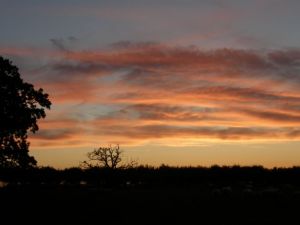
Summer sunset

Summer sunset

I’ve been in Scotland for a few days, but today I was most definitely back in England.  As I walked through the village there was a game of cricket being played on the village green, while the church bells rang out in the summer evening air.  It was the quintessential English scene.  If I was John Betjeman I would have written a gentle poem about it.

But I’m not.  Just a simple (very) amateur naturalist.  I was on my way up to the wood to see how the badgers at the main sett were getting on.  It’s been a while since I looked in on them, having been spending time at the Pine Tree sett.

As it turned out it was a frustrating evening.  At 8.53 a badger emerged from the west end of the sett and promptly trotted off into the impenetrable jungle at the east end.  Another badger emerged and did the same, then another.

I waited for another half an hour but nothing else happened.  The badgers did not come back and no more emerged.  I could hear nothing from the eastern part of the sett – normally if the badgers are congregating there you’ll hear rustling or whickering noises.

Perhaps the recent dry weather has got the badgers more preoccupied with food than with sitting around or playing.  They have to work harder and longer for worms in these dry spells, which means they tend to start foraging earlier.

One point to note is that all three badgers were quite small.  I can’t confidently say they were cubs because I didn’t see them for that long, but they had that look about them.  The third badger also had a noticeably long tail, which I can’t remember seeing before.  If this is a distinguishing feature I’ll have to look out for it in the future.

Read Full Post »

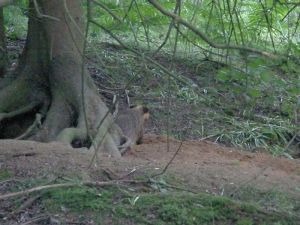
Badger at the Pine Tree sett

Badger at the Pine Tree sett

On my reconnaissance of the Pine Tree sett a few weeks ago I identified three separate holes spread out a hundred or so yards apart along a line roughly north-south.  I’ve watched at the southern hole a couple of times but seen no badgers, and I’ve seen a single badger both times I’ve watched at the northern hole.

Where are the other badgers?  I decided to spend a couple of hours watching the middle hole.

And now it’s time for a confession.  The bracken has grown up over the past couple of weeks, and although I looked for the middle hole I couldn’t find it.  Some outdoorsman I am!

Rather than go back home again I settled down to watch the southern hole.  This is the one with the biggest spoil heap, so it should be occupied, and the spoil showed recent tracks.  Perhaps I could clear up the mystery of why I’ve never seen any badgers there.

At 9.03pm a badger appeared.   But it did not emerge from the hole, it came from the woods behind and then went into the hole.  After another ten minutes or so it emerged again.  This hole is under the roots of a pine tree, and the badger emerged from between the roots, just like a badger in a picture book.

Unfortunately the light had faded and my camera was struggling.  The only decent picture I got is the one at the top of the post, and that isn’t very good.  Shame.  It would have been great to get a picture of the badger emerging from beneath the tree.

After a minute or two the badger trotted off into the depths of the wood.  Nothing else happened.

I’m starting to suspect that there is only one badger at the sett.  When I last saw the badger at the northern hole it emerged at 8.50pm and walked towards the southern hole.  This is exactly the same thing I saw tonight.  I need to get a clear picture and see if I can recognise it as the same badger.

It seems odd that there should be only one though.  Is it normal for one badger to have three holes?  Nor does this square the evidence I got from tracking, which showed multiple tracks on this side of the pasture field, or the well-worn paths in the area.  Perhaps there are more and they still haven’t shown themselves, but I don’t think so.

If nothing else, this highlights my continuing ignorance of what constitutes a main sett and what is merely a subsidiary sett, and how these relate to clan relationships between different groups.  As soon as I’ve worked it out I’ll let you know.

Read Full Post »

I had been getting a little perplexed by the behaviour of my badgers; in particular I was worried that they had been driven to eat bark by the recent dry weather.  However, the more I looked at the problem, the less sure I became.

Thanks very much to everyone who shared their experience with me here.  Spiney, for instance, sent me a picture of bark-eating near a badger sett in Yorkshire.  This looks like a beech tree – another tree with quite a sugary bark.

Bark eating - picture by Spiney - thanks!

Bark eating - picture by Spiney - thanks!

John from Badgerpics.org.uk very helpfully supplied information on the bark-eating habits of different animals, whilst on a related topic Josie was very helpful with further details of the badger ‘nests’.  Thanks everyone – it’s great to have this sort of assistance.

To try and settle the matter I spent the evening down at the Pine Tree sett.  My plan was to lurk around and see if I could catch the culprit in the act.

When I arrived I realised that it was even less likely that badgers were to blame.  The bark-eating had spread to the neighboring trees and extended far up into the branches.  There is no way a badger could get so high on such a thin branch.

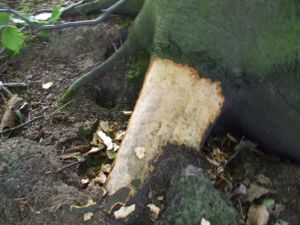
More bark damage

More bark damage

In fact, the only animal I know that can reach these branches is a squirrel.  This seems to be the only possible explanation.  It is far too high for deer, rabbits, badgers or even voles.  The toothmarks on the high level damage are the same as on the ground level damage, so the same animal is responsible for all of it.

Bark tooth marks

Bark tooth marks

There were indeed squirrels in the area, and they were feeding in the sycamore trees, but I couldn’t quite see exactly what they were feeding on.

To make sure, I sat well back from the area and waited, just in case a badger came out and had a quick nibble on a tree.  I was sitting far back from the bank so I couldn’t see the hole, but at 8.50pm I heard the unmistakable sound of a badger scratching, and then a few seconds later the badger itself ambled into view.  Before I could even raise the camera it trotted off towards the southern end of the sett.  It walked past the freshly gnawed tree without even a second glance.

So there you have it.  Two hours of sitting in a wood for one 15 second view of a badger.  It was worth it though.  The bark was a mystery, but it’s been an interesting challenge to work out what was going on.

So, to conclude, it seems that badgers can and do eat bark, particularly sycamore.  However, on this occasion it looks like I have one or more rogue squirrels in the area who have taken a liking to it.  The fact that they started to eat the bark at ground level and right outside a badger sett put me on the wrong track for a while, but the true facts emerged.

Like I said, it keeps me out of mischief!

Read Full Post »

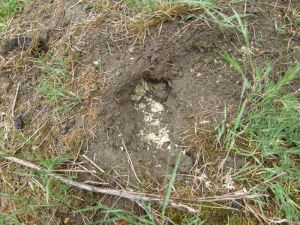
Wasps nest dug out by badger

Wasps nest dug out by badger

The hot dry spell ended with a vengeance on Sunday.  I went for my customary walk at 7.00am and the rain was torrential.  I splashed happily through the rivers of rainwater that were running down the road.

I went for a walk more out of habit than in any hopes of seeing any wildlife.  I thought that they’d have more sense than to be out in a downpour.  And so it proved.  There was one solitary Chinese Water Deer in the field (do they like to be wet?) but apart from that I was on my own.

I did find one interesting thing.  In the field behind my house was a wasps’ nest that had been dug out.  The nest had obviously been dug out overnight as there were a few dazed and confused wasps wandering over the wreck of their home.  This is a classic badger feeding sign, but one I’ve never seen before.  The badgers dig out the nest to get at the larvae inside, and by all accounts they are not bothered too much by the stings.

Fine by me.  I have no love for wasps.  As far as I’m concerned it was a good night’s work by the badger.  That’ll do, badger.  That’ll do.

Read Full Post »

OK.  Time to bare my soul a little.

Most people in Britain have never seen a badger.  Many have seen a dead badger by the side of the road, but few ever see a live one.  Of those that do, I suspect that most are content to enjoy the experience, to enjoy the badger as an impressive yet endearing part of our wildlife.  As I’ve said before, once people see a badger they seem to become hooked.  Even Ernest Neal, the undisputed authority on badgers, first came across one by accident and this led to a lifetime of work studying these creatures.

But for me it is not enough to just watch badgers.  I’ve gone past the “wow – there’s a badger!” phase.  I want to understand them.  I think I’m becoming obsessed.

Now don’t get me wrong – it’s not a bad obsession to have.  It’s quite healthy.  I could be addicted to drink or drugs, but instead I’m becoming addicted to badgers.  It’s a pleasant diversion from work, it keeps my mind active and stops me getting up to mischief, and most importantly it encourages me to get out and enjoy the countryside on my doorstep.

What started out as a good excuse to go for a walk in the woods has now got me learning about animal behaviour, territoriality, social bonding and the whole ecology of woodlands.  As soon as I think I’ve understood how badgers work, I discover something new and realise I actually don’t know very much at all.

All of this philosophical musing has been triggered by a short walk in the woods this morning.  I wanted to go out and have a look at the Pine Tree sett, specifically to see if there was any more evidence of badgers eating the sycamore bark.
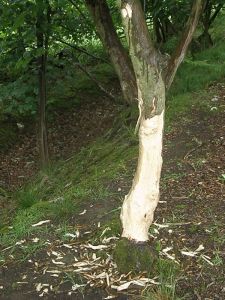
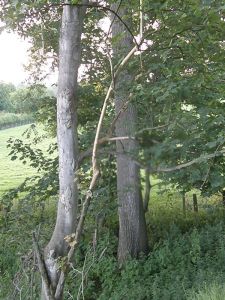
Sycamore with gnawed bark

Sycamore with gnawed bark

When I got to the sett I found that there was a lot more evidence of bark eating.  Another tree had been ‘attacked’ and more bark was missing from the original tree.  But from what I’ve seen, I’m not sure that badgers are the culprits.

The bark shows clear toothmarks – lots of them and quite small – rather than a few large claw marks that I’d expect from a badger.  More conclusive was that the damage to the bark now extends to about 8 feet off the ground.  Badgers are actually surprisingly good at climbing trees (and they seem to enjoy it as a game) but I think that this height is beyond them.  I now need to research squirrel feeding, and see if that fits the bill.  Even better, I need to spend an evening here and see if I can catch the culprit in the act.
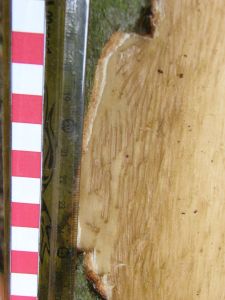
Bark damage close up

Bark damage close up - scale in cm

Acting on suggestions from people on the Wild About Britain forum, I examined the badger dung in the latrine nearby.  It seemed a bit more green than usual but there were no clear signs of bark in it.  And no – I didn’t bring any home for analysis.  I’m not that obsessed yet!
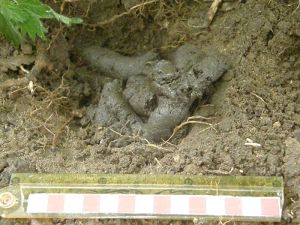
Badger Dung

Badger Dung

Walking back through the woods, I came across more puzzling animal signs.  For want of a better word I’ll call these ‘nests’.  They were substantial piles of grass that had been pulled up and shaped into a mound, sometimes with a hollow in the middle.  They are undoubtedly the bedding of some animal.

I’ve come across these before, and I wondered if they were piles of bedding that a badger had collected and then for some reason abandoned on the way back to the sett.  After seeing more of them today I think that they are more likely to be nests in their own right, where an animal sleeps.  I found them in dry, sheltered spots.  Here’s one under a fallen tree:
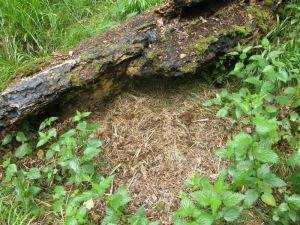
Badger Nest 1

Here’s one under the shelter of a pine tree:
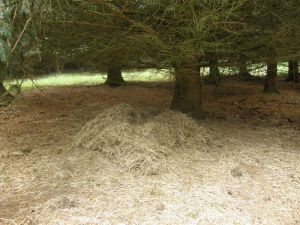
Badger Nest 2

The nests were associated with paths, but whether these were badger paths I could not say.  The whole area is criss-crossed by badger paths and deer paths, and to confuse matters the badgers use deer paths and the deer use badger paths.

Are these nests made by badgers?  What other animals deliberately gather bedding from distance?  If they are badger nests, why are they there?  Why are the badgers not safely underground in their sett?  Are they used as temporary shelter?  Are these badgers part of a sett, or are they some sort of homeless, ‘hobo badgers’, sleeping rough?  If so, how do they fit into the territories of the other badgers?

Do you see now how this whole badger business can become obsessive?  If anyone has any answers, please do let me know.

Read Full Post »

On Saturday I watched the southern entrance of the Pine Tree sett without seeing any badgers.  It looks as though there should be badgers in residence – there’s plenty of fresh spoil and well-used paths – so maybe it was just an odd coincidence that they came out late, or maybe I disturbed them somehow.

To make sure, I went back to this part of the sett on Tuesday.  Once again, I saw no badgers.  I’m coming to the conclusion that there are no badgers in this particular hole.

I’m trying to make sense of all this in terms of used and unused holes and the way a clan of badgers organises itself into main, outlying and subsidiary setts.  I know that sows with cubs will take themselves off to an unused hole, and that boars new to an area will do the same.  Perhaps these are outlying holes and there’s a main part of the sett here that I haven’t observed yet.

Sycamore tree with stripped bark

Sycamore tree with stripped bark

It was still a worthwhile outing, with plenty to see.  I noticed that at the northern hole the badgers have stripped the bark off a young sycamore tree and eaten it.  At least, I presume it was badgers – the tree is right next to the sett and it was stripped of bark up to 3 feet high, so I don’t think anything else could have done it.

Neal and Cheeseman mention that badgers will sometimes eat sycamore bark in early spring when the sap is rising.  It is almost midsummer now, but perhaps the recent dry spell has made other food less available, so the badgers are having to expand their diet.  I’ll keep an eye on this.  I’d rather not feed them, but I don’t want them to go hungry either.

Read Full Post »

« Newer Posts - Older Posts »