First of all, thanks Ghillie and Josie for your comments on the last post. Sorry I haven’t got around to replying sooner. The consensus is that the badger at the Pine Tree sett could well be Nick, but I guess we’ll never know for sure. What I need is some sort of badger face recognition software…
I’ve just come back from a peaceful evening at the Pine Tree sett. It was totally undisturbed by badgers, anyway.
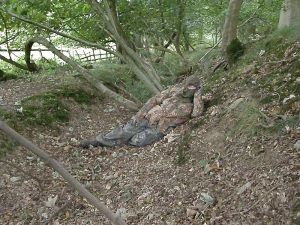
A badgers-eye view - full camouflage
I was making another attempt to photograph the badger there. Everything was right. The wind was coming from a slightly different direction so I didn’t have to sit in the nettles – I had a perfect view of the sett entrance from directly downwind. I was dressed up in my best camouflage outfit and my silhouette was well hidden by the bank of earth. I was in a comfortable position and I sat still for an hour and a half until it got too dark for pictures. In short, it was perfect, except that no badger showed itself.
To be honest, it’s a complex sett. There are at least two active holes a hundred yards apart and (it seems) only one badger. It could well have been in the other hole and I’d never have known.
I don’t regard evenings like this as wasted, not in the slightest. It is enjoyable to sit there on a comfortable bed of leaves and listen to the wind in the trees and the owls hooting. There’ll be plenty of chances to get to grips with the badgers again in the future.
So, my plan was a simple one. Spend the evening down at the north entrance of the Pine Tree sett, photograph the resident badger, and match the pictures of its distinctive facial markings with those of ‘Nick‘ from the main sett last year. If the markings are the same then there’s a good chance that the lone badger at the Pine Tree sett is in fact one that has moved away from the main sett. This will be great evidence for movement of individuals between neighboring setts.
Here's Nick from last year again - look at the notch in the stripe behind the ear
Sunday was a beautiful day and a lovely warm dry evening – just right for a lazy session of badger watching. All I needed was one clear picture. With such a simple plan, what could possibly go wrong?
The wind at the sett was blowing from east to west, which meant that I couldn’t sit on the bank and look down at the hole – the wind would blow my scent straight to the badger. Instead I settled down on the other side of the sett, behind a large bank of nettles.
To increase my chances of getting a picture I broke my own rule and put out some food for the badger. I didn’t plan to do this, but I walked past a crab apple tree on the edge of the wood and I picked up a half-dozen or so ripe fruits off the ground. I know I’ve said I don’t like feeding badgers because it takes away their natural behaviour, but in my defence I wasn’t here to study, I was just here for a picture.
At precisely 7.30pm a stripey nose poked out of the hole.
The badger came out slowly, snaffled up the crab apples and wandered around the area for a few minutes.
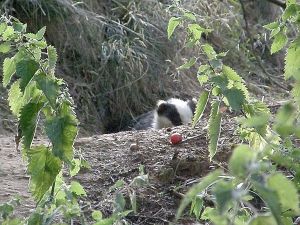
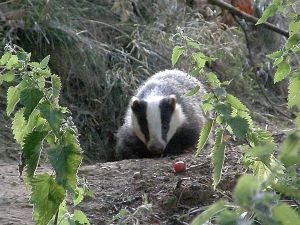
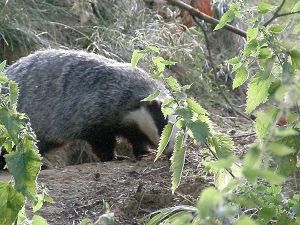
I could see the distinctive notch on its facial stripe, but could I get a clear picture of it? The picture below is as clear as I got – you can see the notch in the stripe, just behind the ear, but it isn’t a great picture of the badger’s face.
Each time I took a picture, the badger disappeared behind a nettle. Spot the difference between the picture above and the one below (I’ll give you a clue – where’s the crab apple?)
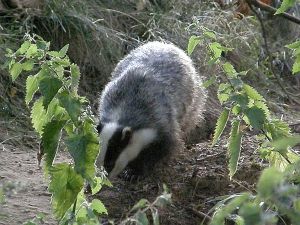
This was obviously a camera shy badger.
You’d think I could line up one decent shot between the nettles, wouldn’t you?
I could have laughed out loud – all I wanted was one good picture. Badgers have an uncanny knack of bringing you back down to earth with a bump.
So was it Nick from the main sett? I like to think so, although I can’t be absolutely positive. There is a big similarity in the facial markings, and the fact that I haven’t seen Nick at the main sett this year seems to point in this direction. It looks like I may have got some evidence for a young male badger moving out to a neighboring sett.
Most people think I’m crazy for getting up at 6.00am on a Sunday, but I like it. It’s my own time – time stolen back from the busy weekend, before I get tied up in the hundred things that I need to do. It’s a fine time to be outside, to be with the animals and birds before the human world has woken up.
I enjoy my Sunday walk, even when there’s not much to be seen. Actually, let me take that back. There’s always something to be seen, if you look.
All week the farmers have been busy harvesting the wheat, working late into the night with lights on the tractors. It looks like a much better harvest than last year. It’s certainly drier. This means that the fields around here are now reduced to stubble and most have had their first harrowing, so the ground is composed of marble-sized clods of clay with patches of straw. I’m sure that a good tracker could track animals over ground like this. I’m equally sure that I’m not that good. I’ll wait until we get some more rain before trying tracking again.
The good thing about the wheat being cut is that the wildlife is visible again. For the past couple of months the only thing I have seen of the chinese water deer is their ears and heads poking up out of the corn. Without the cover they are much more visible (although they probably preferred being out of sight). There was a flock of over a hundred crows and rooks making the most of the spilt grain in one of the fields, and I was pleased to see a hare in the field behind my house.
I like hares. They live more interesting lives than rabbits. Rabbits rely on bolting back to their holes to escape danger, but the hare has no such easy option. Hares will sit in the middle of the field and know that they can spot danger coming and be running before it can get close.
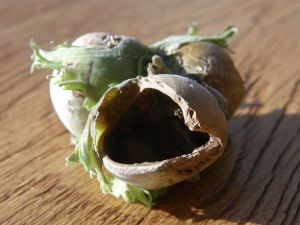
Hazelnut gnawed by squirrel
I sat under a hazel bush and ate breakfast, idly gathering up some fallen hazelnuts. Some were still whole, but others had been gnawed by something. After consulting my books when I got home I’m confident that the nuts had been eaten by squirrels. Squirrels have strong enough jaws to crack open the shells of hazelnuts leaving a jagged hole. Mice and voles can’t do this, so they have to patiently gnaw through.
This is what I mean about these local walks. I know there are squirrels in the area – I see them most days – and I could have guessed that they eat hazelnuts. But having breakfast under a tree led to me collecting the nuts, which in turn led to me finding out about the habits of the animals that eat them. It isn’t a major discovery, but like a squirrel I’m gathering these little facts and storing them away for the future. They’re little pieces in my understanding of the area.
Once again I swapped a relaxing Saturday evening for the dubious pleasures of sitting in a patch of nettles and being ferociously bitten by mosquitoes. To make matters worse, I didn’t see hide nor hair of a badger. To use the fishing expression, I ‘blanked’.
Let me explain. I’ve been down at the Pine Tree sett again, and I’ve been there for a reason. Regular readers will know of my frustration at not being able to recognise individual badgers. In fact, there’s only been a couple of badgers that I could identify reliably.
One of these was a badger I saw last year that was recognisable by a notch or nick in the black stripe, just under the ear. With a startling lack of imagination I name him Nick (although he may be a Nicola – I’ve never been good at sexing badgers). See Fieldnotes: 6th July 2009 for more details.
Here is a picture of Nick, showing the distinctive stripe pattern:
Nick the badger from July last year
So what has this to do with the Pine Tree sett? Well, all season I’ve been looking out for Nick at the main sett and I haven’t seen him. This is the one badger I can recognise and there’s been no sign of him at all. But – and here’s the interesting part – the single badger I’ve seen at the Pine Tree sett had a very similar notch in its stripe.
Now, it could be that the notch in the stripe is a common feature and more than one badger in the area has it. This could well be the case if it is some sort of inherited feature. On the other hand (and you can see where this is going), it could mean that Nick has left the main sett and moved to the Pine Tree sett. This fits all the evidence so far.
If this is the case then I’ve got an example of a badger moving between setts, which is just the sort of thing I’ve been looking for. Hence I decided to go to the Pine Tree sett to try to get a clear picture of the badger there so I can compare it to Nick.
Unfortunately, although the entrance I watched looked like it is still used regularly, I saw nothing. There’s a good chance the badger was in one of the other holes.
The idea is still sound though. I’ll try to get down again and get a picture before the nights start drawing in.
OK. So maybe you’re thinking that the title of this post is a shameless and none-too-subtle attempt to increase the web traffic to this blog. Perhaps you’re right. But read on for the full story.
Today I finally finished the shelves that have taken up quite a lot of my time recently – ten shelves of solid oak, seven feet long, cut to size, jointed and glued into five rectangular units, oiled and now attached to the wall. A good job, if I do say so myself. This gave me the chance to take a stroll up to the wood in the evening to see how the badgers were doing. It’s been the first weekend without the threat of torrential rain for a while, so it would have been a shame not to get outdoors at some point.
It was a windless evening so I settled down in my favourite tree. There were signs of great activity at the western end of the sett. A large heap of fresh spoil suggests the holes have been enlarged over the past few days. I still don’t understand how or why the badgers occupy different parts of the sett at different times. Perhaps there is no pattern? Perhaps they just sleep where they feel like it?
At 7.55pm a pair of badgers emerged from the middle sett entrance. This is new. The badgers haven’t used this part of the sett much at all this year. Soon there were five badgers by the entrance, engaged in some energetic mutual grooming. They were a picture of a happy, healthy badger group. I guess that life is good at the moment, what with the corn ripening in the fields and the wet weather making it easy to catch worms.
After ten minutes or so of grooming, the interaction started to get a little more, shall we say, intimate. To put it more bluntly, two of the badgers started mating. The boar swiftly mounted the female, biting her on the back of the neck to keep her in position.
I’ve seen badgers mating a few times. Badgers can mate at any time of year, although the cubs are always born in spring. This happens because of delayed implantation; the fertilised egg (blastocyst) lying dormant until December. Mating seems to vary in intensity. Sometimes the female resists and it is hard to tell whether they’re mating or fighting. This time was much less vigorous, with only the occasional ‘yip’ from the sow when the boar bit her too hard.
As I’ve mentioned before, Ernest Neal made the distinction between short- and long-duration mating, with only the long-duration mating being a serious attempt at reproduction. This was definitely long-duration mating – a little over 35 minutes by my watch.
The interesting thing for me was the behaviour of the other badgers. Most ignored the mating couple but one in particular – a fairly young boar – took a much more active interest. Although a bigger (and probably older) boar was already mounted on the sow, the smaller one would also bite her neck as if he wanted to mount her too. This resulted in a few sharp snaps from the larger badger at times. Such was the younger badger’s eagerness that at one point he mounted the larger boar while the larger boar was mounted on the sow. Apparently frustrated by his lack of success, the smaller badger also mounted another passing sow, so that there were two badger couples mating side by side at one point.
[You see, not only am I watching badgers mating, I’m watching badgers as they engage in all sorts of deviant sexual activity – there’ll be complaints soon, mark my words!]
The video below shows a selection of events from the mating.
As I said, the coupling lasted for a little over 35 minutes. As soon as it was over and the badgers separated, the smaller boar immediately mounted the female and the process began again. This second mating went on for at least 20 minutes. It was still going strong in the darkness when I left for home.
This second mating by another male is unusual behaviour for a hierarchical animal. Many social animals have evolved mechanisms so that only the dominant ones are allowed to breed. For a larger male to let a smaller male mate with the same female immediately after he has done so goes against this pattern. However, reading through Ernest Neal when I got home, it seems that it is not uncommon in badgers. Female badgers in oestrus seem to be very promiscuous, and it seems that it is the female that will often initiate these multiple matings with different males. Badgers do have other ways of controlling breeding by non-dominant individuals, notably the dominant female killing the cubs of others, so perhaps the actual act of mating is less important.
Apart from being slightly voyeuristic (again!) it was a fascinating evening. It was good to see the whole mating process and to capture it on video. As I always say, it’s the complex social life of badgers that makes them so interesting to study.
I haven’t had the chance to get out badger watching this week. I’ve been continuing work on my shelves (and very nice they look too) and we had a dinner party last night, so the badgers have taken a bit of a back seat.
It was a bit of an effort to get out of bed at 6.15am on a Sunday morning, but worth it. We had rain of biblical deluge proportions here yesterday so the ground is nice and soft – ideal for checking out tracks and seeing what’s been happening around the area.
The soft ground meant that I was able to follow the trail of the local badger for longer than ever before. This time I stopped being lazy and did what I should have done ages ago – I measured the tracks.
The idea behind measuring the tracks is to see if I can recognise individuals by their footprints. If you had a badger with a noticeable injury to its foot, or a strange walking pattern, then you could recognise it easily. With a normal badger it is more difficult to tell their tracks apart. My approach is to measure print size and stride and use these measurements to try to recognise individuals.
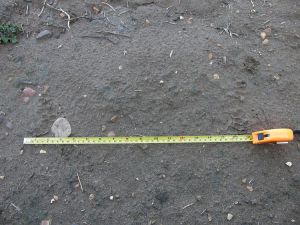
Measuring the stride length of a badger
Of course, print size and stride length are not constant – they vary with ground conditions and terrain, as well as the gait and speed of the animal. It is a maxim that a footprint is not a record of the animal’s foot. It is a record of the interaction between the animal’s foot and the ground. On soft ground the foot will sink in deeper and the print will be larger, plus the animal’s toes may splay out and increase the size further. On harder ground the print will be smaller. For this reason a single measurement would be an inaccurate guide to the identity of the animal. A better approach must be to take a number of measurements and take an average.
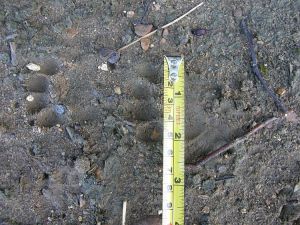
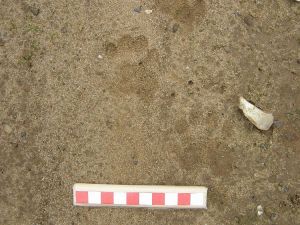
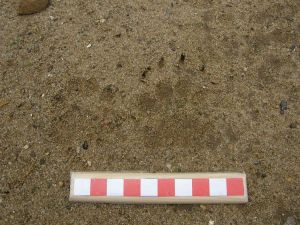
In the photo below, the badger tracks are almost registered (rear foot on top of front foot) which shows the badger was walking at normal speed. This helps to keep the measurements consistent, since I can look for this track pattern in the future and know the speed of the badger.
Measuring the width of badger tracks
I took my width measurements across the four largest toes. These are the most easily distinguishable part of a badger track so it’ll be easy to measure this again in the future.
For the record, I measured the width and stride length of seven consecutive prints today. The average width was 5.2cm (front and rear feet the same) and the average stride length was 39.25cm.
This isn’t a huge sample by any means, but it should be a reasonable accurate baseline measurement for this individual badger. I’ll take more measurements each time I go out, and see how consistent it is. Over time I should be able to recognise this individual and also spot any different badgers in the area.
This may sound like a lot of effort to go to. It probably is. But then again, it is a way of using tracking to build up detailed and accurate information about the badgers in my area.
I’ve been busy building shelves today so I didn’t have time for badger watching in the evening. However, this did give me the perfect excuse to go out after dark and try out my night vision scope.
Having used it out in the field I’m now in a better position to evaluate it. Like most NV scopes it enhances the natural light, so on a moonlit night it should be pretty effective, and for darker nights (like tonight) it has a built-in infra-red torch which really does make a difference. The manufacturer’s claimed range of 100m seems quite accurate. Actually using it took some getting used to. The image is fairly bright, so although it does allow you to see in the dark it pretty well destroys your night vision at the same time.
I decided to see if I could spot any badgers feeding, so I went up to the pasture field. I know there are badgers here every night, so it seemed a good place to try out the scope. I went to my favourite haunt – the stag-headed oak at the top of the hill. The wind was blowing in my face as I looked towards the wood, so I was well placed to watch any badgers as they came out onto the field.
The church clock was just striking eleven when I saw the first badger. Success! It was in a hurry, and trotted past me quickly. I found out another limitation of the scope, and that is the relatively small field of view. I lost sight of the badger when it went behind the tree, and try as I might I couldn’t find it again.
Standing up, I saw two more badgers by the edge of the wood, but as I watched they went back into the trees. Since the wind was in my favour I decided to get closer so that I could spot them as they came out again. Ten minutes later another badger appeared from the other side of the field. Like the others, this one turned and trotted off almost as soon as I focused on it.
Now I was getting concerned. All the badgers I’d seen had run off pretty quickly. This wasn’t supposed to happen. The idea of having an NV scope wasn’t so I could see in the dark (I’ve got a perfectly good torch for that, and it only cost £10 from Tesco), it was so that I could see in the dark without disturbing the wildlife. So far it seemed that the badgers were fairly disturbed. Can badgers see infra-red light? The IR torch on the scope gives out a dim red visible light, but surely not enough to scare a badger? I’ve shone red torches on them before and they didn’t seem to mind as much.
Perhaps I had committed some basic error of fieldcraft. Perhaps the badgers could see me silhouetted against the paler sky. I returned to the tree so I would be less conspicuous, poured a cup of tea from my flask, and gave the badgers time to settle down again.
Ten minutes later I scanned the field again. There was another badger, and once again it ran off when I focused the scope on it.
I didn’t want to disturb the badgers’ feeding, so I decided to head down to the wheat field and see if I had any more luck. Sure enough, when I got there I saw two more badgers just inside the field. Both scampered off quickly but they were downwind of me, so this is perhaps excusable. I waited a while but they didn’t return.
The church clock rang midnight and I decided to call it a night. I didn’t want to disturb the badgers any further, and besides, even badger watchers need to sleep at some point. I kept the scope on though, and at the bottom of the field I came across yet another badger who promptly disappeared into the corn.
In some ways it was a good night. I’ve seen more badgers away from the sett than ever before. The bad news is that I’ve only seen their backsides as they’ve turned and ran. Rather than opening up a new dimension in my study of badgers, the scope has so far only helped me on my way to becoming an expert on badger tails! It was frustrating to be in a field full of badgers but not to get a good look at them.
So was it the scope, or was it something I did wrong? Can badgers see infra-red, or was it just one of those nights? I need to make a few more trips before I can really answer this.
You may recall that I dealt with a roadkill badger a couple of weeks ago. I was concerned that the badger had been killed next to a field that forms part of my usual Sunday morning tracking/ birdwatching walk, and I hoped that the dead badger wasn’t the one that I had become accustomed to tracking.
Well, I went for my usual Sunday walk this morning, and I’m pleased to say that the badger is alive and well and still making tracks.
Tracking really is a fascinating activity. I spent an hour totally absorbed by the animal tracks in a hundred yards of footpath up one single field. Over the last 24 hours a badger, a fox, several Chinese Water Deer and a small herd of fallow deer had all walked up this path. It was a tracker’s heaven!
We’ve had a combination of rain showers and sunshine recently, so the normally hard-packed clay in this field is soft in places, but still firm in others. Many of the tracks showed up only as smudges in the fine silt on top of the clay. In a strange way it is more satisfying to find and follow these faint images.
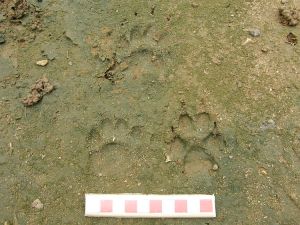
Here’s another set of badger tracks. Note the claws on the front paw on the right.
Here’s where the fox and badger walked side by side (actually, the fox was there first – on the next set of prints I found that the badger’s track overlay the fox’s)
The badger’s front paw print is on the top left, its rear paw on the bottom left and the fox on the right.
Who would have thought that a short stretch of path could prove so interesting – and so informative. If you’ve never tried tracking then give it a go next time you’re out and about. It really does add an extra dimension to your knowledge of the wildlife in your area. And it’s great fun too!
I think it’s time I got back to some serious badgerology.
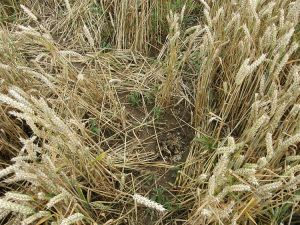
I was up at the wood on Saturday, and an interesting evening it was too. Firstly, the badgers have started feeding on the wheat in the wheat field. This seems to become a regular food source as soon as it ripens. The badgers seem to have a simple way of getting at the wheat – they trample down the stalks and then pull off the grain. You can see the patches where they have been feeding.
Badger feeding signs in wheat
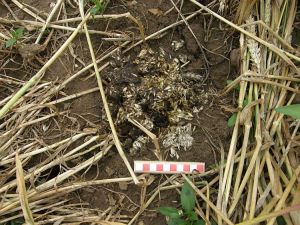
These feeding signs are accompanied by fresh dung, full of wheat. In this case, there is quite an impressive amount.
Badger dung in wheat
The badgers use this field all year (I see their tracks), but the latrines only appear when they are feeding on the wheat. Now, it could be that wheat has an effect on their digestion that makes latrines necessary, but my guess is that it is probably territorial. The wheat fields are a major food resource, so it makes sense that each badger clan will try and claim it as their territory, marking it out with latrine sites. When there is no food, there is no need to mark it, hence the latrines only occur when the wheat is ripe. I must get round to some more of the latrine sites to see which ones contain wheat. That would be interesting, to find out which badgers have been feeding here.
When I arrived, the local buzzard was flying from tree to tree, calling all the time. I could see it through binoculars, perched high up on a branch. I don’t know why buzzards call like this. It is too late for mating, so perhaps it is a territorial display.
I tried to record the sound using the video function on my camera. You can’t actually see the buzzard on the video, but turn the volume up and you should hear its cry. It kept this noise up for over an hour!
At 8.30 a badger emerged briefly from the western sett entrance and then almost immediately went back underground. Ten minutes later the cub did the same. They seemed nervous. It sounds strange, but badgers seem to be afraid of buzzards. A buzzard would have no chance of carrying off even a half-grown badger, yet I’ve seen an entire family of badgers dive for cover when one passed overhead.
Five minutes later a badger came out and trotted off to the west, followed five minutes later by another, and then another and another, all at five minute intervals. None of them stayed near the sett entrance. This means that there were at least four badgers in this half of the sett.
Another ten minutes passed and badgers five and six emerged from the same hole. As they did so, the badgers at the east end of the sett came out into a clearing, foraging, playing and, amusingly, trying to climb trees. I counted five badgers in the group, which, plus the two at the west, gave a total of seven badgers visible at the same time.
One noteworthy behaviour was a fight that developed between two adult badgers. Badgers will usually engage in some rough and tumble play or play-fighting, but this was more serious. It ended with one badger running off, hotly pursued by the other. I could hear their noises at least a hundred yards off; for them to go this far meant it was serious. Perhaps this was an issue about dominance being acted out.
The other interesting event of the night was a fox that trotted past. This must one of the cubs from earlier in the year. I tried Pablo’s trick of calling in a fox by making a high-pitched squeaking noise (see here for a very impressive video), and blow me, it worked! The fox changed direction and came trotting up to the base of my tree!
It obviously felt that something wasn’t right, but I was sitting very still and was well camouflaged. So the fox did a very cunning thing – it walked round my tree in a big circle.
I’ve read about this behaviour but never seen it before. It happens when an animal such as a fox is not sure about you, so they circle round to get downwind so they can check you out. Clever little fox! Since I was in a tree and there was virtually no wind I must have passed the test, for the fox carried on wandering about. It was too dark for pictures, but I watched through the binoculars. The fox was young – its coat sleek and perfect, quite unlike the scruffy urban foxes we got in London. I know that foxes aren’t everyone’s friend, and I know the damage they can do, but they’re still beautiful creatures when you see them in their element.
It’s been a busy week, what with my new job, rushing around buying new suits and train tickets, painting the house and making jam. Nevertheless, I made time for some R&R today.
First on the agenda was the Bedfordshire County Show. This is more of a country fair than a proper agricultural show – there were no competitions for best cow, parsnip, sheepdog etc – although they did have a rabbit show and an exhibition of dancing sheep (don’t ask!). Like any country show it was a great day out, although I was a little disappointed that the ferret racing wasn’t on the schedule this year.
The Bedfordshire Natural History Society was very well represented, with a whole marquee of exhibits, including a fine display by the Badger Network. I’m very impressed with the quality of the work the society does. Many of the members are real experts in their fields and everyone is very happy to share their experience and knowledge. I learnt a great deal, not only about badgers, but also about local birds, moths and how to identify bat species.
It was good to talk to them. My hobby is considered eccentric (if not downright mad) by many people, so it is refreshing to meet like-minded folk. They’re the sort of people that understand when you talk about your experiences of standing by the side of the road in the dead of night, photographing the reproductive organs of a dead badger. Not many people can relate to that…
After spending time in the company of such enthusiasts, it was only natural that I went up to the wood in the evening. Despite the black clouds and the threat of heavy rain it was pleasant enough.
Last week, it seemed as if the badgers had moved to the east end of the sett. Today presented a different story. Three badgers came out of one of the western entrances at about 8.20pm. So, at least some of them are still in residence there. I still don’t know what the badgers are doing, or what (if any) significance there is to their moving between the different parts of the sett.
I had spoken to members of the society about my difficulty in sexing badgers. The advice they gave was ‘if you’re not sure, then it’s a female’. The accuracy of this statement was revealed to me when one of the badgers started grooming. In fact, that wasn’t the only thing that was revealed. As the badger sat there with its legs in the air, it showed itself to be quite definitely male!
I shot a little bit of video. The quality isn’t great due to the near darkness, but if you’ve ever wanted to see what a badger’s testicles look like then watch closely. This is your chance!










 Tales from the Wood - The Diary of a Badger Watching Man