Feeds:
Posts
Comments

Archive for the ‘Fieldnotes’ Category

Snowy woodsI’ve mentioned this before, but the village I live in has a connection to some of the most courageous polar expeditions in history.  The frozen ends of the earth are a long way from our green fields and woods and hedgerows, but I like to think I’m keeping the polar tradition alive by going outside every time it snows.

It snowed a couple of weeks ago and I was looking forward to going out tracking, but unfortunately it all melted by the weekend and I didn’t get the chance.  Today, however, we’ve had another good fall of snow – four inches or so in the space of the afternoon.  The whole of the UK has once again ground to a halt (it took Mrs BWM three and half hours to drive home from London today, on what is normally a one hour journey) but I’m happy.  It’s snowed, it’s Saturday, it’s time to go out tracking.

It’s been a while since I’ve been outdoors, so it felt good to take out my camouflage jacket, put on my walking boots and pick up my tracking stick from its place behind the back door.  It sounds odd, but I always enjoy walking in winter.  There is a satisfaction in getting dressed up and going out into the cold, meeting the challenge of the conditions.  As luck would have it, I bought myself a new piece of kit on Thursday – a windproof fleece balaclava.  I suspect it makes me look even more scary than usual, but it really does keep my ears and neck warm.

The temperature tonight was minus 3 or so, which meant that the snow was still fresh and powdery, the snow-covered fields eerily bright in the moonlight, almost as clear as day. I  headed up to the pasture field in the hope of tracking the badgers there.  I’ve had some fascinating times following the badger trails here – following the tracks of badgers for hundreds of yards and seeing how the trails interact with each other.  The snow provides a wonderful record of badger behaviour that would normally be invisible.
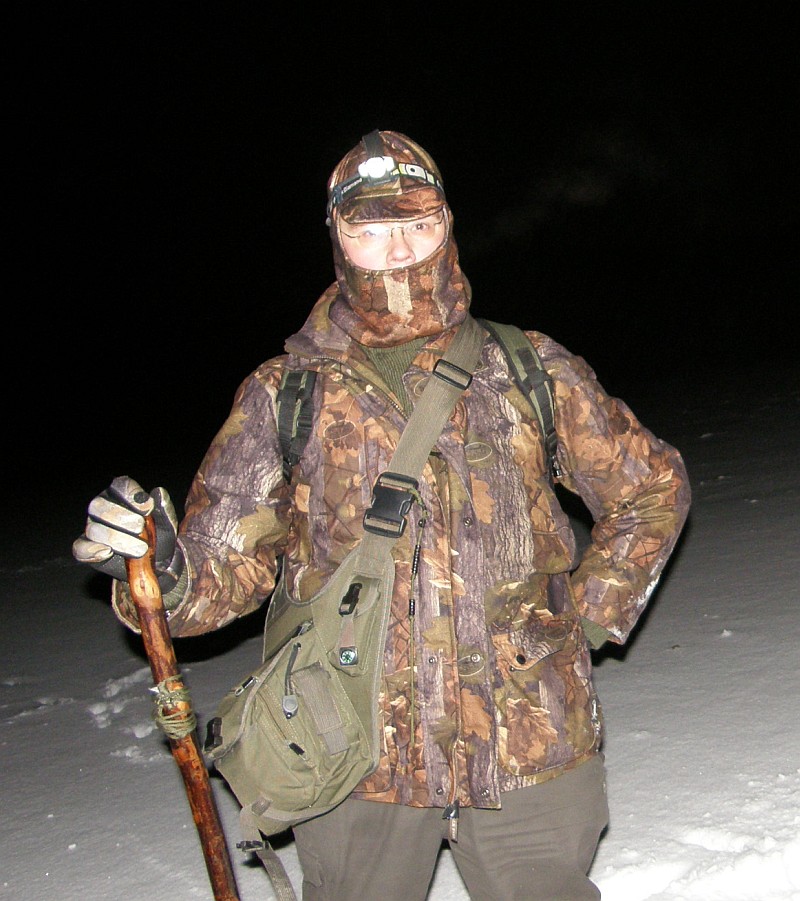
BWM in heroic 'Polar Explorer' pose.  Note the smart new balaclava.

BWM in heroic 'Polar Explorer' pose. Note the smart new balaclava.

Alas, tonight did not reveal anything about badger behaviour.  In fact, there were no badger tracks at all.

A few rabbit tracks, and the fresh trail of a fox trotting across the footpath, but no badgers.  I was out at 9.00 to 10.00pm, so perhaps the badgers had not come out yet.  It might be the case that they are staying underground at the moment – I know that badgers will venture out and forage in snow, but this snow comes after a few days of hard frost.  A hard frost makes it much harder for the badgers to dig for worms, so it may be that the frozen ground has had more of an effect on them than the snow.  I’ll go out again tomorrow and see if there have been any new tracks overnight.

Even without badger tracks it was still a fine night to be out.  Despite the chaos that it brings, I hope we get more snow.  If it carries on into next week I’d like to build an igloo in the garden and really make the most of it.

Read Full Post »


Red Deer Stag at Woburn

Red Deer Stag at Woburn


Today was one of those days when various threads come together in a fortunate way.  Firstly, I have now finished my professional logbook – a task that I’ve been working on, on and off (mostly off) for the last three years – so I have some free time again.  Secondly, it was a nice day and I was looking after Scarlett, so I had the perfect excuse for a walk.  Thirdly, it was the third Sunday in the month, which meant that the Woburn Farmers’ Market was on.  Lastly, we’re in October so the Red Deer in Woburn Deer park are starting their rut.

It was too good an opportunity to pass up.  I put Scarlett in her buggy and took a walk through the deer park to visit the farmers’ market and have lunch in the tea shop in the crypt of the church.

As I’ve said before, the Woburn Deer Park is a great place to visit.  It is crossed by public footpaths so you can stroll through at your leisure (stick to the paths though please).  I’m very lucky having it on my doorstep as I can walk there in the evenings when it’s quiet.  The Woburn estate has had a big influence on the wildlife in the local area, particularly the 11th Duke, who was responsible for introducing almost every non-native species at large in the UK.  From muntjac to wels catfish, if you can think of an alien species it’s a fair bet that it was originally introduced in Woburn by the 11th Duke and subsequently escaped.  One of these days I really will write a book on the subject.


Black Squirrel at Woburn

Black Squirrel at Woburn


One of the animals allegedly introduced into Woburn is the black squirrel.  This is not a separate species, it is a melanistic version of the common grey squirrel.  They’re something of a local speciality here in Bedfordshire and I’ve seen a few now.  I’ve been trying to get a picture of one for a while – a clear picture that doesn’t just show a black blur like a snapshot of bigfoot or the Beast of Bodmin.  Today I got my chance, right in the heart of the Woburn estate where the black squirrels originated.

The real attraction were the deer though.  The Red Deer are starting their rut.  Over the past few weeks the stags have been getting increasingly territorial.  They each find a space of their own and start to call out to the females, who have banded together into small groups or harems.  The Deer Park is dotted with very impressive, testosterone-fuelled stags, each sporting a fine set of antlers and bellowing out their calls.  These calls are very atmospheric as they drift across the park, each stag roaring out his challenge.  If one stag enters the territory of another they’ll face each other off until the less dominant one turns and runs.  As the rut progresses the stags will become more and more aggressive until they come to physical blows, heads down and antlers locked in a violent pushing contest to see who will win the right to the females.

The deer were some distance away from the footpath, which was fine because I don’t like to get too close to the stags when they’re in this sort of mood.  I managed to shoot some video which is as good as I could get with my little camera (I really must get around to building that parabolic microphone one day, but that’s another story).  The video gives you an idea  of what happens with the deer but doesn’t really capture the full spectacle.  For that, there’s no substitute to getting out and experiencing it for yourself.  If you have a deer park nearby, now is a perfect time to go out and pay it a visit.

Read Full Post »

Mystery Tunnel Update

Last week I confessed that I was puzzled by some tunnels that had appeared in one of the the fields near my house.  They were about 15 feet long, fairly straight and looked like some animal had burrowed along close to the surface leaving a small ridge of soil.

Mark Garrett kindly replied with the following information

Moles will dig both shallow and deep tunnels and the classic molehills are the result of “deep” excavations. The soil from the shallow tunnel is just pushed upwards (or to the side) There is a good chance that your mystery tunnels could well be a mole making a shallow tunnel, perhaps returning to the field from the safety of the hedgerow now that the tractor has gone away.

This matches my own limited research.  The Readers Digest Wild Britian – Animals (a small book but very useful and readable) says of moles “Occasionally tunnels are so near the surface that the soil is forced up in a long ridge – once thought (wrongly) to be ‘love runs’ made by male moles seeking a mate“.

I think we can safely say that the mystery is cleared up – the tunnels were mole ‘love runs’.  I think the odd thing is that I’ve never seen them before, despite years of wandering around the countryside.  Perhaps it was a coincidence of the right moles and the right soil conditions.

Read Full Post »


Sloes in the hedgerow - the fruit of the blackthorn

Sloes in the hedgerow


I’m afraid my life isn’t very interesting at the moment.  I’m spending most of my free time hidden away in an outbuilding writing the final entries in my professional logbook.  Once I’ve submitted this at the end of the month, assuming I pass, I’ll be a Chartered Psychologist; and then I’ll be Badger Watching Man BSc MSc CPsychol, thank you very much!  In the evenings it’s just me, my laptop and a mouse that lives up the chimney and keeps me company (for the interested, I think it’s a Mus musculus rather than an Apodemus sylvaticus, but it’s a bit shy and I never quite get a good look at it).

It’s been glorious weather today so, like Mole in The Wind in the Willows I said “bother chartership logbooks!” and took Scarlett out for a short walk around the fields.  Despite the sunshine it’s definitely autumn now.  The trees are starting to turn and the vegetation is dying back.  The hedgerows are still fruitful though.  There are late blackberries still to be found.  Now, you’re not supposed to eat blackberries after a certain date (either Michaelmas (29th September) or 11th October, depending on which version you follow) because allegedly the devil comes up and urinates on them.  It is true that they don’t taste great later in the year, but I had a few today and they were quite nice, so perhaps the devil is waiting until tomorrow.  Scarlett took no chances and refused them all.

The hedgerows were also full of hawthorn berries and rose hips.  I know you can make rose hip syrup, which is a good source of vitamin C for the winter, but I don’t know if you can eat hawthorn berries.  I’ll check it out sometime.  I’ve never heard of anyone eating them, so either they’re not edible or just not very tasty, but there were a lot of them so it’s something to think about.  There seems to be a good crop of sloes this year too (hence the dreadful and inexcusable pun in the title).  As you’ll know if you’ve ever tried one, Sloes – the fruit of the blackthorn – are so tart as to be inedible, but I picked a bagful with an idea of making sloe gin.  Apparently the trick is to put them in the freezer so the cell walls burst and the flavour comes out into the gin more easily.  As an alternative you can prick them all over, but that sounds like far too much work.  We have some chestnut trees in the spinney down the road, but the squirrels seem to have eaten all the best ones, just like they ate all the nuts on my hazel bushes earlier in the year.  Perhaps I’ll take a walk one weekend up to Aspley woods, where there are lots of chestnut trees, hopefully enough so that the squirrels can share their bounty with me.

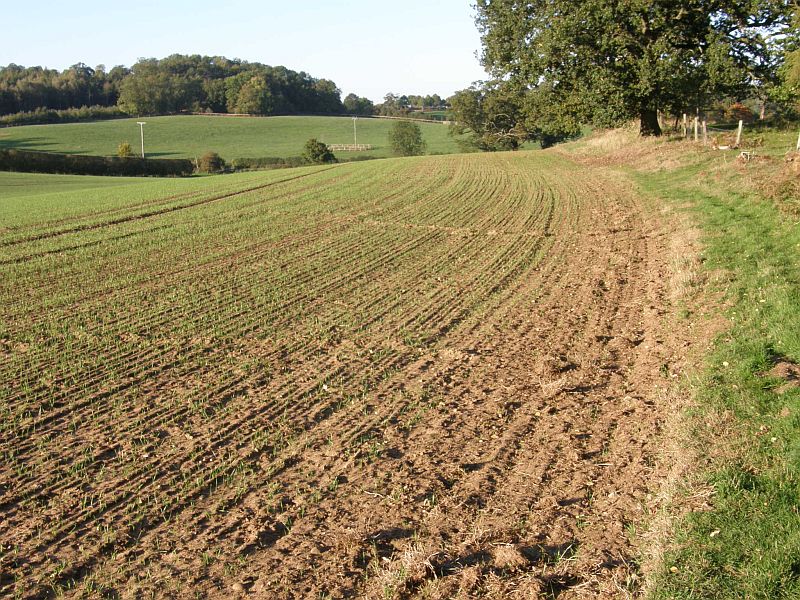
My short walk took me along the sandy field where I do a lot of tracking.  It seems to be planed with wheat already and there weren’t many tracks to be seen, but I did find something mysterious.  In a couple of places there were ridges of earth running out about 15 feet into the field that looked like something had burrowed along just under the surface and pushed up the soil.


The tracking field with mystery tunnels

The tracking field - if you look closely the mystery tunnels lead out from the path


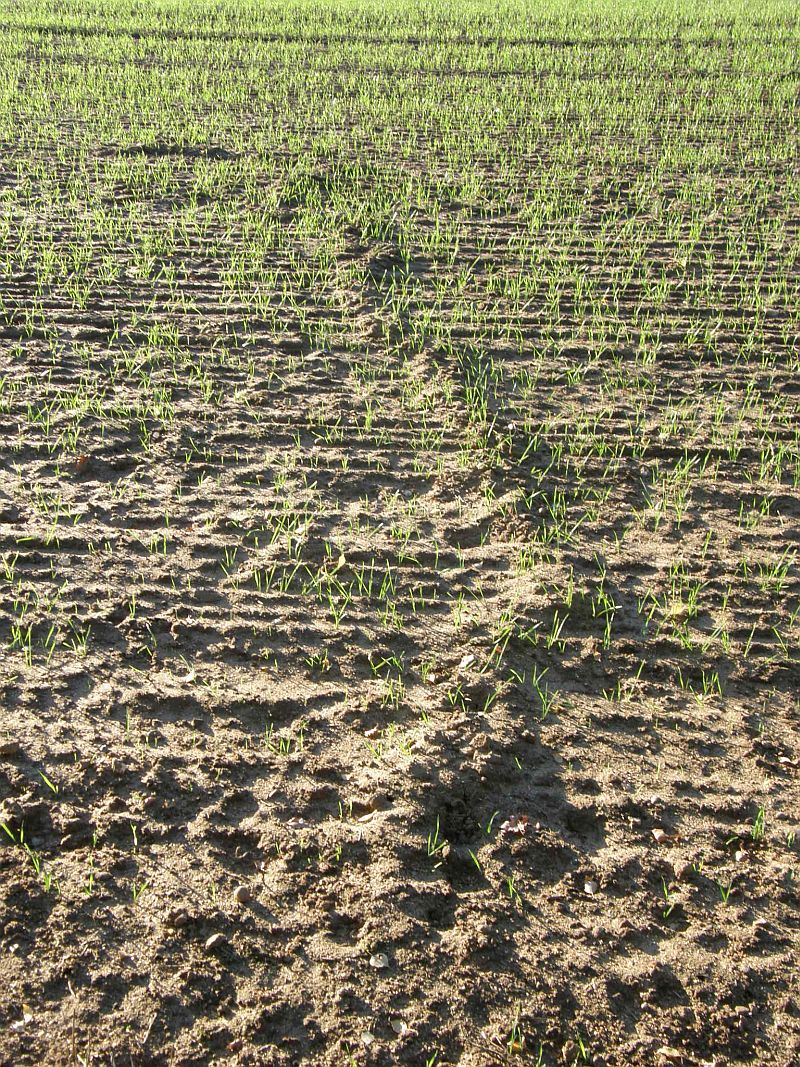
There are lots of rabbits in this field, and voles too, but I’ve never seen anything like this before.  There were no molehills in the immediate vicinity.  I assume they’re tunnels made by an animal, but I don’t know which one.


Mystery tunnel in field

One of the mysterious tunnels


I like a good mystery.  It’ll give me something to think about as I toil away in the evenings working on my logbook.

Read Full Post »

Chinese Water Deer

Chinese Water Deer

I’ve bought a new car.  All that remains is to siphon out the diesel from the old one, Mad Max-style, and it can go to the big scrapheap in the sky.

I made a quick trip to the wood on Sunday.  I decided to visit the main sett and see if there was any sign of more badgers.  I’m becoming certain that there are a lot fewer badgers in residence this year and not having been here for a while I wanted to make sure they were OK.  The dry spell has ended – it seems like we’ve had torrential rain and thunderstorms every other day this week – so at least the foraging should be easier for them.

I arrived at the sett just before 8.00pm, only to find my path blocked by a Chinese Water Deer browsing through the undergrowth.  I like watching deer and they’re great fun to try to stalk in a wood.  This one presented a challenge though.  It was very close to the sett, so if I frightened it, it would probably frighten any badgers that were above ground.  This is how it works with wild creatures: any disturbance to one tends to create a reaction in others, which is why it is so important to move stealthily even when you’re some distance from the animals you want to watch.

Predictably, despite my cautious approach the deer eventually caught sight of me and bounded off.  Interestingly, it had a big split in one of its ears, which should make it possible to identify in the future.  I can only assume that this was caused by a fight with another Chinese Water Deer.  The males have long teeth.  I don’t know for sure, but I’ll bet they fight each other over territory or females, despite their cute appearance.

I don’t know if the deer frightened off any badgers, but there weren’t any in sight.  I sat in my tree and watched for half an hour as the light gradually faded.  At 8.37 a badger emerged from the western end of the sett, showing that they’re back in residence at this end.  It wandered to and fro, foraging in the damp wood.  For a while it sat under my tree, directly underneath me (too dark for pictures, unfortunately).  It seemed healthy and happy, not bothered by any traces of my scent in the area.

After a while it ambled off into the gloom of the wood.  I gave it five minutes head start and left for home.  It was good to see the badger, but it was only one badger on its own.  There’s nothing so far to suggest that my idea that the badgers are much reduced is incorrect.

Read Full Post »

‘Their habitation is even one with your guarded threshold … Man rules now where They ruled once; They shall soon rule where man rules now. After summer is winter, and after winter summer. They wait patient and potent, for here shall They reign again.’

The Dunwich Horror, H.P. Lovecraft

.

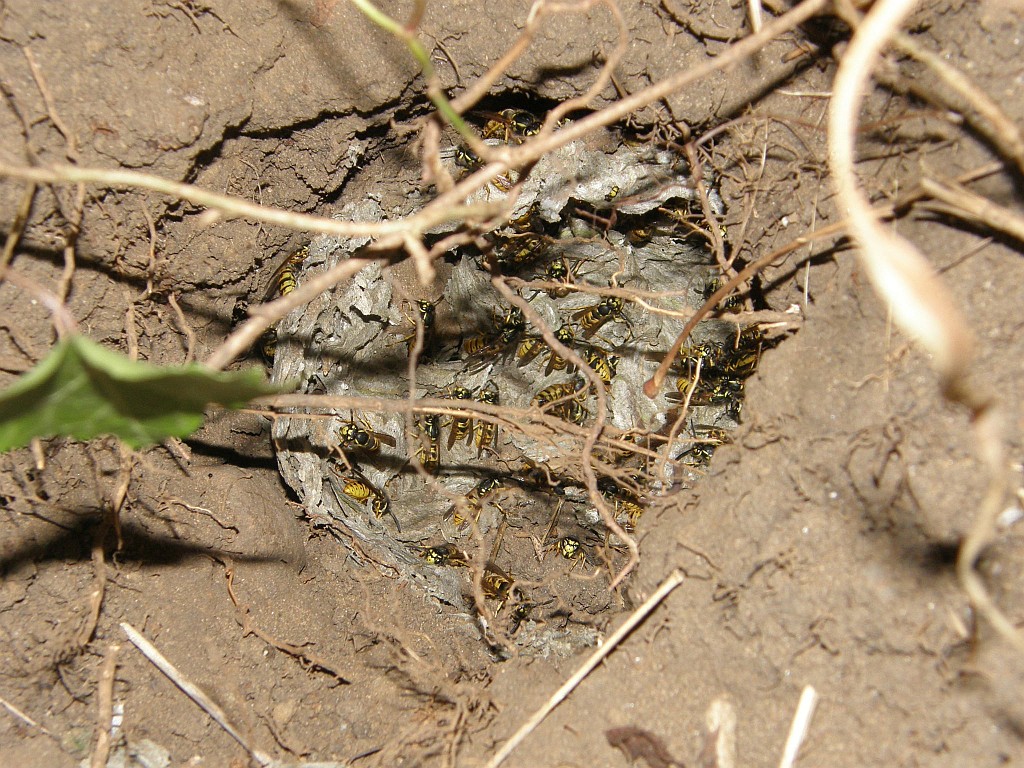
Another post about wasps’ nests and badgers, I’m afraid.  The badgers do seem to dig up these nests in dry weather, presumably as an alternative food source when worms are scarce.  At least, that’s what my limited records show (and those of Steve from Bedfordshire Wild). On the other hand, it may just be coincidence.  Decent-sized wasps’ nests only occur in summer.  Dry spells mostly occur in summer. Perhaps I’ll look back at the archives in years to come and find a definite connection.

A wasps nest dug out by badgers 3

Anyway, I mention this wasps’ nest mostly because of its location.  I spotted it when my wife and I were taking Scarlett to the park – it’s on the verge of the main road through the village.  I’ll admit it isn’t a huge road – it isn’t a huge village – and there is a nice mature hedgerow and pasture fields on both sides, but it was a surprise to see badger activity this close to the houses.  Anyone walking home late from the pub on Saturday night would have got a shock.

Their habitation is even one with your guarded threshold‘ indeed.  Very interesting.  I’ve had to re-draw my map of badger activity in the area because of this find.

Read Full Post »

Continuing in my efforts to understand the local badger population, I paid a visit to the Beech Tree sett this evening. It was a good reminder that successful badger watching involves more than just finding a sett and plonking yourself down and waiting for the badgers.

Packing my camouflage umbrella to keep off the steady drizzle I arrived shortly before 8.00pm.  The sett is on the side of a wide shallow dell, thick with bracken, but I found a nice spot with my back against an old coppiced hazel where I could look out over the sett.  I was quite a distance away, but I was here for observation and counting badger numbers rather than close-up photography.

About ten minutes after I arrived I heard a rustle in the undergrowth and a turned to see a badger trotting up the way I had come, disappearing into the bracken behind me.  This wasn’t how it was supposed to be – the badgers were supposed to come out of the sett!  These badgers are obviously not used to being watched: they don’t know the rules.

I stayed until 9.00pm, listening to a young tawny owl squeaking somewhere nearby, quite dry despite the rain under a double canopy of pine trees above and hazel below.  No more badgers appeared, so I assume they’d left early before I arrived.  Possibly they’re out early to get the most foraging time in the leaner dry weather.  As it stands, my count of badgers at this sett stands at just one.  I’ll need more visits to get a more accurate count, but it’s a pleasant spot to spend an evening so I expect I’ll be back soon.

Read Full Post »

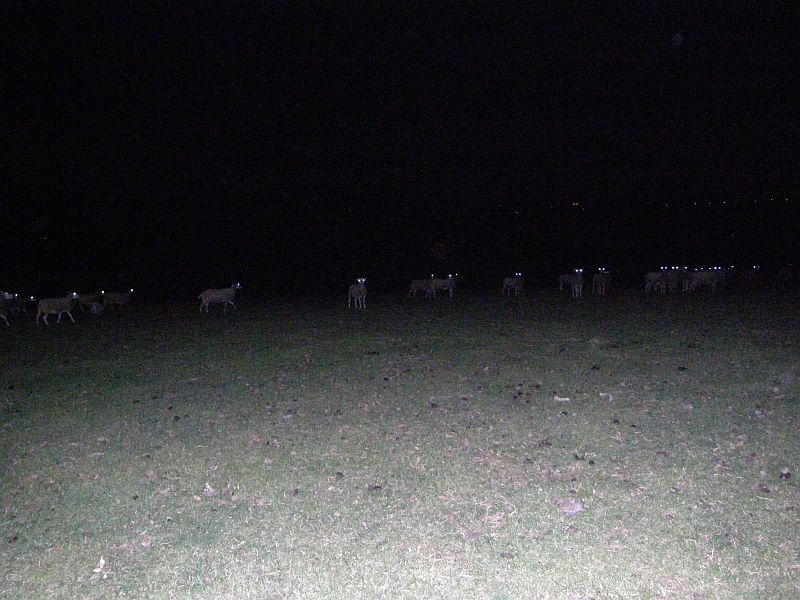
SheepIt’s been a strange evening.

I was busy during the day so I wasn’t able to get out early enough for a badger watching session.  In my experience, if you can’t get to the sett and be in position before the badgers emerge, it’s very difficult to watch without disturbing them.  But it was a fine, warm evening, and being smitten by the Barn Owl I went out again to try and get a picture.

There was a concert playing at Woburn Abbey, clearly audible even though it’s some distance away.  They started off with opera, which was pleasant to listen to as I sat in a field and waited for the owl.  By 9.15pm they’d moved onto more popular stuff, the owl hadn’t appeared and it was getting too dark for photography.  As a lady singer belted out Mambo Italiano I called it a day.

But it was still a fine evening.  Rather than go home, I decided to walk up to the pasture field in the hopes of seeing the badgers out foraging.  I’d brought my night vision scope for just this reason.  On the way I stopped by the Pine Tree sett.  No badgers were in sight, but in the twilight I could see signs of recent activity, which was good.  I’ll have to come here and watch properly soon.

My hopes of seeing any badgers in the pasture field were dashed by sheep.  There are always sheep in this field, but today they were clustered at the top of the hill.  They ran away when I approached, as sheep do.  I settled down in my favourite spot at the base of the stag-headed oak and listened to the concert in the distance.  The sheep, meanwhile, had obviously decided that since I showed no signs of trying to eat them, I might be there to feed them instead.  The whole flock started to edge closer.  Soon I was surrounded by a perfect circle of 300 or so sheep, all staring at me, as the sound of Strangers in the Night drifted over the field.  The sheep stared at me.  I stared back at the sheep. It’s at times like this that I start to question my grasp on reality.

The sheep were not good for badger watching.  My approach depends on sitting still and staying alert for the sight or sound of badgers moving in the field.  Impossible when you’re surrounded by hundreds of coughing, belching sheep.  Incidentally, sheep coughs sound exactly like human coughs.  Once, when camping in the middle of nowhere in Wales, I was kept awake in my tent by what I thought was a crazed stalker with bronchitis. It wasn’t.  It was a sheep.  I left the oak tree and headed to the brow of the hill for a bit of peace and quiet.

It’s a lovely spot, this.  It isn’t a particularly high hill, but you can see for miles and miles – the whole of rural Mid-Bedfordshire spread out in front of you.  As I sat there, the concert moved towards its finale, Last Night of the Proms-style, with a stirring rendition of Jerusalem.

Jerusalem is my favourite hymn.  It has the rare quality of making the hairs on the back of my neck stand up.  I sat there in the warm summer night and listened, with England’s green and pleasant land before me; the fields and trees and woods and hedges.

And did those feet in ancient time.
Walk upon England’s mountains green:
And was the holy Lamb of God,
On England’s pleasant pastures seen!
And did the Countenance Divine,
Shine forth upon our clouded hills?
And was Jerusalem builded here,
Among these dark Satanic Mills?

Bring me my Bow of burning gold;
Bring me my Arrows of desire:
Bring me my Spear: O clouds unfold!
Bring me my Chariot of fire!
I will not cease from Mental Fight,
Nor shall my Sword sleep in my hand:
Till we have built Jerusalem,
In England’s green and pleasant Land.

This was obviously not meant to be a night for badger watching.  I turned for home, striding down the hill as the audience joined in with Land of Hope and Glory.


Read Full Post »

Today we had a village get-together as part of the Big Lunch; and a very nice lunch it was too.  The food was excellent and the company even better.  We sampled the cider we made in the village last year (see Cider and Autumn Strolls) and it ranged from feisty but almost drinkable (the scrumpy) to quite horrible (the perry).  Still, it’s given the cider collective some ideas for this year’s brew.

I was talking to a neighbour and the conversation turned to owls.  He gave me a tip that there are barn owls living in a specific location on the other side of the village.  Now, I’ve not seen a barn owl here in Bedfordshire yet.  We have a lot of tawny owls (difficult to see but easy to hear as they call at night) and the occasional little owls (tend to sit on fence posts during the day) but I haven’t seen a barn owl.  This is a shame, as they’re spectacular birds, and they tend to come out in the evening while it’s still light.

I didn’t have time for a proper badger-watching session this evening, but it was clear and warm and I felt I could spend an hour or two looking for barn owls.  The location is near a small lake, actually a dammed stream – the last remnant of parkland from a long-vanished country house.  It’s a great spot for wildlife, particularly birds of different types, and one that I haven’t given the attention it deserves.

I arrived at about 9.00pm and – to my delight – there was the barn owl, quartering over the fields.  I followed it from one field to another as it patrolled, occasionally swooping down to get a closer look at something.    I sat down at the edge of the field and ten minutes later it flew low overhead, big but perfectly silent.  It was a sight worth the walk – as I said, a spectacular bird.

I took a couple of pictures.  I confess that these are probably the worst pictures of barn owls ever taken – blurred, out of focus and badly composed – but they’re the first I’ve ever taken of a barn owl so I’m sticking one up here.  If you stand some distance away and squint at it, with the eye of faith you can just about believe that it’s an owl.

Embarrassingly bad picture of a barn owl

I know, it’s embarrassing.  Now I know where to go, I’ll be back to try again soon.  And Simon, if you’re reading, thanks for the tip.  It’s rare for me to go out in search of a particular species and actually find it, so this was a good evening for me.

Read Full Post »

I’ve been thinking about the badgers at the sett, and how there seem to be much fewer of them than in previous years.  I’ve been rolling a plan around in my mind that may help me to understand what’s been going on.  Bear with me, and I’ll try to explain my train of thought.

1. The number of badgers has reduced.  This means either a number of badgers have died or they have left the sett.

2. If they have died, this could be due to coincidence (i.e. they all died of old age or unrelated accidents) or due to some catastrophe (disease, interference etc).  I need to have a look round the sett for bodies, but there is always the chance that if they died they did so underground and I might never find any remains.

3.  Based on the work of Hans Kruuk, if they left the sett then they are unlikely to have gone far.  Kruuk found that badgers leaving the clan only went to neighbouring clans, no further.  There won’t have been a long-distance ‘Watership Down’ style exodus.

Following me so far…?

4. So, by monitoring numbers at the neighbouring setts I should be able to get a better idea of what has happened at the main sett.

In other words…

5. If the numbers of adult badgers at the neighbouring setts have increased significantly, this will suggest that badgers from the main sett have left and migrated there (although it wouldn’t prove it).

If the numbers in the neighbouring setts have decreased significantly, it will suggest that some sort of wide-ranging mortality has affected badgers in the area.

If the numbers have stayed the same it will suggest that no major migration has occurred and the reason the badgers in the main sett have decreased is due to death.

Now, the logic of this seems pretty sound to me.  It won’t give definite proof (how do I account for migration to and from the next setts in the chain?), but it may help guide me in the right direction.  However, there is one major and probably fatal flaw in putting the idea into practice: I don’t actually know the number of badgers in all the neighbouring setts, either last year or this year.  This means that I don’t know whether the population has changed or not.  The sett to the west of the main one is the Pine Tree sett.  This had one badger in residence last year, so a big increase in numbers here will imply migration.

The sett to the east of the main sett is about 500 metres away as the badger runs.  Let’s call it the Beech Tree sett, after the vast and ancient specimen of that species nearby.  I’ve known of the existence of this sett for a while (I found it through mapping badger latrine sites) but I’ve never actually sat and watched it.

This evening I decided to have a look at it.  I wouldn’t be able to tell whether the number of badgers had increased or decreased, but the sooner I get some data the sooner I can start to build up a picture of the population in the area.  I arrived at 7.45pm and watched until 9.20pm, but I saw no badgers at all.  I may have arrived too late or disturbed them somehow.  In an ideal world I’d have surveyed the site properly in the winter before the bracken grew up so I knew the location of all the holes and could get a rough idea of how many were active.  I was lazy – I didn’t do this.  I may have been watching the wrong part of the sett for all I knew.

So I’m no further on in my thinking at the moment.  I’ll try to get back to the Beech Tree sett again soon and also to the Pine Tree sett, and see if I have more luck.

As a consolation, as I walked home down the pasture field a badger came bouncing up the path towards me, saw me, and dashed off.  In years gone by I’d have been happy just to see a badger going about its business.  Tonight though I found myself wondering which sett it had come from.  I’ve gone from wanting to see badgers to trying to work out the population dynamics of the whole area.  Perhaps I’m taking all this too seriously.  Perhaps I need to lighten up a little.  After all, a day when you see a badger in the wild can’t be an altogether bad day.

Read Full Post »

« Newer Posts - Older Posts »