Feeds:
Posts
Comments

Archive for the ‘Fieldnotes’ Category

It’s been a beautiful spring day – warm and sunny.  It’s a great feeling after the cold winter we’ve had.  The daffodils and the blackthorn are blooming, the hazels and hawthorns are in bud, and the first butterflies are up and about.  There was even a skylark up in the clear blue sky, giving a wonderful summer feel to the day.

I decided that today would be the perfect day for my first badger watching session of the year.  It is still a little early, as the badgers will only be emerging just as it is getting dark, but I thought I’d give it a go and see.

It was good to be back in the wood again.  A small herd of fallow deer crossed the path a hundred yards or so ahead of me, and the buzzard was flying round the trees.  I can never tire of watching the buzzard when it does this; there is is something truly wild about seeing and hearing such an impressive bird of prey at close quarters.

The wind was blowing from the right direction for me to sit in my favourite tree.  The good thing about watching badgers at this time of year is that the undergrowth has not yet grown up to block the view, so I could see the whole sett from my perch.  It looked like a number of sett entrances were in regular use, and the paths and play areas looked well trodden.  The badgers have obviously been busy.

I sat in the tree from 6.30pm until just after 8.00, but sadly the badgers did not oblige.  I did not see so much as a whisker on a stripey nose.  I guess they are still emerging after dusk.

By 8.10pm it was getting too dark to see, even with binoculars, so I called it a night.  Even without the badgers it was good to get out again, to just sit in a tree in a wood and do nothing.  And besides, it shows that even after four years of watching badgers I still can’t guarantee anything.  I’ll try again in a week or so.

Note to self: even though it’s a warm day, and you’re too hot when walking, after the sun has gone down and you’ve been sitting still for an hour it gets bloody freezing.  Wear your waistcoat or an extra jumper next time!

Read Full Post »

Blackthorn in flower

Blackthorn in flower

In Britain, the spring weather follows a fairly consistent pattern.  The warmer days of February and early March tend to be followed by a short cold spell at the end of March.  This cold snap coincides with the flowering of the blackthorn, hence its country name: the Blackthorn Winter.

This year has followed the tradtional pattern.  The last few weeks have been sunny and relatively warm, but yesterday we had squally hail showers and today there was a ground frost in the morning.  The Blackthorn Winter has arrived.

I’ve been working a fairly hectic schedule recently (as usual!) and I’ve also been on holiday, so I took the chance of getting out and about on one of my Sunday dawn walks.  Getting out of bed wasn’t so easy, as dawn is now about 6.30am, although because the clocks went forward this morning that translates to 5.30am in real terms.  Nevertheless, it was good to get out again.  It’s become quite a comforting routine for me.

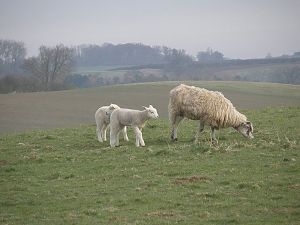
Despite the cold weather, there are signs of spring everywhere.  The lambs in the fields are getting quite big now.

Aww, cute

Aww, cute

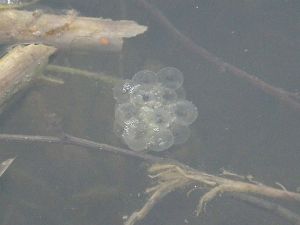
Frogspawn has started to appear in the pond – not much yet, but hopefully there’ll be more to come.

Frogspawn

Frogspawn

In terms of wildlife, one of the fields had been invaded by a gang of geese.  They were mostly Greylags, with a few Canada Geese joining in.  Not a rarity, but it’s the first time I’ve seen them in the village.

Greylag geese

Greylag geese

The badgers in the woods seem to be doing fine.  Judging by the quantity of dung in the latrines they’re obviously busy at the moment.  In fact, I was able to add a few more sites to my expanding map of badger latrines in the area.  This is starting to make some sense now, and I can get a rough idea of the different territories.  Perhaps come the autumn I’ll try the bait marking approach that Pablo mentioned, putting out food containing coloured plastic pellets so I can monitor the precise latrine sites used by different badger clans.  As I always say, there’s always more to learn about badgers.

April is nearly on us, so in another couple of weeks I’ll start proper badger watching again.  Watch this space for more details.

Read Full Post »

Another day, another fall of snow.  I took a stroll up to the pasture field tonight.  The snow is 20cm deep at the top of the hill, and yet there were still the tracks of a couple of badgers.

One of these tracks followed the same general route as one on Monday – out of the wood and down the hill, following the footpath across the pasture.  The other came out of the wood from some distance away, went up to the first track and then doubled back on itself.

As I said, the general line of the first set of tracks follows the footpath up to the wood, and there are three separate badger latrine sites within half a mile along this path.  This has got me thinking.

Badger latrines generally act as territory markers, and it is common for two neighboring badger clans to share a latrine on the border (see my post on mapping badger latrines for more details).  Suppose the badger tracks mark the boundary between two territories, and that the two badgers were from neighbouring setts?  This would explain why the tracks came from opposite directions, and why so many tracks on Monday all converged on this area.  The badgers were walking along the boundary line – staking out their territories from both sides.

If this is true, it also explains why the latrine sites are on the same line, and why the badgers on Monday were taking such an interest in each others’ tracks – they were from different clans.

Such ‘border patrol’ activities are mentioned in the literature.  For instance, I’ve finally read Hans Kruuk’s The Social Badger (and excellent it is, too), and he describes witnessing aggressive encounters between badgers on these shared paths between territories.

Lastly, on Monday I thought that the badger tracks showed that the territory of my badgers is much bigger than I thought it was.  This may not be the case.  If I was walking along a boundary between territories, I was looking at tracks from two different badger clans, one on either side of the border, rather than one big territory covering the whole area.

Curiouser and curiouser.  This means that my tracking in the snow may have pinpointed the precise line between two badger clans.  As a theory, this boundary idea fits all the facts.  I wonder how I could prove it?

Read Full Post »

Winter Oak

Winter Oak

On Monday it snowed.  We had about 4-6 inches of snow, but it was enough to paralyse the whole of the UK.  Everything ground to a halt – the roads jammed up or closed, the trains were cancelled, and even the London buses stopped running for the first time ever.

I woke up at 5.30am as usual, saw the snow and decided to work from home, which I’m luckily able to do.  But once again my thoughts were on tracking, with visions of following badger trails across the pristine fields of snow.  By 9.30 in the evening I’d got dressed up and slipped out into the freezing night.

You may think that I’m eccentric for going out in the middle of the night during the worst snow the UK has seen for 18 years.  You may find it difficult to understand my excitement and wonder why I didn’t sit by the fire in the warm like everyone else.

Let me explain.  I’ve been watching badgers for three years now, and I’ve got closer to them than most people ever do.  I’ve sat by their setts and watched them come out in the evening, and I’m starting to understand their behaviour.

But there’s a whole big part of the badgers’ life that I know very little about.  Every evening they leave the sett and spend the night foraging.  I’ve caught brief glimpses of them as they range about their territory, but the truth is that it’s still a mystery to me.

Tracking has helped me fill in some of the blanks.  An animal’s tracks are an enduring record of its movements, so they help you to piece together its activities.  As well as being a fascinating pastime in its own right, tracking adds to my overall picture of badger behaviour.

But if tracking is like reading a book, then it’s a book with only one or two legible words on each page and most of the pages missing.  You can only track in areas of soft ground, so most of the picture remains hidden.

But snow, now!  Snow gives you the chance to see the whole picture, if only for a night.   Imagine spending months and years trying to understand a book from a few isolated words, and then imagine having the chance to see the whole story, page after glorious page.  Given the chance, wouldn’t you want to get out there for a look?  Isn’t that worth a walk on a snowy night?

So – out into the cold night I went.  Actually, it wasn’t too bad.  Because of the snow it was light enough to see without a torch, and it was exhilarating to be out when the rest of the world was tucked up in bed.

When I got to the pasture field, it was everything I had hoped for.  There were tracks of rabbits, and a fox, and some people with a sledge; but there amongst them were the clear tracks of badgers, no more than an hour or two old.

Thinking about it afterwards, Monday night reflected my development as a tracker.  When I first started tracking, I was excited to find tracks and identify the animals that made them.  So it was on Monday, and I was delighted to find clear badger tracks in the snow.

Here’s a badger forepaw – note the claws, the big pad and the toes like peas in a pod:

Track of badger's forepaw - note the claws

Track of badger's forepaw - note the claws

Here’s a badger track as you often find them, showing the rear foot superimposed on the front one:

Badger tracks showing registration

Badger tracks showing registration

But recognising tracks is only the first part of learning to track.  The interesting thing is using the tracks to tell you about the behaviour of the animal.  I spent two hours in the field, following the tracks of four different badgers.  This was a priceless experience – for the first time I was able to get a real understanding of their movements.  I could see where they had dug into the snow for food:

Following the badger as it foraged

Following the badger as it foraged

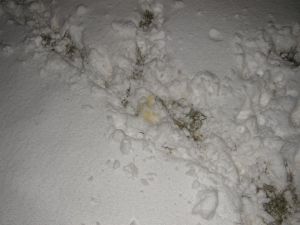
I could even see where they relieved themselves:

Badger urine (makes a change from pictures of dung!)

Badger urine (makes a change from pictures of dung!)

Mind you, with badgers nothing is simple.  This is just as likely to be scent marking as anything else (see my post on why badgers use paths for more details).

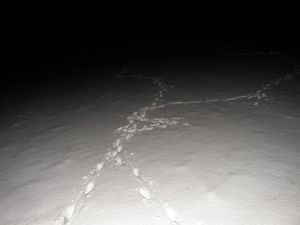
The next level of tracking is not just understanding the individual animals, but understanding how they interact with each other and with their environment.  I followed the tracks of each badger as they meandered across the field, but where the tracks crossed an interesting thing happened.  You could clearly see where the second badger had come across the tracks of the first – it would double back or walk in parallel for a short distance.  This happened on every occasion the tracks crossed, so the badgers were obviously aware of each other, presumably by scent, and checked out each others’ tracks.

Badger tracks interacting

Badger tracks interacting

It was absolutely fascinating to see how the different trails interacted.  At one point in the field the tracks of four different badgers converged.  One of these trails came out of the wood, went to this very spot, turned round and went back again.  This cannot be coincidence – this was obviously an illustration of some badger behaviour I don’t yet understand.

Four badger trails converging

Four badger trails converging

Wandering around a snow-covered field in the middle of the night with a torch is probably not everyone’s idea of a good time, but I thoroughly enjoyed myself.  I learnt more about the foraging activities of my badgers than I have done in years.  I learnt about the routes they took and the way in which they interact.  By following the tracks I’ve revised my ideas about the size of their territory (bigger than I suspected) and the boundary markers they use.

Two hours went by quickly, and then it was time for bed.  While the rest of the country ground to a halt, I had a wonderful evening of tracking.  Like I always say, this sort of thing is out there for anyone willing to take a look.

Read Full Post »

The weather today has been much warmer than of late.  It was a cold night, but the sun came out and the temperature went up to 8 degrees or so.  It doesn’t sound much, but compared to the last couple of weeks it feels almost tropical!

Rabbit tracks in frost

Rabbit tracks in frost

I went on my usual Sunday morning dawn stroll today.  When I set off it was still very frosty.

Here’s an example of tracks that you won’t find in a tracking book.

The pavement was very frosty, although the road had been gritted.  At some point in the night a pair of rabbits had crossed the road, hopped up onto the pavement and then gone through the railings to the field beyond.

They had picked up the salt from the road on their feet, and this salt had melted the frost where their feet had touched it, leaving this perfect set of tracks in the ice.

I decided to make the most of the day and went for a longer walk than usual.  I let my feet carry me in a big loop around the woods.  The Chinese Water Deer were out again, and the local buzzard seems to have found a friend, as there were two buzzards swooping and calling over the fields.  Either that or he was having a territorial dispute with the neighbour.

I thought it was time I checked in at the sett to see how the badgers were doing.  Of course, there was no chance of them being out at 9.30am, but I wanted to have a look round.  It gave me a good chance to look at the different parts of the sett.  In summer, when I’m actively watching the badgers, I don’t like to get to close to the sett for fear of disturbing them as scent can linger for a long while.  Today though, I thought I’d have a look, since the badgers would not be active until much later in the evening.

Everything seemed to be in order at the sett.  There were two entrances that looked to be in very active use.  Here’s a picture of one of them – note the relatively clean hole, without many fallen leaves or other debris.  You can also see how the sides have been polished by the coming and going of many badgers.  This is obviously well-used at the moment.

Badger sett entrance (1)

Badger sett entrance (1)

Very encouragingly, a couple of entrances showed signs of recent digging and of having been cleared out.  In the picture below you can see a furrow pointing directly to the hole, made by badgers dragging out spoil.  This is another classic sign of an active badger sett.

Badger sett entrance (2)

Badger sett entrance (2)

In the picture below, you can see that the badgers have dug out large amounts of dead leaves from this entrance.  This is a sign that they’re clearing out an old chamber for re-use.

Badger sett entrance showing signs of clearing out

Badger sett entrance showing signs of clearing out

Why is this encouraging?  Well, badgers re-dig parts of the sett at this time of year to make ready for the birth of cubs in February.  The sow prepares a separate ‘maternity suite’ where she can get away from the other badgers and won’t be disturbed.  The signs of activity at the sett all point to there being cubs on the way!

The interesting thing is that there is clear activity at both ends of the sett – the east and west sides.  This implies that badgers are in residence at both ends.  There is re-digging going on at both ends too.  Does this mean that there will be two separate litters of cubs from separate mothers?  Has there been a split in the badgers, so that different groups have taken to living in different parts of the sett?

All the books I’ve read suggest that all the badgers in a sett should be part of one single group, with only the dominant male and female breeding.  This wasn’t the case last year, as there were at least two litters of cubs, and the signs seem to indicate that there will be separate litters again this year.

I’ve also been thinking about the number of badgers in the sett at the moment.  If all the cubs survived (and I have no reason to think that they haven’t) then there will be at least 10 badgers in residence.  Do some of them leave home at some point, or do they stay in the group permanently?  Might this account for the active use of different parts of the sett?  If they leave, what is it that determines who leaves and who stays, and where do the badgers that leave go?  Do they join another sett, or start their own?

You see, this is the great thing about badgers.  We’re only in January and already they’ve got me confused.  I’m going to start the badger watching season as I finished the last one – with more questions than answers!

This is a mystery that needs solving.  Does anyone know where I can get a cheap copy of Hans Kruuk’s The Social Badger?  Even better, if anyone knows anything about the clan structure of badger groups and how they change over time, then please do leave a comment and enlighten me.

Read Full Post »

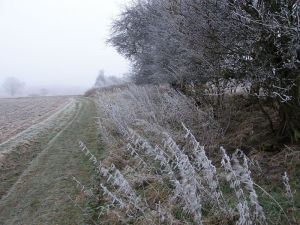
Frosty fields

Frosty fields

Well, we’re ten days into 2009, and so far the only way to describe the year is ‘cold’.

The temperatures have not been much above freezing for two weeks, with night-time temperatures as low as -10 degrees Celsius.

I spent the New Year on the North Wales coast.  Normally this part of the country is quite mild, as the sea acts as a huge storage heater and keeps the temperatures up.  This year, however, the sand on the beach was frozen solid, and even the rock pools had a thick layer of ice.   It was really cold.
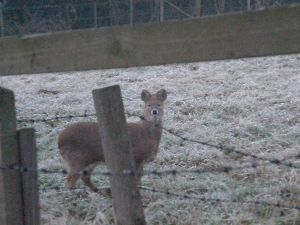
Chinese Water Deer in a frosty paddock

Chinese Water Deer in a frosty paddock

Back in Bedfordshire, the weather has been even colder.  Since most of our house has no heating we’re regularly having to scrape the ice from the inside of the windows in the morning.  We go out each day with a kettle of hot water to defrost the water in the chicken’s drinker, as it freezes solid overnight.

I’m not complaining,
mind you.  It’s quite fun to dress up in warm clothes and get outside, and I’d much rather have this sort of cold, clear weather than the murky drizzle we get so often.

Tracking is almost impossible at the moment, as the ground is like stone.  I came across a fresh fox track on December 27th, just before the frost started.  It is still there today, and looking almost as fresh, fossilised in the hard, icy ground.

The best thing that happened this week was on Monday, when it snowed.  It was only a couple of inches or so, but it got me more excited than you can imagine.  This is the first snow since I started learning tracking, and I was itching for the opportunity to go out and look at the tracks.  I had visions of being able to follow perfect crisp tracks for mile after mile, and to see the full pattern of animal movements written across the snowy ground.

I was working for a long day on Monday, but on Tuesday I managed to get out for an hour or so in the early morning before work.  There were already thousands of tracks from the previous 24 hours.

Here’s an easy one to start with.  Here’s the tracks of our cat, Mayfield.  She was originally a farm cat, and she’s not at all put off by cold weather.  Here you can see the print of her back legs as she sat in the snow.

The cat sat on the... snow

The cat sat on the... snow

Our local fox has been quite active lately.  As long as he keeps away from my chickens then I’m happy to have him around.  Since the chickens have a de-luxe high security run (which they still escape from every now and then), there isn’t much danger to them.

Here’s the fox’s tracks.  Note that the fox, unlike the dog, has an almost perfect register.  This means that the rear feet go into the tracks left by the front feet, so the track looks like they have two feet rather than four.  You can see here that there is only slight overlap to show that there are two prints on top of each other.

Fox tracks

Fox tracks

The vast majority of tracks were from rabbits.  In fact, there were so many rabbit tracks that they obscured almost all the others.  Here is a classic rabbit track.

Rabbit track

Rabbit track

The direction of travel in this case is from left to right.  The two small prints close together on the left are the front paws, and the larger tracks on the right are the rear paws.  When hopping, the rear paws ‘overtake’ the front paws, leaving a track that seems backwards.

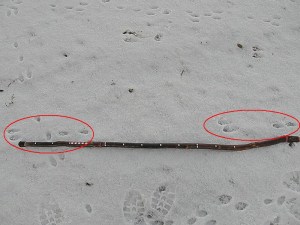
Some of these rabbit tracks are quite impressive.  Look at the tracks immediately above the stick.  There are two sets of rabbit tracks – one at either end of the stick – representing a single bound.  Ignore the trail going from bottom left to top left, and the one across the top of the picture.
Bounding rabbit tracks

Bounding rabbit tracks

The direction of travel is from right to left, with the rear paws quite far ahead of the front ones. This rabbit was obviously bounding along at a fast pace.  The stride length was 120cm, which is a big distance for a rabbit to travel in mid-air.  Actually, the guidebooks give a stride length of 80cm for a rabbit, so this one must have been really sprinting.  It may even have been a hare, as hares have strides of up to 250cm, but the tracks themselves looked like the other rabbit tracks, so perhaps I’ve got a record-breaking rabbit on my hands.

Frustratingly, there were no badger tracks in the area.  I was longing for the chance to trail a badger through the snow, and to try and build up a picture of it’s nightly movements, but it was not to be.  Perhaps badgers don’t like snow.  The hard frost would mean that even a badger would find it difficult to dig up food.

I decided to have one last try at finding badger tracks before the snow melted, and after work I set off for the wood where the main badger sett is.  I had an idea that I might be able to find tracks in the pasture field, as I know they forage there and I’ve seen them in that area before.

I walked up to the wood at about 10.00pm (I worked late!).  The half-moon and the snow on the ground made it quite possible to wander around without a torch.  Unfortunately, by the time I arrived, the pasture field had been trodden over by the resident sheep, countless rabbits, and a solitary human.  Finding individual tracks was almost impossible.

On the borders of the wood though, I came across a trail that looked right for a badger, and I was able to follow it into the wood itself.  There, on the undisturbed snow, were two lines of badger tracks – one going away from the wood and one going back into it.

Badger track in snow

Badger track in snow

And there they were – a little distorted, but unmistakeably badger tracks.  It seems that only a single badger had been out foraging – the others probably had more sense and stayed warm underground.

I didn’t get the chance to follow badger trails as they wandered across a pristine field of snow, but it was fun to go out and look for them.  I hope that we get more snow this winter – ideally at the weekend – so I can go out and spend hours literally following in the footsteps of the wildlife.  In the meantime, may the Protector of All Small Beasts look after the animals and birds and see them safely through the cold spell.

Read Full Post »

Last night – Saturday night – a small herd of fallow deer does crossed the road in front of my car.  Fallow deer are easy to recognise from the car because of their obvious tails and rump patches as they disappear into the hedgerows.  It happened just a few hundred yards from my house, and close to the field where I usually go for my Sunday morning dawn walks.  Knowing that they were in the vicinity gave me a great opportunity to see if I could track them.

Winter field - no tracks here!

Winter field - no tracks here!

On the face of it, it didn’t seem promising for any tracking on Sunday morning.  It rained heavily all night, so much so that severe weather warnings were in force for much of the UK.  Nevertheless, with an effort I got out of bed to find a cold but clear dawn.  The rain had stopped at some point in the early hours.

Much of the field was too wet for clear tracks.  The lower half of the hill is on clay, and was almost underwater, although a few isolated fallow deer tracks were visible, alongside those of the ubiquitous muntjac and Chinese Water Deer.

On the better drained sandy part of the hill it was a different story.  There, spread out before me was the full story of the morning.  A clear line of tracks showed where the deer had crossed the field from the northwest.

The trail of the fallow deer herd

The trail of the fallow deer herd

The deer were walking calmly, as the tracks had a perfect register.  In other words, the rear foot had come down exactly on top of the track of the front foot.  Measuring the stride of the deer gave me a distance of 50cm on average.  This is shorter than the 60cm that the guidebooks suggest, but maybe it’s because my deer were does, or maybe they were not yet fully grown.

The trail of the deer led across the sandy soil and into a pasture field.  Unlike the deer, I respected this as private property, and I walked around to the next arable field where there was a convenient footpath.  I was able to pick up the trail in this field.  The deer had crossed it at an angle, still heading southeast, before crossing the main road and disappearing into the pathless woods beyond.

Fallow deer track - note the perfect register

Fallow deer track - note the perfect register

Fallow deer are not uncommon in the area, but it was quite exciting to be on the trail of a herd, and particularly satisfying as I had seen them the previous night.  If I was a more experienced tracker I’m sure that I could tell a lot from trail like this – how the individuals are spaced out, which one takes the lead, which ones follow behind and so on.  It was quite confusing to have a mass of tracks all together.  As always, there’s so much still to learn, and I’m enjoying every moment of it.

To end on a happy note, there were badger tracks in the field too.  I hadn’t seen any definite badger tracks here since September, and I was beginning to fear that the badger that was making them (I’ve only ever seen one set of tracks at a time) was the road casualty of early October.  Happily though, it seems not, and the badger is back to it’s regular haunts again.  I’ve only ever seen it’s tracks, but it’s kind of an old friend to me now.

Read Full Post »
I don’t know what it is, but I always find this time of year a bit melancholy and dreary.  The leaves are gone from the trees, the woods are quiet, the vegetable garden is sleeping and there is a cold, damp stillness over everything.  Summer seems a long way off.

Because of this, I decided that I needed to shake off the urge to sit in front of the fire for the next three months and get out and do something.  Over the last week or so the lack of badger-watching has been nagging at me, and I made up my mind to try and get a peep at the stripey devils.

As I’ve said before, I am not keen on the idea of using artificial lights by the sett for fear of disturbing the badgers, so I hatched a plan to try and see them as they foraged in the big pasture field.  There would still be a risk of disturbance, but not so great as there would be by shining lights on them as soon as they poked their noses above ground.  So – it was time for another late night excursion to the fields.

I’d seen a badger here the last time I tried it (see Fieldnotes: 2nd August 2008) so I was at least partly confident.  The problem was that sitting in a field for half the night in August is one thing.  Doing it in November is quite another.

As anyone who has spent time outdoors will know, it is perfectly possible to keep warm when you’re walking around.  Indeed, the challenge is often to avoid getting too hot.  When you’re just sitting in one place though, the chill seems to seep into your bones and even a mild night can be very cold.  Tonight was a cold night to begin with, with a sharp wind and a damp mist hanging over the fields.

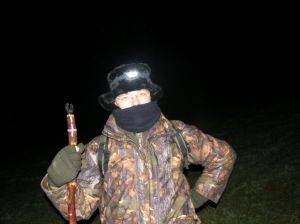
What every badger watcher is wearing this season...

What every badger watcher is wearing this season...

In anticipation of the cold, I dressed up in almost every article of clothing I possess – fleece trousers, thermal T-shirt, mountain walking fleece top (which I never wear when mountain walking because it gets too hot), army extreme cold weather shirt, jumper, waterproof jacket, mittens and fleece neckwarmer.  To top everything off I put on the furry Russian hat that my wife gave me.  I was all dressed up with somewhere to go, and at 10.30pm I headed off towards the fields.

God only knows what I looked like.  A couple of cars passed me as I walked through the village.  To the drivers I must have appeared in the headlights like a cross between a German soldier in the last days of the siege of Stalingrad and some strange Bedfordshire sasquatch!

Sitting on a log at the top of the field I was surprisingly warm and cosy.  As well I should have been, given the amount of gear I was wearing!  In an odd way it was nice to be there in winter, especially after having spent quite a bit of time on the same log over the summer.  It seemed to be taking things full circle in some way.

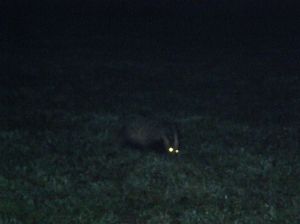
Night-time badger

Night-time badger

I sat there for an hour or so, occasionally shining a torch around the field.  And then, just before midnight, a badger appeared.

It seemed quite unconcerned about me being there as it snuffled about finding worms in the grass.  I turned on my red torch and crept closer, until I was about 20 feet away.  This is the first badger I have seen for a few months now, and it was good just to stand there and watch it.  It was particularly interesting to watch it feeding, working methodically across the field with its nose to the ground, obviously sniffing out the next earthworm.

I took a couple of photos.  They aren’t the best badger pictures ever taken, but they are a first for me.  The badger didn’t seem too put off by the flash, but I didn’t want to make a nuisance of myself.

Night-time badger 2

Night-time badger 2

After about five minutes it ambled off and I let it go.  For me, it was enough to have been out and about on a winters night, and to get a glimpse of one of these fascinating creatures.  I had satisfied my badger cravings for the time being.

Read Full Post »

Muntjac

Muntjac

Once again, things are busy at work, and I’ve been all over the country in the last couple of weeks, bringing business psychology to the masses and having little time for wildlife at home.

Today being Sunday though, I had time to get up early and go on my regular ‘dawn patrol’ walk around the fields and woods just as it is getting light.  It’s a great time to be out watching wildlife, and as long as you don’t mind getting out of bed it gives you a whole extra part of the day.

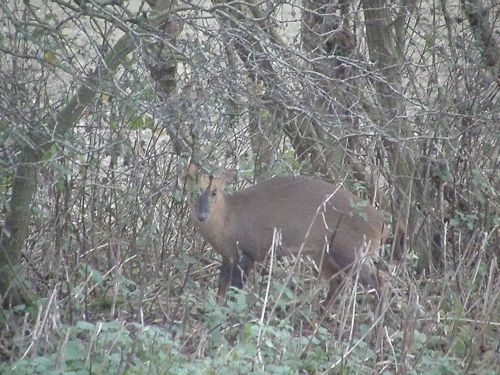
7.00am found me sitting with my back to a tree, looking over a ploughed field.  The usual gaggle of rabbits were out and about, a muntjac peered at me from the hedge, and a large flock of rooks was circling over the woods.  As the light grew though, the main object of interest was a trio of Chinese Water Deer meandering around the field.  Their tawny coats were surprisingly well camouflaged against the sandy soil.

Chinese Water Deer seem to be figuring in my thoughts a lot at the moment.  They seem to be more numerous in the local area than I imagined.  I think some of this has to do with my familiarity with them – a few years ago I would have classed all small deer as ‘muntjac’ and thought no more about it.  Now I can recognise the CWD for what they are and distinguish them easily, and I smile at my past foolishness.

Unfortunately, when it comes to tracking, I’m still quite naive.  I still tend to class all small deer tracks as ‘muntjac’ and think no more about it.  In fact, I’m doing exactly what I used to do with visual sightings.

The problem is, the tracks of muntjac and CWD do look very similar. I could be looking at a field full of what I think are muntjac tracks, and they may actually be CWD.  Or vice versa.  For someone like me, who likes to be accurate, even on meaningless things, this is an important point.

Chinese Water Deer Tracks

Chinese Water Deer Tracks

The classic reference book of tracks, Animal Tracks and Signs, by Bang and Dahlstrom, doesn’t even mention CWD – I suppose they aren’t really common outside the Southeast of England (and China, of course).

The Hamlyn Guide to Animals – Tracks, Trails and Signs, my other preferred guidebook, says that CWD prints are very wide and splayed.  The problem with this is, it’s wrong.  The prints are actually quite small and neat.  I know.  I’ve spent the morning watching the deer and then walking up and looking at their tracks.

So, I’ve got a problem.  It is difficult to tell the deer apart from their tracks alone.

The answer, I think, is to look at the trail as a whole, not at individual tracks.  The trail of an animal is as characteristic as the shape of its feet.  This is the approach recommended by Paul Rezendes in his book Tracking & The Art of Seeing.

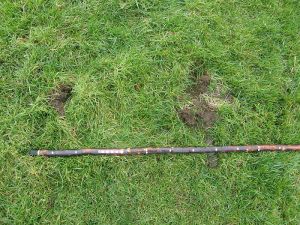
This is where my tracking stick starts to come into its own.  A tracking stick is a walking stick used in tracking.  The main use of a tracking stick is to establish the stride length of a given animal, and knowing this, predict where the next track should be.  The tracking stick helps you to narrow down the search area so you can find every single track. I tend to use my tracking stick as more of a simple measuring tool.  I have marked it in 10cm intervals and it has a 10x1cm scale attached.  This allows me to make rough and ready (but reasonably accurate) measurements in the field.

Measuring deer tracks with my tracking stick

Measuring deer tracks with my tracking stick

Here’s the clever part.  Having come across a new set of tracks, I can measure the stride length.  I did this for one trail, and found the strides to be 32cm to 38cm long, with most around the 36cm mark.

Looking at the guidebooks, they give a typical stride length for muntjac as 25-30cm, and for CWD as 30-40cm.   This means that my deer, with a stride length of about 36cm, falls outside the range for muntjac, but well within the range for CWD.  Based on stride length alone, we can say with some confidence that the trail has been made by a CWD rather than by a muntjac.

This is exciting stuff.  Although I would struggle to differentiate between the two deer based only on the shape of their footprints, measuring and comparing stride length makes it quite easy to do.

As with anything, there are complications to using stride lengths and gait patterns to identify a species.  Is the deer running or walking?  Is it full size or half-grown?  And so on.  But I like it as a technique.

An awful lot of the information available about tracking today seems very ‘spiritual’ and mystical.  I have no problem with this, and I respect anyone who can use it in this way, but it is not for me.  I earn my bread and butter as a scientist, and although I like to get away from work as often as I can, I can never quite turn off my scientific reasoning.

This is why I like this measurement approach – it is scientific and can easily be applied and tested (unlike many ideas connected to tracking) and it appeals to my use of data and facts.  I’ll see if I can make more use of it over the coming months.

Read Full Post »

Lately I’ve taken to getting up at dawn on Sundays and going for a walk around the local area.

I’d recommend it for anyone interested in wildlife.  You are up and about before the human world has woken up, the nocturnal animals – and those that are shy – are still around, and any tracks from the night before are still fresh and untrampled. It’s a rare occasion when I’m not rewarded with views of hares, muntjac and roe deer in the fields.

Badger snuffle holes on pasture

Badger snuffle holes on pasture

Besides, it gives me some extra time before the day really begins.  Of course, dawn is not very early in the morning at the moment – 6.30 to 7.00am – let’s see if I’m still so keen in May when I have to get up at 4.00am!

Today I thought I’d go up to the wood and see what the badgers have been up to.  There was no chance of seeing them, of course, they’d all be tucked up and asleep underground, but I thought I’d have a look.

The good news is that they seem to be thriving.  The pasture field was full of snuffle holes where they’d been foraging for worms and insects, and the usual latrine sites showed evidence of lots of activity.

Unfortunately it had been tipping down with rain for the last 24 hours, so any tracks were either washed away or underwater.  It was definitely a day for wearing wellies!  The only track I found was a fallow deer print under an overhanging tree, but other than that the ground was a clean slate.

Down at the sett the badger paths were well trampled, so they are obviously still very active.  I may try a night time trip with a red torch one of these evenings and see if I can spot anything.  I’m beginning to get badger withdrawal symptoms, so I’d like to try and watch them again before spring.

My fascination with badger dung continues.  The main latrine site by the sett contained large amounts of dung, some that was a mass of seeds, and some that was mostly sweetcorn.  The sweetcorn probably comes from patches of maize that are grown as food and cover for pheasants.

Badger dung with seeds

Badger dung with seeds

There seems to be a pattern here, in that separate piles of badger dung can contain entirely different food.  It suggests that the different badgers in the sett may be feeding on completely different things, and not all foraging together, which is an interesting insight into their behaviour.

I’m sorry to say that I don’t know what the seeds were in the dung.  If I was a proper naturalist I’d have brought some home and looked at it under the microscope, but I didn’t.  My wife seems to tolerate my naturalist ramblings (in every sense of the word).  Bringing home poo would, I feel, be a step too far even for me.

By this time it was time for my other Sunday ritual, bacon and eggs, with fresh free range eggs from the garden.  A good walk in the woods is surely the best way to work up an appetite for breakfast.

Read Full Post »
« Newer Posts - Older Posts »