Feeds:
Posts
Comments

Archive for August, 2011

Walking through Woburn Deer ParkWoburn Abbey is not very far away from where I live.  Every now an then I like to go for a walk through the deer park.  I know they’re not real wild deer, but the park is a great place to watch deer at close quarters and in fairly natural surroundings. Put another way, it is 3,000 acres of grassland, trees, small copses and lakes – although it is managed habitat it offers a chance to see all manner of wildlife.

If you look back at previous years you’ll see that I make a point of visiting the Deer Park in October for the Red Deer rut, and this is truly a spectacle to behold.  I recommend it to anyone if they’re able to travel to Woburn.  But actually, the park is a good place to visit at any time, especially with the attached safari park and zoo.

It is perfectly possible to visit the Deer Park and see plenty of deer without even having to leave your car.  There is a public highway that crosses the park – you can drive through (carefully, mind) and the deer are there either side of the road.  But this isn’t the best way to see it.  There is a whole network of public footpaths that means you can leave the car in one of the neighbouring villages and stroll through on foot.  You can even work out a big circular walk on the paths that takes you well away from the road and into some lovely hidden spots.

Scarlett and I took a walk through the park to visit the monthly farmer’s market in Woburn village.  I like doing this, as it gives me a chance to combine a bit of wildlife with some local shopping, although the highlight of the day is usually in the crypt of Woburn parish church, where they serve tea and home-made cakes.   What more could you ask for in a walk?

The park is home to Red Deer, Fallow Deer, Muntjac and Chinese Water Deer, the last three species having inevitably escaped and become naturalised in the local area.  A fifth species, Pere David’s Deer, have so far remained in the park.  They have the distinction of having been made extinct in their native China but were preserved in Woburn and a few other places, so successfully that they have now been re-introduced back in their homeland.
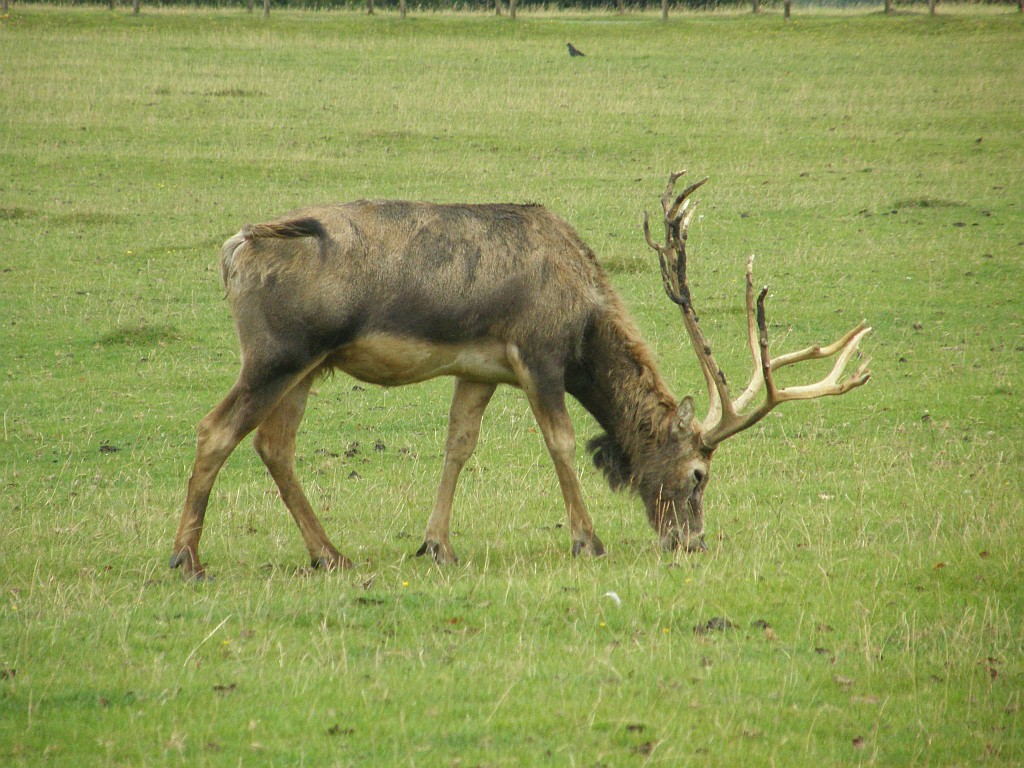
Pere David's Deer at Woburn Deer ParkPere David’s are slightly odd-looking, vaguely cow-like deer.  They can be identified quickly by their backward-pointing antlers (the points of Red Deer antlers face forward).  In their breeding season they gather foliage on their antlers as a display, which is quite a distinctive feature.

Pere David's Deer in a pond at Woburn Deer ParkWhen we visited, the Pere David’s were congregated around and in one of the ponds, standing up to their knees in the water.  I’m not sure why – it wasn’t that hot.  Perhaps it is another of their odd behaviours.
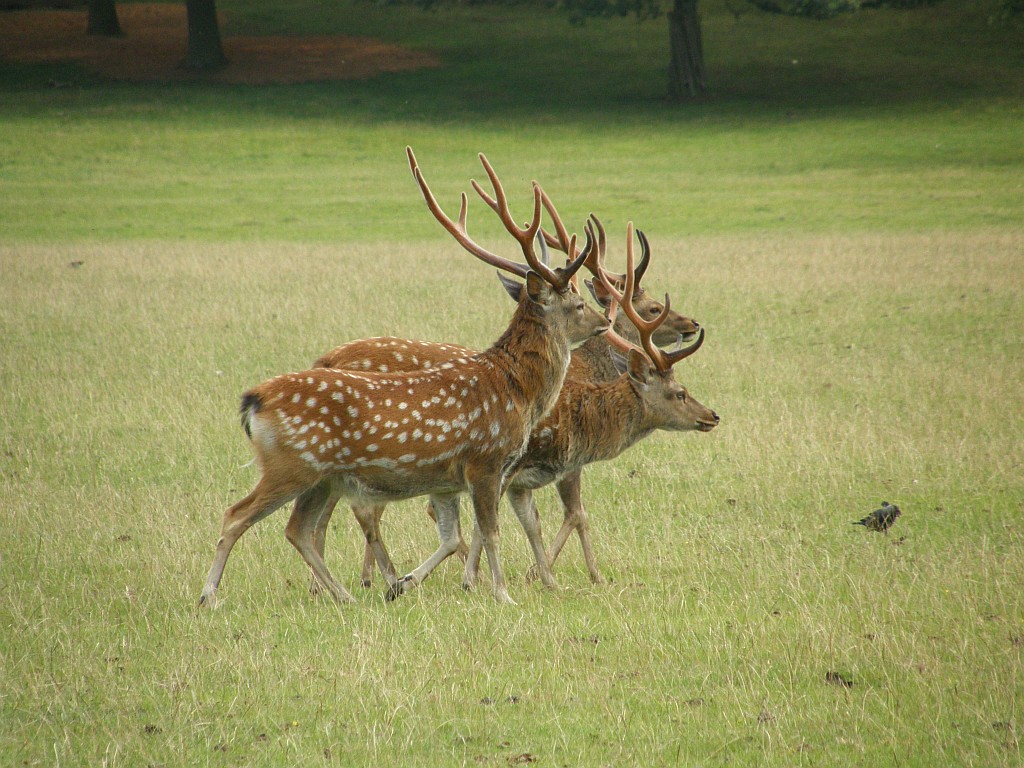
Red Deer Stags at Woburn Deer ParkThe Red Deer are almost ready for the rut now, but the stags are still in groups.  Soon they’ll separate and start calling to attract their own ‘harem’ of females.  The ones in the picture above are still quite young.  As they grow older they will develop more points on their antlers and lose their spots.  There are some real monster stags at Woburn.

Fallow Deer at Woburn

Fallow Deer, like the ones above, were introduced to Britain by the Normans.  They are easily identifiable by their ‘palmate’ antlers (which are flat, like the palm of your hand, I suppose).  Colour is not an absolutely reliable feature for any species, as a rule, but Fallow Deer are typically much lighter than other species, being spotted or even entirely white (a pure white deer was frequently seen running wild around our village a few years ago, a bit like a deer version of Moby Dick).

The deer were the main feature of our walk, but there was plenty more to be seen.  Scarlett enjoyed seeing ducks on the ponds and rabbits on the grass.  I enjoyed finding a wasps’ nest dug out by a badger (so there are badgers about even here, in this managed park!)  But the church in Woburn deserves a mention too, from a naturalist’s point of view (and not just for tea and cakes).

St. Mary’s church is relatively modern, being built by the 8th Duke of Bedford in the 1860’s to replace the older church in the village.  It is handsome enough though, with some fantastic gargoyles.  The vicar, Steve, is a nice chap too.  For me, though, one of the most interesting features is inside: a window commemorating Mary, the ‘Flying Duchess’.  Mary is a fascinating character.  She was a noted aviator, hence the name, and she was lost without trace in a flying accident over the sea in 1937.  During the Great War she set up a hospital for servicemen at Woburn that still bears the name ‘Marylands’, although it is now in the process of being converted to luxury flats.  For more information on Mary, see Wikipedia.

OK – fascinating history lesson, BWM, but where is this actually going?  Well, in addition to her other interests, the Duchess was also a keen birdwatcher.  After her death, she was commemorated with a large stained-glass window in the church depicting St. Francis of Assisi (“Whose work was in the hospitals, whose delight was in the birds” – very fitting).

The St Francis of Assisi window in St Mary's Church, WoburnAnd this is the point I’m slowly getting to.  The artist of the window decorated it with birds found in Woburn Abbey and the park.  An idea is forming in my mind – the ‘Flying Duchess Challenge’.  If all these birds are local, then why don’t I set myself the target of seeing them and ticking them off a list?  Following in Mary’s footsteps, if you will.

This is where it gets tricky.  The picture above is a big, hi-res image so you can zoom in on the birds.  Some are common enough – magpie, tawny owl, heron and so on.  Some are much more challenging.  That looks like a chough in the top right.  I’ve seen these on Anglesey, but they vanished from southern England a long time ago.  Some birds are downright difficult.  There’s a hoopoe in there, and they’ve been recorded in Bedfordshire fewer than half a dozen times since the 1940s.  It will definitely be a challenge, firstly to identify all the birds on the window, and secondly (and more difficult still) to actually see them, particularly locally.

I like the idea of it, even if it is nearly impossible.  I’ll keep you posted.

Read Full Post »

On Saturday night Mrs BWM kindly offered to put Scarlett to bed, so I seized the chance to pop up to the wood.  I jumped into my camouflage clothes, crammed a crust of bread and a piece of cheese into my pocket for supper, and headed off.

Summer is marching on into autumn now.  The wheat in the wheatfield has been harvested and the whole field harrowed over.  Not only is it an absolute bugger to walk over until the footpath is trampled down, it means that the badgers have to look for other sources of food.  At the top of the field there was a fresh badger latrine that showed that not only were they still marking out the field as territory, they are making use of other food resources.

Badger dung with fruit stones

The dung is full of fruit stones.  I thought at first that these were cherry stones, but on reflection they may well be sloes, which are fruiting now.  If you’ve ever eaten a sloe you’ll know how incredibly tart they are, but since badgers will cheerfully eat wasps I am beginning to think they don’t have a sophisticated palate.  As a good (albeit very amateur) scientist I know what I need to do now.  I need to go back and get a sample of the dung and compare the fruit stones to sloes and cherries, and then I’ll have a definite answer.  It may not sound pleasant, but I feel I need to do it – another piece in my badger jigsaw.  This is why my house is well stocked with latex gloves and carbolic soap…

Now, it’s always been a principle of mine when badger watching to approach and leave the area of the sett as quietly as possible.  You never know when the badgers will be around, and even if the badgers are not in the vicinity you can still scare them by setting off a ‘chain reaction’ by scaring other animals – you approach noisily, you frighten a deer, the deer bolts past the sett and frightens the badgers.

My stealthy approach to the main sett is made easier by a large fallen ash tree (ash trees seem to have a habit of falling down – remind me never to camp under one).  I can walk along the trunk silently rather than rustling through the undergrowth.  On this evening, halfway along the trunk, I caught sight of a deer in the direction of the sett.  This is exactly the situation I mentioned above, and it calls for extreme caution.  But it got worse.  As I froze in my tracks, I noticed movement in the undergrowth at the far end of the tree.  It was the badger cub from two weeks ago – out of the sett early and foraging further afield.

There was nothing I could do but remain motionless and pretend to be a tree.  Badgers are a bit like T-Rex – they can’t see you if you don’t move (mostly).  Of course, staying still while perched on a fallen tree trunk is easier said than done, but the badger didn’t notice me.  When it moved out of sight I took my chance and very slowly sat down.

For the next 40 minutes I sat on my fallen tree as the badger snuffled around within 20 feet of so of me.  The light was bad in the middle of the wood so none of my pictures worked, but I took a short video (video works better in low light on my camera).  It isn’t great quality, and it doesn’t shed any light on badger behaviour, but it will remind me of a fascinating evening watching a badger foraging at close quarters.

The badger came closer and closer but still didn’t seem to be aware of me.  At one point it was only six feet or so away from me as it crawled under the tree I was sitting on.  It wasn’t what I planned for the evening, but a memorable encounter just the same.

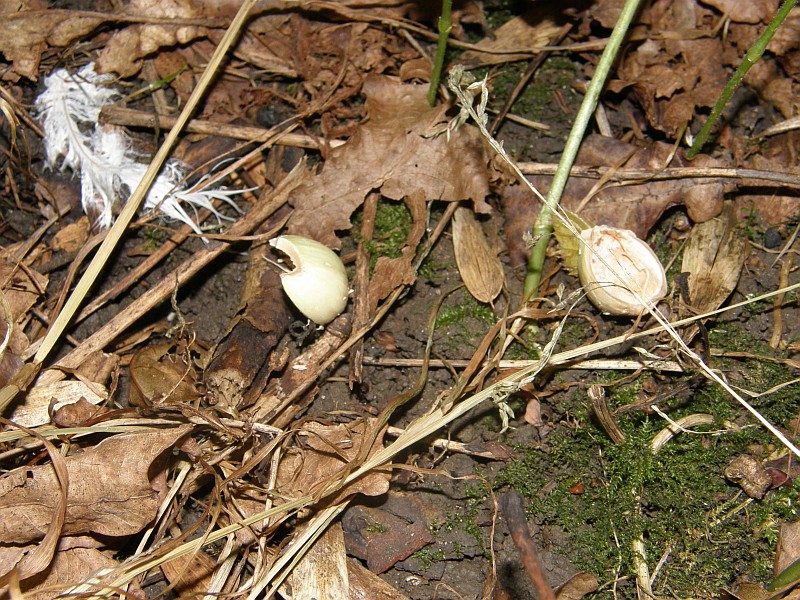
The badger was clearly foraging, but I couldn’t make out what it was feeding on.  I could hear loud cracking, crunching noises every now and then, as if it was chewing on dry sticks.  This was puzzling.  It was louder than the noise of a snail shell breaking, but I couldn’t figure out what it was.  When the badger had moved off I eased my cramped legs off the tree and went for a look.   The tree overhead was a hazel, and spread around the area were broken hazelnut shells.

Broken hazelnut shells, possibly eaten by a badger

Now, I can’t prove that this is what the badger was crunching on, but it seems likely.  A badger’s jaws are certainly strong enough, and hazelnuts are nutritious.  There are references in the literature to badgers eating hazelnuts (in 1935!)  However, the shells could have been there before the badger came – squirrels crack hazelnuts and they’re plentiful in the area.  I tried to find evidence that the badger was responsible – a shell with fresh badger spit on it, for instance, but there was nothing definite.

All in all, a fascinating evening and one that provoked all sorts of thoughts about badgers’ diet.  I can’t prove the badger was eating hazelnuts but there’s no reason why not.  What with the sloes and the nut shells I can see some sort of badger dung analysis project to keep me active through the autumn.  This is what I like about badgers.  Even though they’re a common species, living side by side with humans, there is still a chance to add something, however small, to what we know about them.  Just don’t tell Mrs BWM.

Read Full Post »

I’ve just spent a very pleasant weekend with my parents up in Cheshire, so the badgers have been undisturbed this week.  But this evening I have opened another chapter in the sandpit story.

Remember the saga of the tracks in the sandpit a few weeks ago?  Remember how what I thought was a mouse turned out to be a lizard?  And how the dried-up lizard (after a very sensible suggestion from Steve) turned out to be a newt?

I planned to examine the dessicated little corpse to see if I could make a clear identification, but to be honest I left it outside, it rained and the once dried body went a bit mushy and unpleasant.  Not conducive for a close investigation.

Today, however, the sandpit claimed another victim.  It wasn’t good news for the newt but it gave me a chance to examine the body in more detail.  Firstly, here is the fatal sandpit:

The Fatal Sandpit

Just an excuse to show off our new play area, really.  The sandpit has a fairly close-fitting lid that keeps the cat out but obviously allows newts to creep inside.  The sides are smooth plastic, 6″ tall.  It seems that the newts can climb in but not climb out.  I’m going to have to build some sort of ‘newt ladder’ so that any future visitors can escape.

Anyhow – the more I look at this one, the more it looks like a smooth newt:

Newt - top view

Look at the spots on the underside:

Newt - underside

And here’s a close-up – note the absence of claws on the toes:

Newt - close up

It all fits.  The newts in the neighbour’s pond must have be breeding.  According to Wild About Britain, “when [young smooth newts] leave the pond they are about 3 cm long. They then spend two or three years on land as terrestrial juveniles, and don’t return to the pond until they are ready to breed“.

But as I said, I’ve been wrong before and I’ll be wrong again.  If anyone has any alternate identifications, please do let me know…

Read Full Post »

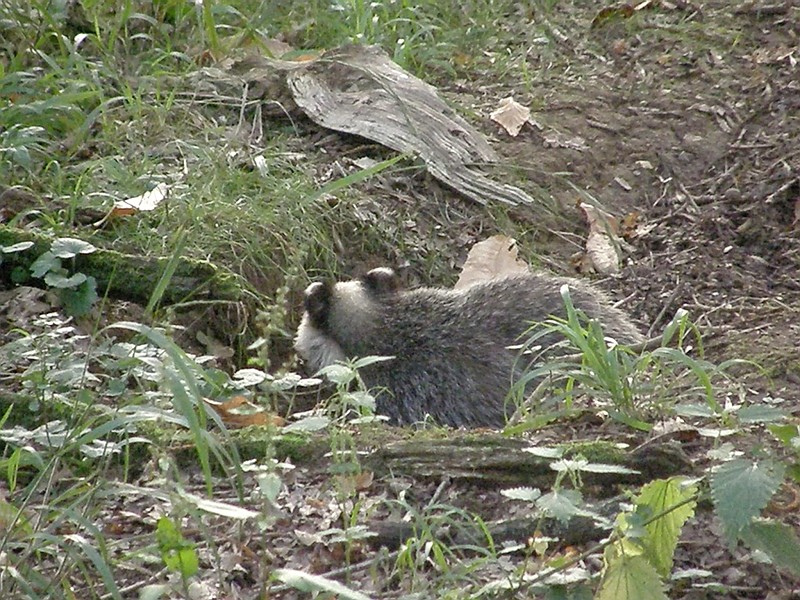
Badger CubSaturday evening was warm without being oppressive, with a light breeze blowing.  Around the world financial markets crashed.  Tanks rolled down Syrian streets.  London was in flames as rioters burned and looted.  And me?  I walked up to the wood to watch badgers.

The wheat in the wheat fields is ripe now.  The badgers are making full use of this seasonal resource, with all the latrine pits full of wheat-filled dung.  They’ll need to make the most of it quickly, as the farmers are starting to harvest.  They’ll carry on late into the night while the dry weather lasts, with spotlights on the combine harvesters.

By 7.35pm I was happily sitting up a tree at the main sett, listening to tractors in the distance, muntjacs in the wood and the buzzard in the trees.  You see, it isn’t that I try to escape from reality by watching badgers.  It’s just a different reality – one that’s been here far longer than the troubles of our modern world.

Having had little luck with the badgers at this sett I wasn’t expecting too much – maybe a quick glimpse.  But it turned out to be a very good evening of watching.  At 7.45 there appeared a badger cub.  It ambled over from the east end of the sett and snuffled contentedly around my tree as it foraged in the undergrowth.  This was good news indeed!  Remember that a couple of years ago I regularly saw 8-10 badgers at this sett, which has gone down to just 2 or 3 this year.  I’ve been concerned about them, to be honest.  A cub is an excellent sign that things are picking up again.

I thought I saw a cub last time I was here, but I only got a brief look so I wasn’t sure.  This time there was no doubt.  Here’s a quick video of the badger cub foraging:

As the cub was under my tree I could hear the whickering sound of badgers at play from the other end of the sett, so that makes at least another two badgers in residence.  At 8.00pm I saw another badger walking off from the east end of the sett, which confirmed things.

The cub spent the next half-hour foraging, snaffling up the odd morsel of food from the ground.  Apart from the delight of getting a good look at a real live badger for the first time in ages, I also got a few new insights.  At one point the local buzzard settled into a tree overhead, calling loudly.  The badger cub reacted visibly to this – it scampered to a disused sett entrance at the west of the site and crouched there.  A badger – even a half-grown cub – has nothing to fear from a buzzard, whose food is mostly carrion and small creatures such as worms, but this one looked visibly nervous.

Badger cub crouched in sett entranceAfter a few minutes the cub disappeared underground, only to reappear from the middle entrance to the sett five minutes later.  This is the first time I’ve seen this, but it means that the middle and the west of the sett are linked underground.  They’re at least 25 yards apart, so there must be a fantastic network of tunnels underground.

All in all, a very satisfying evening.  It must be a record for the latest view of a badger cub (I normally see the first in April) but it was good to see it nonetheless.  It’s a good sign and I feel like a proper badger watcher again.

Read Full Post »