Feeds:
Posts
Comments

Archive for June, 2010

After I described my roadkill polecat (I’ve had it confirmed as a ‘pure’ polecat by the County Mammal Recorder, by the way) Pablo took the time to comment, saying “I suppose you didn’t take its pawprints before you disposed of it?

Pablo – I like the way you think!

As a tracker you get used to seeing partial or distorted prints, and for many of the rarer ones you’re never quite sure what made them.  The chance to get perfect prints from a known species is too good to pass up.  Well, I didn’t take pawprints but I was on the same wavelength as Pablo.  I took pictures instead.

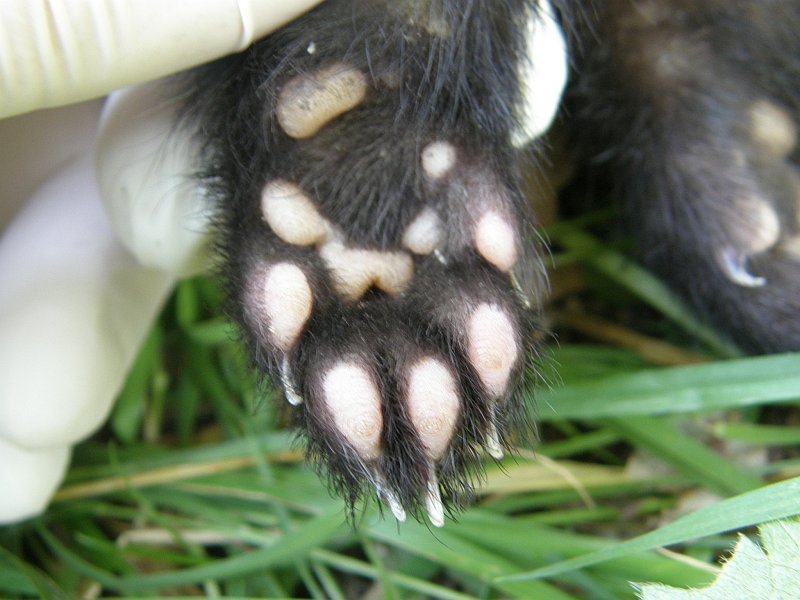
Here, for the record, is what a polecat’s paws look like.  Here’s the fore paw:

Polecat fore (front) paw

Polecat fore (front) paw

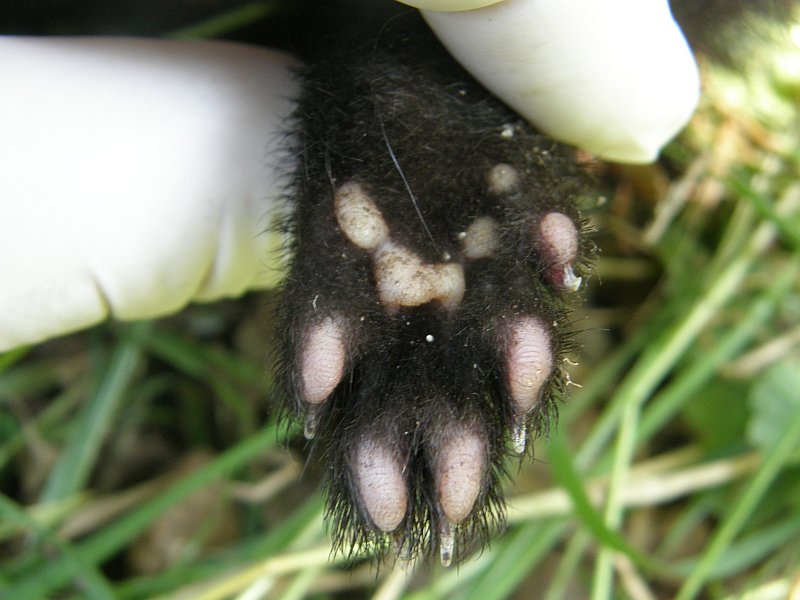
Here’s the hind paw:

Polecat hind (rear) paw

Polecat hind (rear) paw

Note the five toes on each foot.  Polecats are members of the mustelid family, just like badgers, and they share the same basic foot structure.

Here’s a badger foot for comparison:

Badger fore paw

Badger fore paw

So, now we know what we’re looking for, it’s time for us all to go out and start looking out for polecat tracks.  That’s the beauty of tracking – it allows you to find out about the local wildlife without needing to see the animals yourself.  It’s a great tool for the naturalist to have.

I’ll keep you posted on my results.

Read Full Post »

In yesterday’s post I described how I came across a polecat that had been killed on the road just outside our village.  Polecats still being quite rare in these parts, I was quite pleased to have found one so close to home (obviously the circumstances were less than ideal from the polecat’s point of view).  I ended by saying I’d like to see one some day.

Well, this morning I drove to the tip again (I told you it was a regular activity for me) and as I neared the spot where I found the dead polecat, a live one ran across the road in front of me.  It paused to sniff at a parked car and then disappeared into the woods at the side of the road.

It was definitely a polecat, or at least it was definitely the same species as the one I examined yesterday. A beautiful, lithe, sinuous creature.  If I was pleased to see a dead polecat, I was positively ecstatic to see a live one.

It goes to show that where there’s one animal from a species, there will be more.  Fair enough, this was only a fleeting view, but it’s a start.  The next stage will be to try and observe a polecat properly, and to get a photo or two if possible.  Given my lack of success with finding and watching the polecat’s near relative, the stoat, this may be difficult.  In theory, knowing the area where they live, the best thing would be to find a spot with plenty of rabbits (the main prey) and sooner or later I should be rewarded with decent polecat sighting.

And do you remember BBC Springwatch last year?  Simon King (my hero!) had waited 46 years to see a polecat.  With the finest camera equipment available (including multiple night vision cameras), a whole team of people and the pick of polecat hotspots to choose from, it still took them the best part of a week to get any good footage.  Never mind.  One of the good things about being a (very) amateur naturalist is that I’m in no hurry.  I have no deadlines to meet, no live programmes to fill.  It may take a while, but sooner or later I’ll get that picture of a polecat.

Read Full Post »

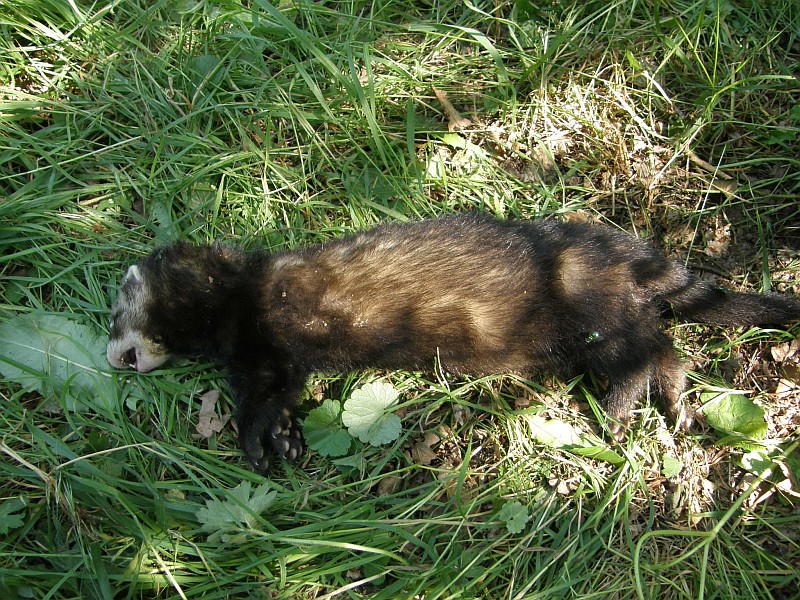
Polecat road casualty in BedfordshireThis morning I was driving to the tip with a load of rubbish (a regular weekend activity when you’re renovating an old house) when I noticed a dead animal on the road about a mile and a half away from my house.  Dead animals are pretty common around here, mostly rabbits and pheasants with the odd muntjac or chinese water deer too.  This animal was different though.  It tells you something about my character that I stopped the car and walked back for a look.  My curiosity overcame my general repugnance at looking at a dead animal on a hot summer day.

I’m pretty sure that the animal was a polecat.  The polecat is one of the success stories of British wildlife, in a slightly topsy-turvy way.  Once commonplace, they were wiped out from most of the country until by the 1930s they were limited to mid-Wales.  Since then, with the decline of gamekeepers and large-scale shooting estates, the polecat has been re-colonising England, and the speed of their spread eastwards seems to be increasing.  Most of our knowledge of polecat distribution in the UK comes not from sightings but from road kills – they’re quite an elusive and inconspicuous species.  Polecats are not unknown in Bedfordshire by any means (my wife saw one crossing a road last year), but they aren’t common either.

This animal had the classic ‘bandit mask’ dark markings around the eyes that are characteristic of polecats. However, Polecat facial markingshaving never seen a polecat before I can’t be 100% sure.  The problem is that escaped ferrets (which are basically domesticated polecats) will revert to polecat-like colouring after a few generations in the wild.  These are known as ‘polecat ferrets’.  But let’s be realistically optimistic about this.  Polecats are expanding across the country and there are confirmed records of them in Bedfordshire.  Unless someone more expert than me can give me evidence to the contrary, I’m going to assume that this animal was a real, bona fide polecat and this means that polecats are established in my local area.  It isn’t a major scientific breakthrough, but it’s another piece in the jigsaw of our local wildlife, and it gives me hope that I might see one in the wild one day.

Incidentally, I don’t really think I should be encouraging people to start messing around with dead animals by the roadside, but if you really do want to, please make sure you stay safe.  Always, always watch out for traffic, and if the road isn’t safe then don’t put yourself at risk.  You’d look pretty daft ending up as another casualty alongside the animal you’re supposed to be looking at.  And please do follow some basic precautions if you want to handle dead animals.  I keep a box of disposable gloves and a bottle of hand sanitiser permanently in my car for just this sort of situation.  Don’t even think about handling wild animals without them.

Read Full Post »

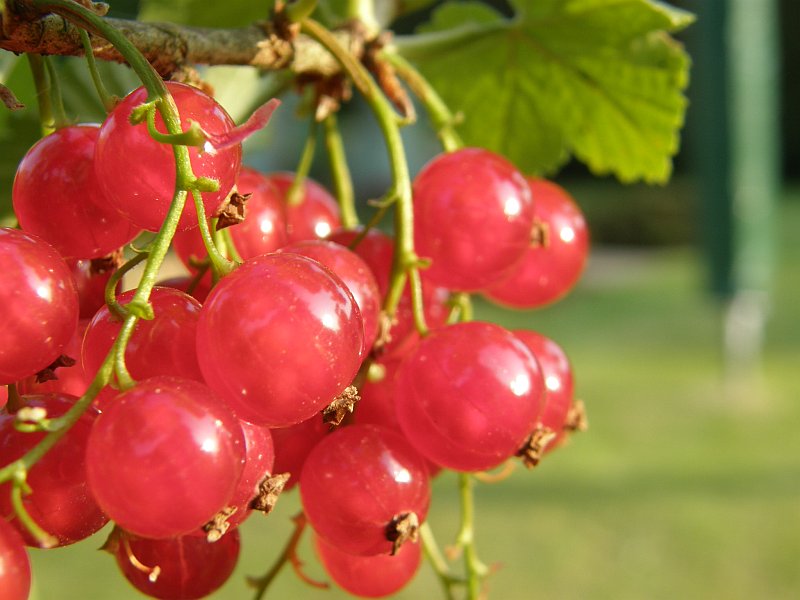
Redcurrants

RedcurrantsToday we picked our redcurrants.  Last year we went away for a weekend and came back to find that the birds had eaten every last one of them – little sods.  This year we netted them against the birds and got a bumper crop (although the local blackbird was circling us like a hungry shark even as we were picking).  Redcurrants are beautiful to look at as well as to eat – a lovely, translucent red; and for the small amount of space and effort they need we get a great return of fruit from our three bushes.

In total we got just over 7lbs with enough left on the bushes to keep the birds happy.   Time to find a recipe for redcurrant jelly…

Read Full Post »

I’ve been busy lately – working in the garden and down in Wiltshire for the solstice – so I haven’t had a chance to get out to the woods for a couple of weeks.  However, I’d like to get a few minor experiences on the record.  They aren’t really enough for a post on their own, hence I’ve brought them together into a collection of short tales.

A Very Regular Owl

Tawny Owl on the RoofEvery summer we get a visit from the local tawny owl.  We have a lot of tawny owls in the area.  For the last three years there has been a nest in a small copse about a quarter mile from our house.  You can year the young owls (owlets?) calling as they start to fly from the nest.

This is a picture of the owl that sat on our roof on June 12th.  Looking back through the archives, I note that I had taken similar pictures of the owl on June 12th 2008 and June 2nd 2009.  It isn’t a very frequent visitor, and it only seems to come in early June.  Clearly an owl of very regular habits!

So why does it only visit the house at this one time of year?  Is it something to do with having young in the nest?  Or is it that I only see it in the long evenings of June?

A Family of Wrens

I was walking through the wood the other day when I disturbed a family of wrens.  They were obviously nesting in an ivy-covered tree stump.  As I walked past, three of the tiny birds flitted out and perched on nearby trees, apart from one of them which perched on my arm.  It was only there for a few seconds (long enough to poo on my sleeve!) but it was fantastic to have one of these delightful little birds so close.  Thinking about it afterwards, I was in a fairly remote part of the woods and the wrens had quite possibly never seen a human before.  Truly a new experience for both of us.

The Bedfordshire Red Kites

Regular readers may remember my quest to see Red Kites in our village.  I haven’t seen them for a while.  I don’t know if this is because they haven’t been in the area or because I haven’t been out and about so much since Scarlett arrived.  Anyway, I was pleased when my wife came home last week to say that she’d watched one of the kites as it glided low over the end of our road.  I’ll have to make an effort to get out more and try and get a photograph, but at least I know they’re still in the area.

Graveyard Hedgehog

I have a soft spot for hedgehogs.  We still get one coming into the garden occasionally (I see the poo on the lawn) but I don’t see them very often out in the wild.

I was walking through the churchyard in the village the other evening.  It was about 7.30pm and still very light.  There, sitting on the path in front of me was a hedgehog, large as life.  Before I could take out my camera it had raised itself up on its little legs and trotted off to a gravestone by the path.

This gravestone dates from the mid 19th century.  It’s a large horizontal stone slab, raised up on blocks on each corner like a low stone table, about 4″ off the ground.  Without pausing, the hedgehog ran straight underneath it.

I lay down on the ground and peered in.  There was a clear run worn into the grass, and under the stone was a wide hollow space, clear and dry.  The hedgehog obviously has its home there, and a perfect home it is too.  I don’t know what the rightful owner of the grave (one Mr John Francis) would say about having a lodger, but the urchin isn’t doing any harm so I hope he wouldn’t mind sharing too much.

Incidentally, I was walking through the churchyard the day before and a kestrel flapped up from where it had been perched on the grave next to this one.  I assume that kestrels don’t hunt hedgehogs, so perhaps it was just a coincidence.  It seems that even in a pretty rural village like ours the old graveyard is still a haven for wildlife of different kinds.

Read Full Post »

“I think you’d better wear your waterproof jacket” said my wife as I headed out of the door this evening.  It was good advice.  It had been a beautiful, warm day but there were ominous banks of black clouds piling up in the west.  I hurried up to the wood as it grew darker and darker.  The weather forecast was for thunderstorms, and so far it seemed to be accurate.

There’s an old country rhyme about which trees are safe to shelter under during a thunderstorm:

Beware the Oak, it draws the stroke
Beware the Ash, it draws the flash
But under the thorn, you’ll come to no harm

I thought about the rhyme as I walked through a mixed wood of mature oak and ash trees on the top of the tallest hill in the area.  I hoped it wasn’t true.

I settled down at the east end of the sett from a spot where the outer holes are visible across a small ravine.  The spot isn’t perfect – it’s not possible to see the holes in the undergrowth at the top of the small rise on which the sett lies, and it’s quite far away so you really need binoculars – but it’s the best place to get a view of this end of the sett.

I sat in the gathering gloom, with only the mosquitoes for company.  Mosquitoes don’t bother you when you’re in a tree, only when you’re on the ground.  I don’t think mosquitoes fly upwards very well.  My normal summer badger watching clothes include a thick moleskin shirt, thick cotton trousers and head net.  They can get a little warm, but they’re mozzie proof.  The trouble is, the little horrors go for exposed areas such as ankles and hands.  They even bite through socks and the thin camouflage gloves I usually wear.  I regularly wear wellies and thick fleece gloves in summer, not to keep warm but to protect myself from the mosquitoes.*

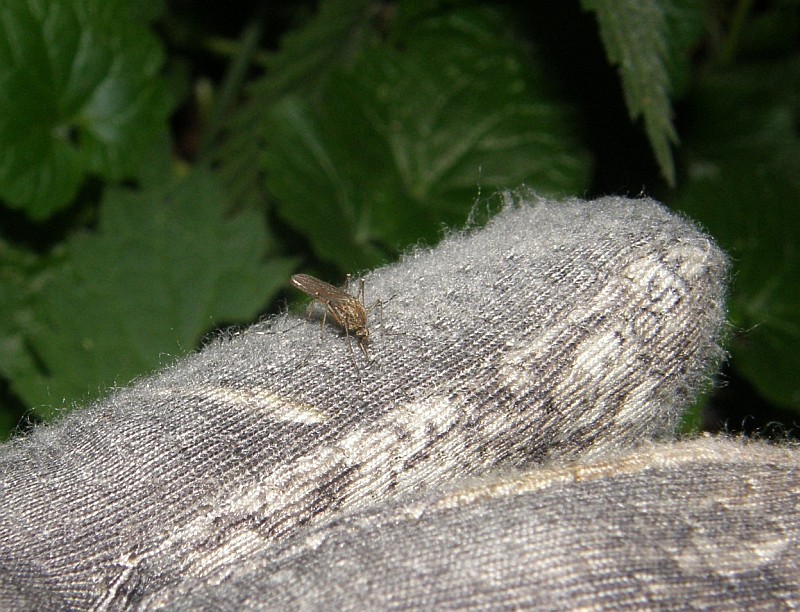
In a spirit of scientific recording (and having nothing else to do at the time) I photographed a mosquito biting me through my camouflage gloves.

Mosquito bitingAnd then I squished it.

At 8.16 a badger appeared from one of the visible holes.  It trotted quickly to the large latrine site and then hurried back underground.  By this time it was too dark for photographs.  At 8.30 another badger came out of another hole and did the same thing.  Ten minutes or so later, both badgers (or different ones) came out together.  There was still no real social behaviour: the badgers seemed distracted or on edge somehow.

At that moment the heavens opened with a downpour of epic monsoon proportions.  Both badgers disappeared underground, sensible beasts that they are.  I had no desire to stay in this sort of rain, so I left too.  At least there was no need for stealth – the noise of the rain drowned out any sounds I made.  I was feeling a little smug to be wearing my jacket but I still got soaked.  The footpath goes through a field of oilseed rape, which is chest-high and flopping over the path.  You don’t so much walk along the path as swim through the rape.  After the downpour it was like walking through a huge, green, soaking scrubbing-brush.  Soaked to the skin from the waist down I plodded home as the thunder rumbled overhead.  Never mind – I’m a rough, tough badger watcher and I can cope with getting a little wet.  Besides, it’s probably time my badger watching clothes got a good wash…

*In British colonial times, officials in India and Africa were issued with canvas ‘mosquito boots’ for just this purpose.  Perhaps I’ll see if they’re still made anywhere.

Read Full Post »

Today was the day of the long-awaited first England game of the World Cup.  All over the country, people have been putting flags on their cars, buying HD televisions and stocking up with crates of lager.  After weeks of anticipation, England faced the US this evening and everything else came to a standstill.

I’ve never much cared about football myself.  Don’t get me wrong, I’d like England to win – I’m as patriotic as the next chap – I just have other things to do instead.  Most people think I’m mad for doing what I do.  Fair enough.  I think they’re mad for getting so worked up over a game.  Let’s just agree to disagree.

The weather was warm and clear, so while everyone else was glued to their TV sets, I walked through our eerily deserted village for an evening of lurking in the woods.  My badger watching has not been very successful this season, so I was pleased when a badger came out of one of the middle holes at 8.02pm.  It disappeared underground fairly soon after though.

At 8.16 another badger came out of one of the western holes, and again went back fairly quickly.  I don’t think I disturbed them. There was very little wind, and what there was, was in the right direction.  The badgers were just not interested in hanging around.

At 8.45 I saw the elder bushes in the centre part of the eastern end of the sett shaking and rustling.  Through the binoculars I could see another badger ambling around in the cover of the undergrowth.  Shortly after 9.00, the badger from the middle hole came out and headed off eastwards, followed a few minutes later by the one from the western hole.

It wasn’t a totally wasted evening.  I saw the badgers (or some of them, at least) and I know that they’re active in all parts of the sett.  But I still haven’t seen any cubs yet, and I haven’t seen any real social behaviour from the badgers this year.  In previous years they would sit around and play and groom together, up to twelve badgers in a big group.  This year I’ve only seen individual badgers with very little interaction.  They may be doing it out of sight, or there may be something odd going on.  I don’t know.  I’m still trying to get to grips with the badgers.  In football terms, let’s call the evening a draw.  Badgers 1 – BWM 1.

Read Full Post »

BadgerWatching badgers, in theory, should be quite simple.  All you need to do is to find an active sett and be there (suitably downwind and out of sight) when the badgers come out in the evening.  I’ve covered the first part – finding an active sett – in an earlier post (see How to Recognise a Badger Sett).  Now I’ll say a little about the second part – when the badgers come out of their sett.

Badgers are nocturnal: they sleep during the day and are active at night.  They emerge from their sett in the evening to play, socialise and forage.  Unfortunately for the badger watcher they don’t come out at exactly the same time every evening.  They vary  the time of emergence from day-to-day and month to month.

Generally speaking, the time that badgers come out is governed by the time of sunset, earlier in winter and later in summer.  It is a little more complicated than this though, as they will often emerge while it is still light.  Badgers need enough time to find food, so during the summer when nights are short they will come out before the sun has set to give them sufficient foraging time.  In winter, when the nights are longer and the badgers are less active, they will emerge well after dark.

There are other factors that affect the time of emergence though.  Neal and Cheeseman, in the classic book Badgers, list a number of these. For example, badgers will come out later when there is more light.  Those in a sett that catches the light of the setting sun may well emerge later than those in a sett that is in shadow.  Nights when there is a bright moon may also mean the badgers come out later.

Weather plays a role too.  Badgers may come out later in strong wind or heavy rain, probably because they cannot detect danger as well in these conditions and they feel less secure.  Linked to weather is the availability of food: damp nights are better for catching worms so the badgers may come out earlier to feed.  On the other hand, a prolonged dry spell may also see them coming out earlier as they are under pressure to find food and need to spend longer foraging.  The same may be true of sows with cubs, who according to Neal and Cheeseman are often the first to leave the sett in the evening, presumably to get as much food as possible.  Lastly, human disturbance may keep the badgers underground for longer.  Setts that are subject to regular human activity tend to emerge later.

All of this means that whilst it is possible to estimate the general time that the badgers will emerge, predicting the precise time is much more difficult.

Here’s where this blog comes in.  The  main reason for writing this blog is to provide a journal for my experiences, to record details that hopefully will prove useful at some point in the future.  Since the beginning, one of the things I have been careful to record is the time that the badgers emerge from the sett.  My hope was that by keeping track of these I’d be able to find a pattern and be able to predict their movements much more accurately.  I’ve now had a chance to look back through the archives from the last two years and plot a graph of badger emergence times at different times of year.

Each point on the graph represents a time when the first badger emerged from the sett.  To show how this varies across the year I have split the graph into half-months.  I obviously don’t do enough badger watching before April and after August!
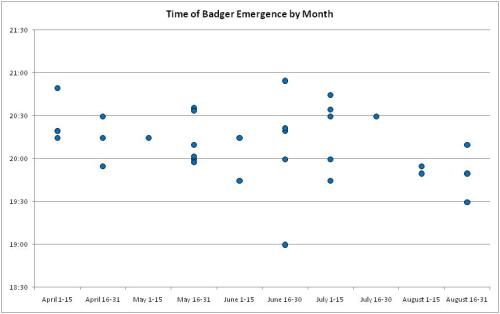
Time when badgers come out of the sett

The first thing to notice is that there is a wide range of times in each month, so there is a lot of variation in times of emergence.  In June, for instance, the badgers have come out as early as 7.00pm and as late as nearly 9.00pm.  The 7.00pm event may have been an anomaly – it was an undersized cub that acted strangely – but there’s still a big variation.

The data set for the graph is statistically too small to support firm conclusions, but it still helps to build a picture of emergence.  For instance, it does seem that the badgers come out slightly later in May and June than they do in August.  The graph also shows that in almost all cases the badgers emerged after 7.30pm and usually around 8.00pm, so it does at least allow me to judge the time I need to arrive at the sett.

Neal and Cheeseman have a much better graph in their book, based on hundreds of observations.  Anyone interested in the subject would be well advised to have a look at it.  Nevertheless, I’m quite proud of this little graph of mine.  It’s based on my own fieldwork and the records I’ve kept of my own experiences.  If you are thinking of going to watch badgers I hope it is of some use to you in planning your visits.

Read Full Post »