 What does a badger sett look like? Every now and then someone asks me this question, so it’s about time that I tried to answer it properly. This is my guide to badger setts and what to look for. I have hesitated a little before writing this. After all, badgers are still persecuted in some parts of the country, and I don’t want to make it any easier for someone with bad intentions to find badger setts. On the other hand, the more people that know about the badgers in their area the better. If people are aware of their local setts then they can keep an eye on them, and besides, badgers have been a source of pleasure for me and I’d like to share the experience with other people if I can.
I’ve illustrated this post with pictures taken on a walk this afternoon. This is a good time of year to go out and look for badger setts. The badgers are active and the vegetation has not yet grown up. Believe me, trying to find badger setts in head-high nettles is a daunting prospect.
The first step to identifying a badger sett is to find a likely area where they might be living. Badgers are surprisingly widespread and they have a fantastic ability to live under people’s noses and yet remain out of sight, so don’t rule out any patch of countryside. They do have certain preferences though, and to narrow down the search you have to understand a little about their habits and lifestyle. It helps to be able to think like a badger!
People think of badgers as woodland creatures, and it’s true, they mostly do live in woods and that is where to look for them. But they don’t spend all their time there. In the UK, the main food of the badger is the earthworm, and the best place to catch earthworms is on short grass – ideally grass that has been grazed by livestock. So the best place to find badgers is in woodland that borders on grassy fields. They live in the wood and that gives them shelter and security; and they can feed in the fields.
But not all woodlands are good for badgers. Badgers live underground, so they need somewhere suitable for digging. Damp, marshy ground is definitely out and anywhere that is liable to flood (such as river valleys) is usually avoided. In my part of Bedfordshire the badgers prefer the nice, dry sandy soil, but they also seem quite happy in clay. Badgers definitely seem to prefer a sloping site rather than a very flat one. This might be the slope of a hill, the side of a disused quarry or even a large hedgerow bank. They like anywhere where they can tunnel in sideways rather than straight down. I suppose that it is easier to dig, easier to shift the soil, better drained and presumably easier for them to walk out of a horizontal hole rather than climb out of a vertical one.
So we are looking for a piece of woodland with sloping ground with grassy fields nearby. Should we now go into the wood and start looking for holes? Well no. Not yet.
Badgers will cover a territory with a radius of 300-500m from their sett. This means that there will often be many signs of badgers in the general area of the sett. Finding these can give you confidence that there are badgers in the vicinity and help to narrow down your search. Fortunately badgers are creatures of habit and leave some regular indications of their presence.
If you’re walking through pasture fields, keep a lookout for badger paths, snuffle holes and dung pits. Badgers travel on paths whenever possible (see Why do badgers use paths?) and over time these paths can be quite pronounced. If I recall, Pablo even managed to identify badger paths from satellite photographs on Google maps. I’ve tried this myself, and it really is possible.
Here is a series of paths over the pasture field. The trouble with paths is that you never really know who makes them, whether it is badgers or another animal (humans being another obvious cause). In this case I have tracked badgers across this field when there has been snow on the ground and they consistently follow these paths.
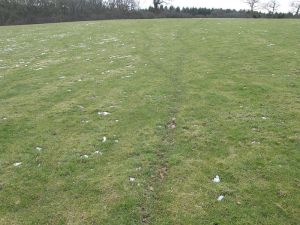 Here’s another example. In this case the path crosses the field and then goes under a fence. This means that it cannot have been made by humans, livestock or deer. Other animals such as rabbits will make regular runs, but if you see a deep path like this, start suspecting badgers.
 Incidentally, if you ever come across a path under a fence, check the bottom strand of wire to see if any hairs have been caught. This can give you a positive i.d. of the animal that made the path. Badger hairs are grey or black and have a squarish cross section. When you roll a badger hair between your fingers it feels irregular rather than round.
Snuffle holes are the holes made by badgers digging for food. They are a good sign of badger activity, but other animals can leave similar holes and cause confusion. Rabbits will often dig shallow scrapes, but rabbit scrapes are usually oval whilst badger snuffle holes are more conical.
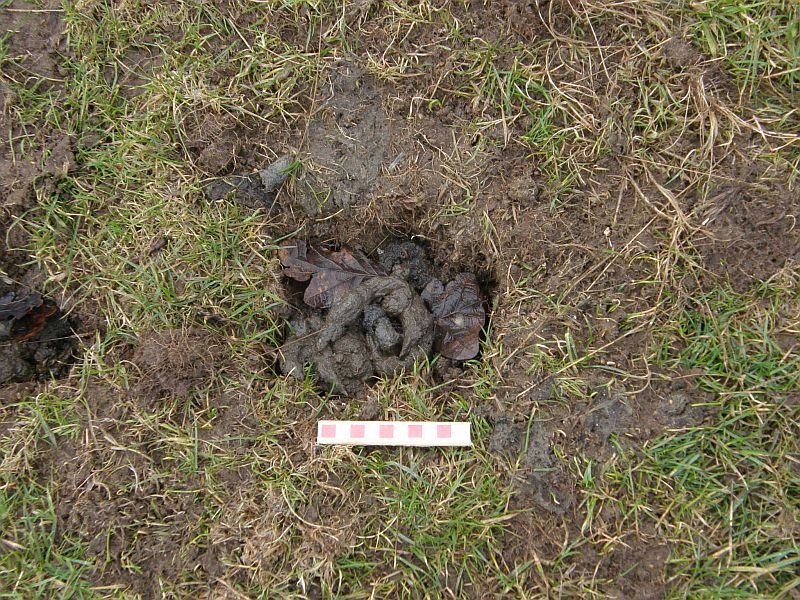
 Dung pits are a particular feature of badger territories. Badgers do not deposit their dung just anywhere, they use special pits. Badgers use dung as a territory marker, so you will often find dung pits on badger paths around the edge of their territory. Dung pits look very much like snuffle holes, but with dung in them.
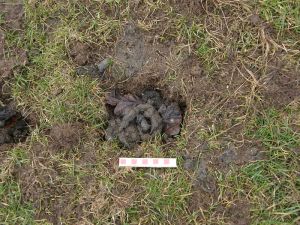 Badger dung is usually a dark greyish-green, which shows that they have been feeding on earthworms. Badgers will cheerfully eat many other things too, so it is always interesting to inspect the dung pits and see what they have been feeding on. Here’s the dung of badger that seems to have been gorging on cherries (I have no idea where it got them in February!)
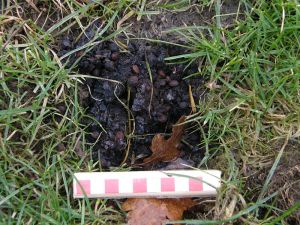 Where the territories of two badger clans meet the dung pits can be quite extensive as each side marks its territory. Here’s a large latrine with many pits that badgers have somewhat inconsiderately dug into a main footpath in the wood.
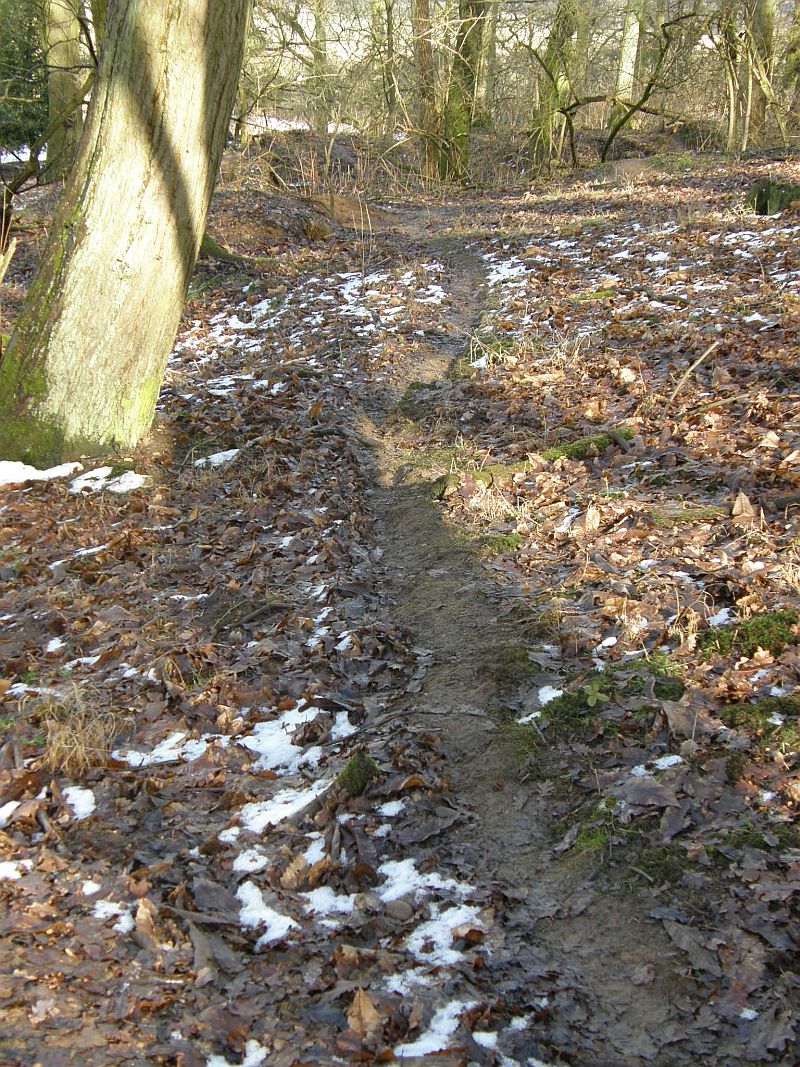
 Signs like these tell you that there are badgers in the area and that they are active. Now you can start to look through the wood and try to find their sett. Rather than looking at random, there are a couple of things that will help you. Remember that badgers prefer a slope, so concentrate on areas of sloping ground, particularly on the outskirts of the wood. The other thing you can do is look for paths and follow them. Sooner or later a path will lead you to a sett. It can be great fun to try to follow paths, as they usually twist and turn through the wood, sometimes clear and obvious, other times fading out altogether. A frustrating but fun way to spend an afternoon.
Here’s a particularly clear badger path. Note how generations of badgers have worn a deep path into the soil.

One way to tell that you are following a badger path is to look for tracks – often a difficult challenge in a wood. Alternatively, here’s something you might see. The path goes over a fallen tree and badgers have left clear claw marks as they climbed over.

So what does an actual badger sett look like? The obvious thing to look for is holes in the ground. Depending on the size of the sett there may be anything between a single hole and twenty holes spread over a hundred yards or so. Many animals live in holes, but there are some features of badger setts to look out for.
Badger setts are very extensive underground. Some have up to 300m of tunnels – far more than rabbits or foxes. The badgers have to shift a lot of soil, and this means that badger setts usually have substantial spoil heaps outside. Over time these spoil heaps can literally change the shape of the landscape, creating large shelves or platforms outside the holes. The main sett that I watch is obviously an old one, as the whole area is pock-marked by holes and hummocks so that it resembles a First World War battlefield. Active setts are easy to spot because there will usually be fresh spoil outside. Badgers are compulsive diggers, and although much digging is done in spring before the cubs arrive, they will tend to dig all year round. Here is an entrance to a sett. Notice the large spoil heap and the obvious path coming in from the right.
 The spoil heaps will often contain dried grass or bracken that the badgers had dragged in as bedding and then subsequently cleared out at a later date. In my experience this happens when they are preparing an old chamber for re-use, for instance when preparing for cubs.
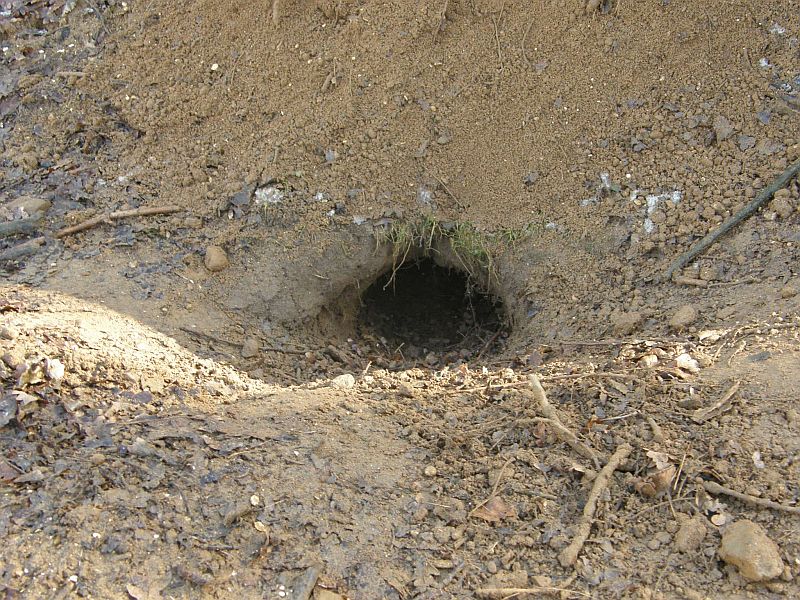
The actual holes of a badger sett have a characteristic shape, usually referred to as a sideways D. The key feature is that they are broader than they are tall. This makes sense if you think of the shape of a badger – fairly wide and low-slung. Rabbit holes, by contrast, are an oval shape that looks like an O. Here is a classic badger sett entrance that shows the typical shape.
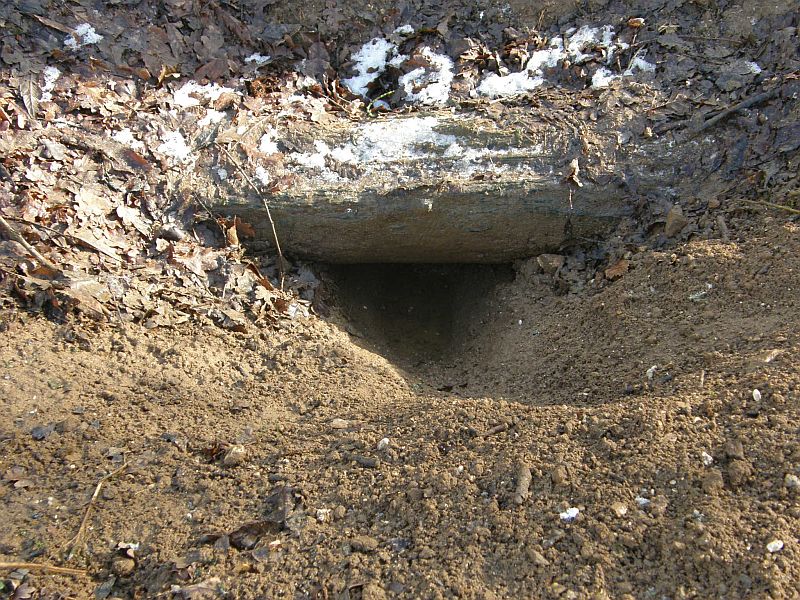
 Here’s another sett entrance where the badgers have dug under a fallen tree, either by accident or on purpose, creating a nice sturdy lintel. There are a couple of holes under trees like this at this sett, which makes me wonder whether it is a deliberate choice. I’ve also seen a few setts that are in the roots at the base of a large tree. Again, this gives the badgers the protection of a wooden roof, at least for the entrance to the sett. Perhaps this is a widespread design feature.
 Again, notice that the hole is still wider than it is tall.
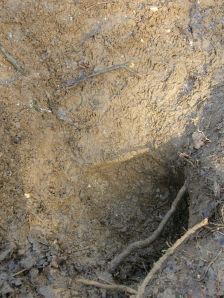
Active holes will show signs of recent digging, but if you are lucky you can find badger tracks at the entrance to a sett. This is the best evidence you can get that the hole is inhabited by a badger. Note the mass of tracks at this hole, suggesting that a number of badgers are present.
 Lastly, have a look around the immediate area of the sett. Badgers will have a main latrine site nearby – like the dung pits on the edge of their territory but larger and more concentrated. At many setts there will be patches of leaf mould that have been dug up and scuffled about as the badgers look for food. There will often also be clear patches where the soil has been worn smooth. These are ‘play areas’ where the badgers congregate, play and groom each other. Sometimes there may be ‘play trees’ – tree stumps or fallen trees that the badgers climb and play over. These are sometimes worn smooth too – the result of whole generations of badgers using them as a playground.
So now you know what to look for. Look for the right sort of habitat – woodland near pasture, ideally with sloping ground. Look out for the peripheral signs of badger activity – paths, dung pits and snuffle holes. Through a combination of following paths and sensibly interpreting the landscape you will hopefully be able to find the sett and confirm that there are badgers in residence. Of course, the best way to tell whether there are badgers present is to actually see one of the beasts, so once you have identified an active sett you can sit up and watch. And that’s where it really starts to get interesting.
Good luck finding badger setts, and good luck watching!
Read Full Post »











 Tales from the Wood - The Diary of a Badger Watching Man