Feeds:
Posts
Comments

Archive for January, 2010

First signs of Spring

First snowdrops of springDespite the freezing temperatures and the occasional snow flurries this weekend, there are signs that the winter won’t last forever and that spring is round the corner.

The first snowdrops have appeared at the edges of the woods and are peeping out from the frosty ground.   The first of the spring flowers, they are taking full advantage of the light that’s available on the woodland floor before the foliage of the trees and shrubs develops later in the year and puts them in shade.

We’ve also had the first eggs from the chickens this week (Monday, to be precise).  Chicken egg-laying is determined by light, not temperature, so the days are obviously getting long enough to stimulate them out of their winter break.

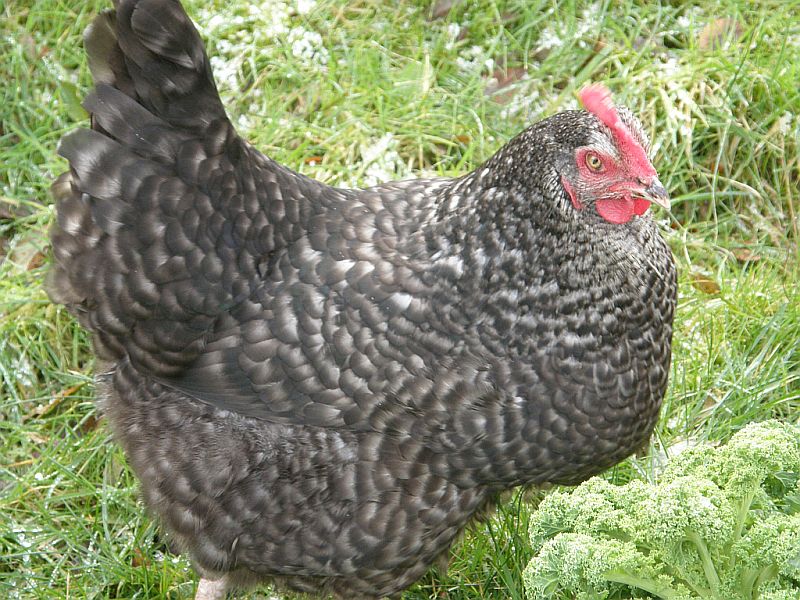
To celebrate, here is a wholly gratuitous picture of a chicken.  Meet Clarissa, everyone.

Read Full Post »

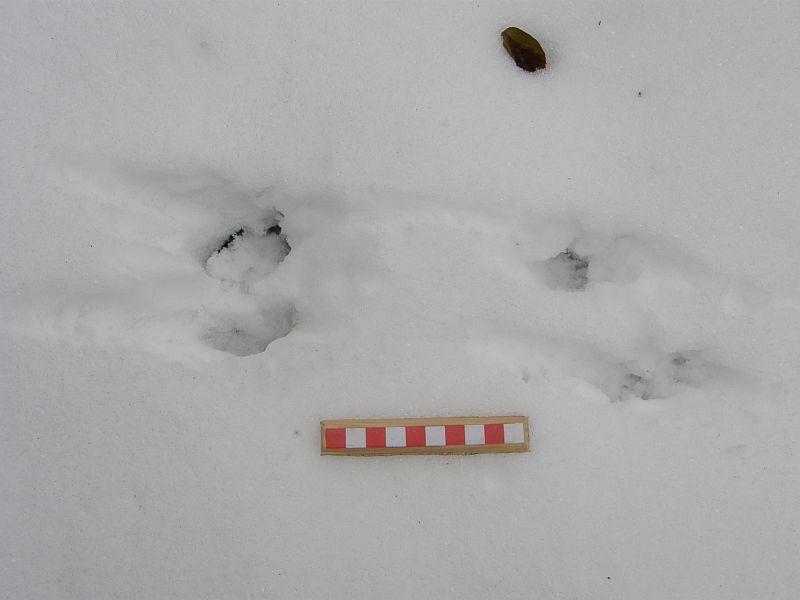
The weekend before last I went out into the snow, and amongst the tracks were a set that puzzled me.  The gait was very like a rabbit or a squirrel – a bounding gait with all four paws together in a group.  The size as very small though – bigger than a mouse (and a mouse wouldn’t bound) and yet much smaller than a rabbit or even a squirrel.

I have been consulting the guidebooks and I think I have a suspect.  Bang and Dahlstrom’s Animal Tracks and Signs has this to say about stoat tracks “Walking prints are very rare, as they move exclusively by jumping.  On reasonably hard ground, such as solid snow, the tracks in jump groups may be four and four, often similar to a small hare.”   The Hamlyn Guide to Animal Tracks, Trails and Signs, adds that the stride length for a bounding stoat is typically 30cm.  Weasel tracks are smaller with a stride of 25-30cm.

Tentative stoat tracks in snow

Tentative stoat tracks in snow

The stride length of my tracks is about 20cm, so a little short, but otherwise the size and gait fits a stoat or weasel.  I can’t find anything else that fits the tracks, so at the moment I’m settling for stoat or weasel as a tentative i.d.

This is exciting stuff.  I have a thing about stoats (and weasels).  I’ve only ever seen these secretive little mustelids a few times, and any evidence that they’re at large in the area is good news for me.

I must be the only person in Britain at the moment wishing for more snow so that I can go and look for more tracks…

Read Full Post »

Alder tree by the brookThe snow has finally melted.  Today has been a balmy 7 degrees and beautifully sunny.  It may not sound very warm, but compared to the past weeks when the temperature didn’t rise above freezing for days on end it feels positively spring-like.  I took advantage and headed out for a stroll in the (slightly soggy) countryside.

I had no particular aim in mind, but with a vague idea of looking at the birds I headed over to the lake.  I don’t go there very often, but there is always the chance of visiting waterfowl.  As it happened the lake was still iced over with not a bird in sight, but the hedges were alive with blue tits, great tits, chaffinches and sparrows.   My personal favourites were a flock of long-tailed tits working their way through the trees.  These are delightful birds but absolutely impossible to photograph.  They are always on the move, flitting about from branch to branch as they forage, never staying in one place for long.  One of these days I’ll be in the right place and get a picture as they travel past.

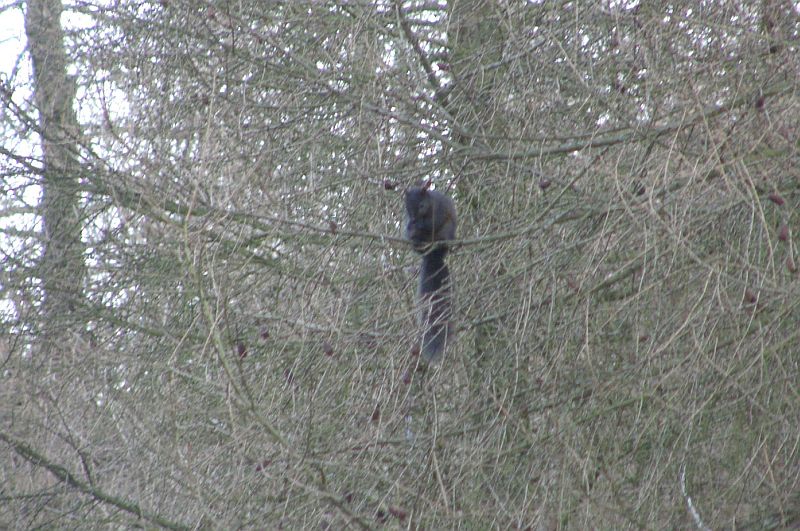
Talking of ambitions, there is one animal that I’ve been quietly trying to photograph for a while now, and that is the black squirrel.  The black squirrel is the melanistic (black) version of the common grey squirrel.  There are populations of black squirrels in a number of places around the country, and some experts believe that the black coat is genetically dominant and will eventually replace the ordinary grey colour.  This hasn’t happened yet, or shown any signs of doing so, so black squirrels are still fairly uncommon.

There is a known population of black squirrels centred on Woburn in Bedfordshire.  I’ve only seen one once before, and it was very striking – a squirrel, but with a black coat.  Ever since then I’ve wanted to get a picture of one.  Today, I got my chance.

Black Squirrel

The almost legendary Black Squirrel of Woburn

Unfortunately the squirrel was quite distant so it was at the very limit of my camera zoom, but it is unmistakeably a black squirrel. I feel a little bit like those people who photograph Bigfoot, only to get home and find the picture only shows a dark blur in the distance, but at least I know it was there.

Black Squirrel

NOT a Bigfoot, but a black squirrel...

I walked home along the brook.  Halfway down I came across a clear animal path running from an old, disused little quarry into the fields.  Now, this looked to me like a classic badger path.  The old quarry was a perfect spot for a badger sett – they love places like this where they can dig sideways into the side of a bank, and the soil is usually dry and well-drained.  There were signs of digging and spoil heaps in the quarry, so something was burrowing there.  In short, it looked exactly like a badger path, except it ran across a 6″ deep fast-flowing brook.

Brook crossed by a badger path

The brook crossed by a badger(?) path

Could this really be a badger path?  Would the badgers really wade across the brook every night to get to the fields?  There were no really conclusive tracks so it is difficult to be sure either way.  Something had made the path, but I don’t know what.  Since the brook is close to my house it looks like an ideal place to make a track trap – to spread some sand and see what tracks I can get.  If it is a badger path then I’ll be back in the summer to see if I can stake it out and get a picture of an aquatic badger.  Remember, you heard it here first!

Read Full Post »

I’ve been away for a while with work, so I’m late catching up with my correspondence.  Sheila, Rick and Mrs B – thank you for your comments and apologies for being so slow in replying.  I always enjoy hearing about other people’s experiences, so please keep them coming.

Somewhat accidentally, I now have an international perspective to the blog.  Steve has been kind enough to send pictures from the New York/New Jersey border.  He found the tracks after sighting a fox near his house.

Mystery Snow Tracks

Mystery Snow Tracks

The problem is, they don’t look like fox tracks to me, at least not the familiar British fox tracks.   Fox tracks are small and neat and diamond-shaped.  These are hand-shaped.

I’m not an expert on North American wildlife, but the closest match I can find in the guidebooks is Raccoon tracks.  Does this make sense?  Do you get Raccoons in northern New Jersey?  Do they walk around people’s houses?

This is just my best guess.  If anyone has any other ideas, please do let me know.

Read Full Post »

For the past week the country has been gripped in a little ice age.  An area of high pressure has settled over Britain, trapping cold air and snow, blocking out the prevailing warm south-westerly winds.  Temperatures as low as -20c have been recorded (my family in Cheshire experienced -14c) coupled with up to a foot of snow.  Predictably, the whole country has ground to a frozen halt.

Personally, the only problem I have with the snow is that I haven’t had enough time to go out and play in it.  Unlike this time last year (see Fieldnotes: 4th-10th January 2009), I’m limited by work and family commitments.  It’s one thing to go out and freeze myself following badger tracks in the snow.  It’s another thing entirely to do it while carrying a five month old baby!  Back in the old days I’d have packed up a tent and sleeping bag and headed out into the woods, just for the challenge of it.  Can’t really justify that now.

Nevertheless, today I drew upon Mid-Bedfordshire’s tradition of polar exploration (there is one, honestly) and went out into the snow to see what is happening.

Here’s some new tracks to have a look at.  These are squirrel tracks.  I watched the squirrel as it bobbed around in our garden and then went out to look at the tracks.  The pattern is similar to that of a rabbit – the same bounding gait – but smaller.

Squirrel Tracks in Snow

Squirrel Tracks in Snow

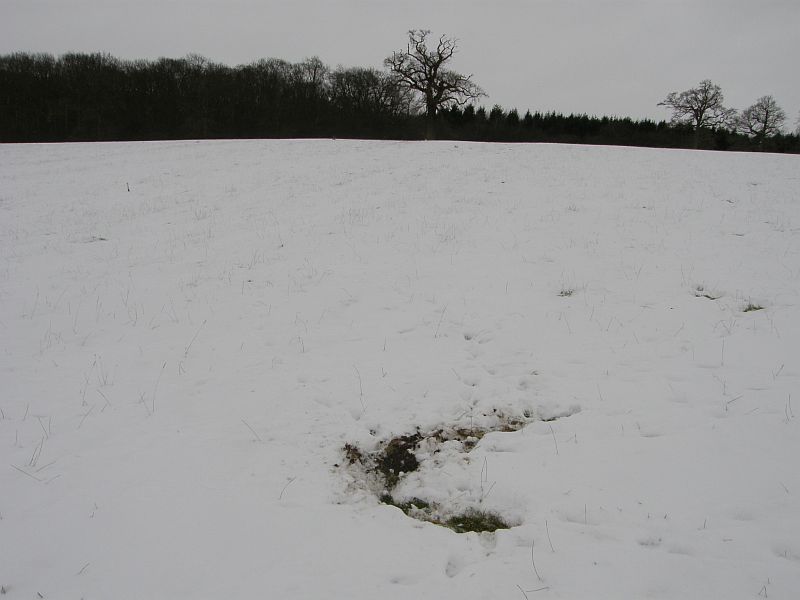
I walked on up to the pasture field to look for evidence of the badgers.  The snow last year was a priceless help in deepening my understanding of badger habits and how the local territories interacted.  This year the picture was much more confused.  There was almost a weeks worth of tracks, of animals and humans, and recent falls of snow have complicated matters still further.  Nevertheless, it was possible to trace the movements of individual badgers.  Clearly visible were the patches where they had dug through the snow into the soil.  I couldn’t see any dung, so I assume it was for food.  Badgers don’t hibernate, but they do slow down.  It’s a useful thing to know that badgers will still come out and forage, even in these extreme weather conditions.
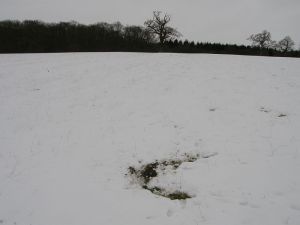
Badger Snuffle Hole in Snow

Badger Snuffle Hole in Snow

Inside the wood there was more evidence of badger activity.  I didn’t get to visit the sett itself (like I said, there is a limit to how far I’ll take my daughter in these conditions – sturdy girl though she is) but I did add a few more snippets to my badger map of the area.  The wood is criss-crossed by paths, but it is difficult to know for sure that they are badger paths. Very often the only tracks you’ll find on them are for deer.  Today, however, there were clear badger tracks, showing that these are indeed badger paths.  I’ve tried to follow them in the past, as I suspect they lead to the almost mythical ‘third sett’ in the area, but I’ve always lost the paths among the trees.  If the snow persists I’ll have the perfect chance to follow them to their source.
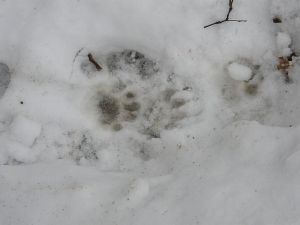
Badger Tracks in Snow

Badger Tracks in Snow

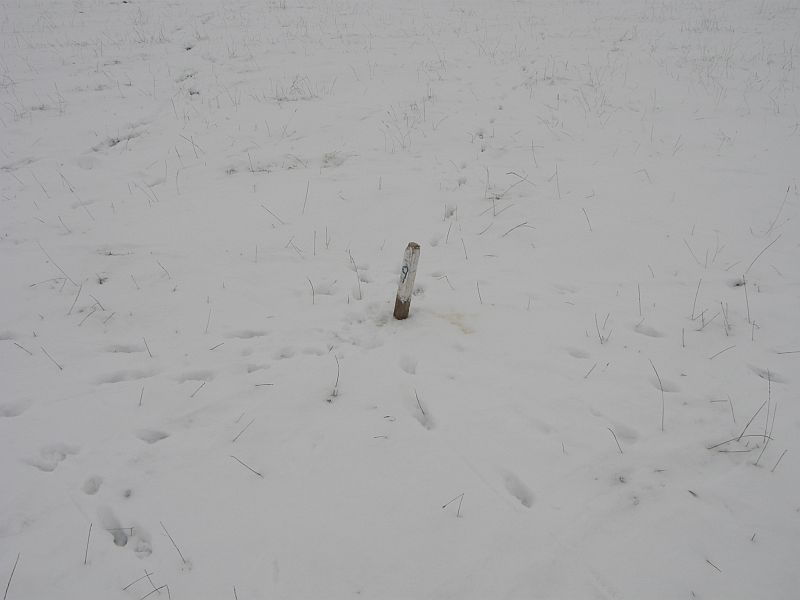
The snow told other stories too.  There were plenty of fox tracks in the field.  They all converged on a post where the foxes had obviously scent-marked.  Just like dogs, I guess.  It’s all part of the territory marking.  Foxes will tend to leave dung in exposed places such as tufts of grass for the same reason.  It’s a nice little insight into fox behaviour.
Fox Tracks and Scent-Marking Post

Fox Tracks and Scent-Marking Post

Lastly, here’s a bit of a mystery.  These tracks were in the middle of the field.  It’s a bounding gait again, with the tracks in groups of four like a rabbit or squirrel, but only a few centimetres across.  The individual prints were not visible in the snow, but the gait can be more revealing.  Something the size of a mouse would surely have burrowed under the snow, not bounded over it.  I’ll need to look this one up, but in the meantime any ideas are welcome.
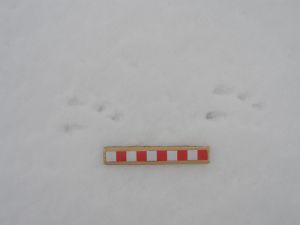
Unidentified Tracks in Snow

Unidentified Tracks in Snow

Hope you’re making the most of the snow too!

Read Full Post »