
Winter Oak
On Monday it snowed. We had about 4-6 inches of snow, but it was enough to paralyse the whole of the UK. Everything ground to a halt – the roads jammed up or closed, the trains were cancelled, and even the London buses stopped running for the first time ever.
I woke up at 5.30am as usual, saw the snow and decided to work from home, which I’m luckily able to do. But once again my thoughts were on tracking, with visions of following badger trails across the pristine fields of snow. By 9.30 in the evening I’d got dressed up and slipped out into the freezing night.
You may think that I’m eccentric for going out in the middle of the night during the worst snow the UK has seen for 18 years. You may find it difficult to understand my excitement and wonder why I didn’t sit by the fire in the warm like everyone else.
Let me explain. I’ve been watching badgers for three years now, and I’ve got closer to them than most people ever do. I’ve sat by their setts and watched them come out in the evening, and I’m starting to understand their behaviour.
But there’s a whole big part of the badgers’ life that I know very little about. Every evening they leave the sett and spend the night foraging. I’ve caught brief glimpses of them as they range about their territory, but the truth is that it’s still a mystery to me.
Tracking has helped me fill in some of the blanks. An animal’s tracks are an enduring record of its movements, so they help you to piece together its activities. As well as being a fascinating pastime in its own right, tracking adds to my overall picture of badger behaviour.
But if tracking is like reading a book, then it’s a book with only one or two legible words on each page and most of the pages missing. You can only track in areas of soft ground, so most of the picture remains hidden.
But snow, now! Snow gives you the chance to see the whole picture, if only for a night. Imagine spending months and years trying to understand a book from a few isolated words, and then imagine having the chance to see the whole story, page after glorious page. Given the chance, wouldn’t you want to get out there for a look? Isn’t that worth a walk on a snowy night?
So – out into the cold night I went. Actually, it wasn’t too bad. Because of the snow it was light enough to see without a torch, and it was exhilarating to be out when the rest of the world was tucked up in bed.
When I got to the pasture field, it was everything I had hoped for. There were tracks of rabbits, and a fox, and some people with a sledge; but there amongst them were the clear tracks of badgers, no more than an hour or two old.
Thinking about it afterwards, Monday night reflected my development as a tracker. When I first started tracking, I was excited to find tracks and identify the animals that made them. So it was on Monday, and I was delighted to find clear badger tracks in the snow.
Here’s a badger forepaw – note the claws, the big pad and the toes like peas in a pod:

Track of badger's forepaw - note the claws
Here’s a badger track as you often find them, showing the rear foot superimposed on the front one:

Badger tracks showing registration
But recognising tracks is only the first part of learning to track. The interesting thing is using the tracks to tell you about the behaviour of the animal. I spent two hours in the field, following the tracks of four different badgers. This was a priceless experience – for the first time I was able to get a real understanding of their movements. I could see where they had dug into the snow for food:

Following the badger as it foraged
I could even see where they relieved themselves:
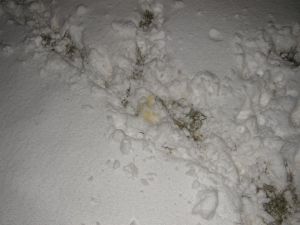
Badger urine (makes a change from pictures of dung!)
Mind you, with badgers nothing is simple. This is just as likely to be scent marking as anything else (see my post on why badgers use paths for more details).
The next level of tracking is not just understanding the individual animals, but understanding how they interact with each other and with their environment. I followed the tracks of each badger as they meandered across the field, but where the tracks crossed an interesting thing happened. You could clearly see where the second badger had come across the tracks of the first – it would double back or walk in parallel for a short distance. This happened on every occasion the tracks crossed, so the badgers were obviously aware of each other, presumably by scent, and checked out each others’ tracks.
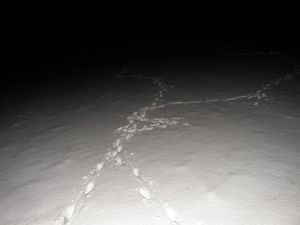
Badger tracks interacting
It was absolutely fascinating to see how the different trails interacted. At one point in the field the tracks of four different badgers converged. One of these trails came out of the wood, went to this very spot, turned round and went back again. This cannot be coincidence – this was obviously an illustration of some badger behaviour I don’t yet understand.

Four badger trails converging
Wandering around a snow-covered field in the middle of the night with a torch is probably not everyone’s idea of a good time, but I thoroughly enjoyed myself. I learnt more about the foraging activities of my badgers than I have done in years. I learnt about the routes they took and the way in which they interact. By following the tracks I’ve revised my ideas about the size of their territory (bigger than I suspected) and the boundary markers they use.
Two hours went by quickly, and then it was time for bed. While the rest of the country ground to a halt, I had a wonderful evening of tracking. Like I always say, this sort of thing is out there for anyone willing to take a look.
Read Full Post »








 Tales from the Wood - The Diary of a Badger Watching Man