Feeds:
Posts
Comments

Archive for October, 2008

More Sparrowhawks

In my post of the 20th October I predicted that having seen one one Sparrowhawk, I’d soon see more.

Well, I was driving through the village a couple of days ago and I saw another.  It flew out of a small wood and along the road, so I had a good view of it.

Two years of wanting to see a Sparrowhawk, and then I see two in less than two weeks!  It really is strange how this happens…

Read Full Post »

The Grim Tithe – Part 2

Another badger was killed on the road yesterday, about a mile away from my house in a small wood.  There must be another sett around there.  A couple of years ago there was another badger killed in almost the same spot, and my wife has had badgers run across the road in front of her there.  There must be a fairly active sett nearby.

I told you this was a bad time of year for road casualties…

Read Full Post »

Autumn dawn

Autumn dawn

A couple of days ago I saw my first Sparrowhawk.  I’ve been looking out for Sparrowhawks for a while now.  I know they’re found in my area, and I know the habitat around our village is perfect for them.  I’ve got friends who regard them almost as pests as they prey on the birds attracted to their bird tables.  I’m not a twitcher by any means – I don’t have list of birds to tick off – but I’ve got a thing about birds of prey and I’ve wanted to see a sparrowhawk.

The irony is, that after countless hours spent in the fields and woods, I saw my first Sparrowhawk sitting on the top of a lamppost on the outskirts of our local town, Bletchley.

In a way it was a little disappointing, but it’s got me thinking about urban wildlife in general and how resilient nature is.  After all, many species are adapting and living alongside man. When I lived in London I had dozens of urban foxes in my garden, but here in the country I’ve only seen a handful.  There are urban badgers in some places, and even reports of urban otters.  And what about the pigeons?  How many people have seen a proper wild Rock Dove, compared to the millions who see urban pigeons every day?  Not to mention the colonies of wild budgies living in South London.

I suppose it is all rather encouraging.  Although the urban landscape is spreading, the wildlife is adapting.  Sure, there are probably as many losers as winners, but it is adapting nonetheless.  The first Red Kite I ever saw was on a bleak mountain in a spectacularly remote part of Wales, four or five hours walk from the nearest road or house.  The last Red Kite I saw was over a dual carriageway off the Oxford ring road.  Perhaps you can’t compare the two experiences, but I’m glad to see the Red Kites flourishing in all areas.

Hopefully I’ll now see more Sparrowhawks, in more aesthetically pleasing surroundings.  I’ve noticed that once you’ve seen one example of a particular bird, or animal, or plant, you tend to see more.  Take Buzzards for example.  When we moved to the village I was convinced that it was the right environment for Buzzards.  I spent hours staring distractedly at the sky hoping to see one, yet it took me two years before I finally got my first sighting.  Now, of course, I see and hear them all the time.  I can take you to four or five spots that each have their own local Buzzard, all within walking distance of my house.

Did my village suddenly get overrun with Buzzards two years ago?  Of course not.  I think what happened was that I became more tuned in to the Buzzards.  Once my ‘Buzzard-sense’ had developed it allowed me to see them much more easily.  The same thing is happening now as I learn to track mammals.  I am seeing vole runs and badger latrines that I must have walked past a hundred times without realising, but now I’m tuned in they stand out clearly.

If there is a meaning to this story, I guess it’s that you should be aware of your local environment.  It’s fine to dash around to new places looking for new wildlife, but spending time getting tuned in pays dividends in the long run.

Here’s to more Sparrowhawks, whether they be urban or rural!

Read Full Post »

Things have been busy at work and home lately, and with the nights drawing in it has meant that I’ve had less time for wildlife.  Nevertheless, there was one spectacle I had no intention of missing, and that was the Red Deer rut.

Red Deer Stag

Red Deer Stag

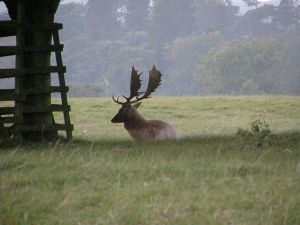
Last Sunday I took a trip to Woburn Abbey, our nearest deer park.  You may think it’s cheating, watching the deer in a park instead of in the wild, but as an experience it was hard to beat.

The good thing about the deer park at Woburn is that it is criss-crossed by public footpaths.  If the Duke of Bedford should ever read this, I’d like to say thanks for this generous and far-sighted move.  It means that you can get close to the deer and also walk through the park in the afternoon when it is quiet.  Whilst the deer are by no means tame, they are habituated to people to a degree, so they are not as shy as their wild cousins.

This was the first time I’d spent any length of time in the park during the rut (I’ve been trail running through it during the rut before, but that’s a different story) and the experience was absolutely fantastic.  I deliberately went in the late afternoon, so I had the park pretty much to myself.  Even as I walked up to the gates I could hear the Red Deer stags bellowing.  The stags had spaced themselves out around the park and were calling to attract mates and challenge other stags.

Red Deer stags are truly impressive beasts.  With a full set of antlers, and charged up on testosterone, they seem even bigger than they really are.  The still evening air was full of bellows and grunts, giving an unreal and almost prehistoric feel to the situation.  They may have been park deer, but this evening they were as wild as any others.

Fallow stag at Woburn

Fallow stag at Woburn

I stuck firmly to the paths and gave the stags as wide a berth as possible.  My second-worst fear was that they would somehow mistake me for another male deer and take offence.  I was carrying a walking stick, but I doubt it would help in a fight, and I wouldn’t want to be on the wrong end of those antlers.  I’ve seen the stags when they clash antlers, and it’s incredibly fast and ferocious.

My very worst fear was that they would somehow mistake me for a female deer…

In all, I spent a couple of hours in the park.  Like I said, it was an incredible experience, and I’d whole-heartedly recommend a trip to Woburn for anyone.  Make the effort and get out of your car and you’ll be amply rewarded.  I’ll certainly be a regular visitor over the winter months.

Chinese Water Deer

Chinese Water Deer

In passing, Woburn is the home to many other species of deer, including the odd-looking Pere David’s Deer, now extinct in their native China.  Another deer from that part of the world is the Chinese Water Deer.  I mentioned these a couple of posts ago.  Like the Muntjac they were originally brought to Britain by the Duke of Bedford and subsequently escaped and bred in the wild.  To make up for not getting a photo of a wild one, here’s one from the park.  Note the large canine teeth.  Even so, these little deer are much cuter (and far less intimidating) than rutting Red Deer.

Read Full Post »

The Grim Tithe

Newborough Forest, Anglesey

Newborough Forest, Anglesey

As I write this it’s blowing a gale outside, with squalls of cold rain gusting about.  I was supposed to be harvesting the last of my potatoes today, but I’ve retreated in the face of the weather and the hope that tomorrow will be better.

It is odd to think that two weeks ago I was sitting on a beach basking in the sunshine, and even more remarkable when that beach was in North Wales.  It was a very pleasant holiday – lots of fishing, walking and generally taking things easy.

The elusive red squirrels, alas, eluded me.  I spent a couple of days walking around Newborough forest, and though there was plenty of sign in the form of gnawed pine cones, the squirrels themselves were nowhere to be seen.  Still, it gives me an excuse to go back there.

Back home, there’s sad news for me.  A badger was killed this week on the main road, about a quarter of a mile from my house.  This is not one of ‘my’ badgers, or at least it isn’t from the sett that I watch – that’s on the other side of the village.  It is however in the area where I take my regular tracking walks, and may even be the badger that I’ve tracked in the field behind my house.

Road accidents account for a large proportion of badger deaths; they are possibly the biggest cause of death.  Every year there is a grim toll of casualties.  Unfortunately, badgers seem to have little road sense.  I’ve twice had badgers run across the road in front of my car, and both times they’ve dashed across without even seeming to look.

Since I moved here five years ago I’ve seen three dead badgers by the side of the roads in this area.  The accidents all seem to occur at this time of year.  I think that as the nights get longer, the badger’s routines come into conflict with those of humans.  During the summer, it gets light before anyone is up and about, so the badgers are safely home before the morning traffic starts.  Now the mornings are getting darker their paths are more likely to cross ours, with tragic results.

I took a walk down the road to have a look.  I get particularly annoyed when I walk along road verges, as they always seem to be littered with crisp packets, fast food wrappers and plastic bottles thrown away by the ignorant and vulgar motorists.  I can’t understand what makes people drive through the countryside tossing out crap from their car windows.  If I could only catch them in the act I’d learn them a lesson, believe me.

A sad end

A sad end

The dead badger was on the verge.  It is a sad end for such a creature, but then I can’t really blame anyone.  I drive a car and I drive down this road, so it could well have been me.  There was a badger path a little way off, so it seems like the badger was returning home after foraging when the accident happened.

I walked home along the route I use on my regular tracking walks, hoping to see fresh badger tracks that would prove that it wasn’t the badger I have been tracking lying there.  Unfortunately the wind and the rain had polished the sandy ground smooth, so there were no tracks at all to be seen.  I’ll have a look tomorrow, weather permitting, and see if any animals have been down there overnight.

Read Full Post »