Feeds:
Posts
Comments

Archive for August, 2008

Just to follow on from the last post, here’s another of the tracks I believe were made by a stoat.

I'm pretty sure it's a stoat track.  Scale in cm.

I'm pretty sure it's a stoat. Scale in cm.

This one was obviously made when the mud was very soft or even under water, as it lacks details of the claws etc. The shape, particularly of the rear pad, is very similar to the stoat tracks in the guidebooks. Of course, if anyone knows more, feel free to leave a comment.

Watch this space. I’ll see if I can get more after the next spell of wet weather. Shouldn’t have to wait too long…!

Read Full Post »

As an antidote to my increasingly desparate attempts to watch badgers, I’ve spent the afternoon having a gentle stroll around the area, tracking wildlife and picking blackberries.

Roe Deer track

Roe Deer track

I’m really getting into tracking at the moment. As well as being a fascinating activity in it’s own right, it offers a window into the movements of all sorts of wildlife. I’m still very much a beginner at tracking, but I’m finding it very rewarding. Tracking, I suppose, is a bit like reading. I’m at the stage where I can recognise individual tracks, or words, and I’m just starting to put them together into full sentences. A lot of the skill in tracking comes from looking, really looking, at the little details, and when you start to notice these, the picture starts to come into focus. A walk in the country becomes almost like reading a book of what the animals have been up to.

Let me give you an example. I’ve been able to recognise badger tracks for years, but it’s only in the last couple of weeks that I realised that a badger regularly uses the path down the field behind my house. It walks down the path at the start of the night, and walks back up the path some time later on. It’s an adult badger, and it doesn’t run, it walks at a normal badger pace. I’ve never seen this badger, but I’ve tracked it enough times to know its routine.

Assorted tracks in the mud

Assorted tracks in the mud

The soil in the fields behind my house varies from clay at the bottom of the hill to pure sand at the top, so it’s an excellent place to learn about tracking. The clay soil dries hard, so the animals leave very little trace, but where it is damp it gives very clear prints. Today was dry, but there were pools of mud in the ruts left by a tractor. I spent a happy twenty minutes sitting looking at these.

It may seem like just a patch of mud, but if you spend time really looking, there is a story there waiting to be told – a time capsule of the comings and goings of the wildlife over the last 24 hours. In this one little patch there were the tracks of two Roe deer, several muntjac, a fox, and what I think is a stoat.

Readers of the blog may be aware of my long-standing desire to watch stoats in this area, and my utter lack of success in doing so. One of the reasons that I am so interested in tracking is because it may help me to get closer to these elusive animals, help me to understand the habits better and ultimately to allow me to watch them going about their business.

Like I say, I’m still a beginner. There are lots of unawswered questions still. Where did the stoat go after hopping through the mud? Where does the badger come from before walking down the field? The more I learn, the more I’ll be able to answer these. In the meantime though, tracking makes a walk in the country much more enjoyable, and as the evenings start to close in and it gets too dark for badger watching, I’ll have a new excuse to wander about the field and hedgerows at the weekends.

Possible stoat track

Possible stoat track

For anyone interested in tracking (and I’d recommend it as a pastime to everyone who is interested in wildlife) have a look at Pablo’s tracking pages here. This is what got me started on the whole thing.

I spent a happy couple of hours strolling about, looking at tracks, watching the buzzards soaring overhead and picking blackberries. The blackberries seem very prolific this year, and in a couple of hours yesterday and today I’ve picked about three kilos – enough for another serious jam-making session.

A thoroughly enjoyable afternoon stroll. I just goes to show what there is to be discovered outdoors if you’re willing to go and look for it.

Read Full Post »

I’ve spent the evening hugging a tree. And no, it wasn’t a joyful spiritual experience.

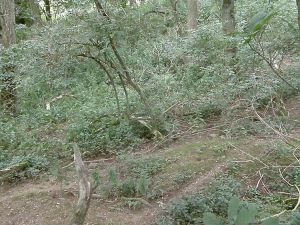
The central sett area - note the badger paths and undergrowth

The central sett area - note the badger paths and undergrowth

As I mentioned in the last post, the badgers have taken up residence in the overgrown craters at the centre of the site, which means that they are practically invisible from anywhere on the outside.

In order to get a good view of them, I spent the evening up a tree on the edge of this overgrown central area. This tree is next to one of the main badger paths, and gives just enough elevation so that you can look over into the craters.

The downside is that this tree only has one side branch from the trunk, about six feet off the ground and facing away from the sett. This side branch grows up at a narrow angle to the trunk. It is dead, so I only trust it to support my weight at the point where it joins the trunk. Sitting down on it is out of the question, so the only possible position is stand on one leg on the branch. After some experimentation, I found that the most secure and comfortable stance was to reach my arms around the trunk and literally hug the tree.

The advantage of this tree was that I was much closer to the sett than usual. I felt like a soldier in enemy territory. For a long time I’ve looked at this patch of ground from a distance, and now I was right here in the middle of it.

The disadvantage was that it was excruciatingly uncomfortable. Having all my weight on one foot wedged into a narrow branch became surprisingly painful after only about ten minutes. I found that by hugging the tree tightly and going through some sort of slow motion hopping manoeuvre I could change legs and ease the pressure a little, but since I was very close to the sett I couldn’t afford to move too much.

The tree did help me to stay out of sight. Even the local rabbit hopped underneath without suspicion.

One of the local rabbits

One of the local rabbits

At 7.50pm I heard the unmistakable whickering of badgers from the deep undergrowth. This was repeated again shortly afterwards.

It meant two things. Firstly, that the badgers were above ground, and engaged in some relaxed and happy play fighting. Secondly, that they were on the other side of the foliage to me.

By 8.15 the light was failing. No badgers had appeared on my side of the sett. I decided to call it a night, and stiffly and gracelessly I slid down the tree on my cramped legs. The badgers carried on yipping and whickering. With their mocking laughter ringing in my ears I slunk off home.

Curse these stripey devils yet again…!

Read Full Post »

Once again I’ve been neglecting my badgers. Or leaving them in peace, depending on your perspective.

Badger print

Badger print

I actually had a little trip up to the wood last weekend, but although I could hear the badgers, I couldn’t see them. Let me explain. The sett itself is on a small rise in the ground There is a small valley to the north of the sett, with parallel gullies running into it on the east and west of the sett. This means that if you are in the low ground on one side you can only see that side of the sett, as the rise in the ground makes it impossible to see the other side.

The badgers have moved to a part of the sett in the centre of this rise, which, to make matters more difficult, resembles an overgrown first world war battlefield. There are big craters dotted around, no doubt the result of spoil heaps and cave-ins at the sett many generations of badgers ago. This local geography is making the badgers very difficult to watch, so it was not a great surprise that I could hear the whickering noises of badgers at play, but to my frustration they were invisible on the other side of the sett.

This evening everything seemed right for badger watching. It was a Friday evening, my wife was working late, and for once it wasn’t raining. There was a nice breeze blowing in from the west, which meant that I could sit in one of the easily climbed trees on the edge of the sett.

And sure enough, I did see the badgers. The first pair, an adult and a cub, came out of the tangle of undergrowth in the middle of the site at about 8.10pm and sat around the central sett entrance. At about 8.30pm I could see movement in the undergrowth, and through binoculars I could see four or five badgers rolling about, grooming and fighting. With the two that had come out earlier, this made a total of six or seven out at the same time.

I couldn’t make out much detail through the foliage, but the badgers seemed happy and healthy enough. The light had gone too much for any photographs. The long exposure required in dim light means that the badgers are inevitably blurred – they rarely sit still long enough.

By 8.45pm they had moved out into the open, but it was getting too dark to really see what was happening. I use 7×50 binoculars, and they are very good at collecting the available light so that things seem brighter than they with the naked eye, but even so I was struggling to see.

This evening won’t go down as one of the best badger watching sessions ever, but it was nice to get out to the cool freshness of the wood, and good to see that the badgers were still going strong.

Read Full Post »

What madness is this?

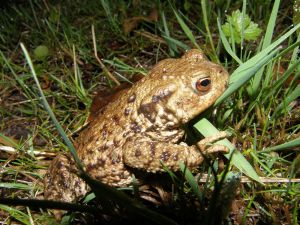
The frog by the path, happy in the rain

The frog by the path, happy in the rain

It’s been raining all day. It’s raining now. I’m sitting on a rotten log underneath a tall oak tree, and everything is wet.

There’s only one dry space in the entire wood, and that’s the three inches under the brim of my hat. I’m sharing this dry space with what seems like every mosquito and bug for miles around, but for once, thrown together by a common need for shelter, they don’t seem to be biting me.

It is 7.30 in the evening and I’m watching at the eastern sett entrance. There’s no sign of the badgers, but then I hardly expected there to be. All my experience tells me that they’ll be snug underground. There’ll be no playing tonight – just a quick exit and then off to feed. Badgers dislike the rain as much as I do. Some foolish instinct has drawn me up here, but I don’t hold out high hopes.

A rabbit hops by about 30 feet away. It shakes itself like a dog and disappears for a moment in a fine spray of water droplets. Even the rabbit is soaking.

The rabbit and I play a quick game of Who Can Stay Still The Longest. To be honest, this is not a very exciting game, and it probably won’t make it onto television any time soon, but it passes the time.

The rules are simple. The rabbit looks at me. I look at the rabbit. The first one to move loses. If I move first, the rabbit confirms its suspicion that I’m a threat, and it hops away. If the rabbit moves first, it means that my camouflage is working and I get the chance to watch the rabbit’s natural behaviour. I’ve played this game many times, and the rabbits always take it very seriously. Winning or losing can literally be a matter of life and death for them in this game.

This time I win, and the rabbit hops a few yards closer to me and sits under a tree. It’s easier for me today because any movement of my head sends a trickle of water into my lap, so I’ve got a real interest in staying still. The trick of the game is to avoid looking directly at the rabbit. Rabbits, like most prey animals, seem to have a paranoid sixth sense that tells them when they’re being watched. If you focus your eyes on the ground and watch them out of the corner of your eye they seem to be more relaxed.

At 7.50 the little badger cub appears. It trots quickly by me and into the foliage on the east. The little cub always seems to be doing its own thing, and this evening is no exception. I don’t think it’s hurrying because of me; it just doesn’t want to hang around in the rain.

By 8.30 it is getting dark, and no more badgers have appeared. I’m cold and I’m wet. My waterproof jacket has done a great job, but the water is coming in down my neck and up my sleeves, and for once I decide that sitting at home with a nice hot cup of tea is the perfect way to spend the evening. I know that my last few badger watching sessions have not been a success, but on the other hand I don’t want to be remembered as the man who came down with hypothermia on an August evening in the south of England. I’ll return soon and get back to some proper badger watching.

As I leave I come across a frog on the path. He’s the only creature who seems genuinely happy with the weather at the moment. Nice weather for frogs indeed!

Read Full Post »

Having failed to see any badgers in the evening, I decided to take another approach. I was confident that the badgers feed in a large pasture field next to the wood, and it’s always been at the back of my mind to take a trip up there one night and see if I can spot them feeding. It being a damp and mild night with ideal conditions for the worms the badgers feed on, I decided to give it a go.

1.45am (way past my bedtime!) saw me walking slowly through the pasture with a dim torch. And there, snuffling around in the grass, was one of the adult badgers!

It didn’t seem too bothered by the torchlight, but carried on snuffling contentedly. I watched it for about five minutes and then left it to get on with its dinner. I was happy to have seen a badger in its own element, and proved that this method of watching them was possible. I may well stay up late on the next full moon and try this again.

Finally, an answer to those readers who think there should be more hedgehogs on this site (you know who you are!). Folk wisdom says that where there are badgers there are not usually many hedgehogs, presumably because one eats the other. I don’t know if that’s true, but I haven’t seen many hedgehogs around here.

Hedgehog!

Hedgehog!

So, especially for you, here’s a picture of an urchin that was feeding contentedly on the village green when I walked past. By the time I’d gone home and got the camera he was sitting in the middle of the road, which says a lot about hedgehogs.

I did try and pick him up and move him off the road, but I found out that the spines on a hedgehog are not just there for show – they really are sharp and spiky! This may sound obvious, but I’d never tried to pick up a hedgehog before. I did manage to move him to the side of the road, and left him there out of harm’s way, spiny and verminous, but safe.

Read Full Post »

I seem to have developed an unhealthy interest in badger dung.

Let me explain. When I first started watching badgers, I made a conscious decision to stick with one sett and focus on that. There are at least two, possibly three, other setts that I know of (or strongly suspect) in the local area, although I don’t know their exact locations. I know they are there because I’ve seen badgers on the roads or other signs, and they’re too far off to be ‘my’ badgers.

I decided to stick with the one sett because I wanted to really get to know one clan of badgers. Only by fully understanding how this sett works as a social group could I learn about the details of badger behaviour. Jumping from one sett to another and watching different groups of badgers would be fun, but I’ve always felt that it would dilute my understanding.

I’ve reached the point now though where I want to understand how ‘my’ sett fits into the bigger picture of setts in the area – how they interact, movement between setts and so on. Hence I’ve just spent an afternoon looking for badger dung.

Badgers are territorial. Each family or clan controls its own territory, marking it out as its own property. This marking is most visibly done with dung. Badgers are quite fastidious, and they tend to deposit their dung in specific ‘latrine sites’, typically located on the boundaries of their territory. If you can locate these sites, you can map the boundary points and hence the area controlled by a particular sett.
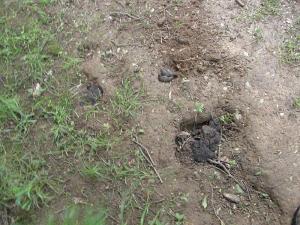
Badger latrine site

Badger latrine site

I spent about three hours wandering up and down the footpaths around the wood, and I’ve mapped out six latrine sites to the east, south west, west and north east of the sett. The distance from these the sett is 300 to 400 metres, with one outlier in the wheat field 600 metres away. This suggests that my badgers are controlling the territory for a radius of 300-400m from their sett.

Of course, this is probably a gross oversimplification. It is most unlikely that the badgers have a perfectly circular territory. Territory size is governed by availability of resources, so it is interesting to note that the latrine sites enclosed an area of woodland (which provides cover and security), plus significant areas of pasture and cereal fields (which provide food). It seems that my badgers are pretty well organised here.

If the latrine sites do represent a boundary between badger territories, this suggests that the neighbouring setts will be something in the order of 600m away, in other words an equal distance from the boundary, assuming the availability of resources is similar. This distance is somewhat higher that the 350m quoted by Neal and Cheeseman, but they were studying badgers in the Cotswolds where resources are likely to be more abundant, and so territories smaller.

So there you have it. An afternoon of looking for dung has allowed my to predict (albeit very roughly) the size of the badgers’ territory and the possible location of neighbouring setts. I’ll carry on working on this idea and see if I can add more detail in the future.

Something else I intend to do more of in the future is tracking. I’ve become intrigued by the idea of tracking mammals, partly as an activity in its own right, but partly also as a way of finding out more about their movements and locations. This could be particularly useful for the rare and shy species, as I can find out what they have been doing without having to be there at the time.

I’ve bought a book on tracking and I’m reading through it at the moment, but I’ve already discovered that it is more difficult than it looks. It rained heavily this morning so any tracks outside the wood have been washed out, and inside the wood the patches of ‘printable’ ground are few and far between. The best I could do was to find a few confused deer tracks (the tracks were confused, not the deer!) and the odd partial badger print.

These badger prints were the closest I got to the stripeys all evening. I watched the eastern side of the sett from 7.00pm to 8.40pm without seeing so much as a black and white nose. They may have come out of another entrance without me being able to see them, as the view is limited on this side of the sett. Perhaps they’re playing more tricks on me. Either way, no pictures of badgers for this post!

It’s been a good day though. Like I said, there’s enough to learn about badgers to keep you busy for years!

Read Full Post »