Feeds:
Posts
Comments

Archive for March, 2009

Blackthorn in flower

Blackthorn in flower

In Britain, the spring weather follows a fairly consistent pattern.  The warmer days of February and early March tend to be followed by a short cold spell at the end of March.  This cold snap coincides with the flowering of the blackthorn, hence its country name: the Blackthorn Winter.

This year has followed the tradtional pattern.  The last few weeks have been sunny and relatively warm, but yesterday we had squally hail showers and today there was a ground frost in the morning.  The Blackthorn Winter has arrived.

I’ve been working a fairly hectic schedule recently (as usual!) and I’ve also been on holiday, so I took the chance of getting out and about on one of my Sunday dawn walks.  Getting out of bed wasn’t so easy, as dawn is now about 6.30am, although because the clocks went forward this morning that translates to 5.30am in real terms.  Nevertheless, it was good to get out again.  It’s become quite a comforting routine for me.

Despite the cold weather, there are signs of spring everywhere.  The lambs in the fields are getting quite big now.
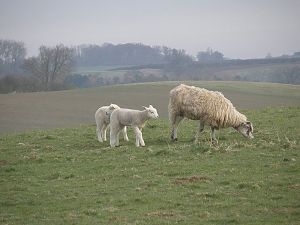
Aww, cute

Aww, cute

Frogspawn has started to appear in the pond – not much yet, but hopefully there’ll be more to come.
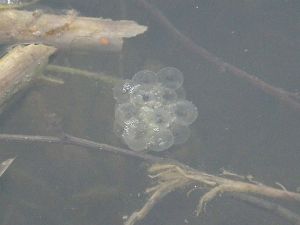
Frogspawn

Frogspawn

In terms of wildlife, one of the fields had been invaded by a gang of geese.  They were mostly Greylags, with a few Canada Geese joining in.  Not a rarity, but it’s the first time I’ve seen them in the village.

Greylag geese

Greylag geese

The badgers in the woods seem to be doing fine.  Judging by the quantity of dung in the latrines they’re obviously busy at the moment.  In fact, I was able to add a few more sites to my expanding map of badger latrines in the area.  This is starting to make some sense now, and I can get a rough idea of the different territories.  Perhaps come the autumn I’ll try the bait marking approach that Pablo mentioned, putting out food containing coloured plastic pellets so I can monitor the precise latrine sites used by different badger clans.  As I always say, there’s always more to learn about badgers.

April is nearly on us, so in another couple of weeks I’ll start proper badger watching again.  Watch this space for more details.
Read Full Post »

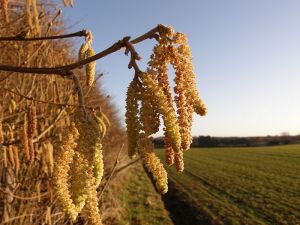
Catkins - spring is coming!

Catkins - spring is coming!

Well, it seems that spring is here at last.  I’ve been keeping busy travelling the world with work lately.  When I went away everything was frozen solid, and now that I’m back it’s thawed out, and allowed the first signs of spring to peep through.

Snowdrops are flowering down the lane, and the hazel catkins are out.  The hawthorns in the hedgerows have the first small buds.  In the vegetable garden I’ve finished the first planting of the year, so the potatoes, onions and beans have all gone in.  Unfortunately one of my chickens (Clarissa) escaped and ate my winter cabbage.  Frustrating, but a fairly regular occurrence in my kitchen garden.

The badgers and the foxes must be busy with young at the moment.  I’ll wait until the end of the month and then I’ll see what they’re up to.  The badger cubs won’t appear above ground until towards the end of April, but it will be good to get out and get up a tree again.

On a sadder note, there has been another badger killed on the roads.  This makes it three that I’m aware of in the last year around our village.  This latest casualty occurred in exactly the same place as the one in October (see The Grim Tithe Part 2).  There’s been some discussion on the Wild About Britain forum on the subject of badger road deaths, and it seems that there is a peak at this time of year.  I wonder if I can get the council to put up a sign?  Given the speed that people drive down this particular road it probably wouldn’t do any good, but you never know.

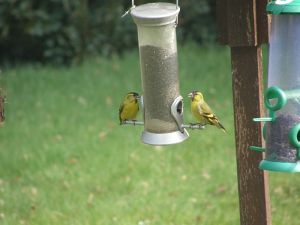
Siskins on the niger seed feeder

Siskins on the niger seed feeder

To end on a happier subject, my garden bird twitching list has increased slightly.  For the last month or so a woodpecker has been hammering on an oak tree just down the road.  I guess he’s getting territorial for spring.  I can hear him well enough, but I’m damned if I can spot him.  There’s been a fieldfare hanging about recently, and my niger seed feeder has been taken over by a gang of siskins.  Not particularly rare, but good-looking birds and new for me.

Read Full Post »

As a psychologist I find coincidences strangely intriguing.  Since I started writing this blog they seem to happening regularly.  Take the sparrowhawks for example; or the time I mused about never having seen a long-tailed tit and then saw a whole flock of them the very next day.

My last post was about the kites that I watched in Hong Kong last week (the birds of prey, not the flying toys).  This morning I received an e-mail from my wife saying that she had seen an unusual bird of prey as she drove to work.  Now, my wife is no twitcher, but she knows the birds and animals of the area pretty well, and she certainly knows something new when she sees it.  She described the bird as being the same size as a buzzard, feeding on a dead pheasant by the roadside and, crucially, having a forked tail.

There’s no doubt about it, this was a Red Kite – the forked tail clinches it.  Red Kites are not unknown in Bedfordshire, according to the Bedfordshire Bird Report 2007, but they aren’t common either.  They are outliers of the large population in the Chilterns.  Put it another way, I’ve never seen one, and I look out for these things.

To see a Red Kite in our area is thus a fairly rare and improbable event.  So, what are the chances of one appearing literally at the end of my road, just at the same time that I’m writing about them?

Carl Jung, the famous (and slightly mad) psychologist saw coincidences such as this as evidence of synchronicity – a meaningful relationship that reveals hidden aspects of reality and illustrates the working of the collective unconscious – the cosmic governing intelligence that connects all things.

More prosaically, it could just be one of those things.  I’ve wrote about quite a few things on here, and only a very small number happen the next day.  I still haven’t got a good look at a stoat, for instance, despite really looking.  What might be happening is that I pay more attention to those events that do coincide, and give them more significance because they are unusual.

Was the Red Kite some sort of cosmic messenger offering dark hints about the mysteries of the universe?  Am I in some way summoning birds and animals with the power of my thoughts?  Was it just a random thing – no explanation, and no point looking for one?  Or am I still a bit jet-lagged, and should I settle down and stop thinking about these things?

Whatever it is, one thing’s for sure.  I’m going to get out at the weekend and see if I can track down the kite.  They’re wonderful birds and it would be great to have them living locally.

And don’t worry, give me a few more good nights’ sleep and I’ll stop this esoteric rambling.  There’ll be more badgers soon, I promise!

Read Full Post »

causeway-bay-hong-kongThings have been very quiet on the wildlife front lately because I’ve been working in Hong Kong.  It’s been a fantastic experience in one of the world’s most dynamic and exciting cities, but at the same time it’s nice to be back in the green fields and quiet lanes of rural Bedfordshire.

Oddly enough, even in the bustling mega-city that is Hong Kong, there is still wildlife to be seen.  From my window on the 14th floor of my hotel you could see large birds of prey circling on the thermals.

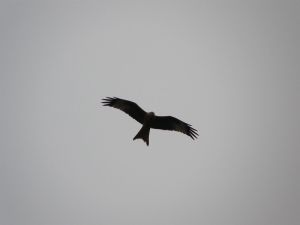
The locals referred to them as ‘eagles’, but they’re a species of Black Kite.  Considering how scarce kites are across most of the UK, it was odd to see them in such an urban environment.    They were perfectly at home, riding on the air currents between the skyscrapers, and giving me some great views as they glided past my window.

kiteI’ve seen similar kites in India, in Delhi and Bangalore, where they are known as Pariah Kites.  Kites are carrion eaters, and they feed on the bodies of cows in the cities. These cows are sacred, hence the kites are seen as outcasts or pariahs for eating them, although they do perform a necessary function in cleaning up the remains.

It’s another great example of nature adapting.  Who knows, perhaps the day isn’t far off when we’ll have urban kites in the UK?

Read Full Post »