Feeds:
Posts
Comments

Archive for December, 2008

Well, today is the shortest day of the year.  Today, the Oak King of Summer has got the upper hand in his endless battle with the Holly King of Winter, at least until the the summer solstice when their fortunes will be reversed.  The Holly King is not beaten yet – the warm weather won’t be here for a good while – but we’ve turned the corner of the year.  After tonight the days will start to get longer.  It’s a time for celebrating, for eating and drinking and shutting the dark outside.  A time to think about the unfolding of the seasons and to be thankful for the year that has gone.

So bring in the mistletoe, put another log on the fire and raise a glass.

Seasons greetings to everyone!

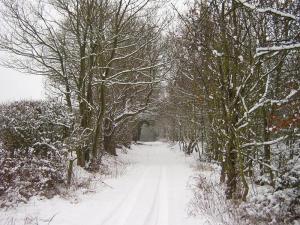
snowy-lane

Read Full Post »

For years, my wife and I have put food out in the garden for the birds, and since it is the coldest December for 30 years they really seem to appreciate it.  I made point of saving some windfall apples from the autumn and the blackbirds love them.

Last weekend we went upmarket and bought some niger seed.  Niger seed (also known as nyjer seed or thistle seed) is a small black seed that is supposed to be very attractive to linnets, siskins and goldfinches.  I’m very fond of our usual tits, sparrows, chaffinches and starlings, but this seemed like a good opportunity to have some ‘classier’ birds in the garden.

So out went the niger seed on Saturday.  By Monday, my wife reported new birds in the garden.  And there they were, a very handsome pair of goldfinches!  They really are very striking birds to see – very colourful.  Almost like having a tropical bird in the garden.

Goldfinch feeding on niger seed

Goldfinch feeding on niger seed

All in all, a good result for the niger seed.  Incidentally, as I was thumbing through my book of birds last night, I came across the page on long-tailed tits.  I’d never seen one of these, and I decided to keep an eye out for them.

Strangely enough, I was in my car down the lane this afternoon, when a small flock of birds starting working their way up the hedgerow towards me.  Yes, you’ve guessed it – they were long-tailed tits!   It’s odd how this sort of thing keeps happening…

Read Full Post »

I’ve always wanted to try plaster casting animal tracks.  I don’t know why, it just seems like an interesting thing to do.  I suppose it would be a useful skill if I ever come across a really rare track of say, a bigfoot or puma.  Neither is very likely in Bedfordshire, but you never know.  Anyway, today I gave it a go.

There isn’t much information on the internet on how to make plaster casts, so here’s a guide if you want to try it yourself.

Firstly, be prepared.  I used plaster of paris (available from the Hobbycraft chain of stores) but I’ve heard of people using decorating filler instead.  You’ll need plaster, water, a bowl to mix it in, and something to stir it with.  You’ll also need some way of making a dam around the track to contain the plaster.  For this I used strips of cardboard and rings cut from a plastic bottle.

Plaster casting kit

Plaster casting kit

A lot of these things could be improvised in the field, but I wanted to be sure that I had everything I needed, and I wanted it to be clean, so I took it with me.

The next step is to mix the plaster.  I feel that this is a bit of an art and may take some practice.  Put the plaster in the bowl first.  It is best to add a little bit more than you think you’ll need.

Plaster first...

Plaster first...

Now add the water and stir slowly.
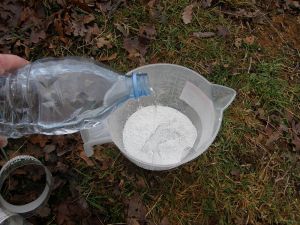
...then add water

...then add water

The aim is to get a smooth and even consistency.  Add enough water to make it slightly runny.  You’ll need to stir it to get all the lumps out, but don’t stir it too vigorously or you’ll introduce air bubbles that may spoil the cast.

Stir carefully

Stir carefully

Next, put a dam around your track.  Here’s one made from a strip of cardboard clipped together around a deer track.  Push it into the ground slightly, but be careful not to distort your track.
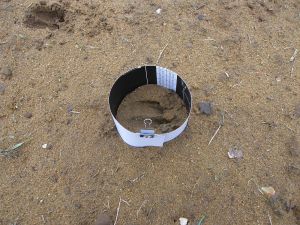
Cardboard dam ready for plaster

Cardboard dam ready for plaster

Then add the plaster.  This dam is made from a section of plastic bottle and is around a badger track.
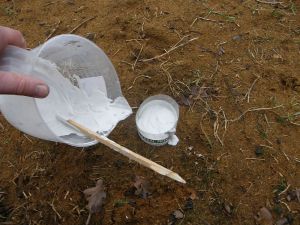
Plastic dam

Plastic dam

Pour the plaster in carefully so it runs into all the little nooks and crannies of the track, and don’t pour it in from a height in case you damage the track.

Leave for 30 minutes or so until the plaster is hard, and then it should be ready to carefully lift out.  It’ll bring some soil with it.  Leave this soil in place for the moment.

Lifting off the cast

Lifting off the cast

Wrap the cast carefully and bring it home.  You’ll need to remember to bring a lot of plastic bags, as you’ll need to wrap up your messy bowl too.  If you’ve used a plastic bowl you can easily clean this when the plaster has dried by flexing it to break off the plaster.

After a couple of hours you can clean the track.  Brush it softly under the tap to get the loose soil off it.  Don’t scrub, or you risk damaging the detail.  The cardboard dam was easy to remove, but the plaster stuck to the plastic one.  Unless you can grease the plastic dam somehow it may be best to use cardboard.

Finished casts - fallow deer on left, badger on right

Finished casts - fallow deer on left, badger on right

And there you have it – a permanent record of the track to study at your leisure.

Read Full Post »
Last night – Saturday night – a small herd of fallow deer does crossed the road in front of my car.  Fallow deer are easy to recognise from the car because of their obvious tails and rump patches as they disappear into the hedgerows.  It happened just a few hundred yards from my house, and close to the field where I usually go for my Sunday morning dawn walks.  Knowing that they were in the vicinity gave me a great opportunity to see if I could track them.

Winter field - no tracks here!

Winter field - no tracks here!

On the face of it, it didn’t seem promising for any tracking on Sunday morning.  It rained heavily all night, so much so that severe weather warnings were in force for much of the UK.  Nevertheless, with an effort I got out of bed to find a cold but clear dawn.  The rain had stopped at some point in the early hours.

Much of the field was too wet for clear tracks.  The lower half of the hill is on clay, and was almost underwater, although a few isolated fallow deer tracks were visible, alongside those of the ubiquitous muntjac and Chinese Water Deer.

On the better drained sandy part of the hill it was a different story.  There, spread out before me was the full story of the morning.  A clear line of tracks showed where the deer had crossed the field from the northwest.

The trail of the fallow deer herd

The trail of the fallow deer herd

The deer were walking calmly, as the tracks had a perfect register.  In other words, the rear foot had come down exactly on top of the track of the front foot.  Measuring the stride of the deer gave me a distance of 50cm on average.  This is shorter than the 60cm that the guidebooks suggest, but maybe it’s because my deer were does, or maybe they were not yet fully grown.

The trail of the deer led across the sandy soil and into a pasture field.  Unlike the deer, I respected this as private property, and I walked around to the next arable field where there was a convenient footpath.  I was able to pick up the trail in this field.  The deer had crossed it at an angle, still heading southeast, before crossing the main road and disappearing into the pathless woods beyond.

Fallow deer track - note the perfect register

Fallow deer track - note the perfect register

Fallow deer are not uncommon in the area, but it was quite exciting to be on the trail of a herd, and particularly satisfying as I had seen them the previous night.  If I was a more experienced tracker I’m sure that I could tell a lot from trail like this – how the individuals are spaced out, which one takes the lead, which ones follow behind and so on.  It was quite confusing to have a mass of tracks all together.  As always, there’s so much still to learn, and I’m enjoying every moment of it.

To end on a happy note, there were badger tracks in the field too.  I hadn’t seen any definite badger tracks here since September, and I was beginning to fear that the badger that was making them (I’ve only ever seen one set of tracks at a time) was the road casualty of early October.  Happily though, it seems not, and the badger is back to it’s regular haunts again.  I’ve only ever seen it’s tracks, but it’s kind of an old friend to me now.

Read Full Post »